Snowflake, Tuya and the Fight for Dominant Design in Cloud (Tech Strategy – Podcast 106)

In this episode of the Tech Strategy podcast, Jeffrey Towson discusses the fight for dominant design in cloud computing with Snowflake and Tuya. Towson argues that Snowflake is building three complementary platforms with four network effects, while Tuya is building a platform for the Internet of Things (IoT). Towson believes that the winner of the cloud computing wars will be the company that can build the most comprehensive and integrated platform.

What Everyone is Getting Wrong About Snowflake (Tech Strategy – Podcast 105)

In this episode of the Tech Strategy podcast, Jeffrey Towson discusses what everyone is getting wrong about Snowflake. Towson argues that Snowflake is a “data ecosystem” company with a compelling digital business model. He believes that Snowflake could become the next Google or Microsoft. Towson also discusses the importance of data in the digital economy and how Snowflake is positioned to capitalize on this trend.

Core vs. Adjacency Growth in Digital Businesses (Tech Strategy – Podcast 104)

Most all sustainable growth is based on 1-2 strong cores. A profitable core is centered on the strongest position in terms of loyal customers, competitive advantage, unique skills, and ability to earn profits. To assess an adjacency move, consider the following factors: 1) how tightly the adjacency is tied to a strong core; 2) the attractiveness of the adjacency market; and 3) the ability to capture economic leadership in that market.

Info Dictators and Why Mark Zuckerberg Will Choose the Next President (Tech Strategy – Podcast 103)

Info-dictators are individuals or organizations that control the flow of information in our world. They have the power to shape our opinions, beliefs, and behaviors. Mark Zuckerberg is one of the most powerful info-dictators in the world. He controls Facebook, which has over 2 billion users. This gives him the power to influence the outcome of elections, spread misinformation, and control the narrative.

Growth, ROIC / RONIC and Growth + Sales in Digital Valuation (Tech Strategy – Podcast 102)

Growth, ROIC, and growth+sales are all important factors to consider when valuing a digital business. Growth is important because it shows that the business is expanding and has the potential to generate more revenue in the future. ROIC is important because it shows how efficiently the business is using its capital. Growth+sales is important because it shows how much revenue the business is generating from each new customer.

Why DCF Sucks for Digital Valuation (Tech Strategy – Podcast 101)

Discounted cash flow (DCF) is a common method for valuing businesses. However, DCF is a poor method for valuing digital businesses. This is because digital businesses are characterized by rapid growth, unpredictable cash flows, and network effects. As a result, the assumptions underlying DCF are not met, and the resulting valuations are often inaccurate.

How Hillhouse Capital Invests In and Digitizes Chinese Companies (Tech Strategy – Podcast 100)

Hillhouse Capital is a leading private equity firm that invests in China. The firm has a successful track record of investing in and digitizing Chinese companies. Hillhouse’s approach is based on three key principles: identifying strong management teams, investing in digital transformation, and building moats.

More Lessons in Digital Operating Basics from Ram Charan. Part 2 of 2 on “Rethinking Competitive Advantage”. (Tech Strategy – Podcast 99)

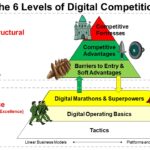
In the digital age, sustainable competitive advantage comes from scale and growth at small incremental cost, targeting a real or imagined 10x or 100x market space, continuous personalization and customer-facing innovation, a digital core for operations, ecosystem and connectedness, people, culture and work design, and money-making at scale.

Lessons in Digital Operating Basics from Ram Charan. Part 1 of 2 on “Rethinking Competitive Advantage”. (Tech Strategy – Podcast 98)

In the digital age, sustainable competitive advantage comes from scale and growth at small incremental cost, personalization, a digital core for operations, ecosystem and connectedness, people, culture and work design, and operational cash flow.

Pinduoduo, Etsy, and OTC: How Specialty Ecommerce Can Thrive Against the Giants. (Tech Strategy – Podcast 97)

In this podcast, Jeffrey Towson discusses how specialty ecommerce companies can thrive against the giants. He identifies five key factors for success: differentiated user experience, competitive logistics, strong competitive advantage, clear path to operational cash flow, and avoidance of markets and situations that are attractive or strategic for the major ecommerce companies. He argues that specialty ecommerce companies can succeed by focusing on specific niches and providing a superior user experience.