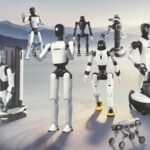
JD’s Bet Is a “JoyAI Brain” Plus a “JoyAgent Team” (3 of 3) (Tech Strategy)

JD’s Bet Is a “JoyAI Brain” with a “JoyAgent Team” (3 of 3) (Tech Strategy). JoyAI-LLM Flash is the True “Brain” and JoyAgent is the Team, as digital AI strategy consultant Jeffrey Towson explains how JD advances digital AI transformation strategy with its Vision-Language-World-Action model and multi-agent orchestration framework. Ok. That’s it for JoyInside, JoyAI and JoyAgent.

My Firsthand Look at Embodied AI at JD: JoyAI and JoyInside (Tech Strategy – Podcast 299)

This week’s podcast is about JD’s big moves in robotics and embodied AI. Specifically JoyAI and JoyInside. Digital AI strategy consultant Jeffrey Towson shares how JD is advancing digital AI transformation strategy by becoming a major retailer for intelligent autonomous products, providing JoyInside solutions for hardware OEMs, and developing JoyAI foundation models.

JoyAI: The 8 Models Powering JD’s Robots and Smart Devices (2 of 3) (Tech Strategy)

In this analysis of JD’s JoyAI, digital AI strategy consultant Jeffrey Towson details the eight specialized models—spanning voice interaction (JoyAI-Voice and JoyAI-Talker), multimodal interaction (JoyAI-Echo, JoyAI-VL-Interaction, JoyAI-Video-Edit, and JoyAI-Image-Edit), embodied intelligence (JoyAI-RA), and reasoning (JoyAI-Flash)—that form the brains behind JoyInside for OEMs. Unlike Tencent’s all-encompassing Tairos, JoyAI represents a focused digital AI transformation strategy centered on embodied AI capabilities for robots, appliances, and toys, processed largely in the cloud. The models simplify into layers of “ears and voice,” “eyes,” and “body,” enabling continuous low-latency interaction, real-time video understanding, long-form generation, and physical action based on sensory inputs.


JD’s JoyAI and JoyInside Are a Smarter Bet Than Building Humanoid Robots (1 of 3) (Tech Strategy)

JD’s JoyAI is the foundational “cloud brain” of models for language, vision, spatial reasoning and real-time voice, while JoyInside is the deployment framework that embeds those models into physical hardware such as robots, toys and appliances—forming a powerful digital AI transformation strategy. Through JoyInside, JD provides hardware makers with AI models, developer tools, supply-chain support and distribution on JD.com, turning traditional products into smart, autonomous devices. This approach, highlighted by digital AI strategy consultant Jeffrey Towson, positions JD’s JoyAI and JoyInside as a smarter bet than building humanoid robots.

Day 1 of Our Alibaba Ecommerce Training Program: Visiting Geely / Zeekr (1 of 5) (Tech Strategy)

We just finished up Phase 2 of our Alibaba Ecommerce Training Program in partnership with Alibaba, including visits to local companies like Geely / Zeekr and deep dives into their tech strategy. Digital AI strategy consultant Jeffrey Towson highlights how Geely / Zeekr is advancing digital AI transformation strategy through LLMs, World Behavior Models, smart cockpits, and full AI mobility tech stacks. Having the right product at the right time, combined with rapid moves in EVs and AI, has positioned Geely / Zeekr as a rising giant behind leaders like BYD.

Huawei, China Unicom, and the Rise of Robot-Native Networks (Tech Strategy)

Huawei and China Unicom deployed the first robot-native mobile network using 5G-Advanced large uplink technology to support the second World Humanoid Robot Competition in Beijing, enabling real-time high-resolution sensory data streaming from over 2,000 robots with peak uplink speeds of 1 Gbps and latency under 30 milliseconds. This marks a breakthrough in infrastructure for humanoid robots that function as continuous sensory engines, shifting heavy compute to the cloud to overcome on-device battery and GPU limits as part of a broader digital AI transformation strategy. Digital AI strategy consultant Jeffrey Towson highlights how Beijing’s 5G Capital initiative positions the city as the future epicenter for scaled robot deployment.

Huawei and China Unicom Launch a “Robot-Native Network” at the World Humanoid Robot Competition (Tech Strategy – Podcast 294)

This week’s podcast is about the robot-native network Huawei and China Unicom built for the World Humanoid Robot Games in Beijing, a key element of digital AI transformation strategy. Digital AI strategy consultant Jeffrey Towson explains that robots require high uplink capacity around 1 gigabit per second and end-to-end latency under 30 milliseconds, achieved at about 18 milliseconds using 5G Advanced. Networks form a critical part of AI infrastructure for robots and agents, enabling real-world performance in competitions that drive industry standards and applications.

To access this post, you must log in as a member, purchase Subscriptions.

A Summary of Tencent’s Robot Brain Tairos (1 of 5) (Tech Strategy)

Tencent wants to be for robots what Android is for smartphones by providing the full software stack for embodied intelligence rather than making robots themselves, centering this effort on Tairos as part of a broader digital AI transformation strategy. Tairos features a three-layer brain with RxBrain for cognitive planning and world simulation, a Vision Language Model for high-level spatial perception, and a Vision-Language-Action model for physical execution, alongside developer tools like TairosAgent and Apexio. As explained by digital AI strategy consultant Jeffrey Towson, this approach aims to both push the frontier of robot intelligence and lower the technical bar for manufacturers, businesses, and product developers.

5 Take-Aways from the Unitree Filing (Tech Strategy – Podcast 293)

Unitree has frontier-level expertise in robot bodies and agility, but they were late to embodied AI capabilities. The hands don’t appear advanced, and operationally, they are still a relatively small company with only 516 FTEs. Digital AI transformation strategy and robotics competition are central themes, as digital AI strategy consultant Jeffrey Towson breaks down what matters most in this rapidly evolving market.

To access this post, you must log in as a member, purchase Subscriptions.

AgiBot’s Robot Intelligence Depends on Genie Operator (GO) and Genie Envisioner (GE) (3 of 3) (Tech Strategy)

AgiBot’s robot intelligence depends on Genie Operator (GO), its Vision-Language-Latent-Action model that translates vision and language into physical actions through chain-of-thought processes, and Genie Envisioner (GE), its World Action Model that predicts future environmental states for complex dynamics. These systems form the core of embodied AI, with GO handling real-time operations and GE supporting training and predictive simulations as detailed by digital strategy consultant Jeffrey Towson. Understanding this hardware-intelligence interplay is essential for any digital transformation strategy involving scalable robotics.