
I was at the Tencent forum at WAIC 2026. It was pretty great. And it was really helpful in terms of seeing where Tencent is focusing (in AI).
I had 3 take-aways from the Tencent forum:
- Tencent is way more focused on robot brains (i.e., embodied AI) than I was aware of.
- WorkBuddy is their flagship for AI agents. But they have 5 other “buddies” to keep an eye on.
- Tencent will likely be the global leader in AI and agent marketing.
There was also some good stuff about vivid avatars by the CEO of Huya, which is now a subsidiary.
However, this article is about Tencent’s main projects in robots and embodied AI.
Basically, Tencent wants to be for robots what Android is for smartphones. They will not make robots themselves (mostly). Instead, they will provide the full software stack for embodied intelligence to robot manufacturers and companies.
They want to make it easy for others to launch and operate robots.
They want to both push the frontier of robot intelligence and lower the technical bar for manufacturers, businesses and product developers.
The center of this strategy is Tairos.
Tairos Is Tencent’s Tech Stack for Embodied Intelligence
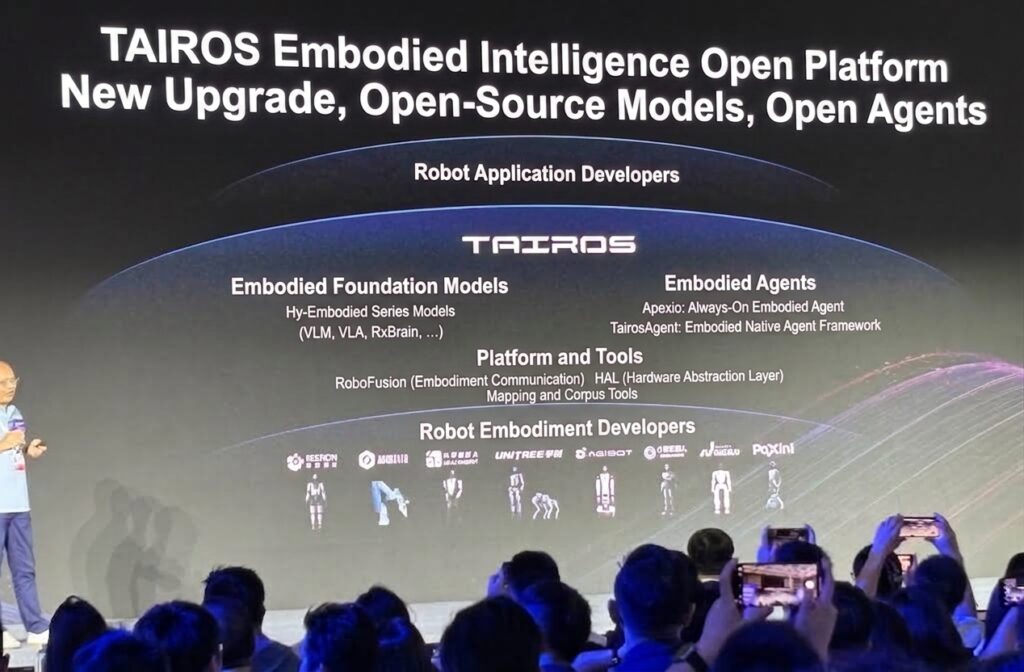
Here is how Tencent summarizes Tairos.

Don’t worry about the Chinese.
The middle layer is the key stuff. That’s the software that makes up the Tairos tech stack. Here is what matters.
- A 3-Layer Brain for Embodied AI
- RxBrain (i.e., Hy-Embodied-RxBrain-1.0). This handles cognitive planning and world simulation.
- Vision Language Model (i.e., Hy-Embodied-VLM-1.0). This handles high-level spatial perception.
- Vision-Language-Action (i.e., Hy-Embodied-VLA-0.5). This is the physical execution layer, generating continuous low-level motor trajectories for robotic arms and hands.
- Developer tools
- TairosAgent
- Apexio
And keep in mind the main Hy models (like Hy3) all sit above these Embodied intelligence models in the tech stack.
Here’s a translated version (I made).
***
Here are the details of the three embodied AI models. I’m just going to lay out the details and how Tencent is different in this area. You can skip this if the details are not that interesting to you.
1: RxBrain (i.e., Hy-Embodied-RxBrain-1.0). This Is the Most Important.
Tencent describes RxBrain as an “embodied world cognition model”. So, it’s closer to a world model than a VLA. It couples language reasoning with imagination of possible visual future state.
The analogy I use is that world models are like predicting the next move in billiards. It takes the visual field (the current state of the game) and combines it with an action (hitting a ball). And it predicts future outcomes, which requires understanding the entire environment and physics.
Here’s how Tencent presented RxBrain. With my translation.

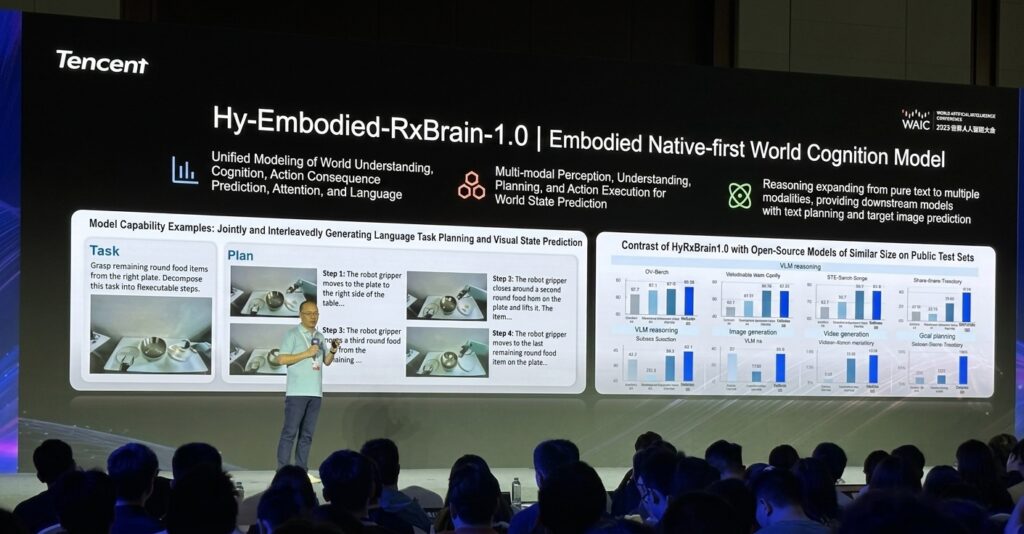
The Chinese basically details how the architecture integrates world-state prediction with multimodal planning and execution. It includes:
- Unified World Modeling
- It unifies world understanding, cognition, action outcome prediction, attention mechanisms, and natural language into a single framework.
- World State Prediction Capability
- It combines multimodal perception, scene understanding, task planning, and physical action execution alongside world state prediction capabilities.
- Multimodal Thought Expansion
- It expands internal reasoning beyond pure text to multiple modalities, supplying downstream models with both textual planning and predicted goal images (visual target states).
How Tencent is different in world models.
- Tencent describes Hy-Embodied-RxBrain-1.0 as an interleaved hybrid world model and planner, rather than a pure visual world model.
- Pure Generative World Models (like Sora and Runway Gen-3) focus almost entirely on predicting future visual frames or video trajectories based on physics.
- Traditional VLMs process visual data and output text or code plans, but they do not visually predict what the scene will look like as the task progresses.
- RxBrain-1.0 combines both of these into one. It’s a hybrid.
Here are some more details if you’re interested.
- RxBrain is a 6.2B parameter model that breaks down requests (e.g., “clean the desk”) into logical sub-goals, evaluates physics constraints, and imagines dynamic outcomes before execution.
- The model does future visual state prediction with a flow-matching visual generation head, that allows it to imagine near-future camera frames resulting from an action before the robot executes it.
- As RxBrain plans a task (e.g., “open the door”), it outputs a step-by-step sequence that pairs language instructions (what to do) with predicted goal images (what the physical world should look like after the step). So, it combines text and visual planning.
- RxBrain imagines intermediate visual states. So, it evaluates physical risks (such as knocking over an object or running out of clearance) in its mind prior to sending motor commands. They call that Visual Counterfactual Reasoning.
Moving on…
2: Vision Language Model (i.e., Hy-Embodied-VLM-1.0)
This is a new generation embodied Vision-Language Model (VLM) developed by Tencent and presented at the World Artificial Intelligence Conference (WAIC).
It’s a 30B parameter MoE vision-language model for spatial perception. So, it’s a lot of firepower in real-time spatial tracking and multimodal visual plus tactile understanding. This is about understanding the world.
In practice, it processes camera feeds and touch sensor data. And creates 3D hierarchical spatial maps, object orientation and physical clearance.
The outputs of the model are high-level spatial intelligence, target states, sub-goal reasoning, and action plans in language or structured representations (e.g., “detect handle,” “check depth,” “determine next step”).
Note: The VLM does not directly generate joint motor commands (such as torque and motor voltages). It acts as the high-level brain or planner, passing its step-by-step reasoning to a lower-level controller to perform the physical motion.
How Tencent is different in VLMs.
The Tairos VLM appears to be focused on advancing from simple image recognition toward complex physical interaction, action planning, and task execution.
Here are the details (from my understanding).
- It’s about “Action-Relevant State Understanding”
- It does not just recognize objects; it analyzes properties, depth, spatial relationships, operable areas, robot perspective, functional components, and environmental affordance (actions the environment allows).
- And then “Action-Transition Reasoning”
- This is about moving from scene understanding to deciding how to act.
- The model possesses action-related reasoning capabilities. It evaluates the task goal, object positions, video progress, and current state to determine what step to take next, where the target is located, how trajectories or directions should adjust, and whether an action is executable.
- It has Sequential and Adaptive Reasoning
- This is long-horizon task execution equipped with planning, memory, and error-correction capabilities.
- The model supports multi-step planning, vision-language navigation, historical and spatial memory, failure diagnosis, counterfactual analysis, and dynamic replanning.
- During execution, it tracks progress, detects failures, analyzes root causes, and generates corrective plans.
How is this different than RxBrain?
- Both are higher level cognition.
- But Tairos VLM functions as a perception and scene-understanding model. It sees. It is “right brain”.
- RxBrain is an embodied cognition and world model that integrates language planning with visual imagination. It imagines the potential future states of the environment. It is “left brain”.
Here is how Tencent summarizes the VLM.

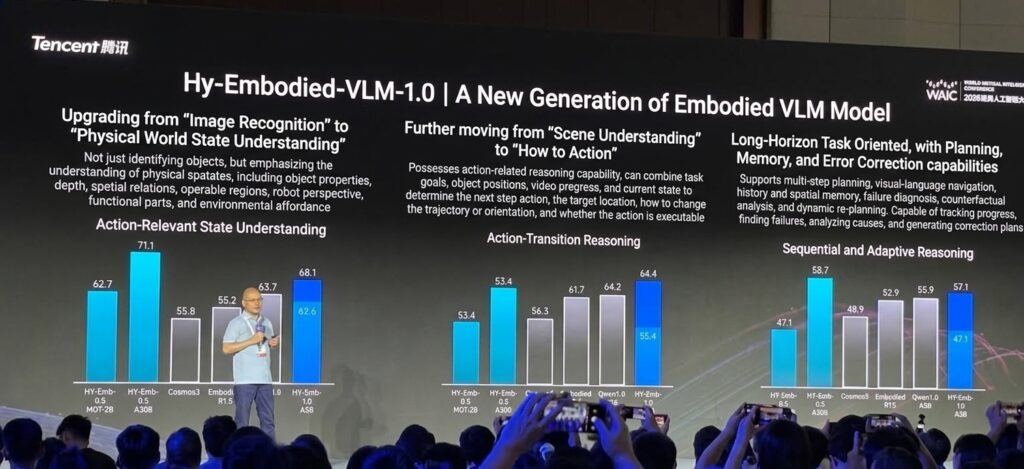
Don’t worry about the slide. You can translate it if you want more details.
3: Vision-Language-Action (i.e., Hy-Embodied-VLA-0.5)
Hy-Embodied-VLA-0.5 is Tencent’s in-house developed Vision-Language-Action (VLA) foundation model.
It bridges visual inputs and direct physical actions. It generates direct motor/actuator trajectories from multimodal prompts. It maps instructions directly into high-frequency end-effector / joint Cartesian trajectory adjustments on onboard hardware.
The analogy I use here is this is like catching a baseball in your hand. You are focused on seeing the ball and moving your hand to grab it.

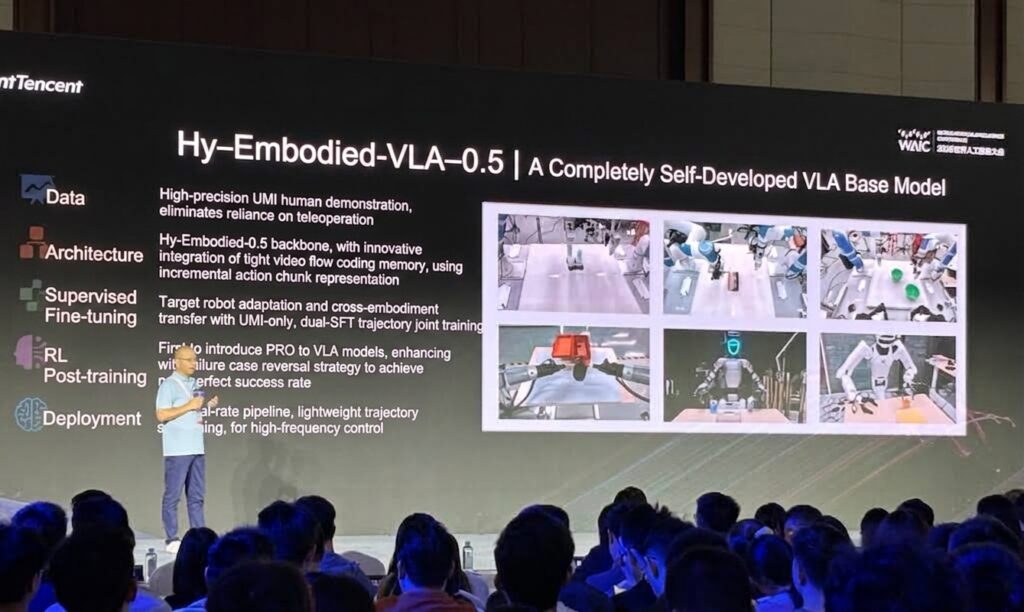
I don’t see too much here that is different than other VLA models.
It’s a lightweight 0.5B parameter model. It operates locally on the device to handle rapid joint adjustments, balance, and collision avoidance.
***
This completes Tencent’s three-layer brain.
- VLM-1.0 handles high-level spatial perception.
- RxBrain-1.0 handles cognitive planning and world simulation.
- VLA-0.5 sits at the bottom of the stack as the physical execution layer, generating continuous low-level motor trajectories for robotic arms and hands.
Let’s move on to developer tools. This is Tencent’s suite of tools for building and deploying brains into robot systems. These are mostly for developers and businesses.
4: TairosAgent
TairosAgent is Tencent’s software developer platform and runtime framework.
It ties the models (VLM, RxBrain, VLA) to the physical hardware. And custom skills, and low-latency interaction loops.
TairosAgent has the standardized code structures, protocols, and APIs robot developers use to connect perception models, cognitive models, and physical hardware. It sets up the system.
So, this is not an agent running things like AI agents. I’m not sure why they named it that.
This is downloadable SDK / Code frameworks. Developers can install these into their development environment (IDE) to build, customize, and write software programs for robots using Tencent’s standard protocols. It includes software development kits (SDKs), code libraries, and open APIs.
I think about these things like the tools video games developers use to create the gaming engine for their game. It sets up the system. But it doesn’t run the game.
Here’s how Tencent describes TairosAgent:

This is the translation. TairosAgent has:
- Multi-Model Support (支持接入更多模型):
- Tairos can integrate a wide variety of AI models. That’s important. It allows developers to plug in different vision, language, world, or action models as needed.
- Custom Skill Encapsulation (支持封装、调用自有Skill):
- It supports encapsulating and executing proprietary skills and custom robotic functions. That’s also important. You may want specific grasping strategies, tool use, or specialized navigation behaviors.
- Hardware Abstraction Layer (提供硬件抽象层,适配不同本体):
- There is a built-in Hardware Abstraction Layer (HAL). This abstracts away the low-level physical differences of various robot platforms (humanoids vs. dual-arm manipulators vs. wheeled robots) and allows the same high-level skills and models to run across different physical bodies.
- Faster Response and User-Friendly Interaction (反应更快,交互友好):
- It optimizes for real-time human-robot interaction, significantly reducing instruction processing delays and latency during live operations.
That’s all pretty impressive.
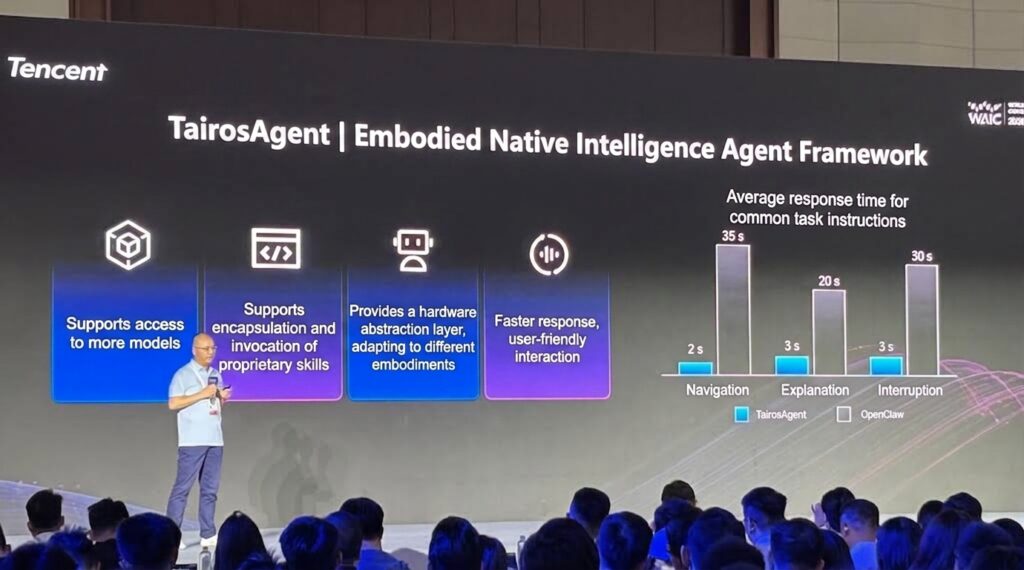
And you can see this is where Tencent has a lot of strength. They know how to make things easy to use. TairosAgent is clearly focused on lowering the technical bar to setting up robots and doing lots of customized functions.
5: Apexio
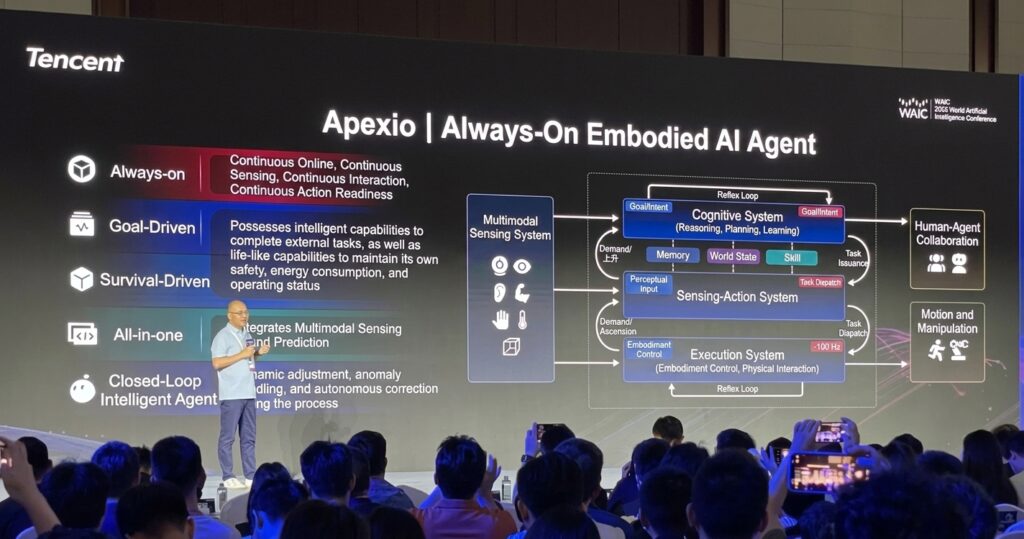
They call this the “Always on” embodied agent.
Apexio is the overall agent system architecture that ties the models (VLM planner, RxBrain world model, and VLA low-level execution controller) together into a continuously operating robot brain.
If TairosAgent is the game engine for building your video game, Apexio is the real-time system for playing the video game.
It is the software you download to run live on the physical robot hardware. It is the live running program, a runtime and safety-middleware engine.
Apexio is downloaded and installed directly onto the robot’s onboard computer (such as an Nvidia Jetson, Intel NUC, or embedded ARM processor) and is paired with Tencent Cloud services. Once installed, it runs in the background on the physical robot to manage real-time motor reflexes and vision processing.

Ok. That’s most of what I wanted to cover.
One last point on how this ties in with infrastructure and compute services.
Tencent Cloud Now Offers Embodied AI as a Service (EaaS)
A lot of this runs on robots. But a lot is connected to cloud and higher-powered servers. This means the performance of the compute and connectivity are a big deal. Enter Tencent Cloud.
Tencent offers Embodied AI as a service (EaaS).
EaaS offloads complex processing through real-time server streams. It includes:
- Access to the 3-Layer Brain Architecture
- Tencent offloads high-level spatial reasoning (such as Hy-Embodied-VLM and long-context Hunyuan planning models) to cloud GPU clusters. And then streams processed intent back down to the robot.
- Real-Time Control Channels: This integrates Tencent’s Real-Time Communication (TRTC) and Remote Real-Time Control (TRRO) protocols for ultra-low latency video streaming, telemetry, and live human-in-the-loop teleoperation. Note: Tencent Cloud does a lot of business in real-time audio-visual services. Such as live streaming gaming and big sports events.
- Data Acquisition and Pipelines: This is about ingesting, annotating, and processing multi-modal sensor data (tactile, visual, spatial, and torque) from physical demonstration rigs and operational robot units.
- Cloud Simulation and Physics Engine: I like this part. This is the cloud hosted virtual physics environments that generate synthetic data, simulate robot dynamics, and refine navigation trajectories.
- Fleet Management Hub: This provides centralized cloud monitoring, updates, and orchestration for physical hardware fleets (such as units from Unitree, AgiBot, or KEENON) deployed across multiple sites.
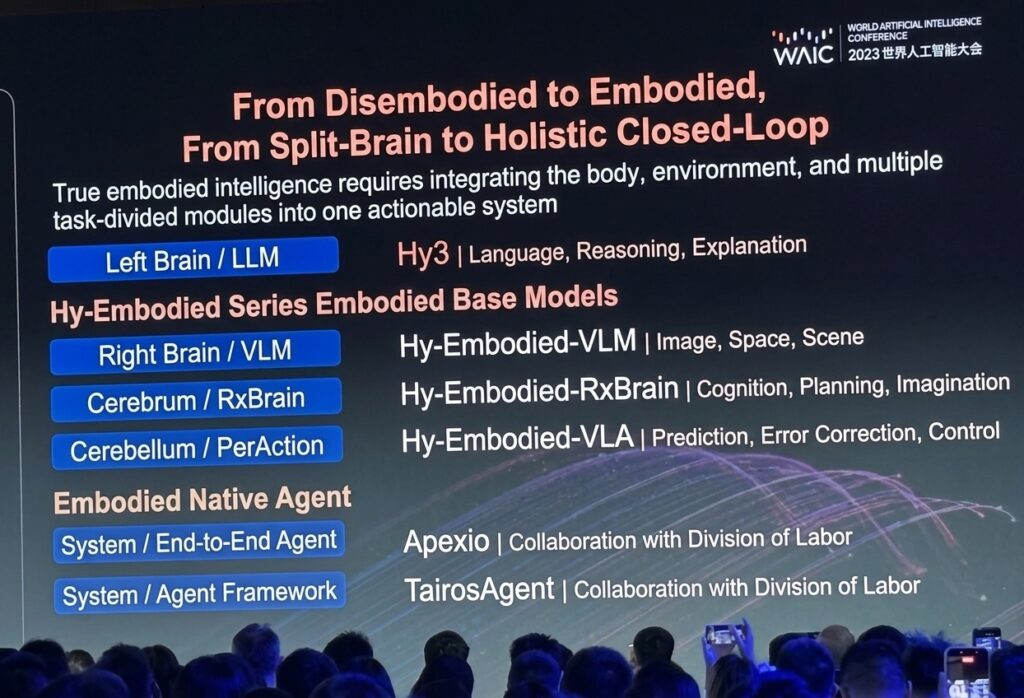
Finally, keep in mind that Tencent’s embodied multi-model matrix is built on its Hunyuan (HY) foundation model family. Which can work alongside the specialized embodied models mentioned (Hy-Embodied suite).
For top-level task decomposition, long-context planning, and complex dialogue, Tairos links directly into Tencent’s general flagship LLMs:
- Hunyuan Hy3 / Hunyuan-MoE Series: This is the primary broad-reasoning LLM. Its Mixture-of-Experts (MoE) architecture handles long context, multi-turn reasoning, and high-level goal decomposition.
- Hunyuan-A13B / HY Think Models: This is for efficient, low-latency reasoning used in hybrid configurations. It toggles between fast execution and deep sequential planning depending on environmental demands.
Here’s the summary from the forum. It’s in Chinese, but you can see the main names. Including Hy3 at the top.

Ok. That’s it for Tairos.
A lot of detail but I thought it was really important. This is the best breakdown of frontier embodied AI I have found.
Interestingly, the example Tencent presented at WAIC 2026 was a robot that could do massages.


***
In the next article, I’ll go into HY4 and WorkBuddy updates. Which is much more business focused.
Cheers, jeff
Disclosure. I have had a paid consulting relationship with Tencent in the past twelve months.
- AgiBot’s Robot Intelligence Depends on Genie Operator (GO) and Genie Envisioner (GE) (3 of 4) (Tech Strategy)
- AgiBot’s Race to Embodied AI Robots at Scale (1 of 2) (Tech Strategy)
- Why I Like AgiBot (Podcast 290)
——-
Related articles:
- More High-Tech Flex by Huawei R&D (4 of 4) (Tech Strategy)
- 6 Big Events in AI Agentic Ecommerce (Tech Strategy)
From the Concept Library, concepts for this article are:
- Robotics
- Embodied AI: World Model
- Embodied AI: VLM
- Embodied AI: VLA
From the Company Library, companies for this article are:
- Tencent Tairos
- Tencent AI Cloud
——–