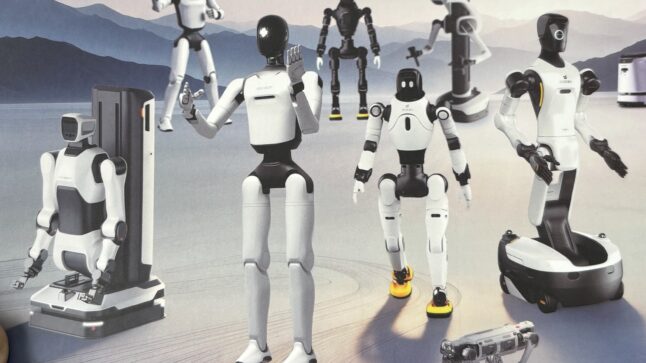
A business that got my attention at WAIC 2026 was AgiBot. I talked about this in my podcast:
I like that they are playing for the entire humanoid robotics business. And they are racing to get to scale.
Here’s what got my attention about AgiBot:
- They have rapidly expanded (within 2 years) to all types of humanoids, quadrupeds and cleaning robots (see below).
- They are targeting all industries and use cases (see below).
- They are building almost a full AI tech stack. This is really important. Their architecture benefits from efficient training data.
- AgiBot is co-founded and run by a Huawei SVP and a hardware tech whiz.
- There is an understandable strategy for scale in robot infrastructure. Similar to Huawei’s.
- AgiBot is in the top 1-2 in actual humanoids shipped globally.
- AgiBot shipped +5,000 humanoid units in 2025.
- Note: Unitree’s 2025 humanoid shipments were +4,000. Unitree’s total units sold in 2025 were +23,000, but that’s mostly quadrupeds (i.e., robodogs).
AgiBot’s Co-Founders Combine Execution Expertise and Top Tier Hardware Talent
AgiBot was established in February 2023 in Shanghai. The founders are pretty interesting.
Peng Zhihui (CTO / Co-Founder) is well known online.
He is a hardware innovator with millions of online followers. He’s known for hardware engineering, AI and open-source robotics.
He completed undergraduate and then did a master’s degrees in information and communication engineering at the University of Electronic Science and Technology of China (UESTC).
During his university years, he participated in national engineering competitions in smart vehicles, embedded electronics, and robotics. His teams won dozens of awards and he built a reputation early as an exceptionally skilled hardware builder.
Following graduation in 2018, Peng joined the AI lab at OPPO Research Institute as an algorithm engineer.
- Parallel to his corporate work, Peng built a massive public following on Bilibili with the moniker “Wild Iron Man”.
- He published detailed video walk throughs of complex DIY engineering builds created in his personal laboratory. Projects included an autonomous self-balancing bicycle equipped with lidar, a miniature robotic arm capable of stitching grape skins, mini computers, and customized handheld gaming devices.
In July 2020, Peng was selected into Huawei’s Genius Youth recruitment program. At Huawei, he worked as a core AI algorithm engineer in Huawei’s Ascend Computing Department.
- That meant edge computing architectures, chip inference optimization, and integrating AI software with specialized hardware.
In December 2022, Peng resigned from Huawei and co-founded AgiBot a few months later.
Deng Taihua (CEO / Co-Founder) is a former senior vice president of Huawei.
He’s the operational, commercial, and executive scaling experience.
Interestingly, Deng Taihua also studied information and communication engineering at the same University of Electronic Science and Technology of China (UESTC), joining the university (graduating in 1995).
After graduation, Deng joined Huawei and spent +20 years rising to senior vice president.
- In his earlier roles, Deng served as the head of Huawei Wireless Network Product Line. He oversaw the development and global commercial deployment of cellular base station infrastructure, including 4G and 5G equipment.
- He became President of Huawei Computing Product Line and corporate vice president. He led the building of the Kunpeng general computing ecosystem and the Ascend artificial intelligence computing platform.
- Under his leadership, the Ascend platform became China’s primary domestic hardware and software ecosystem for training and deploying large language models and computer vision systems.
Ok. That’s an impressive team.
And it kind of explains how this company has been growing so fast.
AgiBot Went from Founding to Mass Production in Under 2 Years
AgiBot was established in Shanghai in February 2023. So, all that stuff I mentioned earlier (tons of robot types, tons of use cases, world leader in sales) happened in 2.5 years.
Take a look at the pace in 2023 and 2024:
- February 2023: AgiBot founded
- August 2023: Unveiled its first working humanoid prototype, the Raise A1.
- August 2024: Expanded from a single humanoid prototype to a portfolio of robots:
- Full size humanoids (A2)
- Compact research units (X1)
- Industrial humanoids (G2)
- Quadruped platforms (D1)
- Sweeping systems (C5)
- September 2024: Launched a Data Factory in Shanghai.
- In this facility, +100 robots collect continuous trajectory, vision, and tactile movement data across real world scenarios to train physical foundation models.
- December 2024: Released their AgiBot World dataset.
- This was an open-source collection then containing +100,000 movement training sets to support embodied AI development globally. This provides global developers with demonstration trajectories covering dozens of complex operational skills.
- Their long-term goal is +1M data training sets.
- March 2025: Released GO-1 (Genie Operator-1).
- This is AgiBot’s embodied AI architecture, which centers on a Vision-Language-Latent-Action (ViLLA) model. It also includes a high-level VLA (Vision-Language-Action) model for semantic understanding and long-horizon task planning and lower-level motor policies for real-time closed-loop control.
- December 2025: AgiBot surpassed 5,500 mass produced robots shipped (not just produced).
AgiBot Has Robots for Most of the Major Categories Now
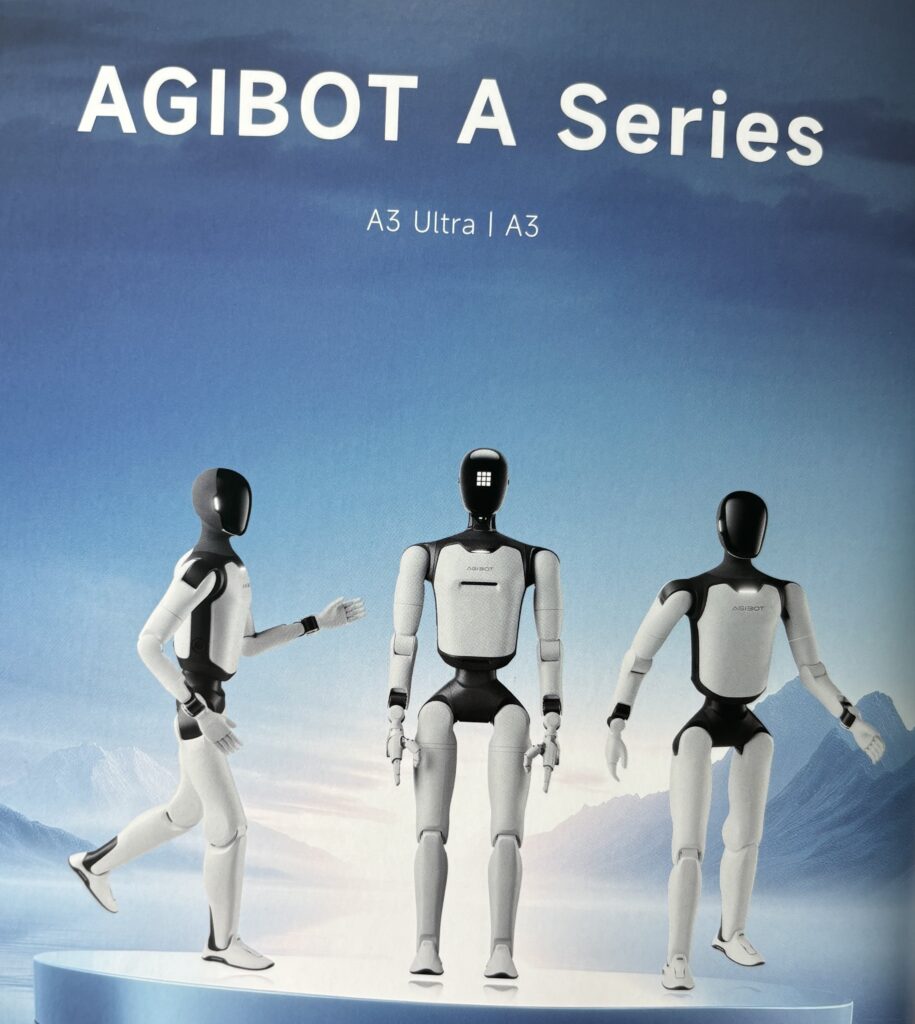
- A Series
- Full-size humanoid robots (A2 Ultra, A2 Lite, A2-W).
- Designed for service, interaction, and flexible manufacturing with advanced dexterity and mobility options.
- Offers both bipedal (standard A2) and wheeled (A2-W) versions.
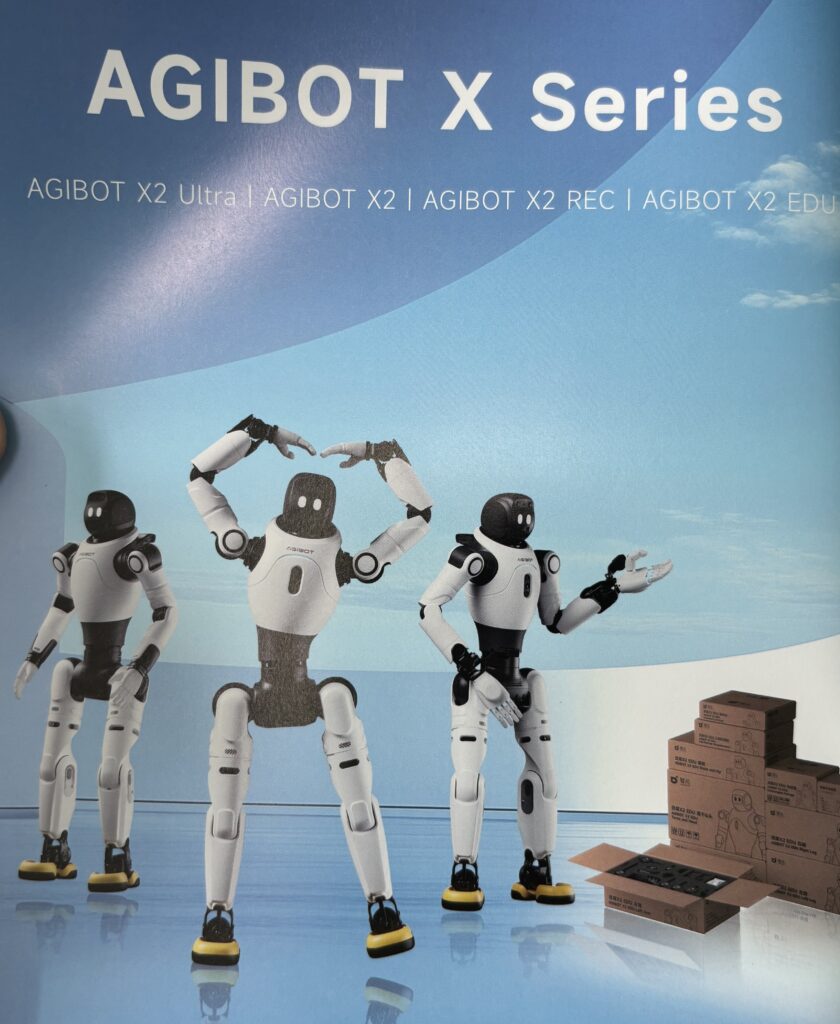
- X Series
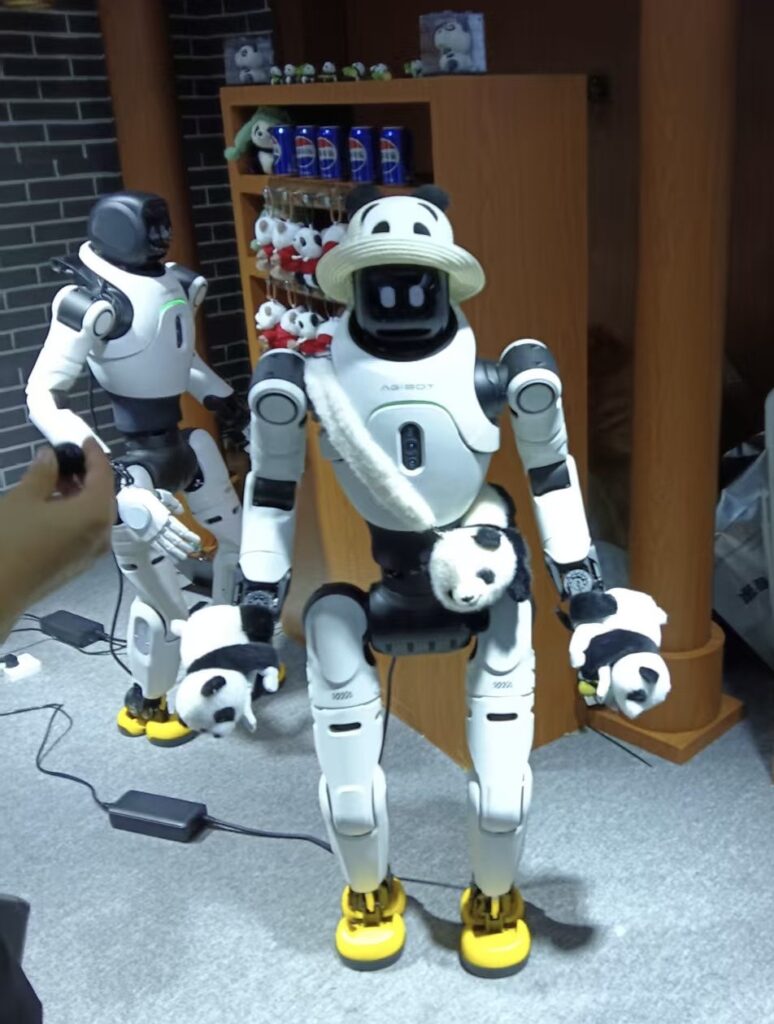
- Compact, agile humanoids (X1 / X2) focused on research, embodied AI development, and nimble tasks.
- Bipedal only.
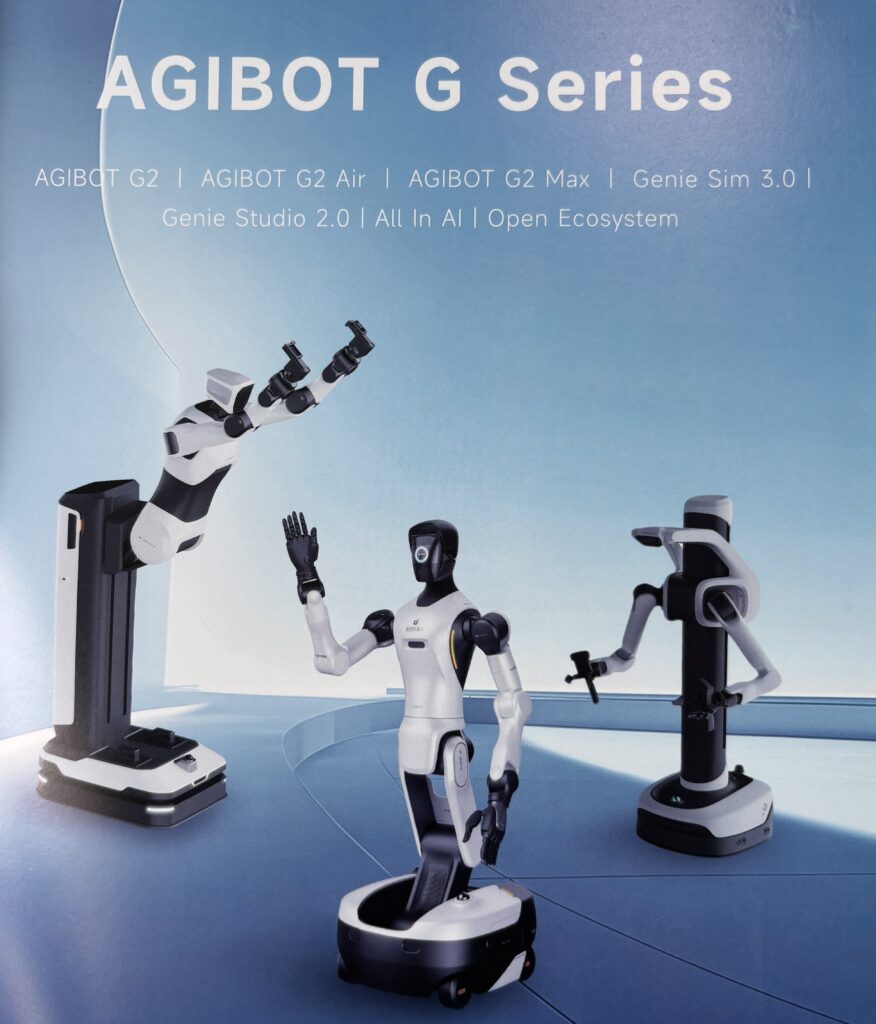
- G Series (G1 / G2 / Genie)
- Industrial grade humanoid for general-purpose applications and industrial scenarios.
- Wheeled only versions.
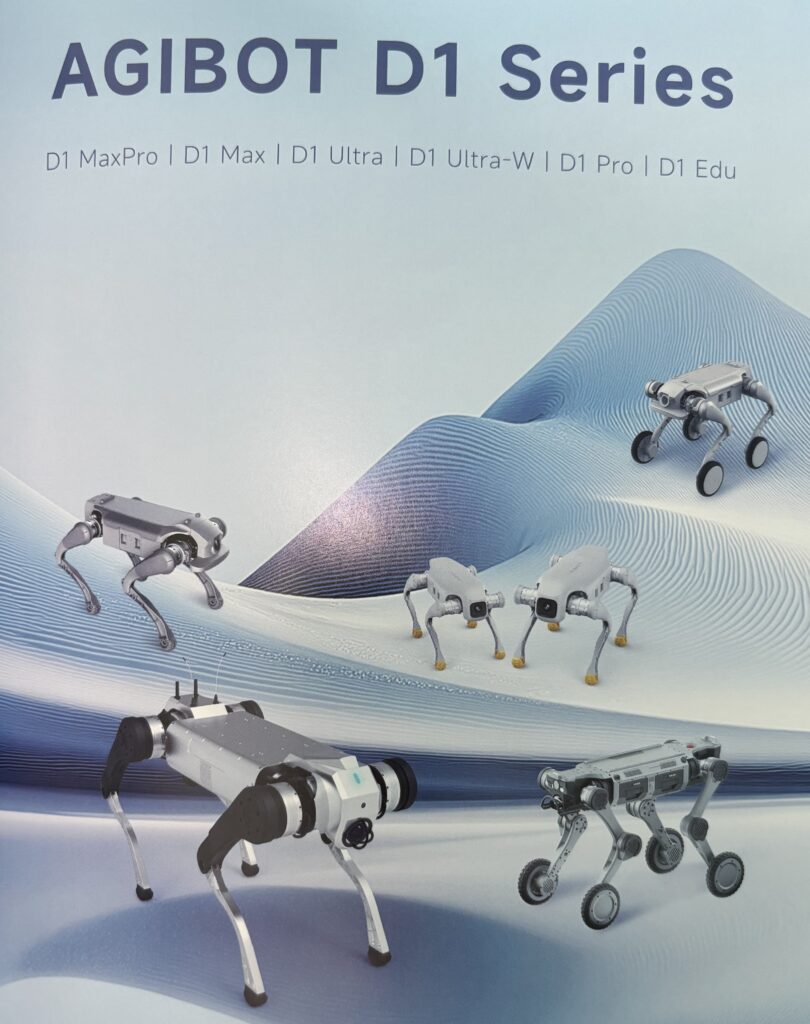
- D Series
- High-performance quadruped robots (D1 Ultra, D1 Max, etc.) for industrial productivity, inspection, and rugged terrain.
- Wheeled and peg leg versions
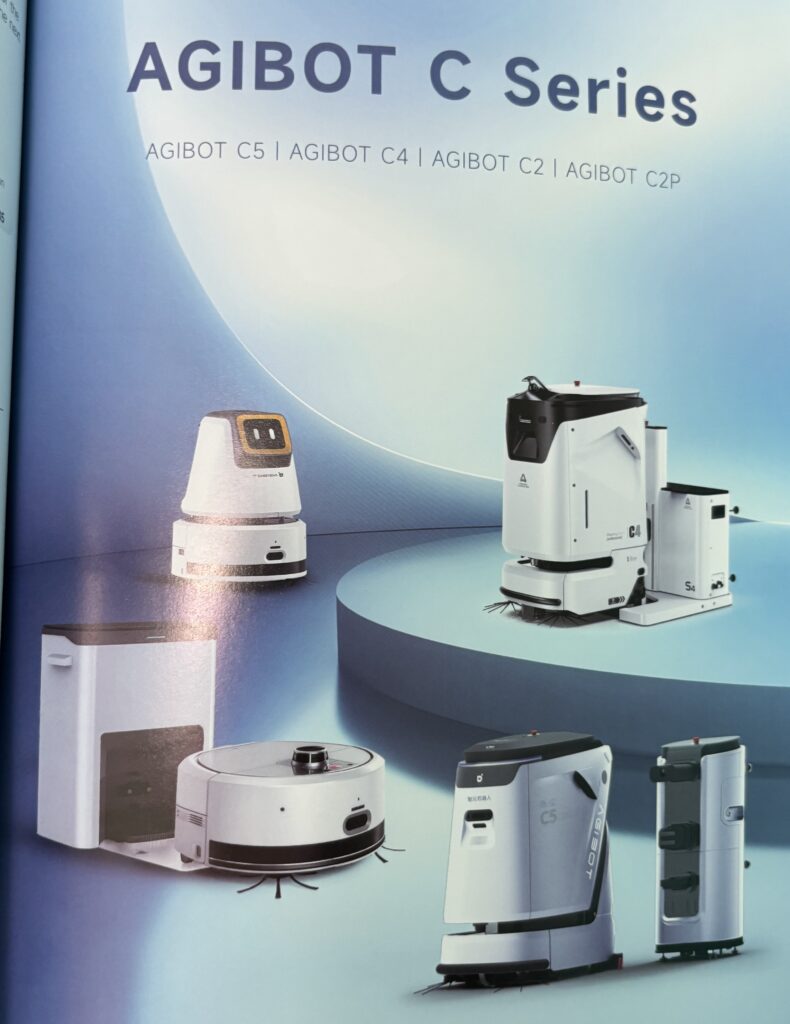
- C Series
- Commercial cleaning robot for service environments.
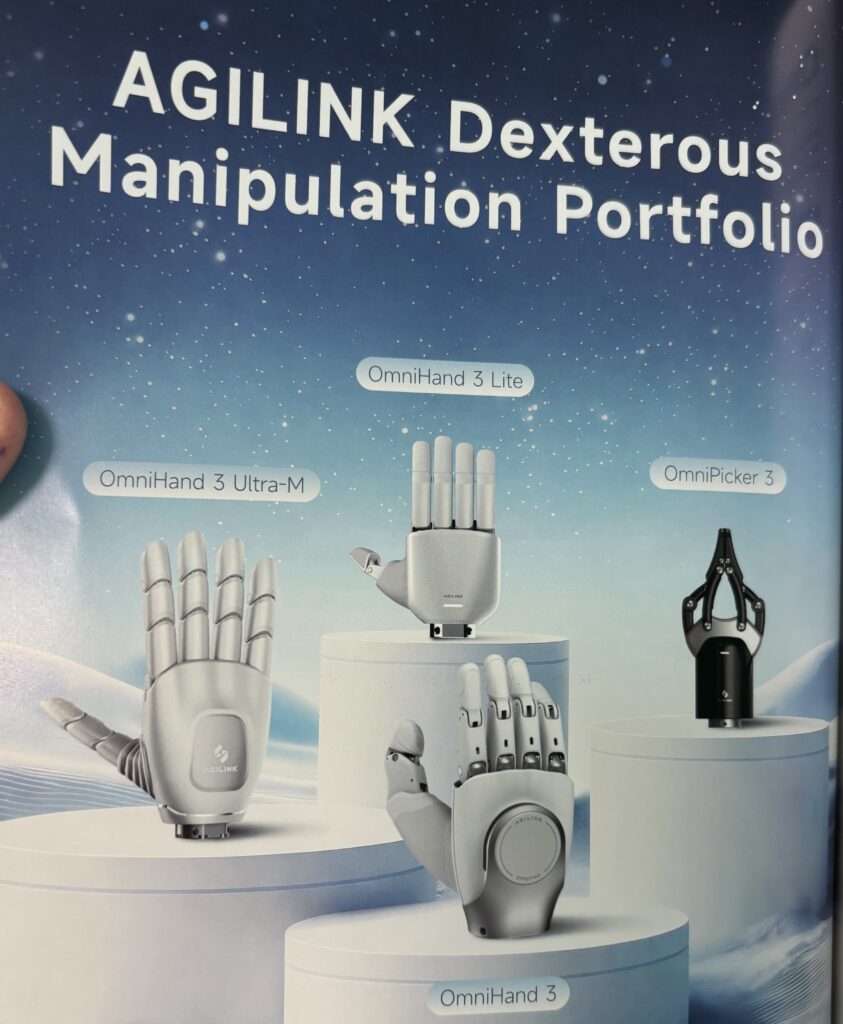
- Supporting Tech: OmniHand dexterous hands, VR teleoperation kits, and embodied AI development platforms.
The Core Capabilities Are Now In Place
You can see the strategy in the core capabilities they have built:
- Rapid Hardware / Software Co-Design: Rather than building hardware and using off the shelf software, AgiBot builds its own actuators, end effectors (OmniHand), AimRT (a faster alternative to ROS2), and AI foundation models (GO-1) concurrently.
- Efficient Data-Centric Training: By creating a physical factory specifically to collect interaction data, AgiBot bypasses reliance on physics simulators, speeding up deployment in messy real-world settings.
- Scaled Up Mass Production: Their main facility is in the Lin-gang Industrial Park in Shanghai.
The AIDEA Giga Data Factory is pretty interesting.
It’s in the Zhangjiang Science City in Pudong, Shanghai. This specialized facility is +3,000 square meters and it functions as a physical training and validation site for teleoperated robots. They run real world tasks and gather trajectory and tactile data.
The factory has +3,000 objects for robots to learn from, in physical dynamics like friction, weight distribution, and soft material deformation.
It has five real world operational zones:
- Residential Homes. This zone reproduces complete home layouts including kitchens, bedrooms, living spaces, and bathrooms.
- Industrial Warehousing. This zone features active conveyor belts, sorting systems, and packaging stations to teach robots material handling.
- Commercial Catering. This zone tests tasks such as food handling and table clearing.
- Retail Stores. This space simulates shelf stocking, item selection, and cashier guidance.
- Office Environments. This area tests document handling and venue navigation.
Human operators control the robots using motion capture suits, virtual reality headsets, and teleoperation rigs.
The data gathered includes:
- Visual Data. Multi angle cameras record visual scenes and spatial depth.
- Motion Trajectories. Joint positions, head orientation, and movement velocity are recorded continuously.
- Force Feedback. Tactile sensors on dexterous robotic hands record contact pressure and gripping force during physical manipulation.
Data generated trains AgiBot’s embodied models like GO 1. And it populates the open source AgiBot World dataset.
The Scenarios / Use Cases Are Also Pretty Much Everything
This is not robots doing flips and dancing. And they are not experimental prototypes. The use cases are focused on replacing or supplementing labor in structured and semi-structured environments.
There actually aren’t that many of these yet.
1. Industrial Manufacturing
Think electronics, semiconductor assembly, and automotive components.
- Loading and Unloading.
- The more advanced robots can use dexterous hands to perform more precise component placement on assembly lines. Equipped with dexterous hands, they can handle delicate electronic parts without damaging sensitive materials.
- Intralogistics and Line Feeding.
- Humanoid units pick up raw components from storage racks and transport them to individual workstations, integrating directly into existing manufacturing execution software.
2. Warehousing and Logistics
Logistics operations are about maintaining consistent throughput in fulfillment hubs.
- Parcel Sorting and Item Fulfillment. Humanoids handle irregular, soft, or packaged goods, sorting parcels into designated bins and reaching processing speeds that closely approach manual operational rates.
- Facility Material Handling. Wheeled variants like the A2 W maneuver across flat warehouse floors to move heavier crates without requiring facility restructuring.
3. Commercial Services, Retail, and Hospitality
Customer-facing environments require interactive humanoids (like robot cashiers and baristas). Specialized cleaning units are common here (C5).
- Store Guidance and Reception. Humanoid models operate in retail stores, restaurants, and cultural tourism sites to manage queue systems, direct visitors, and provide automated assistance.
- Commercial Floor Maintenance. The dedicated C series sweeping and scrubbing units automate floor cleaning in large venues, handling autonomous charging, water filling, and drainage cycles.
- Event and Promotional Marketing. Businesses lease humanoid units via commercial rental programs to perform interactive demonstrations at corporate launches and trade exhibitions.
4. Security Patrol and Infrastructure Inspection
Environments featuring rugged terrain, staircases, or outdoor elements utilize specialized movement platforms.
- Rugged Site Inspection. D1 quadruped robots navigate uneven surfaces, staircases, and gravel to inspect industrial facilities, power plants, and utility infrastructure.
- Autonomous Security Patrols. Robots execute scheduled perimeter routes, using continuous visual and thermal sensing to detect facility anomalies or equipment faults.
5. Embodied AI Research and Data Gathering
This is pretty important. And common across the robot companies.
- Developer Testing. Compact models like the X series provide open-source bipedal testbeds for labs developing policy algorithms and physical spatial reasoning.
- Real World Data Collection. Teleoperated fleets collect tactile, visual, and movement data across real physical spaces. Plus there’s haptic feedback and other information that trains general embodied intelligence models.
***
That’s it for Part 1 and the basic intro. In Part 2, I’ll go through AI aspects and the strategy.
Cheers, jeff
- A Breakdown of AgiBot’s Embodied AI Tech Stack (2 of 3) (Tech Strategy)
- Why I Like AgiBot (Podcast 290)
——-
Related articles:
- More High-Tech Flex by Huawei R&D (4 of 4) (Tech Strategy)
- 6 Big Events in AI Agentic Ecommerce (Tech Strategy)
From the Concept Library, concepts for this article are:
- Robotics
From the Company Library, companies for this article are:
- AgiBot
——-
I am a consultant & keynote speaker on how to increase digital growth and strengthen digital AI moats.
I am the founder of TechMoat Consulting, a consulting firm specialized in increasing digital growth and strengthening digital AI moats. Get in contact here.
I write (a lot) about digital growth and digital AI strategy (3 best selling books, +2.9M followers on LinkedIn). There is a free book and email newsletter below.
My Moats and Marathons book series is a framework for building and measuring competitive advantages in digital businesses.
This content (articles, podcasts, website info) is not investment, legal or tax advice. The information and opinions from me and any guests may be incorrect. The numbers and information may be wrong. The views expressed may no longer be relevant or accurate. This is not investment advice. Investing is risky. Do your own research.