
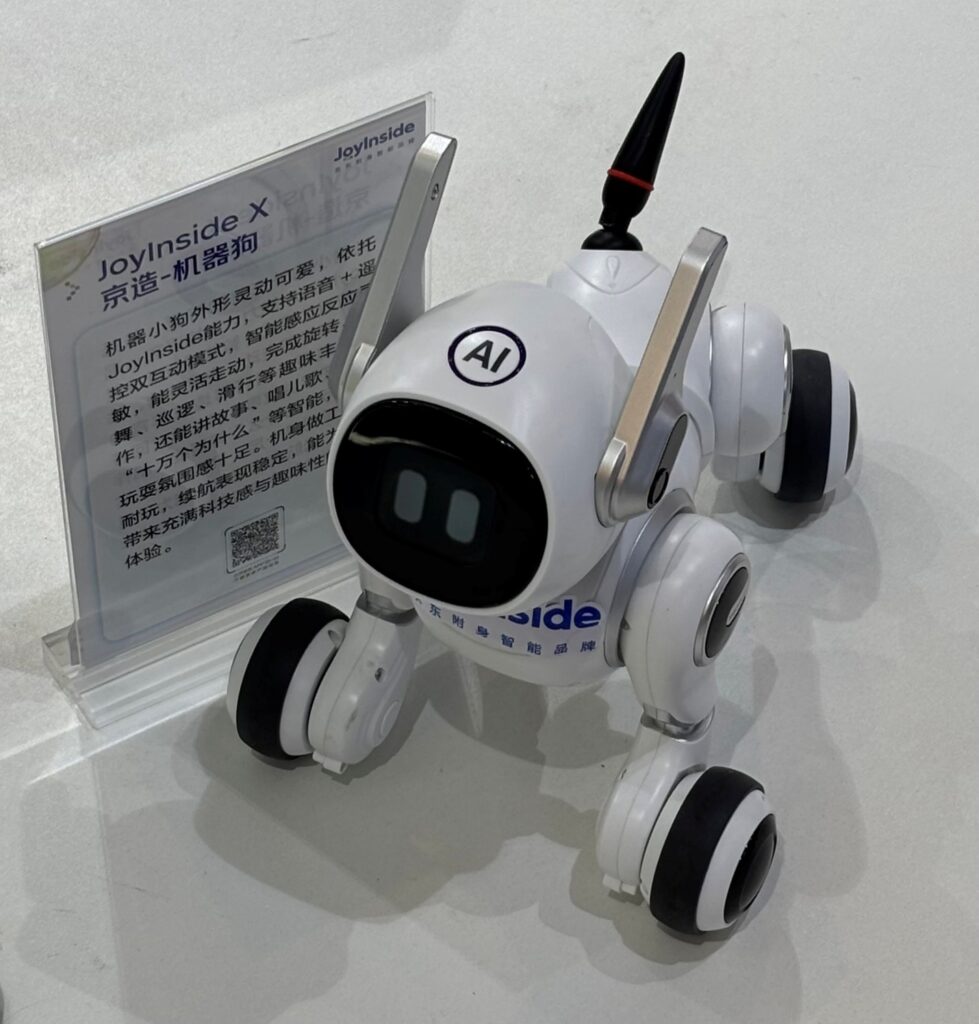
In Part 1, I went through JoyInside, which is JD’s embodied intelligence and distribution solution for OEMs.
In this Part, I will go through JoyAI, which is the brains for all of this. JoyAI is JD’s suite of foundation models.
And it reveals a pretty unique strategy.
JoyAI Is a Focused Strategy, Not an Everything Suite
JoyAI is an interesting contrast to Tairos, Tencent’s models suite for robots. I wrote about that here.
Tairos is an all-encompassing suite of models for embodied AI. They are playing all across the board in AI.
In contrast, JoyAI is a much more focused suite of AI models. They are focused on providing embodied AI as a capability for all types of OEMs. From big robots to appliances and toys.
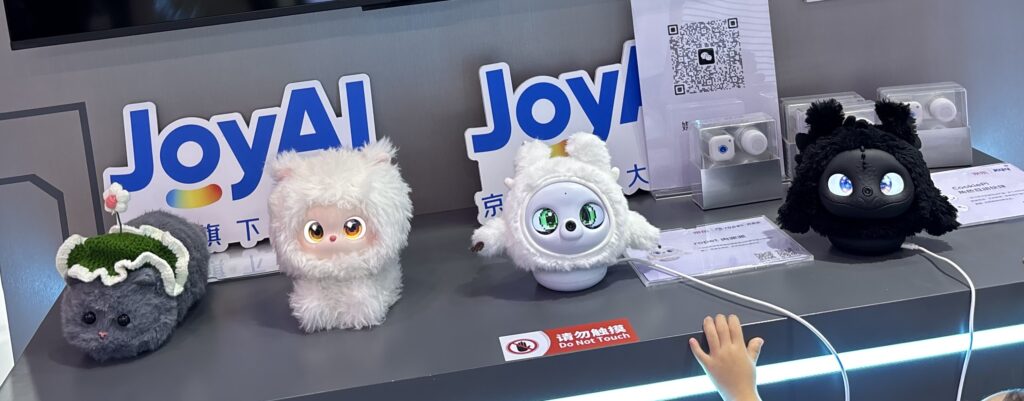

JD also appears to only have general-purpose reasoning LLM (JoyAI-Flash). The other models are specialists for voice, vision, video and action.
The Simple Version of JoyAI: Ears, Mouth, Eyes and Body
Keep in mind, most embodied AI devices do not process complex AI logic on the small, lower-power chips on robot. Or on device if we are talking toasters and toys.
When a user speaks to a JoyInside-connected device or when its camera captures an environment, the multimodal raw data is processed by the JoyAI foundation suite. And mostly in the cloud.
Between robot and cloud, there are the eight models in four layers. I’ll list them first. Them explain one by one.
Voice Interaction
- JoyAI-Voice: speech generation model
- JoyAI-Talker: voice interaction model
Multimodal Interaction
- JoyAI-Echo: ultra-long audio and video generation model
- JoyAI-VL-Interaction: real-time video interaction model
- JoyAI-Video-Edit: real-time video editing model
- JoyAI-Image-Edit: image editing model
Embodied Intelligence
- JoyAI-RA: embodied manipulation foundation model
Reasoning
- JoyAI-Flash: general-purpose language model
We can simplify this down to ears, voice, eyes and body:
- The “Ears” and “Voice”, which is JoyAI-Voice and JoyAI-Talker. These models handle speech generation and voice interaction for interactive hardware.
- The “Eyes”, which is JoyAI-VL-Interaction. Plus models for image editing, video editing and long video generation. JD calls this layer Multimodal Interaction.
- The “Body”, which is JoyAI-RA. JD calls this its embodied manipulation foundation model. It is a single model for “robot action”. It lets embodied hardware execute physical actions based on real-world sensory inputs.
That’s a simplified list but a solid first pass for thinking about them.
Here is how JD summarizes JoyAI. This is from a sign JD had at the World Robot Conference in Beijing (which I had AI translate to English).
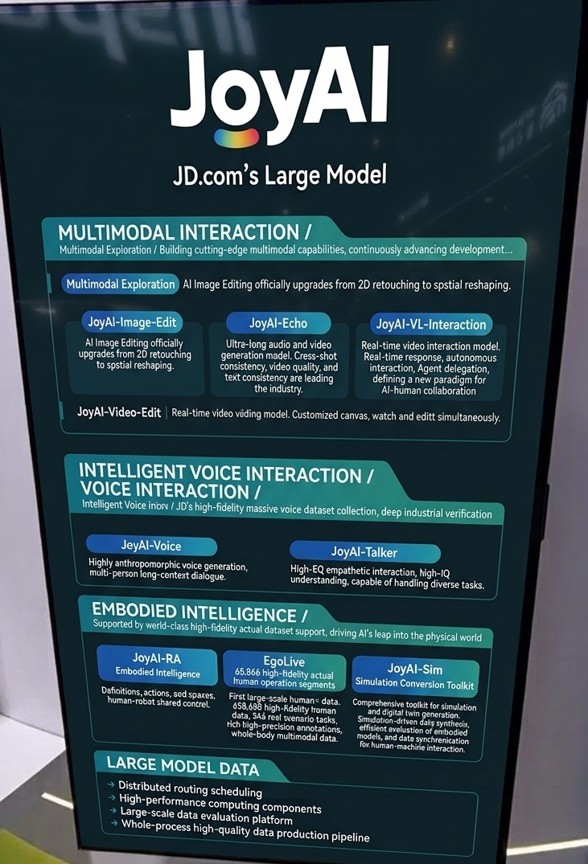
You can see it contains the three main pieces I mentioned. But it’s also quite a bit more complicated. Let me walk you through it.
Layer 1: Voice Interaction (the Ears and Voice)
Instead of traditional turn-based voice commands (“stop and wait”), this layer has continuous, low-latency conversation. So, it’s seamless back and forth conversation, which is actually pretty difficult to achieve.
It helps to have specialized models for this capability. JoyAI has two models in this layer:
- JoyAI-Voice is the speech generation model. JD describes it as highly human-like. The sign mentions its ability to keep track of long-context dialogue.
- JoyAI-Talker is the model for voice interactions. It is focused on both the EQ and IQ of a conversation. Understanding and cognition are a big part of this. But so is emotion.
JD’s Voice Interaction Layer can also handle background noise, user interruptions, and tone/emotion recognition in real time.
Layer 2: Multimodal Interaction (the Eyes)
Like with voice, there are specialized models for vision and spatial understanding. There are four in this layer. JD published a list of these models (which I had translated from Chinese).
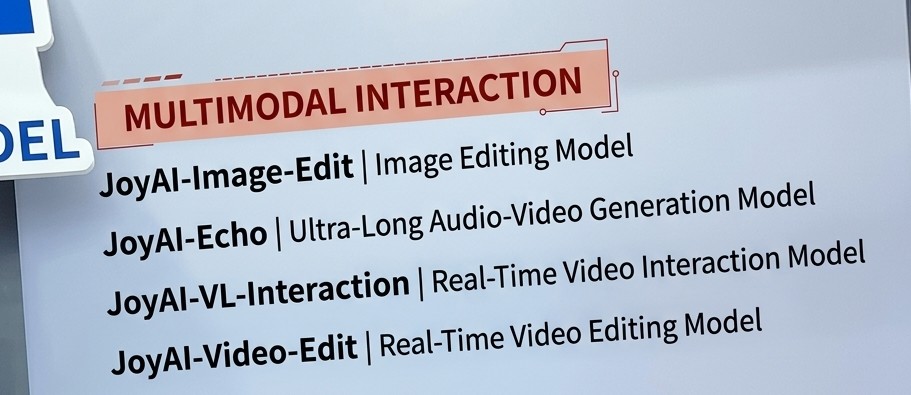
For me, this layer had the biggest lessons.
JoyAI-Echo: Long Video Generation
JD describes this as an ultra-long audio and video generation model (with cross-shot consistency). Most video models produce short clips. This one can go up to about 5 minutes.
Why it’s necessary: A robot needs to imagine a scene after it changes. After an object has moved. Or the same shelf seen from a different angle. That is spatial image editing. JD names robotics and robot action models as uses for JoyAI-Echo.
JoyAI-Echo also has a world-model variant, Echo-WM, that generates a video world you can navigate through. I think about Echo-WM as their simulation model for training. More on this below.
Why it’s different: This is the only one of the four models that creates video from scratch. The other three watch or change video and images that already exist.
JoyAI-VL-Interaction: Real-Time Video Interaction
This model watches a live video feed continuously. It can comment on what it sees and flag events without waiting for a prompt. JD describes it as real-time response, autonomous interaction and agent delegation.
Why it’s necessary: The physical world doesn’t send prompts. A robot or smart device has to watch continuously and decide for itself when to act or speak. JD says physical AI requires real-time response and low latency, and this is the model built for that.
Why it’s different: This is the only one that watches and understands. Video goes in and language comes out. It doesn’t create or change any video. And it decides for itself when to speak up, which is what makes a device proactive and not just reactive.
JoyAI-Video-Edit: Real-Time Video Editing
This is a real-time, instruction-guided video editor. You tell it what to change and it changes the video as it plays. It can change appearance, edit objects, add, remove or replace subjects, replace backgrounds and transfer style.
Why it’s necessary: JD doesn’t say too much about this model. But devices interacting with people through cameras and screens will need to generate and change video live, not after the fact. And real-time is the hard part.
JoyAI-Image-Edit: Image Editing
JD says it upgrades AI image editing from 2D retouching to spatial reshaping.
Why it’s necessary: A robot has to understand space: where objects are and how they relate to each other. JD’s research describes this kind of spatially aware image model as a promising path toward robot action models and world models.
Why it’s different: This works on still images, not video. And its focus is on space, meaning where things are in a scene and how they relate, not just how the picture looks. It doesn’t move anything physically. That’s done by JoyAI-RA.
***
Basically, one model creates video and simulations (Echo). One watches video and responds (VL-Interaction). One changes video (Video-Edit). One changes images (Image-Edit).
I’ll cover the rest of the models in Part 3.
Here are two last comments.
JoyAI-Echo Matters Beyond Robots
JoyAI-Echo is not just about robots. It’s a bigger initiative at JD.
Also known as Echo-LongVideo, it is a long-form AI audio-video generation model. It was developed by JD’s Joy Future Academy team and released in May 2026.
As mentioned, JoyAI-Echo is designed to generate up to 5 minutes of multi-shot video. Complete with natively synchronized audio.
And the Joy Future Academy team developed Echo-WM (World Model) as an offshoot of the main Echo model. It leverages Echo’s ability to maintain structural consistency over long video generations to create a world model that responds to continuous navigation.
Echo-WM can generate video, environmental sound, music and speech together as you navigate through a scene. JD describes it as a world model for generative media.
So, there’s:
- JoyAI-Echo 1.5. This is a long-form video generation model. The output is multi-shot video clips with persistent character identities, scene context, and synced audio.
- EchoWM. This is a navigable world model. The output is an interactive, enterable virtual environment where the video, sound and speech are generated as you move through a scene.
JoyAI-VL-Interaction Is the Model to Watch
JD’s Joy Future Academy released JoyAI-VL-Interaction as an open-source 8B parameter model in mid-2026.
As mentioned, this is a real-time video-language model that watches a continuous live video feed. And by watching the video feed, it independently determines whether to speak, stay silent, or trigger a background task.
This is the actual perception layer that solves the “real-time streaming” problem. It acts as a continuous, proactive observer.
So, Echo-WM is the world model that generates worlds.
And JoyAI-VL-Interaction is the model that watches live videos and interacts.
***
Ok. That’s enough for today. In Part 3, I’ll go through the rest of the robot tech stack.
Cheers, Jeff
——-
Related articles:
- JD’s JoyAI and JoyInside Are a Smarter Bet Than Building Humanoid Robots (1 of 3) (Tech Strategy)
- Why ChatGPT and Generative AI Are a Mortal Threat to Disney, Netflix and Most Hollywood Studios (Tech Strategy – Podcast 150)
From the Concept Library, concepts for this article are:
- Embodied AI
From the Company Library, companies for this article are:
- JD: JoyAI
- JD: JoyInside
——
I am a founder, consultant and keynote speaker specialized in digital and AI agentic strategy.
I am the founder of Agentic Org Now, a firm that helps leadership teams launch AI and agentic initiatives fast.
I write (a lot) about digital and digital AI strategy (3 best selling books, +2.9M followers on LinkedIn). You can get a free book at the email sign-up below.
My Moats and Marathons book series is a framework for building and measuring competitive advantages in digital and AI businesses.
This content (articles, podcasts, website info) is not investment, legal or tax advice. The information and opinions from me and any guests may be incorrect. The numbers and information may be wrong. The views expressed may no longer be relevant or accurate. This is not investment advice. Investing is risky. Do your own research.