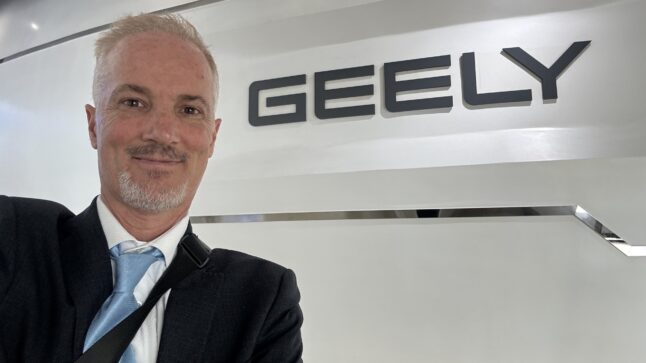
We just finished up Phase 2 of our Alibaba Ecommerce Training Program. This is our program (in partnership with Alibaba) for training ecommerce entrepreneurs.
- Phase 1 was a month of classes on ecommerce entrepreneurship. We cover everything from long-term strategy to AI marketing.
- Phase 2 was a week in Hangzhou doing classes at the Alibaba headquarters and also visiting local companies.
Overall, it was pretty great.
And it put the entrepreneurs at the center of ecommerce innovation. Alibaba is really the world leader for AI and agentic commerce.
We’re looking to roll this program out in other geographies Probably Southeast Asia and Brazil / Latam. I’m starting to talk with local partners right now if you have any suggestions.
If you want to know more about our tours and training programs, go to here.
And to be frank, I’m really enjoying being an Alibaba professor.
I taught for almost ten years at Peking University and CEIBS in China. And I had gotten tired of teaching MBAs and Exec MBAs. Too much theory. Too little action.
Teaching ecommerce to entrepreneurs is very different. It’s all action-oriented.
- How can we sell more right now?
- What AI tools should we be using?
- How do we chart a winning course over 1-2 years?
It was great. I’m definitely doing more of this going forward.
In these articles, I want to go through the week in Hangzhou, the fun stuff and some take-aways.
Arriving in Hangzhou
I really like Hangzhou.
I can remember taking the 3-hour train from Shanghai to Hangzhou back in 2007. The high-speed train now takes 45 minutes.
Back then, Hangzhou was a historic and mostly undeveloped tourist town. It had tons of Chinese visiting for the famous West lake and enjoying the eternal spring environment. There were also lots of plastic paddle boats in the lake. And the pathways around the lake were the same as 50 years prior.
Fast forward to today and Hangzhou is filled with modern roads and skyscrapers, all of which must have LEDs on them apparently.
West Lake is completely redeveloped and looks like it was designed by the Four Seasons. Walking around the lake at night is amazing. Lots of restaurants, cafés and musicians playing.

Photo by Stewart Edward on Unsplash
To the south, there is the Binjiang district, with lots of big tech companies. Including NetEase, Hikvision, Dahua Technology, BEST Logistics and the original Alibaba campus.
The district is also home to high-growth startups such as Unitree Robotics, DeepSeek, DEEP Robotics, Leapmotor, and BrainCo.
To the west, is the ever-expanding Alibaba headquarters (plus the Ant headquarters).
Hangzhou has become a really great city. It’s definitely in the top tier with Shanghai, Shenzhen and Beijing. I’m always pretty happy to be there.
Tour Day 1: Some Lectures and Then Off to Geely / Zeekr
Our tour started on Monday morning. So, I started with my standard Luckin Coffee order (butter latte, which is probably bad for me). Ordered on Meituan, it was delivered to my hotel room door by a little robot. I’m still not sure how the robot rings my doorbell.
In the morning, we got the group together and I did some lectures on ecommerce and how to think about China business. This mostly follows from the One Hour China, which is still doing well after 13 years (surprisingly). I like to do deep dives into any companies we are going to visit. It usually makes us look pretty good to the company representatives. So, we talked about Geely / Zeekr and then headed out to their headquarters.
Geely has a long and interesting history.
The company lore is that Li Shufu (Eric) made his first move into auto in 1994 with the acquisition of a motorcycle SOE business (the Taizhou Motorcycle Factory). After making scooters under the Geely name, he converted this business into passenger cars (around 1997). This made it the first private car manufacturer in China.
His history before this is also pretty interesting.
Eric’s family was rural farmers and he grew up in rural Zhejiang. This type of humble beginning was common in China’s first generation of entrepreneurs (1980-1990). The country had just begun to open up and most of the big entrepreneurs that emerged began as farmers, government employees and military.
In 1986, at age 23, Eric began manufacturing refrigerator parts. This was technically the founding of Geely. The business also made some building decoration materials. He did this for ten years and made his famous pivot to motorcycles (and then cars) in his early 30’s. These businesses were all based in his hometown of Taizhou, about 3 hours from Hangzhou. The Geely HQ moved to Hangzhou in 2003.
Eric’s early years had lots of smaller successes (and failures). He didn’t really take off until he went for passenger cars.
The lesson here is that timing is key.
Having the right product at the right time is a huge part of success as an entrepreneur.
You need to be early to an opportunity.
But you also can’t be too early.
Launching passenger cars in China in 1997 was the right product at the right time. And Geely took off like a rocket.
- The first cars were produced in 1997.
- Eric appeared on the Forbes China Rich List in 2004.
- And Geely went public in Hong Kong in 2005.
The fact that Geely didn’t have a license to do passenger cars until around 2001 is part of the lore.
This is actually common in China. Emerging industries are often allowed to operate in a sort of grey area. But don’t confuse the lack of a license with a lack of approval. There were likely discussions.
And he partnered with and bought out the Sichuan Deyang Prison Vehicle Factory (a state-owned truck manufacturer). By purchasing this struggling SOE, Geely acquired not only infrastructure, but also its state-issued automotive production license. He repeatedly used this approach in his career.
After the early rocket ship years, Geely went international and acquired lots of brands. It famously acquired Volvo in 2010, a case we now teach in business school. And Eric gained international prominence.
Over time, Geely evolved into a holding company with a pretty big portfolio of auto brands.
- In 2012, Geely became the second-largest Chinese car exporter (behind Chery) after shipping over 100,000 vehicles overseas.
- In 2017, Geely became the #1 domestic brand and the #2 car maker in China (trailing only Volkswagen).
However…
Geely (like most Chinese purely domestic car makers) never really succeeded in moving up market. With the exception of Volvo, Geely and the other China passenger car companies were mostly confined to lower-cost economy cars. You could find Great Wall, Geely and others selling economy cars all over China, Latin America and Southeast Asia. But you didn’t see them selling SUVs in Europe.
The legacy players (Toyota, Volkswagen) and their China JVs (SAIC-GM, SAIC-Volkswagen) really dominated the middle and upper markets of China. In 2019, we used to write about how the foreign JVs were expanding their dominant China market share.
Even today, Geely and the Chinese automakers are much smaller than the legacy automakers.
- In 2025, Geely sold 4.1M cars overall (not just EVs). Its sales growth has been pretty steady over the past ten years. It’s been steadily upwards.
- That is only about half of Toyota (10.8M units) and Volkswagen (9.0M units).
And then EVs arrived.
Geely / Zeekr: The Other Rising Giant in EVs
EVs leveled the playing field with a tech paradigm change.
- The extensive supply chains built for combustion-based automobiles were no longer a big barrier to entry.
- Brand names built over decades didn’t have automatic trust when it came to buying an EV.
- The armies of automotive engineers at legacy companies were not a strength when cars became mostly about batteries and computers.
Yes, the dealer networks and financial strength of the auto giants still mattered. But EVs largely leveled the playing field.
And Geely and other Chinese EV companies moved really fast.
Like before, having the right product at the right time can really make a difference.
By 2025, Geely was now the #3 EV maker in the world. Right behind Tesla and a ways behind leader BYD. Although you have to separate out hybrids vs. pure EV for these comparisons.
Geely’s EV business has gone international. And it is growing fast. It should surpass Tesla in a few months, which will get a lot of attention. Geely / Zeekr is the next BYD.
Here are some numbers.
- In 2025, BYD sold a total of 4.6M New Energy Vehicles (NEVs) worldwide, a 7.7% increase from 2024.
- In 2025, Tesla sold a total of 1.6M EVs worldwide. But growth was negative 8%. Note: those are pure EVs, no hybrids.
- In 2025, Geely Auto / Zeekr sold +1.6M units in its electric and plug-in hybrid lines. The growth rate was 90%.
Basically, Geely is #3 and is rising very fast. And these are just the Geely Auto / Zeekr numbers. Not the other holdings (Volvo, etc.).
The company is now targeting:
- 5M in car sales by 2030 (all types)
- With new energy vehicles accounting for 75% of sales
- And with overseas sales accounting for 1/3 of sales
Within this, Zeekr is the EV everyone is talking about. That’s the premium EV. They are going international aggressively. Their cars are great. And their dealerships across Southeast Asia are spectacular. Here are some photos.
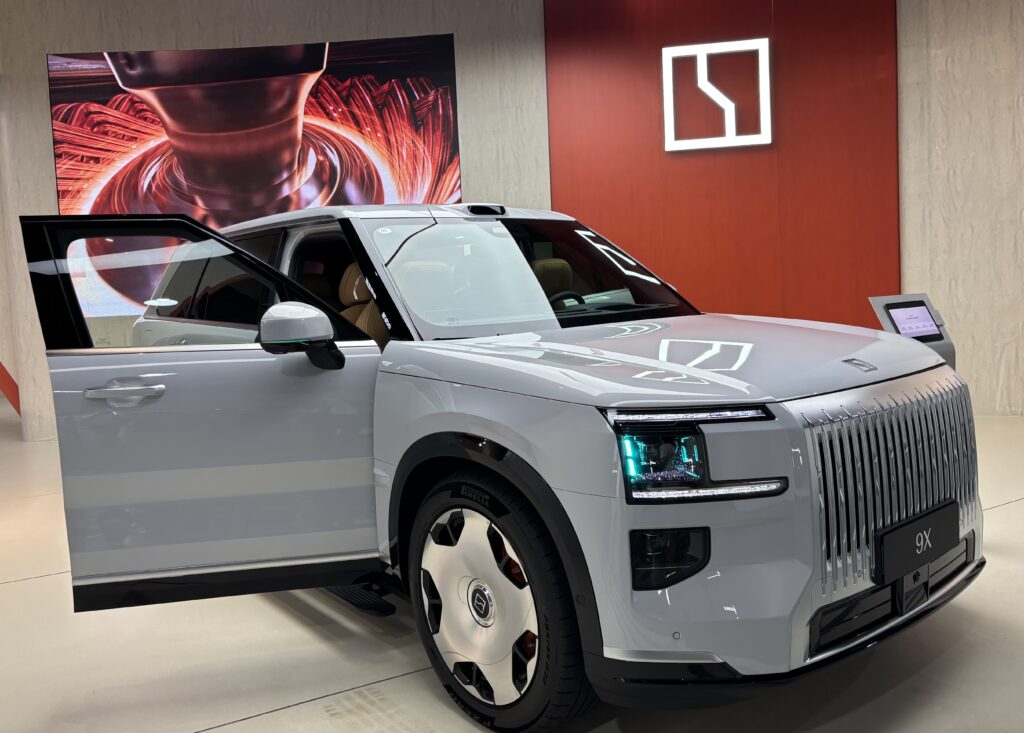
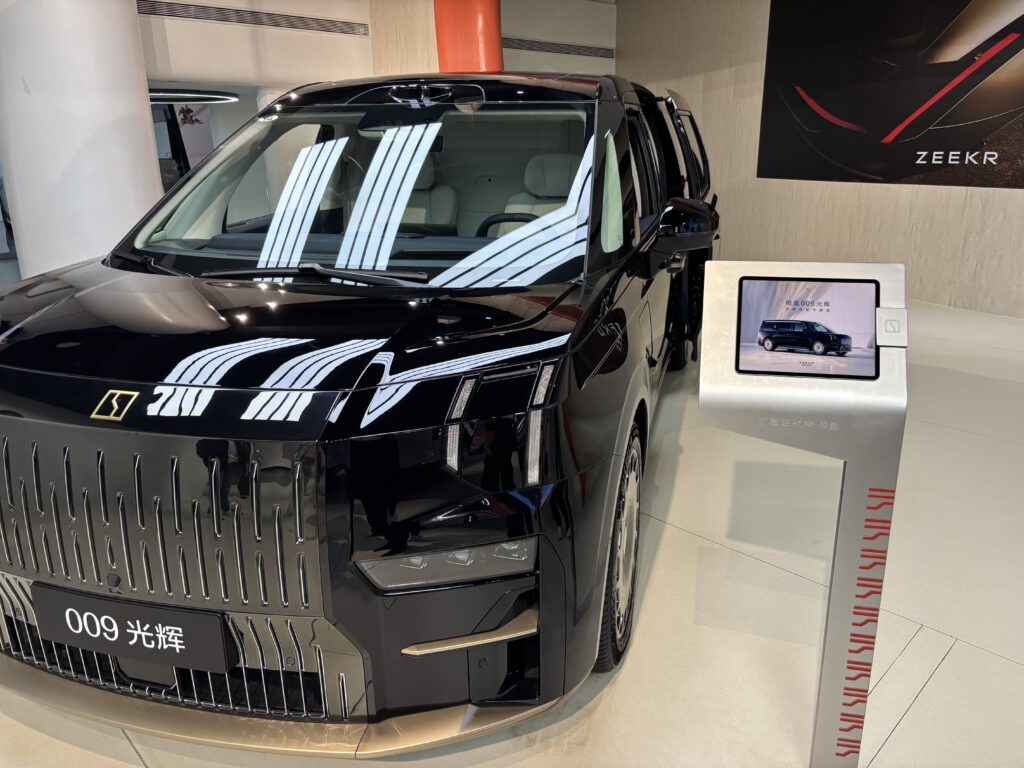
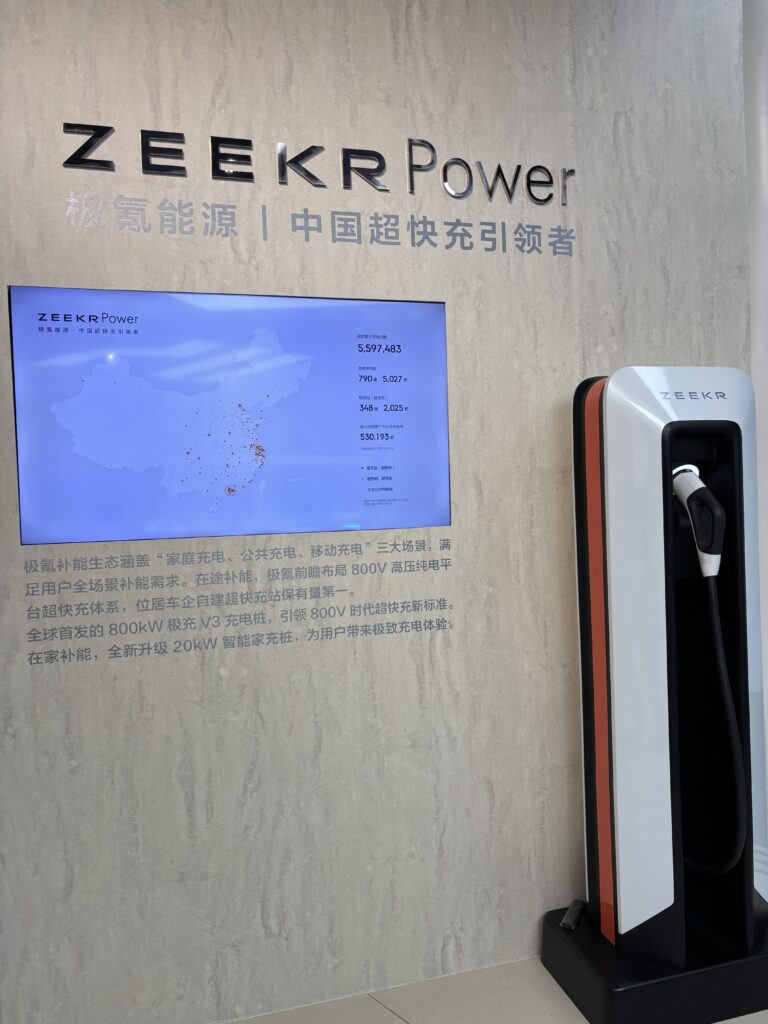
Another brand I like is Lotus. This 1952-founded UK company was acquired by Geely in 2017. They gave it an electric makeover.
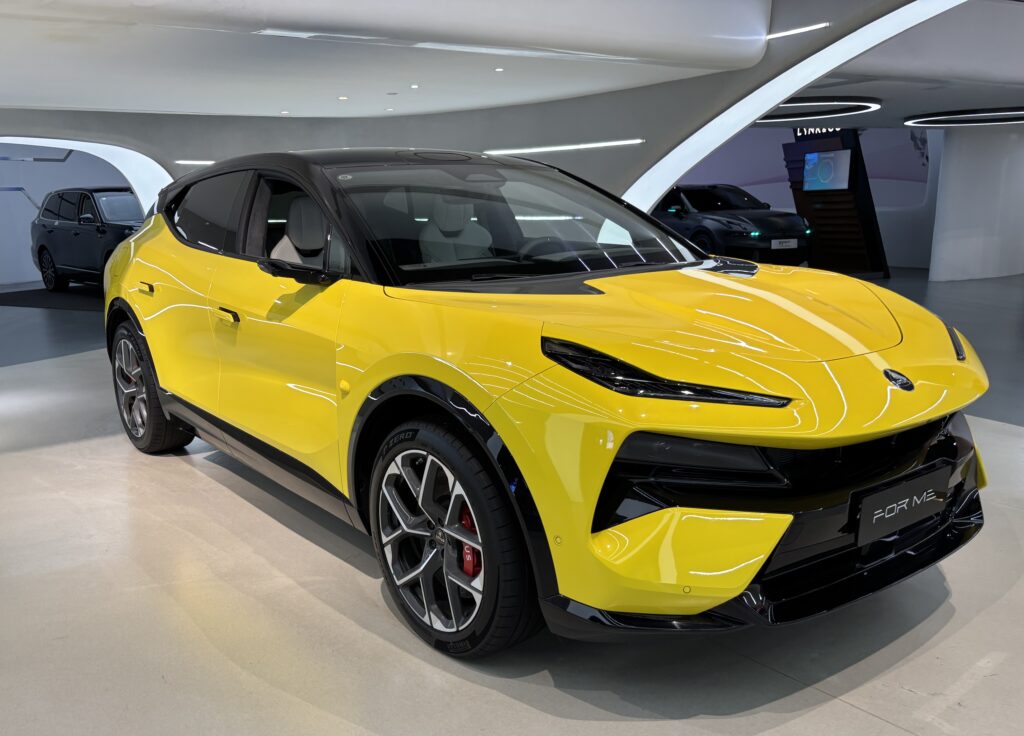
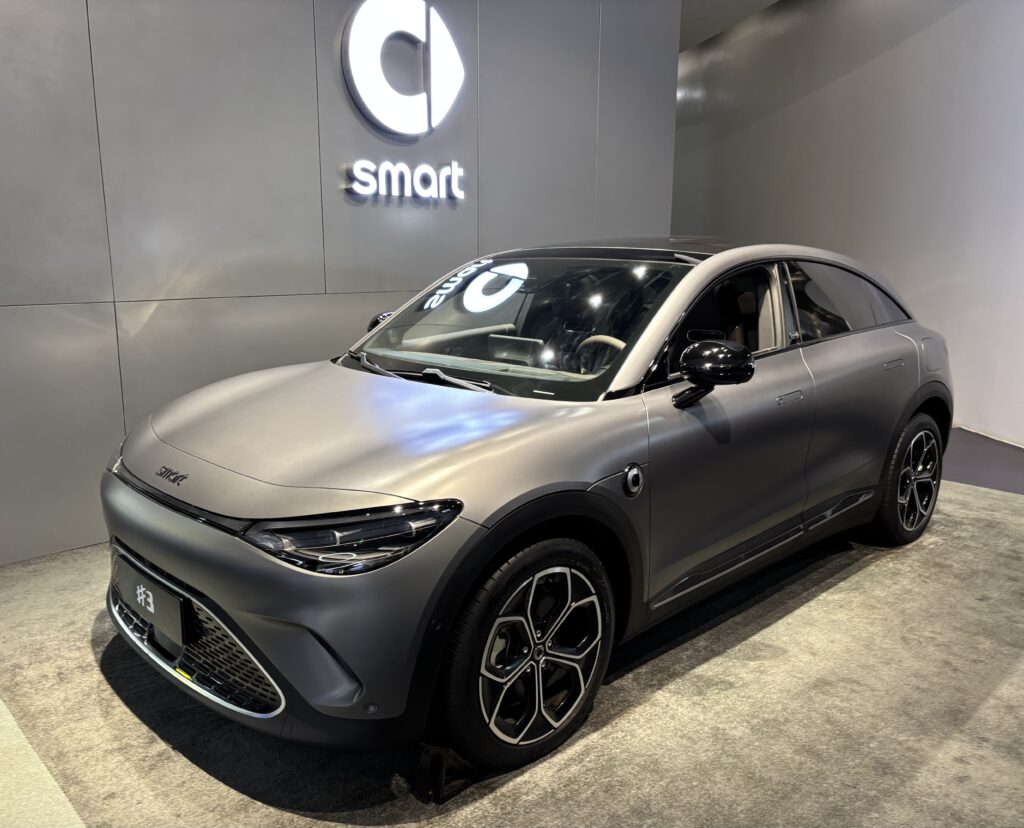
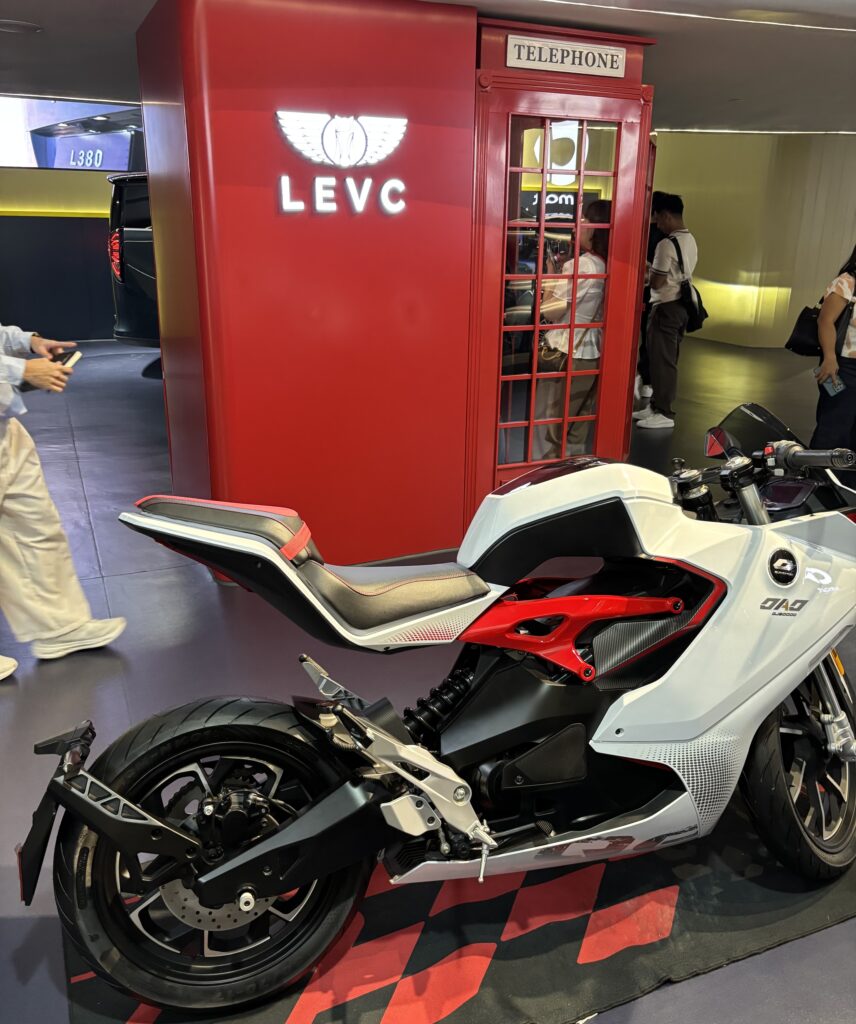
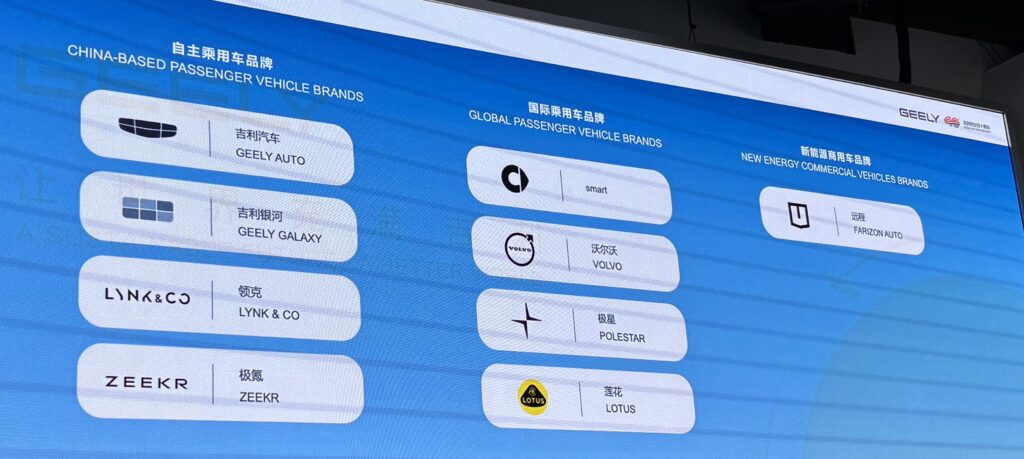
Other brands include Geely, Geely Galaxy, Lynk & Co, Radar, and Smart. They even have an EV motorcycle. Note: electric motorcycles are a really bad idea.

Here’s the current brand portfolio.
 I’m not going to go into the various products. That’s not my expertise.
I want to talk about scale and software (my area).
Unsurprisingly, Geely is Leaning Hard into EV R&D and Manufacturing
Geely has about 40,000 people in R&D. This gets them economies of scope across their multiple vehicle types.
R&D spending in 2025 was about $3B. About 5% of revenue.
That’s large but much smaller than competitors overall. Volkswagen spends about $20B on R&D. And has about 50,000 staff in R&D.
But that’s overall. The key is to break it down by R&D specifically for EVs. Here are their core vehicle architectures.

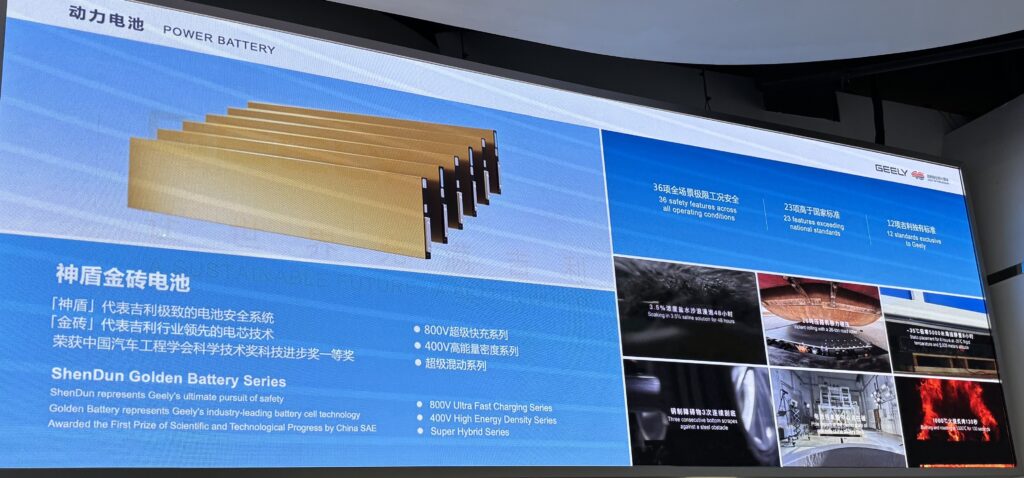
Geely has some degree of vertical integration into batteries. Not as much as BYD, but they have a significant upstream presence. About 30-40% of their cars have Geely batteries. It also relies on major external suppliers like CATL for a large portion of its supply.
You can read about my visit to CATL here.
Final Point: Geely’s AI and World Models Are a Big Deal
Now we’re in my area.
Geely / Zeekr is going for the full AI and mobility tech stack. They are going beyond building cars. They are building infrastructure for themselves and for other automakers.
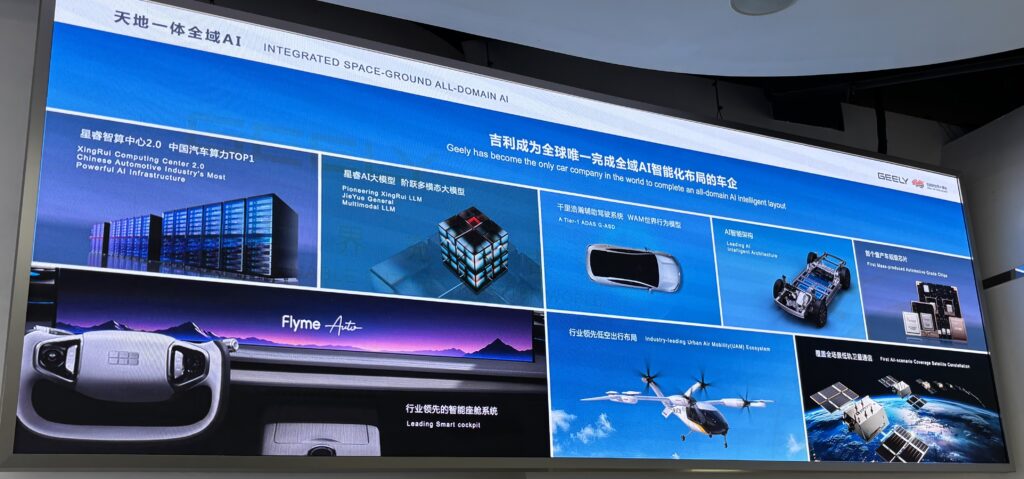
That means everything from chips to satellites (note: they have 64 of their own). Here’s the list for the auto AI tech stack.
- Infrastructure and Compute: This includes the XingRui Computing Center 2.0, arguably the Chinese automotive industry’s most powerful AI infrastructure.
- Large Language Models: Powered by the XingRui LLM and JieYue General Multimodal LLM to support advanced AI applications.
- Smart Cockpit: Integrates Flyme Auto to deliver an industry-leading intelligent cockpit experience.
- Autonomous Driving: Employs Tier-1 ADAS with a World Behavior Model (WAM).
- AI Architecture and Hardware: Utilizes a leading AI intelligent vehicle architecture along with first mass-produced automotive-grade chips.
- Urban Air Mobility (UAM): Expands mobility beyond roads with an industry-leading low-altitude/eVTOL urban air ecosystem.
- Space Connectivity: Integrates a first all-scenario coverage satellite constellation for continuous space-to-ground communications.
Within this, I am mostly focusing on their LLMs and World Behavior Models (WAM). And their deployed agents.
For the Large Language Models (LLMs), it’s:
- XingRui LLM (星睿 AI 大模型): Geely’s proprietary foundation model engineered for multimodal processing, handling both natural language and visual inputs.
- JieYue General Multimodal LLM (捷跃多模态大模型): A large-scale model with up to 100B parameters. It powers cross-domain reasoning, complex task planning, and human-like voice interaction across Geely’s vehicle ecosystem.
For the World Models, it’s their WAM (World Action Model / 世界行为模型):
- This is Geely’s flagship World Model that functions as a unified vehicle brain.
- It uses the standard hierarchical process (“understanding → planning → preview → judgment → correction”).
- It also focuses heavily on extreme scenario simulations, such as long-tail corner cases and safety situations.
For agents, there are 3 main ones right now. They are part of Geely’s “1 + 2 + N” multi-agent framework:
- 1 Super-Agent
- Eva (their Hyper-Human AI Agent) is onboard inside Flyme Auto 2.
- Eva acts as the primary, emotionally aware master agent that directly faces the driver and passengers.
- It handles high-level reasoning, proactive services, and intent recognition.
- 2 Vertical Domain Agents
- Vehicle Control Agent: It manages in-cabin hardware execution, chassis responses, climate, windows, and physical controls based on spoken or intent-driven actions.
- Navigation and Spatial Agent: It handles real-time spatial positioning, routing, and environmental context (integrated with HD mapping and satellite networks).
- N Specialized Sub-Agents
- This is an open ecosystem of sub-agents responsible for specialized tasks, such as autonomous driving adjustments (coordinated with WAM), ticketing, payment integrations, or low-altitude air mobility (UAM) routing.

***
That’s it for Geely for now. Keep an eye on this company.
I’m going to write a lot more about their agents and models. This overlaps a lot with what is going on in robotics.
Next stop on the tour was DEEP Robotics. That’s the next article.
Cheers, Jeff
——–
Related articles:
- Two Lessons from My Visit to Tencent Cloud (1 of 2) (Tech Strategy)
- How Amap Beat Baidu Maps. My Summary of the Alibaba Playbook. (Tech Strategy – Podcast 252)
- Scale Advantages Are Key. But Competitive Advantages Are More Specific and Measurable. (Tech Strategy)
From the Concept Library, concepts for this article are:
- Auto EV AV
- Embodied AI: World Models
From the Company Library, companies for this article are:
- Geely Zeekr
———
I am a founder, consultant and keynote speaker specialized in digital and AI agentic strategy.
I am the founder of Agentic Org Now, a firm that helps leadership teams launch AI and agentic initiatives fast.
I write (a lot) about digital and digital AI strategy (3 best selling books, +2.9M followers on LinkedIn). You can get a free book at the email sign-up below.
My Moats and Marathons book series is a framework for building and measuring competitive advantages in digital and AI businesses.
This content (articles, podcasts, website info) is not investment, legal or tax advice. The information and opinions from me and any guests may be incorrect. The numbers and information may be wrong. The views expressed may no longer be relevant or accurate. This is not investment advice. Investing is risky. Do your own research.