
I recently visited the CATL headquarters in Ningde, China. CATL is the world’s largest rechargeable battery-maker by a big margin. And their batteries are in about 40% of all EVs globally. I had wanted to learn about them for a long time.
I was visiting for the launch of their new energy storage testing center (ESVL). Thanks to CATL for covering my flight and hotel to attend the event. I’ll be detailing that in Part 3.
But in this first article, I wanted to go through the basics of CATL and their approach to innovation. They are really on the frontier of battery innovation, which is an increasingly important topic.
Here’s the headquarters in Ningde. Yes, it is shaped like big battery.

A Quick Introduction to CATL
This information is mostly from their 2025 annual report. Nothing here is non-public. This is not investment advice in any way shape or form.
The basics:
- CATL is the world’s largest manufacturer of lithium-ion batteries for electric vehicles (EVs) and energy storage systems (ESS).
- Their core business is the power batteries (70-75% of revenue). Basically, batteries you put in EVs and other mobile equipment, which need to be small with high energy density. And capable of rapid power delivery.
- They are currently expanding in energy storage, where the batteries are less about being small and energy dense – and more about being low cost and efficient. AI Data Centers is a big area here (I spend a lot of time looking at AIDCs).
Here is how CATL describes their product portfolio (from annual report).
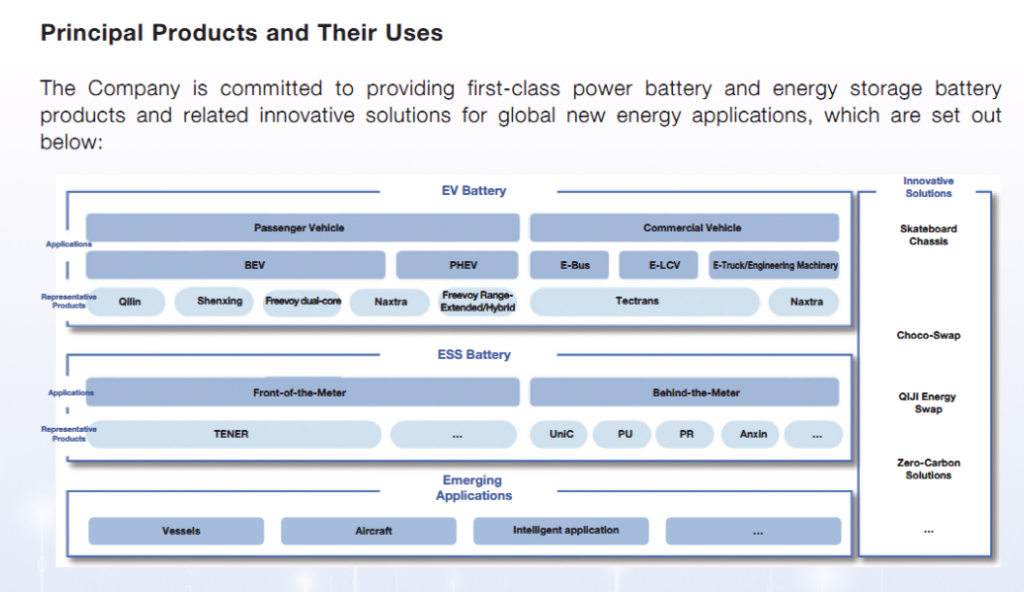
Here are CATL’s market share numbers (approximately).
- For global EV batteries, CATL had 39% of the market share in 2025 (according to SNE Research).
- That’s pretty amazing. And the company has been number one globally for nine consecutive years.
- Plus, their EV battery sales grew 42% in 2025.
- For China’s EV battery market, CATL’s share was 46-48% in 2025.
- Note: This is quite a bit more than BYD’s market share in China, which is about 25%.
- For global energy storage (ESS), CATL’s market share was 30% in 2025.
- CATL has been number one in global energy storage batteries for five consecutive years.
- Plus, their sales grew 29% in 2025.
Ok. that’s pretty crazy. These numbers are why I have been looking into CATL recently. This is real leadership in both China and globally. With rapid growth as well. That’s pretty unusual.
Here’s how CATL describes their power battery business (from annual report).

This is because CATL is benefiting from some pretty big growth trends:
- Big and growing EV sales.
- In 2025, 21M EVs were sold globally (13M in China). This was up 21%.
- Charging, swapping and related infrastructure are also growing fast.
- Big growth in energy storage systems.
- Lots of money is going into AI data centers and other storage advancements
- Intelligence tech depends on big data centers, which have lots of energy storage needs.
- And there are also lots of advancements in power grids, renewables and other areas.
- Overseas expansion
Here’s how CATL describes these trends (from annual report).

Some more basic information:
- CATL’s customers include most of the major EV brands, including Tesla, Volkswagen, BMW, NIO, Geely, and SAIC. About one in three electric vehicles worldwide runs on a CATL battery.
- CATL has 130,000 employees globally. And operates 13 production sites and 6 research and development centers (mostly in China but expanding globally).
From the 2025 financials:
- Revenue was about $61B, which was up 17% from 2024.
- Operating profit was about $20B, which was up 17% from 2024.
Ok. That’s the basics.
- So how did a company founded in only 2011 do this?
Let’s start by looking at CATL’s approach to innovation, which I think is 50% of the answer.
CATL’s 4 Areas of R&D and Innovation
In CATL’s annual report and other presentations, they typically break their R&D into 4 areas:
- Material and electrochemistry
- Lots of focus on developing battery materials, chemistry, and electrochemical systems. Basically, lots of battery chemistry.
- The goals include higher energy density, longer lifespan, faster charging, and improved safety.
- System structure innovation
- This is about better battery cell structures, modules, and pack architecture.
- The goals include optimizing performance, thermal management (particularly important), mechanical strength, and overall system efficiency.
- Extreme manufacturing innovation or intelligent Manufacturing
- The goals include higher precision, lower costs, reduced energy consumption, increased product safety and increased product reliability.
- Includes Green manufacturing, which is about more efficient and environmentally sustainable manufacturing processes.
- Business model innovation
- CATL has been expanding into more service-oriented businesses such as battery swapping, battery-as-a-service, leasing, and energy solutions.
- The goal is to create additional value beyond hardware sales.
That’s a pretty interesting breakdown. Although I tend to look at it differently. I’ll go into that but first let me detail 5 of their more well-known innovations right now.
Innovation 1: CATL’s Naxtra Sodium Ion Battery
I’ve been doing lots of reading about battery chemistry this week. Especially because I keep hearing announcements about sodium ion batteries.
Lithium ion has been the standard for rechargeable batteries since the early 1990’s. But sodium ion batteries have a couple of big advantages
- First, sodium ion batters are about 20% cheaper. This is mostly from cheaper procurement (sodium is really cheap). But also from manufacturing.
- Second, unlike lithium, sodium is super abundant. It removes dependency on lithium.
- Third, they are safer and charge faster.
- Fourth, they are better at low temperatures.
Their weakness is that they have about 60-85% of the energy density of lithium batteries.
Sodium ion batteries are mostly used for stationary energy storage.
Big stationary batteries don’t need high energy density like in EVs. And they don’t need to be small. So, the main usage is energy storage. That plus, they are also used in some low-cost vehicles like scooters.
Keep in mind, EV vs. ESS batteries have different performance requirements.
In EV batteries, you want to go the longest distance with the least weight. Density and space constraints are a big deal. You also need to deal with rapid spikes in usage. And it helps if they are fast in DC charging.
Compare that to ESS batteries, where you want low cost per kWH and lots of charge-discharge cycles in its lifespan (8,000-10,000 for ESS vs. 3,000 for EVs). Weight and size aren’t as important.
Which brings me to the Naxtra battery, which is CATL’s sodium-ion battery platform.
Originally launched in April 2024, production is scaling up and should be the world’s first mass-produced sodium-ion battery for vehicles.
The Naxtra moved sodium-ion technology from the lab to mass production. And if Naxtra achieves 175 Wh/kg energy density, that will be the highest for any mass-produced sodium-ion battery and comparable to entry-level LFP batteries.
***
Here’s some background on lithium batteries. Skip to the next section if you’re not interested in this.
In 1991, Sony launched the world’s first commercial rechargeable lithium-ion battery. This was the beginning of widespread adoption of lithium ion and it started with portable electronics (like camcorders and the Sony Walkman). Within 10 years, lithium became the global standard for rechargeable batteries.
This came as a surprise to the Bolivians who happened to own 15% of the world’s lithium. It tuns out 60% of the world’s lithium is in the dried-out salt flats high in the Andes (called the lithium triangle because it straddles Bolivia, Chile and Argentina). About 8% is in Qinghai, China.
For rechargeable batteries to function, you need electrons to move back and forth between the cathode and the anode in cycles. And you need a small, light positively charged particle that can accompany the electrons as they move back and forth (to keep a neutral overall charge).
It turns out lithium ions are an almost ideal passive passenger for this process of charging and discharging energy. Lithium itself is neutrally charged (3 protons, 3 electrons) but you can strip off the unstable electron in the outer shell to give it a positive charge (i.e., a lithium ion). This is also why lithium reacts with water. It wants to lose that electron.
In discharge, the lithium ions follow the electrons from the graphite anode to the cathode. The electrons go through the wire and external circuit. The lithium ions go through the electrolyte fluid. The cathode can be made with different materials depending on desired performance. The two common ones are lithium, iron and phosphate (LFP batteries) and nickel, manganese, and cobalt (NMC batteries).
Recall my previous article where I wrote about how Huawei had switched to Silicon-Carbon in their batteries for ultra-thin devices. That’s how they have achieved such crazy battery performance in their MatePads and smart watches.
From that article:
“Traditional batteries use graphite anodes which are reliable but have a limit for how much energy they can hold. Silicon can store a lot more but it can swell with energy (technically Lithium).
Huawei came up with a solution to this which is their Silicon-Carbon tech, which uses a specialized porous structure to handle swelling. The carbon matrix allows the silicon to expand during lithiation without fracturing the electrode, preserving cycle.
The MatePad Pro Max has a 10,400 mAh battery. By using a silicon-carbon anode instead of traditional graphite, Huawei has an energy density 15-20% higher than previous generations. This allowed them to shave nearly 1mm off the thickness of the preceding MatePad Pro 13.2 (which was 5.5mm) while maintaining the same battery capacity.”
***
Ok. Back to the innovation list in Part 2.
-Jeff
FYI. If you want to know how convenient delivery is in China, here’s the 7-11 I ordered delivery from. Photo taken from my hotel room in Ningde.

——–
Related articles:
- More High-Tech Flex by Huawei R&D (4 of 4) (Tech Strategy)
- 6 Big Events in AI Agentic Ecommerce (Tech Strategy)
From the Concept Library, concepts for this article are:
- Innovation
- Batteries and energy storage
From the Company Library, companies for this article are:
- CATL
—–
I am a founder, consultant and keynote speaker specialized in digital and AI agentic strategy.
I am the founder of Agentic Org Now, a firm that helps leadership teams launch AI and agentic initiatives fast.
I write (a lot) about digital and digital AI strategy (3 best selling books, +2.9M followers on LinkedIn). You can get a free book at the email sign-up below.
My Moats and Marathons book series is a framework for building and measuring competitive advantages in digital and AI businesses.
This content (articles, podcasts, website info) is not investment, legal or tax advice. The information and opinions from me and any guests may be incorrect. The numbers and information may be wrong. The views expressed may no longer be relevant or accurate. This is not investment advice. Investing is risky. Do your own research.