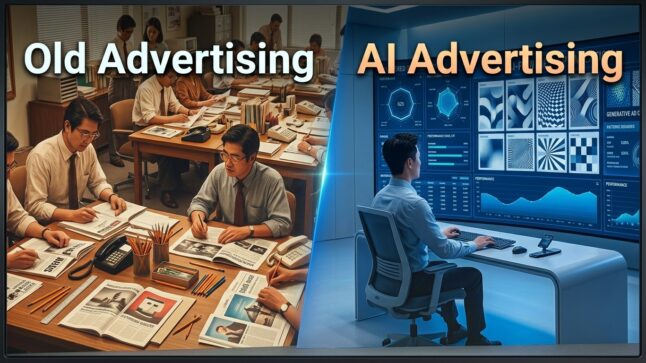
I was recently at the Tencent forum at WAIC 2026. It was pretty great.
And it was really helpful in terms of seeing what Tencent is focusing on in AI.
I had 3 take-aways:
- Tencent is way more focused on robot brains (i.e., embodied AI) than I thought.
- I wrote about this in Article 1.
- WorkBuddy is their flagship product for AI agents. But they have also expanded to other “buddies”. And they have a platform for deploying enterprise agents at scale (very important).
- Tencent will likely be the global leader in AI advertising and marketing.
- That’s what this article is about.
For “AI Meets Advertising”, I Study Tencent
For the topic of “AI meets ecommerce”, I study Alibaba.
They are a world leader in both fields. And they are on the frontier of this rapidly evolving intersection. Agentic commerce is the very core of Alibaba’s business going forward. It’s where they must win.
Similarly, Tencent is my “go to” company for “AI meets advertising”.
Tencent is a world leader in both AI and in getting user attention. That’s marketing, advertising and engagement.
Tencent has tons of products. But historically, most are about getting and keeping user attention and engagement (videos, gaming, literature, music, chatting, etc.). And they have historically monetized this attention with a mix of micro-transactions, utilities and ads.
Overall, I put Tencent in the same category as Facebook and ByteDance. They are mostly in the attention business.
Tencent is about capturing and growing share of attention.
Alibaba is about capturing and growing share of wallet.
And recently at the Tencent Forum at WAIC, Xu Wei (徐伟), Deputy General Manager of Tencent Marketing’s Commercial Ops, spoke about the current state of AI meets advertising at Tencent.
That really got my attention.
I’ll go through that in this article.
His basic argument was that advertising is evolving from a craft business to an industrialized system.
And this was a tee up for Marketing AIM+, which is Tencent’s big new product in this area.
Here are my take-aways from his talk:
Take-Away 1: AI is Reconstructing the User Decision Path. And Therefore Advertising.
In advertising, there has long been a lot of action in the shift from traditional to digital channels. From billboards and TV ads to Facebook ads and SEO.
Xu Wei made some comments about how the shift is now happening to AI marketing. He said AI Marketing is only 4% of digital marketing today. But it is growing at 25%. And this is happening globally.
He also made the point that marketing is a great area for AI tools. There is tons of high quality data. And you get really fast feedback. That really makes AI work well.
But the biggest issue is the reconstruction of user decision path.
And this is happening at scale.
- There are 515M GenAI users in China today.
- 70% of users already use GenAI when making a purchase.
So how people shop online is really changing fast.
He said that the current “search-click” model is shifting to a “question-generate-decision” model.
I think it’s a lot more complicated than that. But that’s a good starting point.
Basically, anyone doing advertising is going to have to develop a whole new set of strategies and tools.
Take-Away 2: Creativity Has Been the Bottleneck in Scaling Advertising
Xu Wei argued that the effectiveness of advertising mostly depends on creativity. He says that creativity is the key capability that makes some ads way more effective than others.
And this is a problem.
Because creativity is rare. It is human created and it doesn’t scale well.
So, there is a mismatch. Consumers actually consume content rapidly. And this is growing.
But production is slow and laborious to create.
Here is his slide. Note: I translated these slides from Chinese.
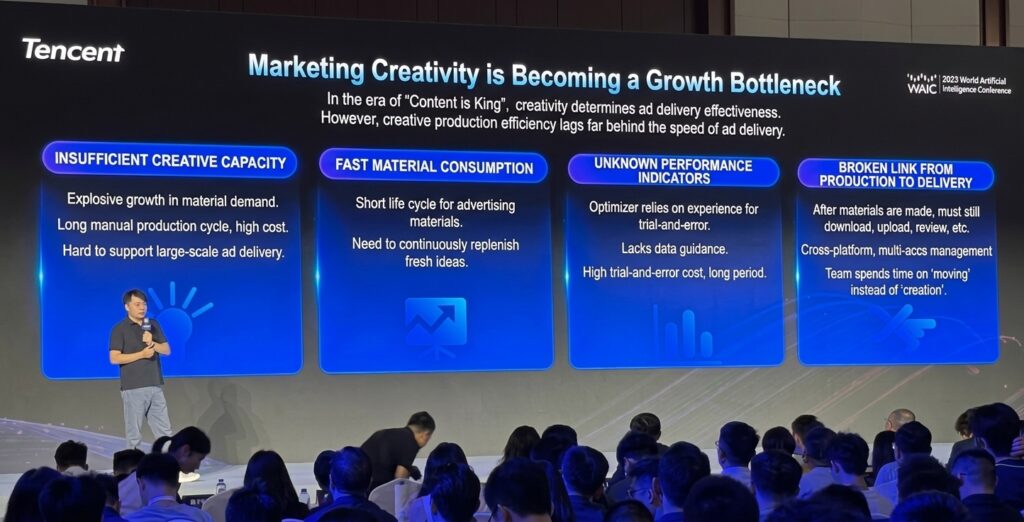
Production has not kept pace with demand for advertising. Manual creativity is time consuming and costly.
There are also other problems.
- Consumption is getting faster. And the lifespan of advertising is getting shorter. You must constantly be creating and refreshing.
- Creation is data-poor. We don’t really know what to make. We rely on experience and on lots of trial and error. That is slow and costly.
- Delivery is broken. We don’t really know how and where to place ads. The link between production and distribution is dumb and inefficient. And there is lots of copying to multiple channels.
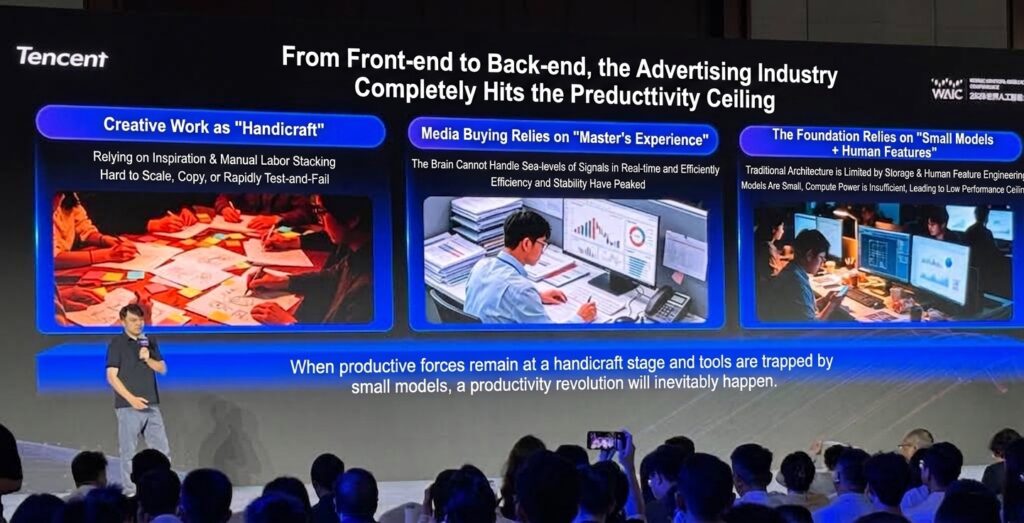
So, in the current advertising operating system is mostly:
- Creativity and production are a craft.
- It relies on inspiration and manpower. It depends on humans.
- That means it’s hard to scale, replicate and quickly test and fail.
- Deployment relies on the experience of veteran workers.
- It’s experienced masters with apprentices.
- Feedback is pretty fast.
- But the human brain cannot process lots of signals in real-time.
- Currently used AI models are small size and dependent on features.
The current system looks like this.
Take-Away 3: AI and Agent Advertising Solve the “Creativity at Scale” Problem
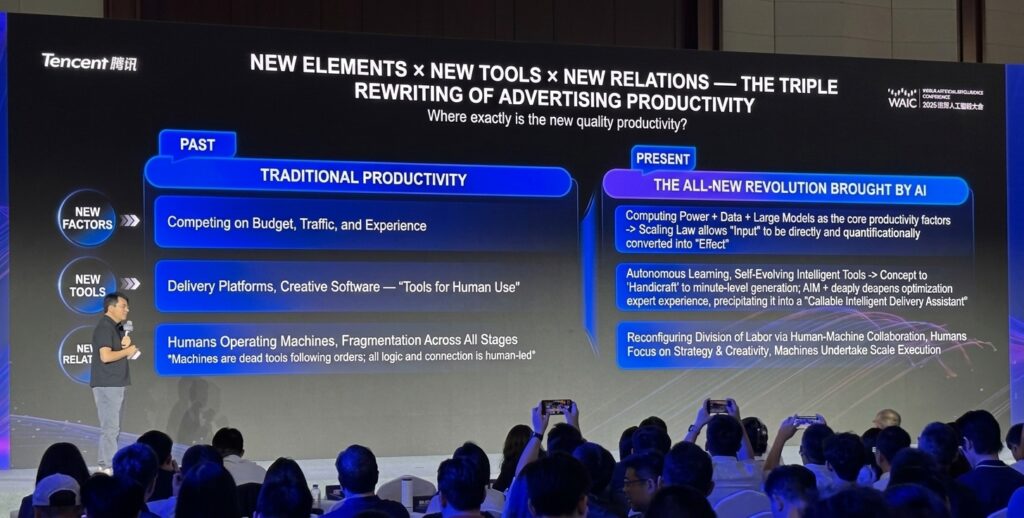
Xu Wei made the point that we are now shifting from mostly small human agencies to systems managers running AI systems. It is going from handcraft to industrialization.
So instead of teams of ad execs working together in a room, it is likely 1-2 people managing an AI system.
That looks like this.
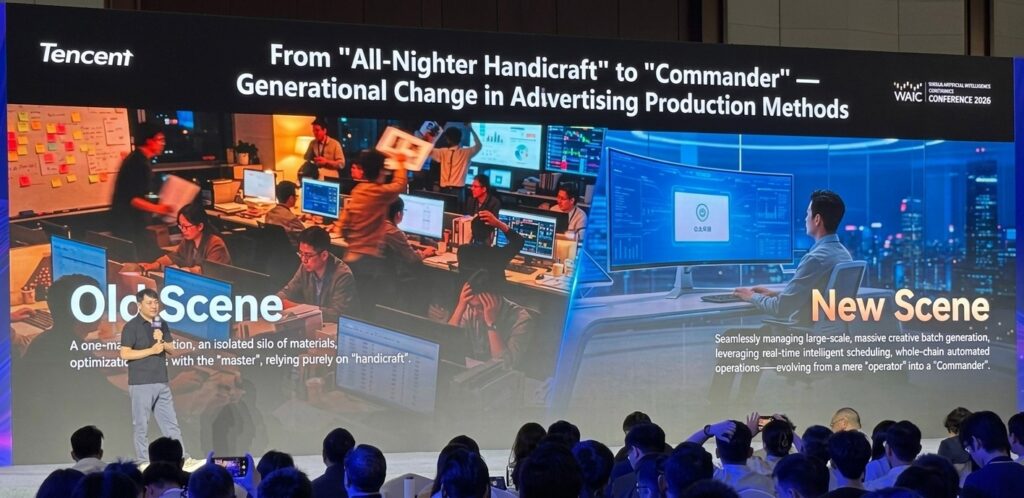
I like this slide.
We need to move past rooms of busy teams. We need industrial advertising production at scale that can match rapid consumption in real time.
That includes:
- AIGC for ads
- Intelligent ad placement
- Long-duration agents
- Tight feedback loops
If advertising effectiveness depends on creativity (and other things), that means it is no longer going to be about creative teams with budgets.
It will be about computing power and data.
Note: There’s another problem here.
Industrialization of creative production means content is going to explode. Getting noticed is going to get much harder.
So, we all need to scale up just to compete.
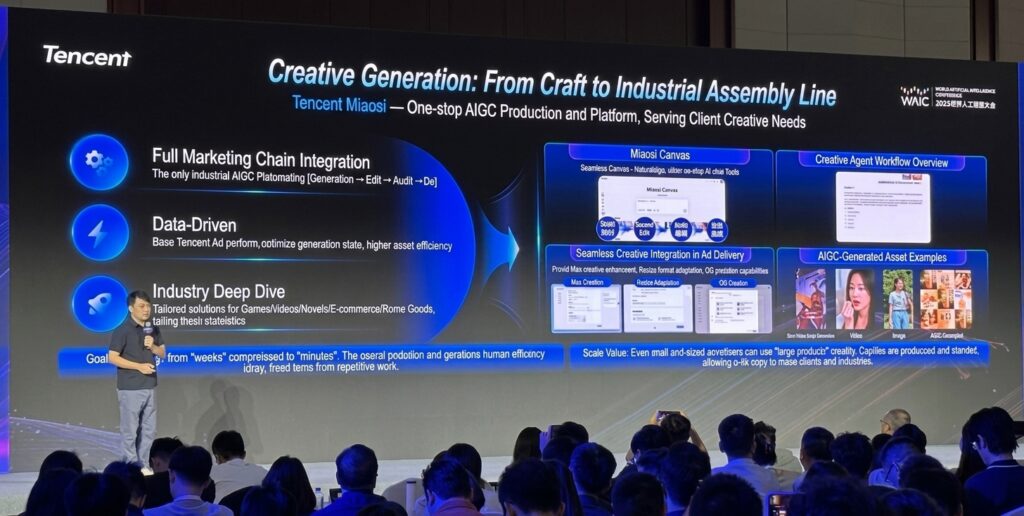
That is my assessment of the summary.
And it tees up their highlighted products.
An Intro to Tencent’s AIM+ Platform. And Miaosi.
Tencent has lots of marketing and advertising products. They are in Tencent Ads, as well as Tencent Marketing Cloud.
It’s a long list. See the end of this article.
For AI advertising, I am mostly looking at Miaosi and AIM+ right now. Here’s a summary of them.
Miaosi
This is a one-stop AIGC creative platform for advertising and marketing. This is how you go from handcraft to industrialization. It’s a one stop creation tool.
It’s a tool for advertisers, e-commerce sellers, game companies, and agencies. So that they can quickly generate high-quality images, videos, posters, digital-human videos, and other ad assets.
It’s based on the Hunyuan models. And it is tied to AIM+, which is the distribution platform.
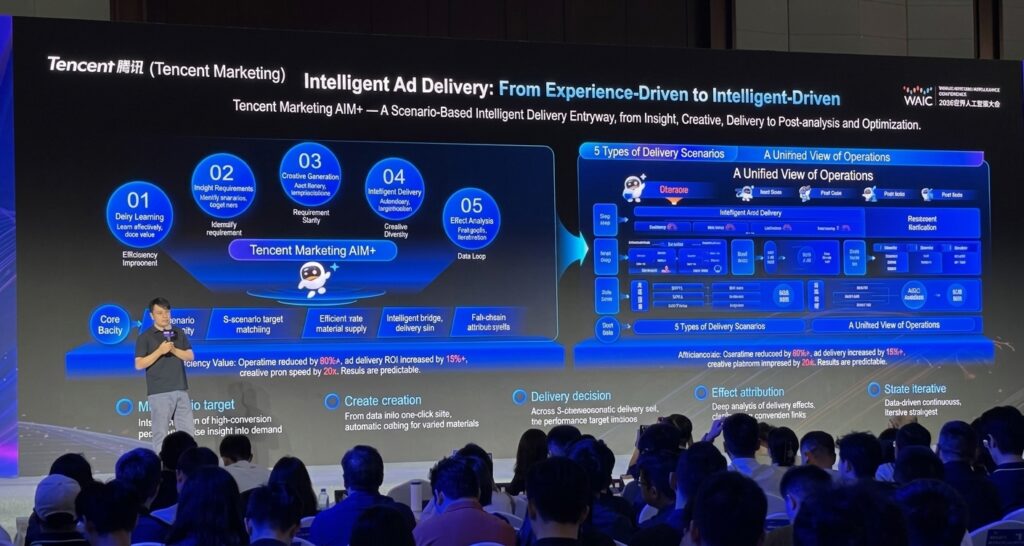
AIM+ platform
This is Tencent’s product suite for intelligent advertising placement. This is within Tencent Ads so it’s mostly about placing ads within the Tencent ecosystem.
AIM+ is about simplifying and automating (important) the entire ad buying process. Advertisers no longer need to manually handle most of the complex setup and optimization work.
These tools are increasingly automated and designed for specific advertising goals or scenarios, including:
- Content AIM+ for small games and short dramas.
- Xiaodian AIM+ for WeChat store merchants.
- App AIM+ for app downloads.
- Lead AIM+ for lead generation campaigns.
- Product AIM+ for WeChat Mini Program direct-purchase product campaigns.
Here’s a summary of AIM+:
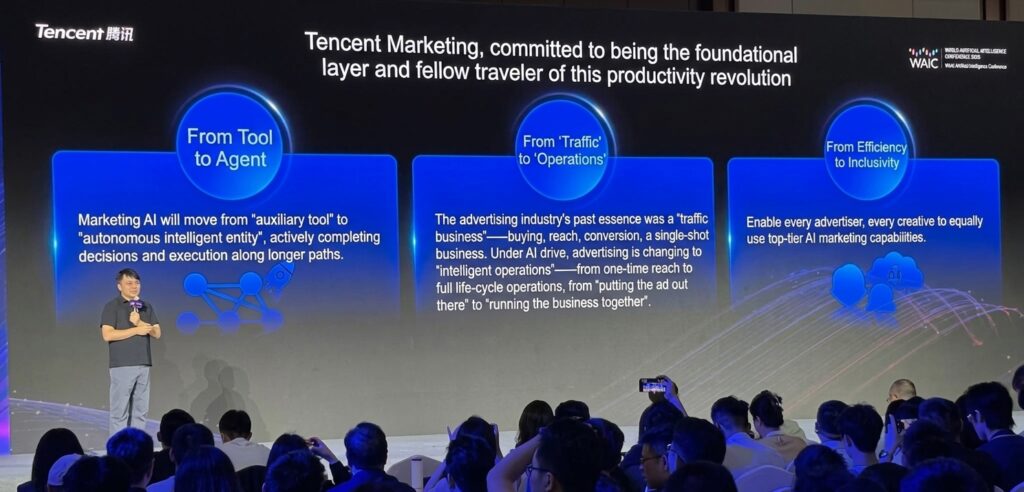
Putting these together, AI-powered marketing starts to look very different.
***
Ok. That’s it.
Pretty interesting stuff.
Cheers, jeff
If you’re interested, here’s my working list of Tencent’s advertising and marketing products.
My List of Tencent’s Advertising and Marketing Services
Tencent Ads
- This is the advertising house for placing ads within the Tencent ecosystem. Especially in:
- WeChat, including Moments (朋友圈), Channels (视频号), Official Accounts, Mini Programs / Mini Stores.
- QQ and related QQ products
- Tencent Video
- Plus Tencent News, Tencent Music, QQ Browser, etc.
- This also includes Youlianghui (Tencent Ads Network). This is Tencent’s ad network that distributes ads to non-core Tencent products and third-party apps and sites.
- Overall, Tencent Ads and its related products are tools for buying and placing ads.
- The goal is Customer Acquisition, to efficiently reach new audiences and convert them into customers through paid advertising.
- The main customer is Advertisers. That’s ad buyers, performance marketers, and e-commerce sellers looking to run and optimize ad campaigns.
- It’s about the Paid Media So, WeChat Moments, Channels, third-party apps via Youlianghui, etc.
Data and Insights Platforms
- This is the platform within Tencent Ads for data management supporting audience targeting and strategy.
- Ruyi is their newer system for this. It does data-driven tools for audience targeting, campaign strategy, and performance measurement within the Tencent Ads ecosystem.
- Note: Ruyi was launched in early 2024. It builds on previous DMP capabilities but adds AI-powered audience discovery (R0) and lifecycle measurement (5R model).
Tencent Data Cloud (TDC)
- This is a Customer Data Platform for deeper brand analytics and data strategy. It is for brands to better understand competitive positioning and drive full-funnel marketing.
- It integrates with Tencent Marketing Cloud (TMC).
Zhishu
- This is for data preparation and insight before launching campaigns. It’s part of the broader data tools suite.
Tencent Marketing AIM+
- As discussed, this is a product matrix for intelligent advertising placement (within Tencent Ads). It is designed to simplify and automate the entire ad buying process. Advertisers no longer need to manually handle most of the complex setup and optimization work.
- Scenario products include:
- Content AIM+ for small games and short dramas.
- Xiaodian AIM+ for WeChat store merchants.
- App AIM+ for app downloads.
- Lead AIM+ for lead generation campaigns.
- Product AIM+ for WeChat Mini Program direct-purchase product campaigns.
Miaosi
- This is a one-stop AIGC creative platform for advertising and marketing.
- It helps advertisers, e-commerce sellers, game companies, and agencies quickly generate high-quality images, videos, posters, digital-human videos, and other ad assets.
- It uses Hunyuan models, is tied to AIM+ and is designed for ad creatives.
Miora
- This does broader design/brand/UI/3D work, with memory and multi-agent planning.
- This is a more general AI creative agent studio than Miaosi. I discussed this in previous article.
Tencent Marketing Miaowen
- This is genAI assistant integrated into Tencent Ads for real-time campaign optimization. It can answer advertising-related questions, assist with strategy, and support complex tasks like campaign planning.
Tencent Ads Mutual Selection
- A platform connecting advertisers with content creators (like WeChat Official Accounts and Channels influencers) for branded content collaborations.
Marketing APIs
- A set of programmatic interfaces that allow advertisers, agencies, and platform clients to build custom, automated marketing solutions on top of Tencent’s advertising system.
Miaobo
- An ecommerce livestreaming solution that uses digital humans. Specifically for WeChat Channels / Mini Programs.
Qimiao Digital Human
- Integrated with Miaosi for ad creative video generation.
- It has a library of over 3,000 AI-powered digital human avatars that can be used across various industries for advertising and marketing content.
Tencent Marketing Cloud (TMC)
- This is a separate paid SaaS product for managing and automating customer relationships and marketing operations.
- It’s an enterprise-grade data management and marketing automation platform that integrates CRM and analytics. It ingests data from Tencent Ads for full-funnel analysis.
- The goal is Customer Lifecycle Management, to manage the entire customer journey (from acquisition to retention and loyalty) through personalized engagement and automation.
- The key customer is Enterprise Marketing Teams. That’s brand managers, CRM specialists, and operations teams managing customer data, journeys, and retention strategies.
- It’s about Owned and Operated Media. For owned channels (e.g., your brand’s WeChat Official Account, Mini Program, enterprise WeChat, App, website). Plus offline data (e.g., in-store) and third-party data onboarding.
Disclosure. I have had a paid consulting relationship with Tencent in the past twelve months.
———
Related articles:
- HY4 Preview Is Here. Plus, WorkBuddy Gets 3 Updates (2 of 4) (Tech Strategy)
- More High-Tech Flex by Huawei R&D (4 of 4) (Tech Strategy)
- 6 Big Events in AI Agentic Ecommerce (Tech Strategy)
From the Concept Library, concepts for this article are:
- GenAI: LLM
- AI Agents
- AI Marketing and Advertising
- Digital Avatars
- Livestreaming
From the Company Library, companies for this article are:
- Tencent: Marketing AIM+ Platform
- Miaosi
——
I am a consultant & keynote speaker on how to increase digital growth and strengthen digital AI moats.
I am the founder of TechMoat Consulting, a consulting firm specialized in increasing digital growth and strengthening digital AI moats. Get in contact here.
I write (a lot) about digital growth and digital AI strategy (3 best selling books, +2.9M followers on LinkedIn). There is a free book and email newsletter below.
My Moats and Marathons book series is a framework for building and measuring competitive advantages in digital businesses.
This content (articles, podcasts, website info) is not investment, legal or tax advice. The information and opinions from me and any guests may be incorrect. The numbers and information may be wrong. The views expressed may no longer be relevant or accurate. This is not investment advice. Investing is risky. Do your own research.