
I’ve covered Tencent’s WorkBuddy, CodeBuddy and QClaw (with updates).
But this is just a subset of tools and agents Tencent is launching. And they frame this as Finding Your Buddy.
In this article, I’ll go through some of the others.
Choose Your Buddy
I’ve been arguing for a while that Tencent is the company to watch for AI assistants and agents. Because they are on the frontier of AI AND because they have a big suite of products in their ecosystem. With a huge user base. So, they can both deploy and get adoption fast. Which is what has been happening.
They are positioning their “easy to use” AI Agent tools as “buddies”.
Here’s the list from WAIC 2026.

Let me run through them quickly:
吐司 (the Toast icon on the right)
Toast is a Vibe Coding AI tool for individuals (not enterprise).
Basically, anyone can build a functional mobile app using natural language. No coding required. You describe an app idea in plain language and three AI agents (product planning, design, and development) will work together to generate a complete app package. Which you can then install on your phone.
The Toast platform has four main capabilities:
- Create apps: Describe your idea → AI breaks it down into features → refine through conversation → generate an APK.
- Inspiration Square: Browse public apps made by others, use them as templates, or remix them with your own ideas.
- Social sharing: Share apps via link, QR code, or installation packages.
- App search: Find apps by searching or describing what you need
As of July 2026, Toast has generated about 50,000 apps, serving approximately 30,000 users. The most popular categories are lifestyle tools, educational apps, and mini-games.
Why is it a piece of toast?
No idea. Kind of weird.
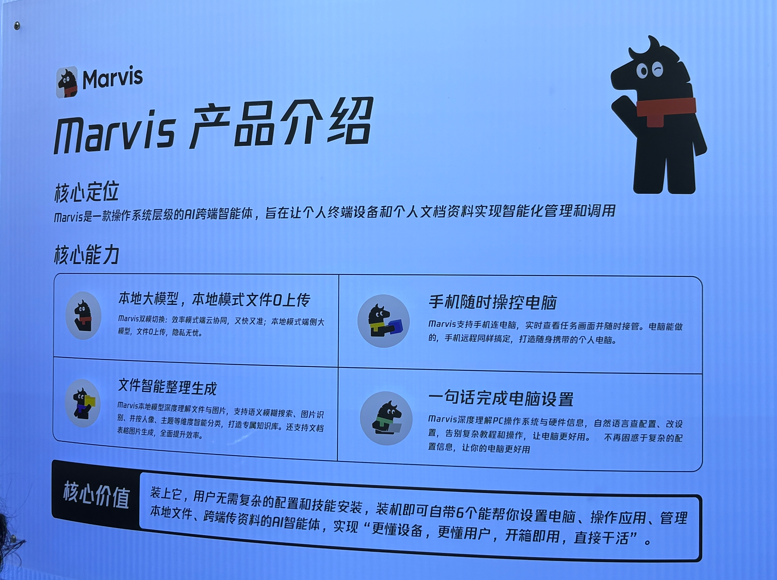
Marvis (the horse with the red scarf)
This is Tencent’s operating system-level personal AI assistant. Think Jarvis, the AI assistant from the Iron Man movies. Which is what it was named after.
It was officially launched on May 20, 2026.
Unlike ChatGPT or Tencent Yuanbao, which are dialogue-based AI, Marvis is designed to directly operate your computer.
So, it doesn’t just tell you how to do something. It actually does it on your computer (with your permission). The idea is to turn your computer into something you can talk to.
And it is a cross-device agent. So, it can work across personal devices and personal documents.
What Marvis can do:
- System-level control: It can query hardware specs, check battery health, adjust system settings, optimize startup items, and clean files. With natural language conversation.
- Smart file management: It can search files by content (not just filename), understand images and text within images, and organize photos by people, themes, or locations.
- Cross-device control: You can view and control your PC screen from your phone. I think you can even unlock it remotely while the PC is locked. It supports Windows, macOS, Android, and iOS.
- Run phone apps on PC: This leverages Tencent App Store’s cross-device engine to let you run Android apps directly on your computer. That would be fun.
And it’s easy to use.
No complex configurations or skills for installation. Out of the box, you get 6 AI agents that can set up your computer, operate applications, manage local files, and transfer data across devices.
Here are some details from WAIC 2026.
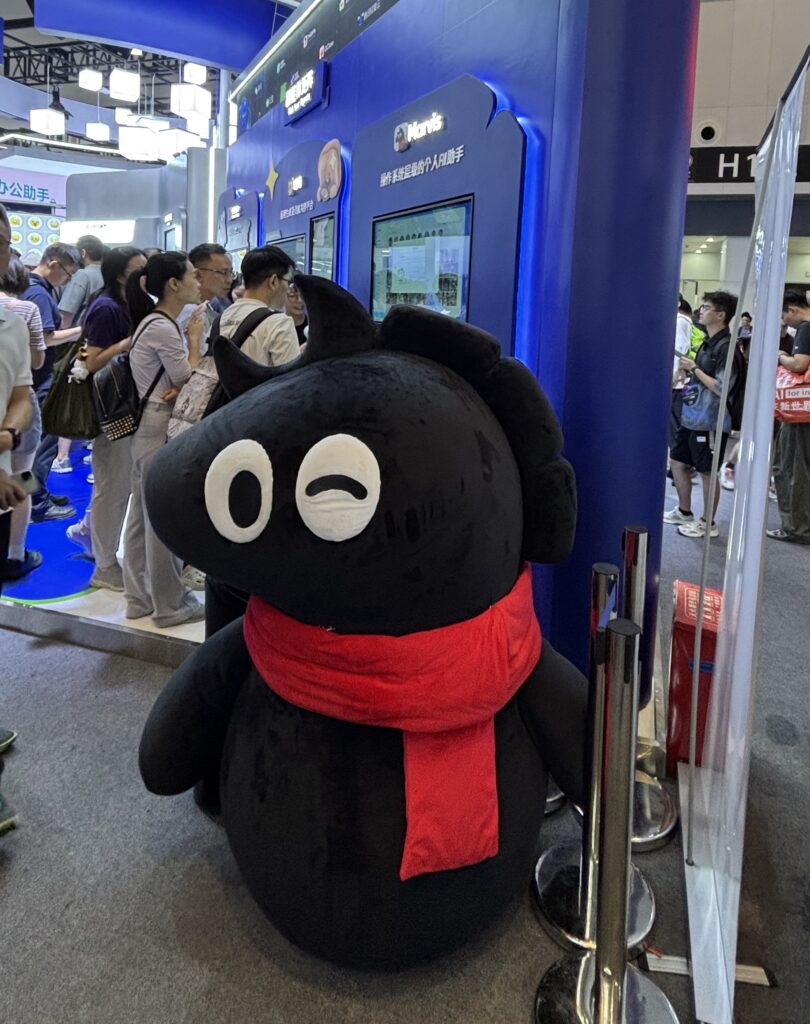
Why is it a horse with a red scarf?
Don’t know. But I like it more than the toast.
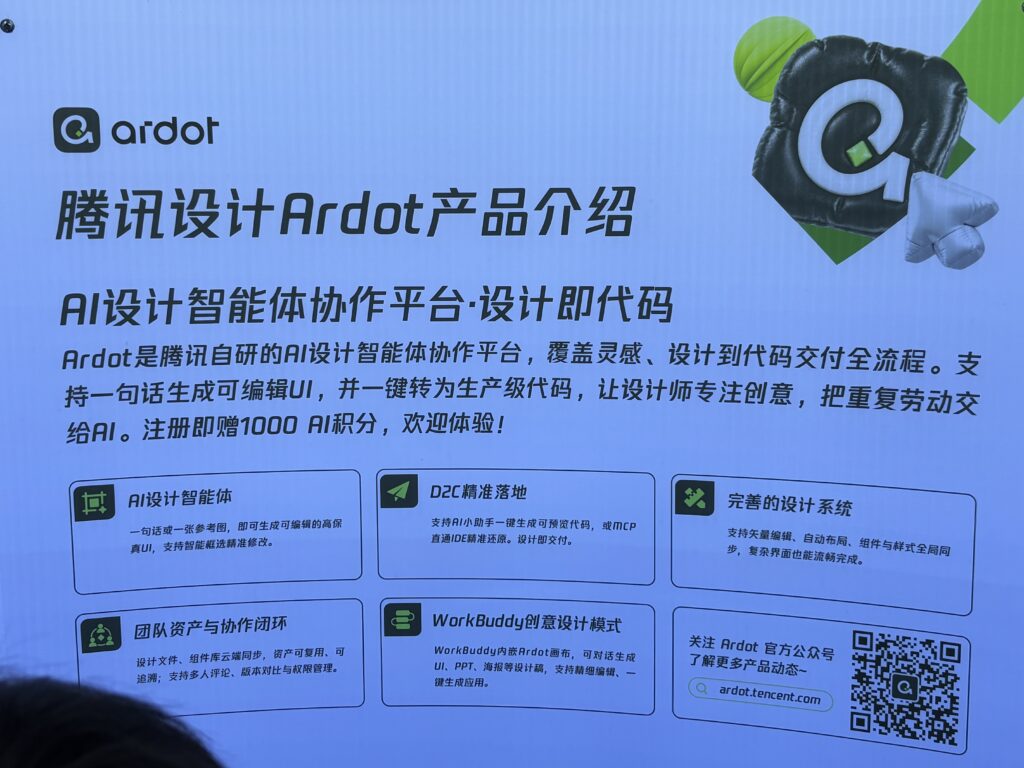
Ardot
This is the little black square in the graphic. In Chinese, it’s Ar Dian.
This is an AI-powered design agent platform. It lets you create digital products and UI/UX. Which are editable, reusable, and deliverable assets rather than static images. That’s the key feature.
So, it generates a variety of digital assets, including:
- App Pages: For mobile applications.
- Websites / Official Pages: For corporate or product sites.
- Posters and Illustrations: For marketing and visual content.
- PPT Presentations: For business or product decks.
The key differentiator is that its outputs are editable design drafts. Every element (layer, component, text) remains structured and modifiable. This “asset-based” output is a major improvement over traditional AI art tools.
Miora: A Full-Stack Creative Studio
I like this one.
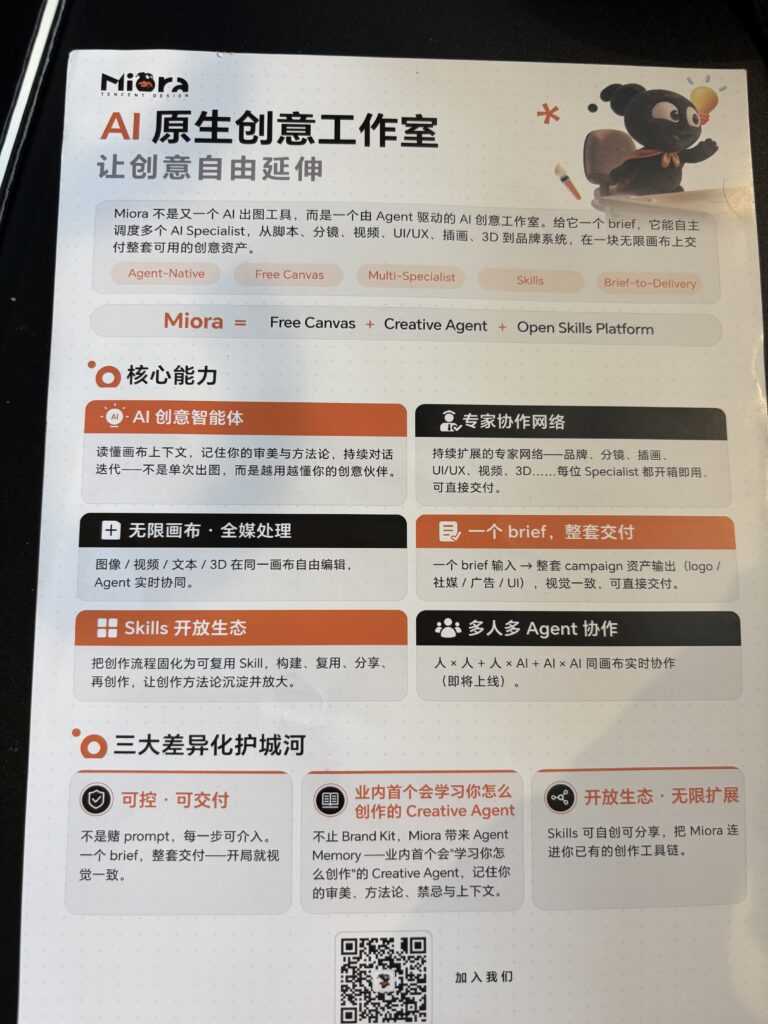
Miora is for creative professionals who need to produce visual content. This includes brand identities, marketing campaigns, and videos. So, it is an AI creative design studio that delivers complete visual packages in a single workflow.
The primary users are brand designers, marketing professionals, and creative teams.
However, this is not Tencent’s main AI marketing tool (covered in next articles. A big topic). This is focused on the creative elements.
Miora’s built-in scenario modes include:
- Brand Design: It creates complete brand visual systems, including logos, VI standards, and IP characters.
- E-commerce Advertising: It generates product pages, promotional materials, and ad creatives.
- Video and Campaign Assets: It produces storyboards, promotional videos, and short-form video content.
- Social Media and Content: It generates posters, illustrations, and visual assets for ongoing campaign needs.
It uses a multi-agent system where a primary agent coordinates five specialized sub-agents to handle imagery, video, 3D, and UI generation in parallel.
It also has a memory function that learns and retains a brand’s aesthetic and preferences over time.
That’s great. Totally using this.
Last One: Ima Copilot
This is the panda on the lower left of the graphic
The panda is now really a new buddy. This is just a new interface for interacting with ima. The panda is essentially a face for ima’s agent capabilities.
Ima is an AI knowledge management platform more for individuals (as opposed to enterprises). It was launched in November 2024 and ties in with the Hunyuan foundation model and the RAG (Retrieval-Augmented Generation) architecture.
So, it’s a centralized workspace where you can store documents, web articles, notes, and images, and then use AI to search, analyze, and generate content from that stored information.
***
Ok. That’s it for the other buddies.
In the next article, I’ll go into the Agent Development Platform. After WorkBuddy, this ADP system is my top priority.
Cheers, Jeff
Disclosure. I have had a paid consulting relationship with Tencent in the past twelve months.
——–
Related articles:
- HY4 Preview Is Here. Plus, WorkBuddy Gets 3 Updates (2 of 4) (Tech Strategy)
- More High-Tech Flex by Huawei R&D (4 of 4) (Tech Strategy)
- 6 Big Events in AI Agentic Ecommerce (Tech Strategy)
From the Concept Library, concepts for this article are:
- GenAI: LLM
- AI Agents
From the Company Library, companies for this article are:
- Tencent: Marvis, Ardot, Miora, Ima, Toast
———