This is my series on rising China robot companies I am following. Many of these are going public this year.
The previous companies I’ve covered:
- DEEP Robotics’ Industrial Quadrupeds – and 4 Other Robot Use Cases I Like
- Galbot’s Retail Solutions – and 4 Other Robot Use Cases I Like
- AgiBot’s Race to Embodied AI Robots at Scale
- 3 Lessons from My Visit to Unitree Robotics
This article is about Booster Robotics.
Why Are Booster’s Mini-Humanoids Playing Soccer?
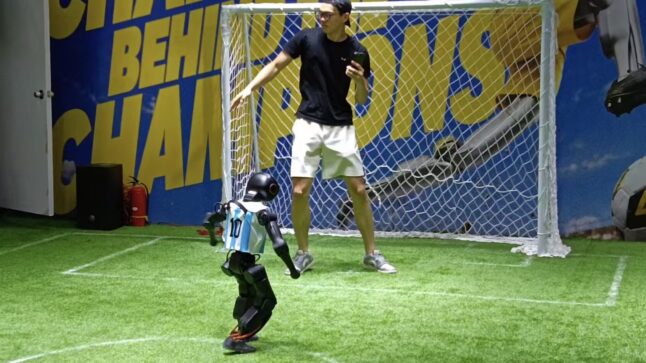
At WAIC 2026, Booster had a mini soccer pitch. And one of their small humanoids was taking shots on a human goalie. And it was pretty good.
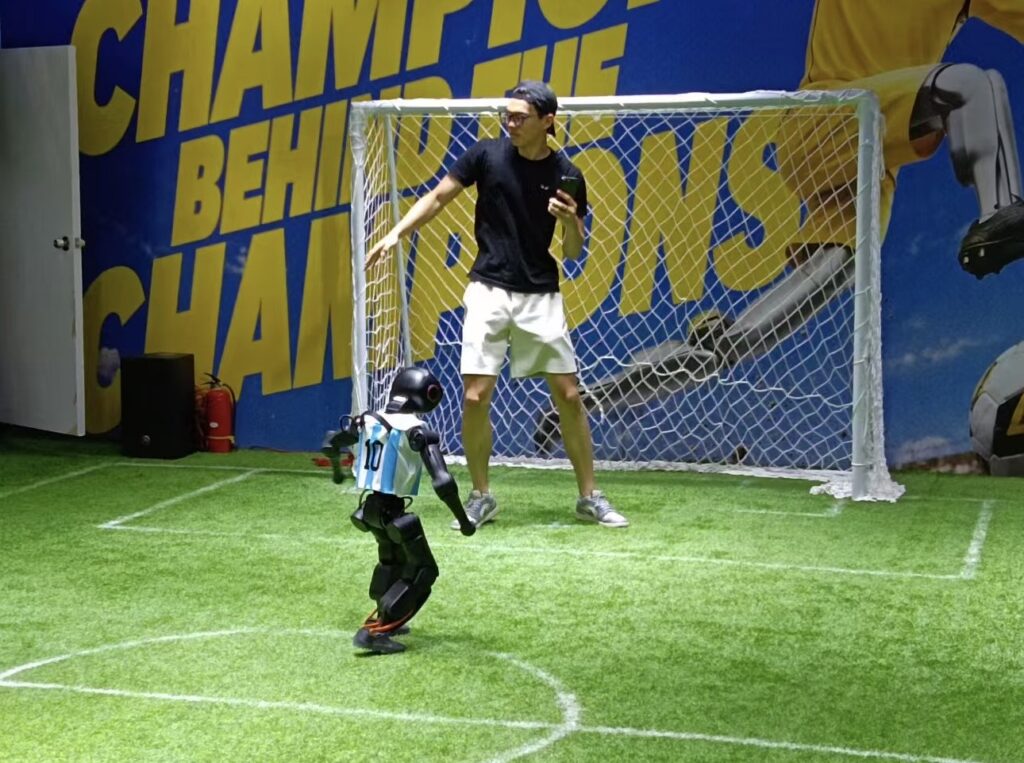
That’s weird.
Why would they do this?
The focus on soccer is not just for viral clips (like robots doing flips). Booster has its own soccer league. And they are sponsors and participants in other leagues.
- RoBoLeague (Robot Soccer League). This league is organized by Booster Robotics and Shangyicheng Group. All the teams use the Booster platforms (e.g., the Booster T1 robots) so it’s mostly a competition in software and algorithm control.
- RoboCup (Humanoid Soccer League): Booster Robotics is also an official partner of the RoboCup. Lots of teams use their robots for these autonomous matches, where there is an AdultSize division (Booster T2) and a KidSize division (Booster K1). Tsinghua University just used the Booster T1 platform to win the AdultSize world championship.
- World Humanoid Robotics Games (WHRG): In these competitions, teams using Booster hardware participate in track-and-field events, gymnastics, and 3v3 / 5v5 soccer competitions. Teams using Booster T1s and K1s hardware won gold, silver, and bronze medals in multiple dynamic locomotion and team sports disciplines.
Ok. So, Booster is really serious about sports competitions.
So, what kind of business is this? Are they in entertainment and sports leagues?
Nope.
They are (currently) in the business of research tools and education services for universities and research centers.
And eventually they will likely be doing the same for corporate developers.
The previously discussed robot companies were all creating tools used by consumers (robot retail), companies (industrial robot dogs). They were focused on the mass consumer market and corporate contracts.
But Booster’s robots are for developers and researchers at academic institutions.
Here’s their K1 robot playing soccer.
An Introduction to Booster Robotics
Booster was founded in Beijing in June 2023 by Hao Cheng (程昊). It was spun out of academic research at Tsinghua University.
Hao Cheng earned bachelor’s and master’s degrees from Tsinghua University’s Department of Automation under Professor Zhao Mingguo (a key figure in Chinese bipedal robotics).
He later founded Zhaoxi Calendar, which was acquired by ByteDance. And he then served as Vice President of Product for ByteDance’s enterprise suite, Lark.
In 2023, he founded Booster with the goal of making humanoid robots as accessible, reliable, and standardized as personal computers.
That’s a bit vague.
In practice, they have been creating standardized robot hardware plus operating systems plus developer tools that anyone can build upon. And they are starting with academic institutions and research centers.
Imagine you are a robotics research team at Carnegie Melon. You want to research, test and publish your work on robot algorithms for something like juggling. Or a new training mechanism.
- Do you have to build and assemble your own hardware (actuators, batteries, etc.)?
- Do you have to spend lots of time putting the basic robot software in place (feedback loops for standing and walking)?
Or you can just buy the Booster T1 package, with its robot, software, and developer kits. Then you use it to test your new algorithm.
But how do you know how good your algorithm is?
You can test it against benchmarks and publish.
Or you can have it compete in competitions against other research teams’ robots.
Hence the competitions. Competitions are a key part of both testing and education.
The core value proposition of Booster Robotics (today) is an integrated hardware-software platform. Educational institutions, researchers, and developers can purchase platforms for the Booster T1 or the Booster K1 and they come with everything you need.
Booster also provides open-source demo code, SDK access, and repositories under permissive open licenses (such as Apache 2.0). So, you’re joining a developer community and ecosystem.
A companion application, Booster OS, provides motion action libraries, remote control capabilities, and AI agent integration.
The Details for the Booster Robots
These details are worth going through. The differences in the hardware are important to understand.
Booster T1
The Booster T1 was released in 2024. It was designed as an open-architecture development platform tailored for university laboratories and advanced research.
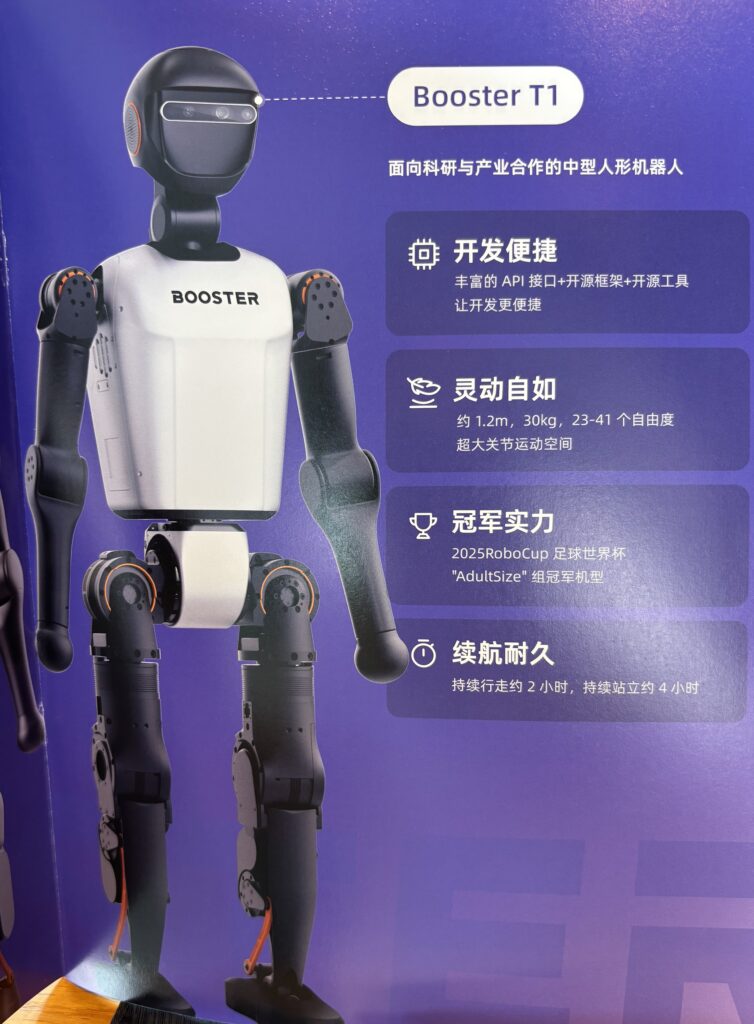
Here are the specs.
- Height: 118 cm
- Weight: 30 kg
- Degrees of Freedom:
- 23 active joints in the standard configuration (6 DoF per leg, 4 DoF per arm, 1 waist joint, and 2 head joints).
- It is expandable up to 31 DoF with gripper hardware or 41 DoF with fully articulated hands.
- Joint Performance: High-performance actuators with a peak torque of 130 Nm
- Speed:
- Omnidirectional walking at 0.5 m/s
- Dynamic running capabilities reaching up to 1.0 m/s
- Payload: 2.5 kg per arm
- Computing Architecture:
- An NVIDIA Jetson AGX Orin module (200 TOPS) for perception and AI inference
- An Intel Core i7 processor for real-time motion control
- Perception:
- Intel RealSense depth camera
- 9-axis IMU
- An array microphone with speaker
- Battery: 1.5-2 hours of continuous walking (up to 4 hours standing) using a 504 Wh battery pack
Booster T2
The Booster T2 was released in July 2026. This is the flagship humanoid platform designed for complex physical manipulation and multi-modal vision models.
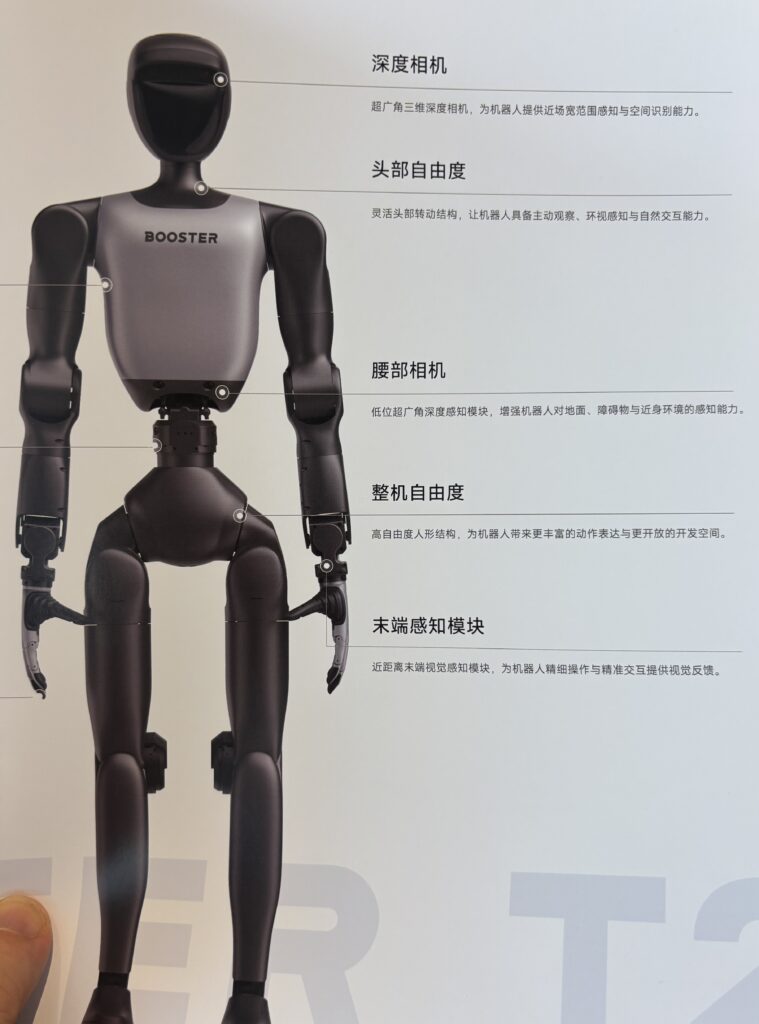
Target customers are:
- Enterprise R&D: Used by technology, manufacturing, and logistics companies to test real-world physical manipulation, automated inspection, warehouse material handling, and end-to-end task execution.
- Academic AI Research: Sold to universities, government labs, and enterprise AI research divisions as a platform to train multi-modal vision-language-action (VLA) models, reinforcement learning policies, and bipedal control systems.
Here are the specs for the T2:
- Height: 140 cm
- Weight: 42 kg
- So, it is larger and heavier than the T1.
- Degrees of Freedom: 31 active joints across the legs, arms, waist, and head
- That’s a solid increase from the T1.
- Joint Performance: High-torque joint modules with peak joint torque of 140 Nm
- Speed: Top walking speed up to 2.0 m/s.
- That’s faster than the T1 in walking speed.
- Payload: Dual-arm lifting capacity up to 10 kg total (3 kg per arm in fine manipulation tasks)
- That’s 2x the T1.
- Computing Architecture:
- NVIDIA Thor architecture up to 2,070 TFLOPS of compute power for onboard vision-language-action model execution
- This is the most important increase. That is a big step up in computing power from the T1.
- 14-core Arm CPU handles general computing tasks, system scheduling, and high-level logic execution.
- NVIDIA Thor architecture up to 2,070 TFLOPS of compute power for onboard vision-language-action model execution
- Perception:
- Dual 3D depth cameras (positioned at the head and waist)
- That’s a big upgrade in vision.
- 9-axis IMU
- Microphone array
- External power and expansion ports
- Dual 3D depth cameras (positioned at the head and waist)
- Battery: Up to 2 hours of active operation
Booster K1
The Booster K1 was released in October 2025. This is a compact, ultra-portable humanoid robot for classrooms, STEM education, and competitive events like RoboCup.
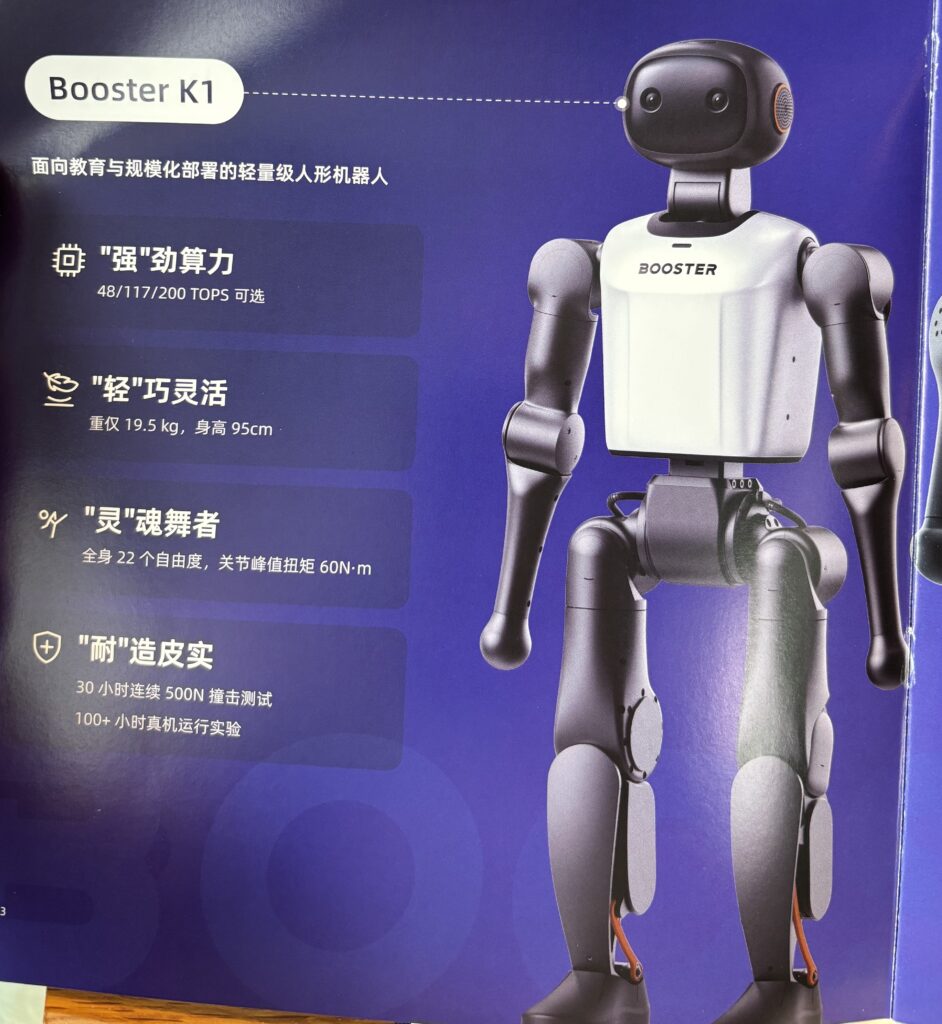
Here are the specs for the K1:
- Height: 95 cm
- Weight: 19.5 kg
- Degrees of Freedom: 22 active joints total (6 DoF per leg, 4 DoF per arm, and 2 DoF for the head)
- Joint Performance: High-torque dual-encoder joint modules generating up to 60 Nm of peak knee torque
- Speed: Up to 0.4 m/s
- Processor Options:
- Geek Version: Qualcomm QCS8550 delivering 48 TOPS of AI compute
- Edu Version: NVIDIA Jetson Orin NX (8 GB) delivering 117 TOPS
- Pro Version: NVIDIA Jetson AGX Orin (32 GB) delivering 200 TOPS
- Perception:
- 3D stereo depth camera
- 9-axis Inertial Measurement Unit (IMU)
- Tactile contact sensors
- A 6-microphone array with integrated speaker
- Battery: 30 to 80 minutes depending on battery size (2 Ah or 5 Ah) and onboard compute load
Why I Like Research and Education as Robot Use Cases
Booster Robotics will eventually go for corporate robot researchers and developers. But I think its primary market today (and initial go-to-market focus) are universities, research labs, and educational institutions.
And I like this use case.
Research at Universities and Academic Labs is Cool but Small.
Academic and educational institutions probably represent the majority of Booster’s client base today. These are the robotics departments, embodied AI research laboratories, vocational schools, and student competition teams (such as RoboCup and IEEE-RAS teams).
As mentioned, these academic labs require durable, cost-effective, open-source humanoid hardware to test spatial AI, computer vision, and bipedal locomotion algorithms.
Hence, the Booster T1 and T2. With their NVIDIA Orin and Thor SoCs). Research areas include:
- Reinforcement Learning (RL) and Sim-to-Real Transfer: Researchers train motion, balance, and locomotion algorithms in software physics simulations (e.g., FastTD3 or Isaac Gym) and deploy them directly onto the hardware.
- Loco-Manipulation: Studies on force control and physical interaction, such as pushing loads, opening doors, or handling dynamic contact forces.
- Perception-Action Loops: Dynamic tracking tasks, such as autonomous soccer (RoboCup) or playing table tennis.
Some examples:
- Carnegie Mellon University (CMU) used the T1 for evaluating force-control RL frameworks (FALCON) in physical environments.
- UC Berkeley applied zero-shot sim-to-real locomotion policies using the T1 platform.
- Purdue University conducted dynamic whole-body coordination research (such as high-speed table tennis interception).
That’s all cool. But this is ultimately a small market.
Education at Universities and K-12 Are a Much Bigger Market.
This is the use case that got my attention. And is why I started looking at Booster.
Booster says its robots have been delivered to thousands of schools and universities. And that these robots are platforms for teaching students to program and operate robots in the real world.
The education approach they cite (which lines up with China national policy) is:
Teach -> Learn -> Practice -> Compete
That’s the education loop.
Students are taught how to program and operate robots. Then they practice doing it themselves. And then their robots compete.
The whole soccer thing lines up with how education is done in China.
And this process can be done at various levels of expertise depending on the students. K-12 students versus university versus advanced researchers.
As part of this, Booster launched the “Hundred Cities, Ten Thousand Schools” Initiative, where they plan to partner with +1,000 universities, 2,000 vocational institutions, and primary/secondary STEM schools.
This is also why the Booster K1 Model was launched as a lower-cost platform (~$4,000). It is targeted at classroom labs, student clubs, and entry-level embodied AI development.
For this Booster outlines 4 levels. And has built its software to work at each of these levels (depending on the student).
Level 1: Discovery
This is for beginners and entry level. Such as K-12 students, teachers and non-technical operators. They learn the basics of an embodied agent.
For this level, Booster Studio functions as a visual dashboard and operator interface. Students open pre-loaded “agents”, such as Football Master, Dance Master or Hi Chat. They can drag and drop dance agents, soccer agents, and home tutors into their program or workflow. And then download into the robot.
That’s the Booster K1, which is their introductory educational and research model.
Level 2: Foundations
This is for intermediate students and introduces coding. This is for Middle / High School students and beginner programmers.
For this level, Booster Studio uses visual block coding. Booster Studio acts as a visual drag-and-drop IDE with instant code translation shown next to the blocks. It is a transition to text-based code (Python).
So here students operate between visual drag-and-drop blocks and Python scripts.
And the robotics pipeline is separated into modular sub-systems (perception, decision, action).
Level 3: Applied Engineering
This is for undergraduates, STEM educators and robotics apprentices.
Here students transition from block editors to text-based software engineering and ROS 2 system design. That means text-based Python programming and system integration on real physical robots. This includes:
- Python SDK development. Developers write native Python scripts directly in Booster Studio. To create custom agents.
- ROS 2 Topic and Service inspection. Users monitor and publish to ROS 2 topics through Booster studio.
Level 4: Research and Innovation
This is for AI researchers, post-graduates and competition teams.
This is research grade robotics, multi-agent coordination and custom AI policies. This includes Reinforcement Learning, digital twins, Sim-to-Real policy transfer and VLA deployment.
Researchers train neural network policies (reinforcement learning gaits) using frameworks like Booster Gym and Booster Train. Then import the model weights into Booster Studio.
***
All in all. That’s a really cool use case.
Final Stuff: Booster Studio and the Software
Booster Studio is the key tool for creation and operation. It’s their Sim-to-Real IDE environment where you can simulate, test and debug behavior before sending it to the robot.
As mentioned, it can operate at different levels.
There is Low-Code and No-Code Creation and Operation
For beginning students, there is a graphical programming platform. Students stack visual instruction blocks. Which trigger python scripts. This is a simplified interface.
This is used for rapid prototyping and deploying pre-built agents.
- Natural language code generation (i.e., vibe coding).
- Agent based workflows. You can drag and drop pre-packaged agents into constructed workflows. Agents include “Football master” and “Hi Chat”.
- UI controls and parameter sliders. You can adjust parameters like walking speed, direction, state triggers and joystick control mapping with widgets and sliders.
For intermediate students, there is a simulation platform for building programming skills. They do visual testing in a sandbox to build, test and debug their robot programs. Then they do hardware migration (sim2real). With lots of tools for telemetry and monitoring.
There Is Complete Low-Level Control and Customization
This opens up full access. It lets researchers do custom motion control, hardware manipulation and research. This includes:
- Joint and motor control APIs. You can code direct motor torques, position loops and such for individual actuators.
- ROS 2 and C++/ Python Integration
***
Booster Studio works with
- Booster App. A smartphone app for quick remote controls, network setup, status monitoring and toggling between robot states.
- Agent Store. A library where creators publish and share robot packages. You can download and run an Agent without writing code.
- Booster Gym and Booster Train. These function as specialized reinforcement learning frameworks that leverage simulation platforms like NVIDIA Isaac Lab to train locomotion models. They can do high-level AIA model training and custom physics simulations, based on dedicated external open-source frameworks. Advanced work here can be imported into Booster Studio.
- Booster Deploy. A lightweight standalone deployment framework for Sim-to-Real and Sim-to-Sim model transfers.
- Third Party python environments. Advanced researchers can write standalone scripts outside of Booster Studio using Python SDK.
***
That’s it for Booster. Tomorrow will be a short article about Leju and LinkerBot. That’s the end of this series.
Cheers, jeff
———
Related articles:
- AgiBot’s Race to Embodied AI Robots at Scale (1 of 2) (Tech Strategy)
- Why I Like AgiBot (Podcast 290)
From the Concept Library, concepts for this article are:
- Robotics
- Education
From the Company Library, companies for this article are:
- Booster Robotics
——-
I am a consultant & keynote speaker on how to increase digital growth and strengthen digital AI moats.
I am the founder of TechMoat Consulting, a consulting firm specialized in increasing digital growth and strengthening digital AI moats. Get in contact here.
I write (a lot) about digital growth and digital AI strategy (3 best selling books, +2.9M followers on LinkedIn). There is a free book and email newsletter below.
My Moats and Marathons book series is a framework for building and measuring competitive advantages in digital businesses.
This content (articles, podcasts, website info) is not investment, legal or tax advice. The information and opinions from me and any guests may be incorrect. The numbers and information may be wrong. The views expressed may no longer be relevant or accurate. This is not investment advice. Investing is risky. Do your own research.