


This week’s podcast is about agentic commerce. Who is winning and losing. And how to think about it. I have 6 basic points. See below.
You can listen to this podcast here, which has the slides and graphics mentioned. Also available at iTunes and Google Podcasts.
Here is the link to Agentic Org Now.
Here is the link to our Tech Tours.
My 5 points are:
- Grok bot and AI Assistants are the iPhone moment.
- Buyers are delegating, and that changes everything downstream.
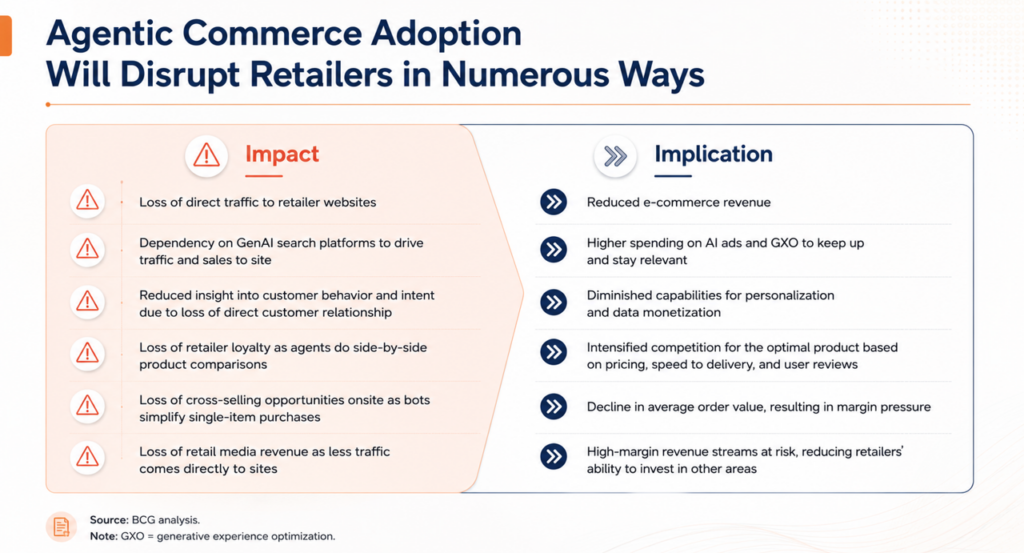
- Lots of brands will lose humans as customers. Attention, data and brand equity all fall. Selling to agents will be necessary.
- Brands win where humans don’t delegate. That’s your core.
- Agents weaken marketplaces like Amazon. But strengthen platforms like YouTube and Payment.
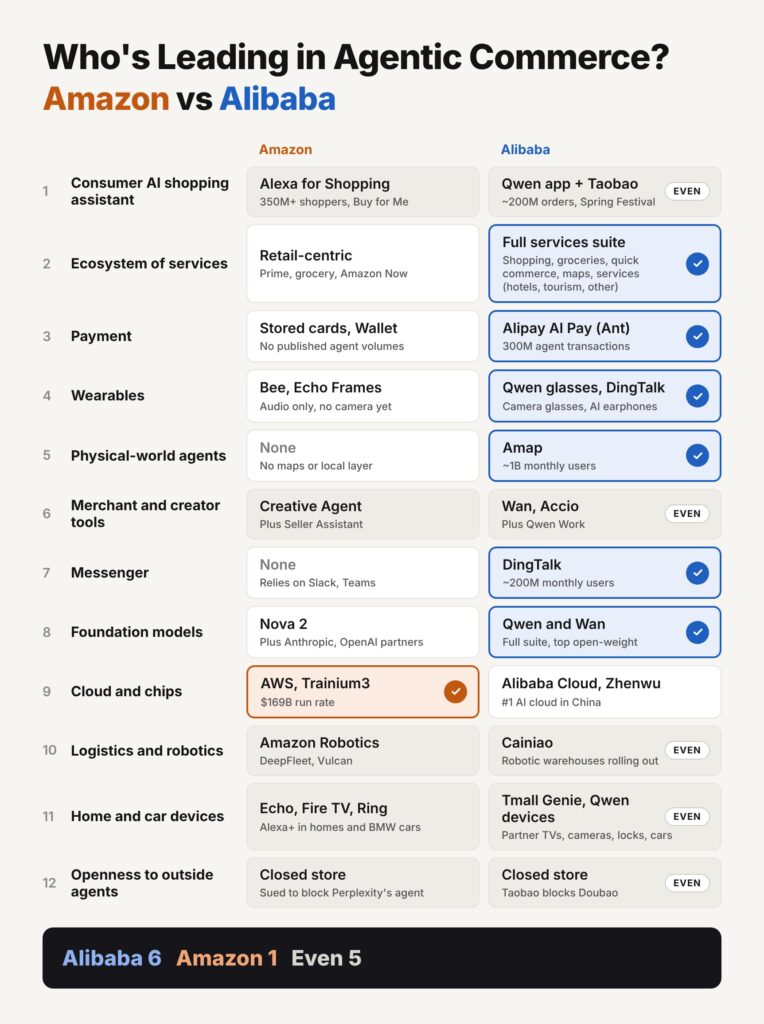
- Alibaba is ahead of Amazon in most agentic commerce capabilities.
Here are the mentioned slides:
Here are the mentioned articles:
- Amazon vs Alibaba: Who’s Winning in Agentic Commerce? (1 of 2) (Tech Strategy)
- Alibaba vs. Amazon in Agentic Commerce: Every Merchant Gets an AI Team (Tech Strategy) (2 of 2) (Tech Strategy)
*Disclosure: AsiaTech Services, LLC has had a partnership with Alibaba within the past 12 months. This article received no financial sponsorship or backing.*
——–
Related articles:
- How Alibaba.com Re-Ignited Growth with the Alibaba Management Playbook (Tech Strategy – Podcast 253)
- How Amap Beat Baidu Maps. My Summary of the Alibaba Playbook. (Tech Strategy – Podcast 252)
- Scale Advantages Are Key. But Competitive Advantages Are More Specific and Measurable. (Tech Strategy)
From the Concept Library, concepts for this article are:
- Agentic Commerce
From the Company Library, companies for this article are:
- Alibaba
- Amazon
———transcription below
00:05
Welcome, welcome everybody. My name is Jeff Towson and this is the Tech Strategy Podcast from Agentic Org Now and the topic for today What happens to Amazon Alibaba and really most brands? When agents are doing the buying So this is about agentic commerce, which is really my number one focus these days agentic commerce and agentic organizations
00:33
That’s kind of 80 % of what I’m focusing on and there was some major news in the last couple weeks in this I think the ground has absolutely shifted and What was theory a month ago looks like it’s happening in practice today and that’s the idea of Look agents are starting to do the buying now that is impacting platforms Amazon Alibaba. It’s impacting brands. It’s changing consumer behavior. It’s changing payment
01:03
It’s a major disruption transformation and it’s pretty much happening right now. So I’m going to talk about kind of how I see it and what I predict is going to happen. Basic housekeeping stuff here. We have, if you’re curious about getting sort of our weekly email now, which has become a big priority, we’re sending out an agentic frontiers email, just lessons for management on what to do in agents. We send that every week. You can go over it to
01:30
Agenticorgnow.com or Jefftowson.com just sign up for the email list. You’ll get that It’s free. You also get a copy of my book motes and marathons. That’s free there now as well And let’s see other things if you’re willing to share or review this podcast especially on iTunes. That’s a big deal I would appreciate it doesn’t take any time if you’re going to leave a bad review. Okay, maybe not but it’s not terrible that actually is helpful
01:55
Okay, standard disclaimer here. Nothing in this podcast, my writing or website is investment advice. The numbers and information for me and any guests may be incorrect. The views and opinions expressed may no longer be relevant or accurate. Overall, investing is risky. This is not investment, legal business or tax advice. Do your own research. And with that, let’s get into the topic. Now the topic for today is agenda commerce. I don’t really have any strategy lessons in this. This is kind of…
02:21
just how I see things evolving and what to do if you’re a platform or a merchant or a brand. Things are changing very, very quickly. It’s awesome. It’s kind of nerve wracking at the same time. I mean, I tell you, in the last three months, I feel like my professional life has completely changed. I’m doing 10 times more than I ever used to do. I’ve got articles, I’ve got…
02:50
client work, I’ve got books, you know, dramatically more than I would ever have done before. In addition to that, I’ve started doing stuff I wanted to do but never did. Doing a lot of coding now, spinning up websites and various apps and functions. It’s really easy to do and I have a minimal coding background. I always wanted to do it. Didn’t really have the time to learn the skills properly. Now I’m doing it like it’s nothing, just using Anthropic or whatever.
03:18
I’m starting to do robotics, just designing up engineering plans for various devices. I’m going to start building my own robot, I think. And it’s the same thing. You just use the AI. I mean, I’ve got a physics background, so I can understand that to a certain extent. Yeah, I’m building robots. I’m doing AI. I’m doing apps. so the stuff I always did, I’m 10 times more effective. And there’s all this other stuff that I can do now. It’s amazing. At the same time.
03:48
It’s super disruptive. Disruptive. I the analogy I’m starting to use is like it’s like riding a roller coaster. You’re getting on the roller coaster. You know it’s going to be sort of a little traumatic and big huge drops, but at the same time, it’s really fun. But you’re also going to do the massive drop. That’s what I feel like. I’m like 50 % excited and I’m 50 % oh, this is going to be bad. Like I’m always caught between those two feelings. So I’m not sure what you call that.
04:16
Within all of that, let’s kind of talk about agentic commerce, which is going to start online, but it’s going to move into the offline world. It’s really going to impact anyone who’s selling things online. Outside of that, there might be some exceptions, but anyone who’s got a presence online, yeah, it’s a big deal. We can call all of that agentic commerce. Soon we won’t even call it agentic commerce. We’ll just call it commerce. And fortunately, I’ve been spending a lot of time in Alibaba, which is great.
04:46
And they are at the center of the action of this. mean, they are literally the epicenter of agentic commerce is Hanzo and Alibaba. I don’t think anyone else is on the frontier to the degree they are. They are really leaning forward into this. So I’m going to kind of make five points in how I see the world changing right now. Point number one, Grokbot, we could also say muse and dots.
05:13
I mean, this is the iPhone moment of agents. Like I use Grokbot 50 times a day. I’d be surprised if it’s not 100 times a day. I live on Grokbot now. I’ve got 11 bots that I’ve teed up there. I’m checking in with them all the time. I don’t even check my apps for the most part. Like one of my Grokbots is just my calendar.
05:40
So I talked to about what I got to do this week, what I’ve got on Wednesday, what’s going on. I haven’t opened my calendar app in a long time. I haven’t given it access to my email. I’m not totally comfortable with that. I have another bot that’s just travel and sort of visiting companies. I check in with that all the time. It’s always asking, hey, you’re going to China. Do you have your QR code ready? You’re meeting with this company on Tuesday. Let me send you some notes ahead of time on what’s going on.
06:07
By the way, have you thought about meeting with this company? I know you know somebody there. You should talk to them and meet it. I mean, it is just planning my travel life. Fantastic. I still don’t feel comfortable giving a payment or email. But then I’ve got another 10, which I won’t go through. mean, these AI assistant tools, it’s like the iPhone. It is clearly a transformative, it’s the new normal for how you engage with the online world.
06:37
You know, it was the laptop, then it was the iPhone. Well, what’s the iPhone? I pull it out of my pocket and I got a lot of apps on my desktop. The operating system was very, very powerful. This is beyond that. I don’t open the apps anymore. I just talk to my, you know, talk to my various bots and more and more they can just directly go into my apps. They call this headless apps. I don’t need to open them anymore. Some I still do. If I’m watching YouTube, I’ll still watch.
07:05
I don’t do most of them anymore. I suspect another year I won’t use 80 % of the apps. So we have a new user interface. And why do I think Grokbot is good? I think it’s a Steve Jobs moment. It’s not the most powerful. I think Anthropic, WorkBuddy, Alibaba, Quinn, I think they are better in terms of just pure intelligence of the models. I don’t really use OpenAI.
07:34
Okay, Grok, no, it’s not as powerful, that’s very clear. But I think the user interface is far more intuitive, like the iPhone was, a la Steve Jobs. It’s just such an easy interface to deal with all your bots, they all talk to each other. You can centralize everything under a couple central bots, like your chief of staff, they deal with the other bots. It’s super easy. As a net result, I’m not using apps.
08:02
I’m not reading emails like I used to, I’m just getting summaries. Yeah, and even news feeds, I’m not reading, one of the reasons I like Grokbot is because it’s linked directly into X, Twitter. So, and that’s not usually the case. It can see all the posts all the time. I’m not even scrolling on my newsfeed anymore. I just have standing routines every day where it finds me people and subjects I like.
08:29
and it tees up things I should read and tweets I should look at. So I’ve almost stopped using newsfeeds as well. So it’s a major change in the user interface. That’s why I think, it’s a Steve Jobs. That’s actually a good question. What would Steve Jobs have built if he was alive today? I think he would have nailed the user interface and it would be better than any we’ve seen. Now, Anthropic has one.
08:58
Meta has one, obviously OpenAI has one, Grok has one. I like the Grokbot one best. I think the iPhone one should have been superior, but that’s not Tim Cook’s thing, innovation. All right, that’s point number one. That change has happened in the last month. It’s a huge deal. Number two, the next thing that happens after that,
09:25
Buyers are going to increasingly delegate their shopping decisions, recommendations, browsing, behavior. When we move into agentic commerce, because we now have a viable user interface for the agentic world, buyers are going to change their behavior very quickly. Now, they’re still going to watch YouTube themselves. You wouldn’t have an agent watch YouTube for you, but man,
09:55
you use these things for everything. So the analogy I’ve been using, this is life working. As I mentioned, I used to work for a billionaire, a billionaire prince, and they have people for everything. He hadn’t been to a, I he owned supermarkets, but outside of that, he hadn’t been to a supermarket in 20 years. People did it for him. He had a staff member that went and went, got the food and stocked up his fridge and whatever.
10:23
You know, he wouldn’t buy movie tickets on his own. They would do that for him. He wouldn’t buy his travel plans himself. There are luxury travel agents that plan entire vacations for the billionaire class. He would just hand all these things off. And then on top of that, that’s shopping behavior. We can also look at just sort of daily chores like answering emails, checking your calendar, routine buying. You know, they don’t do any of that. Billionaires have people for all of that stuff.
10:53
Well, bots are like that. You they have an entourage. Well, bots are your digital entourage. And you just spin up 10 of them and you have one for your calendar, one for your email, one for your groceries, one for your travel. Same thing. So I think that’s the argument I use for this is billionaires have been billionaires have no limits on their resources for the most part.
11:17
So they live in a world of abundance. Now you could argue the rest of us are moving into a world of abundance very soon. Well, they got their first. And they’ve spent decades figuring out what is the best lifestyle when you live in a world of abundance. So we don’t have to figure it out. They’ve already answered that question. What is the best lifestyle you should live if you have unlimited resources in a world of abundance? Well, look at the billionaires. They figured that out a long time ago.
11:46
So we copy them. They stay involved in its things where it’s fun or it’s personal. That’s kind of how they do it. So the question within the delegated lifestyle, the billionaire lifestyle, you ask yourself, what are you going to be directly involved with yourself? What are you not going to delegate? Or you’re going to delegate part of it, but not all of it. That’s the key question.
12:16
So you’re going to have staff, but are you in the lead? Are they doing most of it and you’re just approving or are you not involved at all? Now, let’s get into how that impacts brands and merchants and really anyone selling. Because if you’re trying to sell to a customer on the street, what do you do? You put up billboards, you send them emails, you post content. None of that works with billionaires. You can’t reach them. If you’re trying to sell to a billionaire, you have to go through their people.
12:45
You have to go through the lawyer, their chief of staff, whatever. Maybe you get a meeting. A lot of what you’re pitching will never go to them. The chief of staff will just make the decision on their own. Sometimes you get in the room and then you get three to five minutes to pitch. Okay. A lot of brands are going to lose humans as customers. They’re going to be dealing with agents entirely or partially. Sometimes not at all.
13:15
but whatever. Now what does that mean? Well, that means you lose the engagement. You lose the data you get from dealing with them. You lose their attention. And a lot of brand equity is based on engagement with customers. Well, that’s going to disappear. A lot of brand equity is going to get wiped out. So any merchant or brand wants to focus as much as possible into things
13:44
that humans don’t delegate. However, that’s not enough. That’s a very antagonistic relationship with an agentic first world. You can’t just avoid the problem forever. You’re going to have to also find out how to be synergistic with an agent first world. You’re going to have to serve agents. Just the same way, if I want to sell to a billionaire, yes, I have to go with him directly, but I also have to…
14:11
aggressively sell to his chief of staff. Avoiding the agents is not a solution for most companies. So yeah, don’t think I’m just going to avoid it. It’s just the way it is. All right, point number three. Brands are probably going to do best in the areas where humans don’t delegate. That’s probably your best foundation. Okay, what do humans not delegate?
14:40
They don’t delegate relationships. So talking on Twitter or going to Reddit into an online community forum where you’re really about talking to other people, they’re not going to delegate and have their bot go have that conversation. WeChat, group chats, Slack, group chats. If someone has their bot in there answering for them, it’s going to annoy everyone. No, you’re there for the human conversation. So relationships.
15:10
Conversations those things are going to be in person and there could be other experiences like going to the mall Going to the theme park watching a movie You’re not going to delegate an agent to watch a movie for you and tell you what it was. No, so YouTube is in pretty good shape But you might have an agent read a bunch of emails that come in and just give you a summary so videos Community forums whether in person or online
15:40
in-person experiences, video games, online experiences, podcasts, I like podcasts, WeChat, meetings, private sales, all of that. That can be all right. So that’s point number three. Brands are going to do their best where humans don’t delegate. That’s a good way to think about it. All right. Now, within that, that’s kind of we can put points two and three under the idea of
16:09
Look, how does all of this impact merchants and brands? BCG has a good slide about all the ways this impacts merchants and brands, agentic commerce. I’ll put that in the show notes. That is worth looking at. I think it’s a very good summary. I won’t go through it here. Point four, I’m only got five points today. Okay, I’ve told you how buyers are going to change agentic commerce. I’ve told you how merchants and brands are going to have to change.
16:38
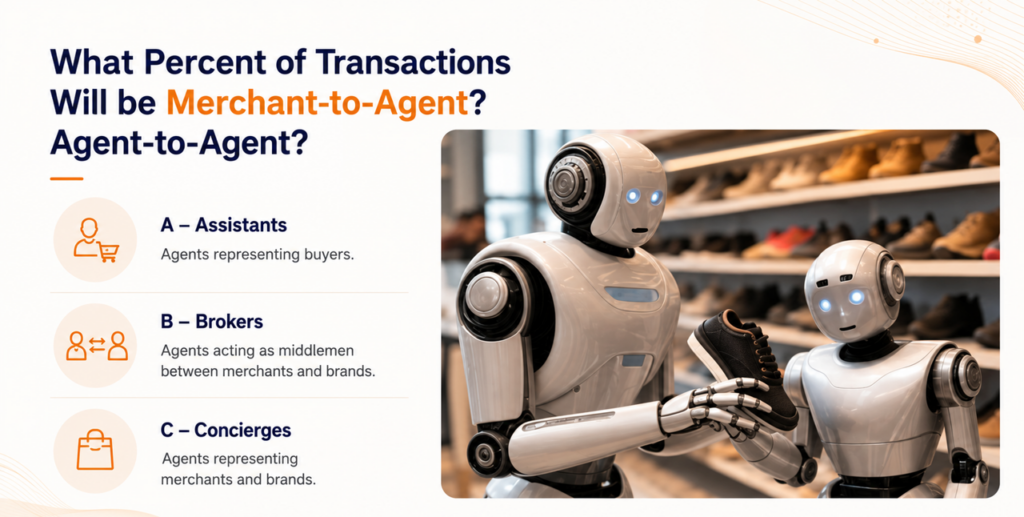
And oh, the other part on merchants and brands I didn’t talk about was the fact that you can have your own agents, which I’ve talked about before. call this the ABCs. Buyers will have assistants. The Bs are brokers. They’ll be intermediaries and merchants will have concierges. See ABC. You know, when you go into a hotel, there’s a concierge in the lobby to help you with anything. Taxis, restaurants, theater tickets. Businesses will have that as well.
17:08
So a lot of commerce won’t be, some commerce will be human to human like today. Some commerce will be agent to human, consumer to buyer. Some will be agent to agent. Some might be human to broker to agent. I mean, it’s going to be all over the map. Okay, think about that. I’ll put the ABCs chart in the show notes as well. Look at the BCG one, look at the ABC ones. All right, point number four. How does this impact
17:36
Platforms now platform business models have been you know the apex predator of the last 25 years Amazon Google YouTube Facebook all platform business models. I’ve talked about this forever Okay Do agents change this and? The answer is yeah, they do it actually is a problem depending what you’re doing
18:04
Let’s think about an easy platform business model like YouTube. Now YouTube we would call an audience builder platform. On one side of the platform you have content creators, professional, amateur. On the other side we have viewers. It’s a classic platform. The more content you have, the more valuable it is to the viewers. The more viewers you have, the more valuable it is to the content creators. So it is a cross-border network effect. Very powerful.
18:32
Is that going to change with agentic organizations and content creation in this case? And yeah, it will. It will get stronger. The amount of supply, the amount of videos being created is going to go through the roof and everyone can be Hollywood now. So the amount of supply is going to go through the roof. That’s going to be dramatically better for the viewers. Does it hurt the platform? Not really.
19:01
because people still watch videos themselves. They don’t delegate that. So from the viewer perspective, the customer offering just got better. I used to have a million videos, now I have 10 million videos. That’s all good for me. It’s a benefit. And agents don’t really impact, let’s call it audience builder platforms. Okay, what about payment platforms like Alipay, Mastercard?
19:30
Does the rise of agentic commerce make that better or worse? Okay, it doesn’t really make it better in the sense of the consul, well, I take that back. What happens with agents when they start to become buyers themselves or they become sellers themselves?
19:52
What happens is the trust issues have a real problem. Most of what credit card companies do is you walk into the store, you hand them their credit card. The first thing they check is what is the point of the platform? The point of the platform business model is to lower coordination costs. What are the coordination costs when I walk into a store and show them my credit card? One coordination cost is we don’t know if this card’s any good or if it’s fake.
20:21
Okay, MasterCard answers that. Then they don’t know if I’m authorized to use this credit card identity. That’s another trust issue, a coordination cost that’s hindering the transaction. Well, MasterCard solves both of those problems. It lowers the coordination cost. That is the purpose of a platform business model. Okay, what happens when it’s an agent doing the buying? Well, the coordination cost just went through the roof.
20:50
Because now it’s not even a human. It’s a piece of software. We don’t know if the card is real. We don’t know if the agent is authorized to make this purchase. We don’t know if it’s some spammy thing. And even if it is authorized to purchase, how much is it authorized to purchase? Can it spend $100,000 or does it have a limit? Or can it only spend what it’s been authorized to buy, a backpack? So the coordination cause of agents doing purchases
21:20
dramatically increased to when humans do purchases. Well that’s great for Alipay, that’s great for MasterCard, and they are rolling out all types of new services. So as the coordination costs of a platform business model for payment go up, the value of the platform increases. So I would argue that payment platforms are probably more important than ever. Okay, now let me give you the counter example.
21:50
How does this impact Amazon and Alibaba? Their platform business models, their marketplaces, merchants on one side, buyers on the other.
22:03
What happens when agents start doing the buying? Is that good or bad for the platform? Unclear in terms, it doesn’t make it stronger. You don’t need it a lot more. What about on the supply side? Well, can agents create new products? Kind of, but it’s probably human. Here’s how I view it. I actually think it’s a, I think it’s a significant problem. Here’s why.
22:34
How do humans shop in this world? When we talk about marketplaces, we talk about share of wallet. How much of your wallet is Amazon getting? How much of the wallet is Alibaba getting? But underneath that, there’s another question. We have a limited bandwidth for attention. You know, I go into a store, Amazon, and Amazon has more products than a smaller e-commerce site, so it is more valuable to me.
23:04
Why is it more valuable to me if you have more? Because I have a limited attention. I need you to put all the products together in one place so I can skip through them. Because my attention is limited, your greater quantity of supply that is aggregated in one fixed place becomes valuable to me. As I walk down the aisles of a supermarket, I have a limited attention.
23:34
The fact that you show me hundreds of products as I walk down the aisle is helpful to me. So what these marketplace business models do is they aggregate supply in a very small location so that human beings can actually sort through all the supply quickly. Yes, we appreciate the more supply, but our attention is limited. That’s the problem. What do agents do?
24:03
When it comes to videos, agents don’t increase my attention because I can’t delegate watching a video to somebody. But when it comes to shopping, I can delegate shopping to someone else. So my attention just increased dramatically. I can now look at 10,000 stores and find the best deal because I don’t have to do it myself.
24:28
When it was just me, I needed everything in the Walmart store. I needed everything in Amazon. But if I can spin up 10 agents to hunt around all sorts of stores, suddenly my attention is dramatically more. And therefore, your aggregated supply isn’t that valuable to me. It changes the nature of how we shop. So I think the platform business models are going to get significantly weaker.
24:59
in terms of what they offer to consumers. What Walmart, Amazon, Alibaba all offer is, if you come to this app, we will have more supply than anyone else and you can see it all in one place. You don’t have to go to 20 stores. For a human, that is valuable. For an agent, it doesn’t matter. So I think the whole business model, the whole customer offering is much weaker now. When I can spin up
25:29
10 assistants to run around town and find what I want. So platform business models, audience builders, YouTube, more powerful. Payment platforms, probably more powerful, not as much. Marketplaces like Amazon and Alibaba, less powerful. And let me finish up with one point and then I’ll finish up on point five. So much of retail and e-commerce is convenience.
25:58
You’ll hear it all the time. We have a bigger selection, we have low prices, and we’re very convenient. You hear convenience all the time. Convenience is powerful for humans who have limited attention. Does convenience matter to an agent at all? I don’t think online it matters. Now convenience matters in terms of delivery time, but does it matter if it’s a one-click buy or a five-click buy?
26:26
Does it matter if all the supplies in one place? it matter if, know, does any of that matter? Do agents care about convenience? I’m not sure they do. So anyways, that’s the point. right, point number five and I’ll finish up. Now, I sent out to people who are on the subscribe list, I sent out a summary of where Amazon is versus Alibaba. And I think it’s pretty good. I basically said, look, agentic commerce is emerging quickly.
26:56
the most powerful players on the planet, Amazon, Alibaba. I think there are 12 capabilities that matter within agentic commerce, and I’m just rating them on where they are now versus May versus January versus November. And November, September last year was when this really kicked off. I’m just tracking it. And of the 12 core capabilities, I think Alibaba is ahead in six.
27:25
I think Amazon is ahead in one and I think they’re tied in five. And I will put a JPEG in the notes, which basically is one slide that summarizes where they think they are. And that shouldn’t be too surprising really. Alibaba is a much larger ecosystem of e-commerce services. They have Ant Financial. Amazon doesn’t have a financial services group. They both have merchants and consumers and…
27:54
logistics. But no, there’s a lot of differences within these things. Now, the one that Amazon is better at is chips in cloud. Amazon Web Services is ahead. Cloud in the West is pretty far ahead of what China is doing, and chips because of political reasons. So chips in cloud because of Amazon Web Services, you got to give Amazon the lead. They’re ahead. But Alibaba, I think, is really ahead and probably
28:24
five. May five to six. They’re seriously ahead. Not because Amazon’s bad, but Alibaba has Ding Talk. Ding Talk is a messenger service with 400 plus million users. Now, what is the most powerful user interface that you can put agentic capabilities in that are going to make a difference? Well, messenger is maybe the most powerful one. Ding Talk, WeChat,
28:54
WhatsApp should be there, but you know, what is the primary interface that a user uses? Well, Messenger’s always been number one. So they have that, Amazon doesn’t. What about foundation models? Well, Alibaba is building foundation models across the board. They are not an e-commerce company in this regard. They are trying to be a frontier AI company, full stop, right up there with Anthropic and OpenAI. Okay, Amazon’s not doing that.
29:22
You can look at other things like AMAP. AMAP is a mapping program like Google Maps, very number one in China. That is another user interface that if you put agents into it, it is very powerful. know, agents on your phone find they can search the web for you, but a mapping service as you drive down the street, you put agents in that, it can tell you to turn into this shop on your left and do whatever, right?
29:51
So that’s agents in the physical world. So Alibaba just has a lot of stuff that Amazon doesn’t have. And I put them ahead in that regard. But as you can see my summary, and we’ll see what it looks like in a couple months. I’m going to keep updating this. But I think it’s pretty good so far. Okay, those are my five points. Let me recap them for you here quickly. Number one, the Grokbot, these AI assistants, man, this is the iPhone moment.
30:20
It’s absolutely arrived. I think it’s a fundamental change in how we engage with the internet. I use it all day long, every day. Number two, this is going to impact very quickly how people buy and they are going to start delegating things, partially or fully to their bots who they are now comfortable with. You got to get the payment approved, you got to get the rails in place.
30:50
but this is going to happen very quickly and we already see it happening. The billionaire lifestyle, I find that an easy way to figure out what people are going to delegate and what they’re going to do themselves. Number three, this has lots of implications for merchants and brands, really anyone selling online. A lot of brands are going to lose humans as their primary customers, maybe partially, maybe fully. So one,
31:17
you’re going to on the human side, you’re going to lose a lot of attention, data, engagement and brand equity. You’re going to have to deal with that. And two, you’re going to have to learn to sell to bots. Avoiding them is not going to be a solution. Ideally, it’s a secondary strategy, but it’s not. can’t do it. Number three, the brands that will win are those where humans don’t delegate. That needs to be your core business model if you can. And that may mean
31:46
Maybe it’s an online activity where people don’t delegate like listening to podcasts. Or it could be something in the physical world. It may be time to open retail stores because we know humans walk in. Communities. Communities are a very powerful place to be actually. I think about that a lot. Number four. Agents are weakening marketplaces like Amazon and Alibaba. Platform business models are not going to have the power they used to have.
32:16
because a lot of what they offered to humans agents don’t need. In other areas like YouTube and payments, it’s going to actually increase with dramatically increased supply. Fine. Last point, number five, you can kind of keep an eye on Alibaba versus Amazon for what’s happening in a agenda commerce. I think Alibaba is way ahead, but it’s a different market. So you kind of take that with a grain of salt.
32:45
But we’ll see how they both evolve. Agents in general do better when you have existing ecosystems where everything is already connected. Identity is there, payment is there, verification is there, which Alibaba has and Tencent has. So putting agents into an existing super app or ecosystem is a lot easier than creating new protocols for disparate parties to start to connect for the first time. That’s MCP, that’s API.
33:16
And that’s what we’re seeing outside of China for the most part. So that’s going to be slower. Okay. That’s the content for today. I hope that’s helpful. This is where really where I’m, I’m focusing 70 % of my time. It’s literally why I changed the name of our business to agentic org now, which is you have to become an agentic first organization right now. And especially if you’re in commerce. So agentic commerce now, I think it’s transformative.
33:44
Unlike robots, which I spend a lot of time learning about robot parts, it’s going to happen really fast. This stuff is going to be like wildfire. Robots are going to actually take some time. So that’s what I focus. If you want to talk about this stuff, go over to agenticorgnow.com and we’re doing sort of very fast engagements with clients to talk about, look, this is probably what I do this week. Let’s get it launched. Let’s move, move, move. Hence, agenticorgnow. Anyways, if you’re curious.
34:14
Okay, that’s it for me. I’m packing up here. I’m flying out to China in the next day. I’m going to go to the Tencent Cloud Conference, which I absolutely love. I mean, I go to conferences all the time in China, but there’s a couple that I think are fantastic. One of them is Tencent Cloud, which is they have it in Shenzhen every year this time. I’m going to interview one, maybe two of their executives, so I’ll write that up. But
34:44
They are really on the frontier of this stuff. Alibaba, Baidu, Tencent, and some others, ByteDance is pretty good. But Alibaba and Tencent, one, they’re on the frontier of AI and cloud and agents. And two, they’re going international pretty aggressively right now. So they’re in Southeast Asia. They’re going to go to Europe soon. So their primary agentic products, which are CodeBuddy and WorkBuddy, and they have a new design when coming, that’s going to be a big deal.
35:13
And I think I’m really early on this. I’m sort of way ahead of the curve on this topic. So we’ll see. Anyways, I’m going to do that for a couple of days. I’ll write it all up. It should be lot of fun. Other than that, I’m just doing well. I’m sort of through a difficult two months. So the next month is going to be a lot more relaxed, which I’m looking forward to. Anyways, that’s it for me. I hope everyone is doing well. yeah, I’ll talk to you when I get back from China, I think. That’s it. Talk to you next week. Bye bye.
——–
I am a founder, consultant and keynote speaker specialized in digital and AI agentic strategy.
I am the founder of Agentic Org Now, a firm that helps leadership teams launch AI and agentic initiatives fast.
I write (a lot) about digital and digital AI strategy (3 best selling books, +2.9M followers on LinkedIn). You can get a free book at the email sign-up below.
My Moats and Marathons book series is a framework for building and measuring competitive advantages in digital and AI businesses.
Note: This content (articles, podcasts, website info) is not investment advice. The information and opinions from me and any guests may be incorrect. The numbers and information may be wrong. The views expressed may no longer be relevant or accurate. Investing is risky. Do your own research.
