



In Part 1, I argued that Alibaba is way ahead in the 12 capabilities that matter for agentic commerce. Here’s my summary:
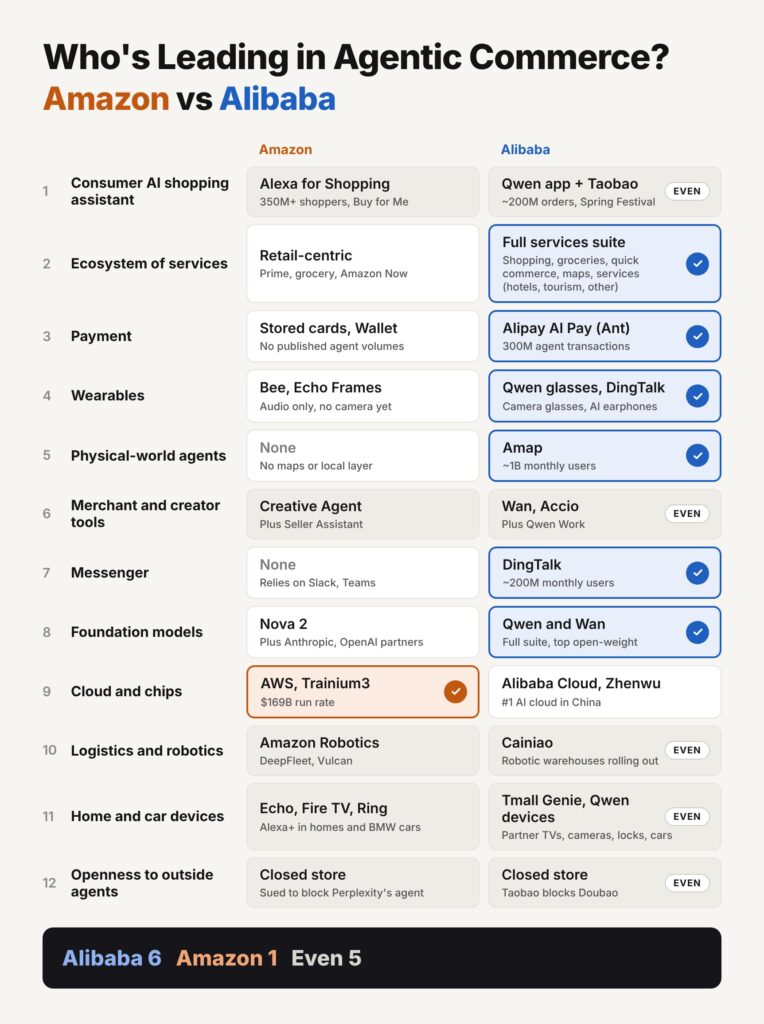
Let me pick up with 6, Merchant and Creator Tools.
6. Merchant and Creator Tools: Both Are Putting Agents to Work for Sellers. It’s a Tie (for Now).
The other side of agentic commerce is the merchant. Sellers are getting AI agents too. For content, customer chat, CRM, marketing and store operations.
Alibaba is giving every Taobao and Tmall merchant an AI team. Its merchant Business Assistant now comes with six “AI employees”:
- AI Data Analyst
- AI Marketing Operator
- AI Audience Operator (i.e., CRM)
- AI Designer (content creation)
- AI Customer Service
- AI Order Handler
And merchants are using them.
More than 5M merchants used Taobao and Tmall’s AI tools during Double 11 in 2025. Dian Xiaomi, the AI customer service agent, handled 300M shopper questions, 100M of them fully automated, and lifted merchant conversion rates by 30% (source: Tmall via Tiger Brokers).
In March 2026, Tmall upgraded this into a 24/7 AI agent team that runs store analytics, ad placement, customer service and after-sales, using the merchant’s own CRM data. And Tmall’s president says AI will be built into merchants’ internal workflows starting in 2027.
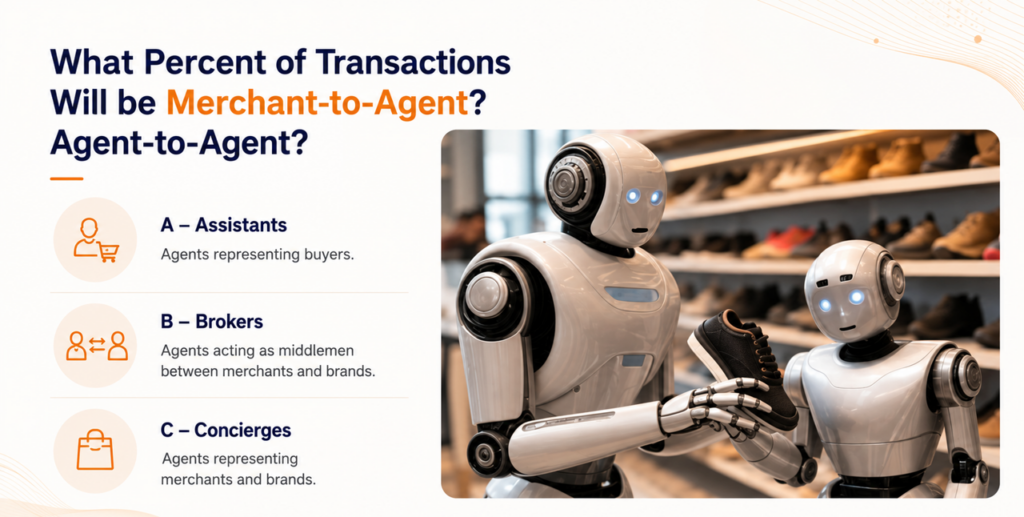
I call merchant-side agents “Concierges”, like the concierges in a hotel. They work for the business and they can help with more than just the hotel services.
Alibaba also has the Wan models for general design and video, and Accio for cross-border sellers.
Amazon is doing similar things.
In September 2025, it made its Seller Assistant agentic. It can reason, plan and act with the seller’s permission. It flags slow-moving inventory, watches account health and walks sellers through compliance. It’s free for all US sellers. And Amazon’s AI ad tools now produce video ads in hours instead of weeks.
I call this a tie for now. Both are putting agents into the seller’s workflow. But Alibaba’s tools go deeper, and it has published much bigger usage numbers.
7. Messenger: DingTalk Gives Alibaba an Agent Platform in a Huge Messenger App
Messaging apps are a powerful interface for agents. Maybe the most powerful one. People already spend their day in them.
DingTalk is China’s largest workplace messenger. It has about 200M MAUs and a 32.7% share of China’s collaborative office market (source: QuestMobile via 36Kr).
And in March 2026, Alibaba launched Wukong, an enterprise AI agent platform built directly into DingTalk.
That puts Alibaba’s agents where employees, suppliers and merchants already talk and approve things. That matters for B2B commerce, like procurement, purchase orders and approvals.
And it’s a starting point for other agentic services. Watch for DingTalk to grow far beyond just work messaging. I wouldn’t be surprised if they roll this into something much larger.
Amazon has no messenger. Its business customers are on Slack and Teams. So, its agents have to reach them through someone else’s app.
8. Foundation Models: Alibaba Has Built a Full Suite of AI Models
Qwen is not one model. It is a family covering language, vision, audio, image and video. It includes Qwen-VL, Qwen-Audio, Qwen-Image and the Wan video models.
And in March 2026, Qwen had more than 50% of global open-source model downloads (source: AEO Vision).
Alibaba is striving to be a leading AI player in its own right. Up with OpenAI, Google and Anthropic.
Amazon does have its Nova 2 models. But its model strategy is mostly partnerships.
- It has invested $13 billion in Anthropic and pledged up to $20 billion more (source: MarketBeat).
- It is investing $50 billion in OpenAI, whose models will be customized for Amazon’s consumer products (source: Axios).
Amazon has access to frontier models. But it doesn’t own them.
9. Cloud and Chips: Amazon Is the Clear Leader in Cloud
Amazon’s biggest advantage in agentic commerce is cloud and chips.
AWS revenue grew 37% to $42.2 billion in Q2 2026. That puts it at around $169B in annualized revenue. That dwarfs Alibaba Cloud. And really cloud in China.
Beneath this is Amazon’s custom chip business and its AI business. Each of which passed a $25 billion run rate (source: S&P Global, Bloomberg via AI Weekly).
Alibaba Cloud is the leader in China, and its new Zhenwu V900 chip goes into mass production in early 2027. But it is not at AWS’s scale.
10. Logistics and Robotics: It’s a Tie
Amazon runs over a million warehouse robots, coordinated by its DeepFleet AI model. Its same-day and overnight deliveries rose 40% year over year in the first half of 2026 (source: Retail Dive).
Alibaba’s Cainiao is rolling out robotic warehouses, and Taobao Instant Commerce and Freshippo give it a fast local delivery network.
Both are strong.
11. Home and Car Devices: Another Tie
Amazon builds its own devices. Echo, Fire TV and Ring put Alexa+ throughout US homes. And Alexa+ is now in BMW cars and Samsung TVs.
Alibaba takes a partner approach. Alongside its Tmall Genie smart speakers, its Qwen Smart Hardware partnership puts Qwen into TVs, home cameras and smart locks from brands like Hisense, Skyworth, Ezviz and Imou. Qwen also powers in-car assistants for BMW in China and for Hongqi.
12. Openness to Outside Agents: Both Companies Run Closed Stores
Neither company lets outside agents shop freely.
Amazon sued Perplexity to stop its Comet browser agent from shopping on Amazon. An appeals court reversed the injunction in August, but the lawsuit continues.
Taobao similarly blocks ByteDance’s Doubao agent.
The reason is the same for both: ads. Agents skip the search results page, and that page is where both companies sell ads. Plus, agents are strategic assets.
Final Point: China Shows Where US Agentic Commerce is Heading
Alibaba is ahead in agentic commerce because it owns more of the consumer stack: the agent, the payments, the services and the devices. And it has a larger ecosystem of capabilities.
Amazon’s clear lead is the cloud infrastructure that powers it.
For management teams, two lessons stand out:
- Plan for agents that complete the purchase, not just recommend. China shows the shift from AI-assisted shopping to agent-placed orders is already underway.
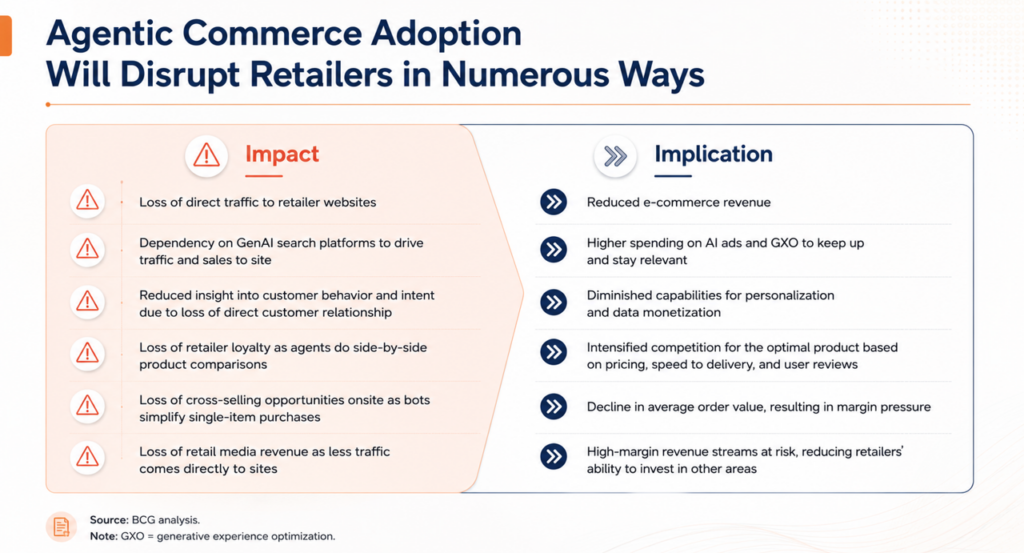
- Make your products and services readable by agents. If an agent can’t find your inventory, prices and delivery times, it will order from someone else.
This second point is important. Take a look at BCG’s summary for how this all impacts merchants and brands.
I’ll keep tracking Alibaba vs. Amazon.
Cheers, Jeff
For my weekly take on agentic AI and what it means for your business, sign up for my free Agentic Frontier email at jefftowson.com.
*Disclosure: AsiaTech Services, LLC has had a partnership with Alibaba within the past 12 months. This article received no financial sponsorship or backing.*
——-
Related articles:
- JD’s JoyAI and JoyInside Are a Smarter Bet Than Building Humanoid Robots (1 of 3) (Tech Strategy)
- Why ChatGPT and Generative AI Are a Mortal Threat to Disney, Netflix and Most Hollywood Studios (Tech Strategy – Podcast 150)
From the Concept Library, concepts for this article are:
- Agentic Commerce
From the Company Library, companies for this article are:
- Alibaba
- Amazon
——–
I am a founder, consultant and keynote speaker specialized in digital and AI agentic strategy.
I am the founder of Agentic Org Now, a firm that helps leadership teams launch AI and agentic initiatives fast.
I write (a lot) about digital and digital AI strategy (3 best selling books, +2.9M followers on LinkedIn). You can get a free book at the email sign-up below.
My Moats and Marathons book series is a framework for building and measuring competitive advantages in digital and AI businesses.
Note: This content (articles, podcasts, website info) is not investment advice. The information and opinions from me and any guests may be incorrect. The numbers and information may be wrong. The views expressed may no longer be relevant or accurate. Investing is risky. Do your own research.
