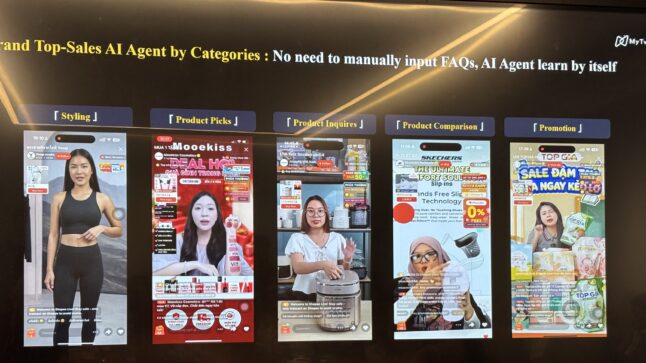
We just finished up Phase 2 of our Alibaba Ecommerce Training Program. This is our program (in partnership with Alibaba) for training ecommerce entrepreneurs.
- Phase 1 was a month of classes on ecommerce entrepreneurship. We cover everything from long-term strategy to AI marketing.
- Phase 2 was a week in Hangzhou doing classes at the Alibaba headquarters. And also visiting local companies.
The program really went well. I think it’s a pretty unique training offering.
And on Day 3, we went to visit the frontlines of livestreaming, which was fascinating. I spoke about this on a recent podcast.
Here are my conclusions.
Point 1: In Ecommerce, Digital Livestreamers Have Arrived
After Rstar, our group went across town to visit mytwins.ai, which is a pioneer in digital (i.e., non-human) livestreamers.
This visit kind of blew my mind.
I have been watching digital livestreamers emerge. And I was waiting to see when (and if) they would be acceptable replacements for humans.
Well, that moment has arrived.
In many (not all) product categories, digital livestreamers are definitely succeeding. Here’s a chart from mytwins.ai.
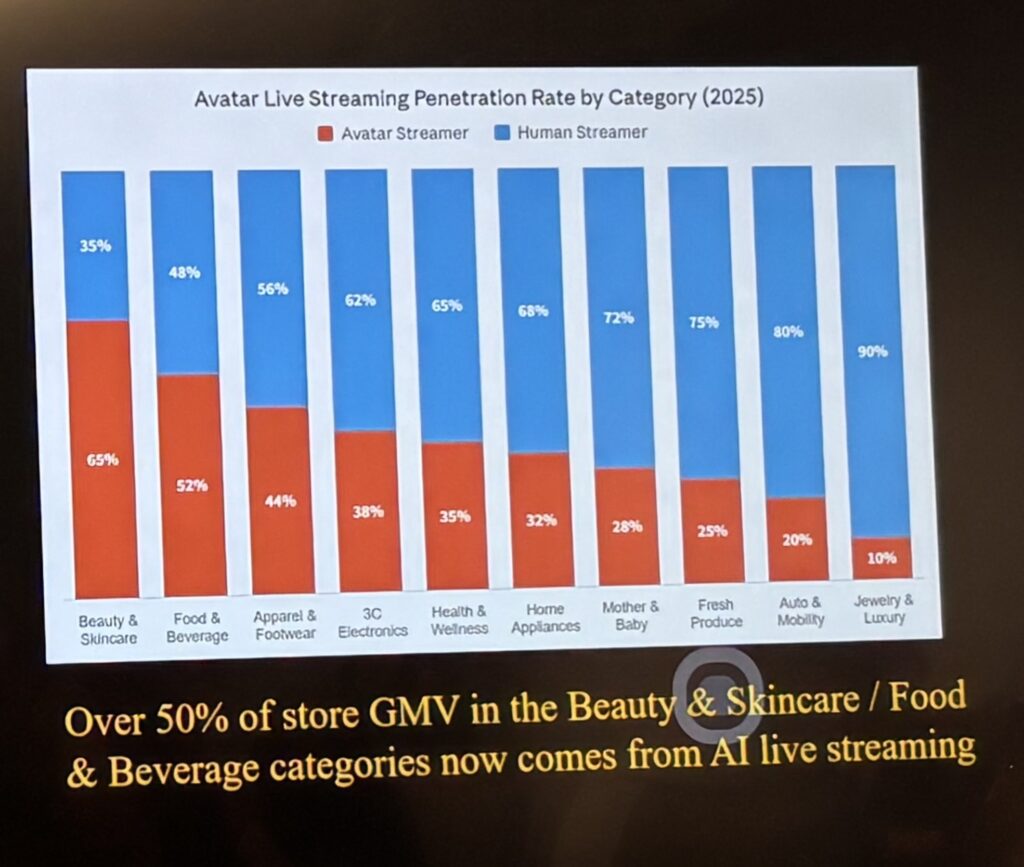
Note the red bars. That is the penetration of digital livestreaming by category.
My questions are:
- Can viewers tell the digital avatars from the humans? That’s the uncanny valley question.
- Do viewers care? For a specific product category.
The first question is almost over. You can’t tell them from humans easily. And I think this will be the last year before the tech is perfected.
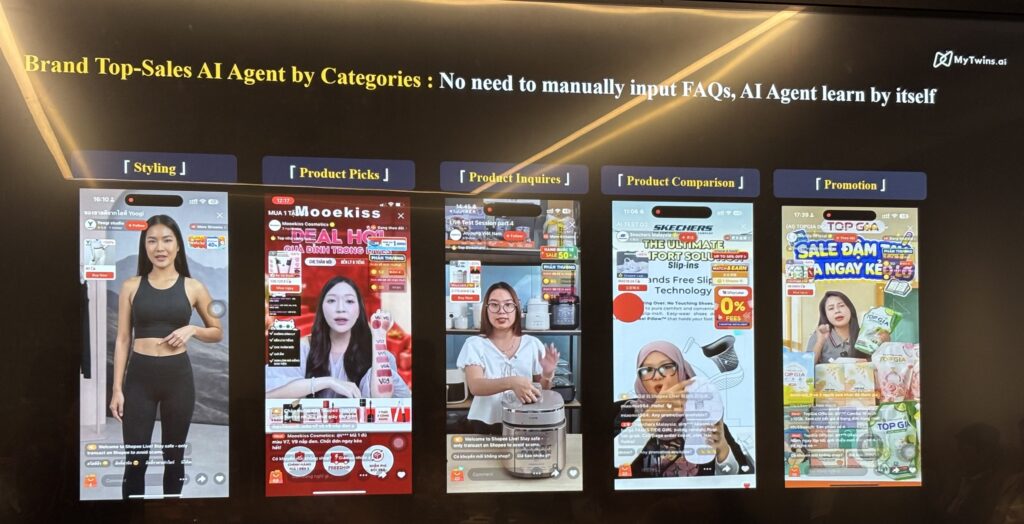
Here’s a slide from mytwins.ai. One of these livestreamers is not human.
That second question is pretty interesting.
If I am watching a livestreamer (or video creator) to find a good café or restaurant in Paris, I want the livestreamer to be human. I do not want to hear food recommendations from non-humans.
But if I am choosing between two washing machines, I don’t really care if it’s a human. The specs and features are clear. It’s not about taste and experience. It’s just functionality. And a digital KOL is totally fine.
My working conclusion:
In ecommerce, digital livestreamers are going to take off fast and in huge volume.
Note: the livestreamer on the left above was not human.
Point 2: Digital Livestreamers Have Powerful Advantages Over Humans
Digital livestreamers are a solution to the very large and long-standing problems of human livestreamers. Human livestreamers are:
- Labor intensive and expensive.
- Non-scalable. Both at the individual and the collective level.
- Talent, not data, dependent.
- Scandal prone, which impacts brands associated with livestreamers.
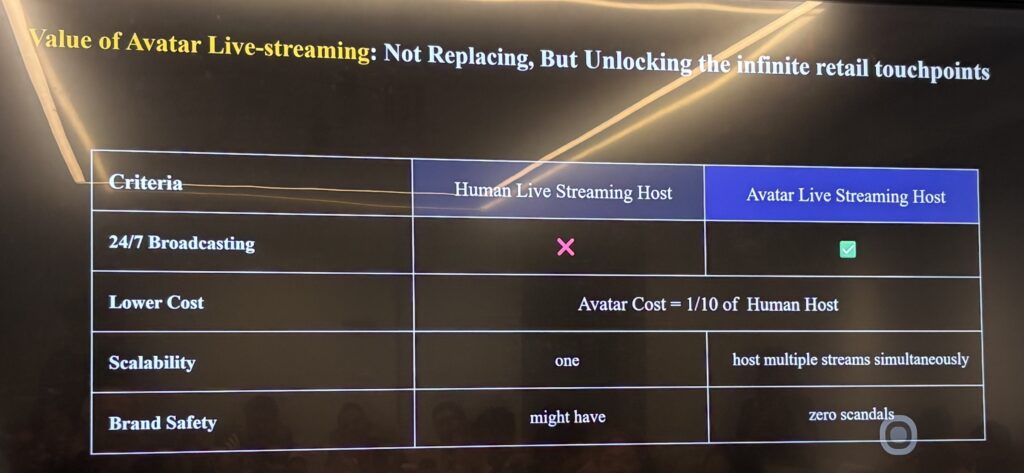
Here’s how digital livestreamers compare:
That is a powerful solution.
- Digital livestreamers can operate 24/7
- They are 1/10 the price humans. At least.
And that violates my number one rule in business:
Rule #1: Never compete with free
They can also scale. If you have one effective livestreamer, why not deploy 100?
And why not make each version a bit different? Different languages, different settings, different personalities, etc.
Because software is really good at offering lots of variations for different customer subsegments.
Which brings me to my number two rule in business:
Rule #2: Never compete with software
It’s not that software is cheap. It can scale cheaply without limit. It has no capacity limits. And it can do endless permutations.
In a fight between humans and software, software always wins.
So digital livestreamers are just a really powerful solution. And it is not a surprise that brands are very interested.
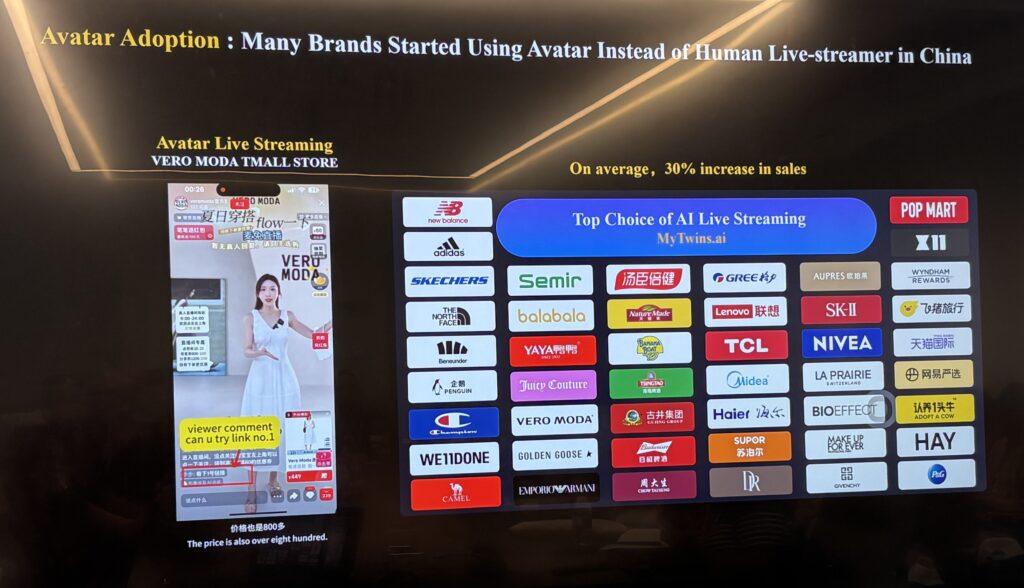
Mytwins.ai founder Bin Du says their missions is to “Help brands increase sales at lower cost.”
That’s a great mission statement. Really direct and to the point.
She also outlined the process of building a digital livestreamer, which was fascinating. It had three steps.
Step 1: Generate Live Content That Builds Trust
The power of human livestreamers is trust and authenticity.
- You know it’s a real person, not a corporation. That makes their opinions more authentic (usually).
- There is a level of fan behavior where you like the person.
- The back-and-forth interactions are interesting.
So, the big hurdle for a digital livestreamer is to build this type of trust and authenticity (and likeability).
Trust starts with product selection.
You need to choose quality products that people actually like. If you’re not selling the right stuff, you won’t succeed.
But then it’s about the personal likeability and trust factor.
That’s intangible and, as mentioned, rare. Talent and the “it” factor are uncommon.
Well, it turns out you can just train your AI to have this.
And you do it by training them on human livestreamers that have trust, likeability and fandom. Whatever people are connecting with online, you just copy. The AI can create a similar avatar. It can match the speech patterns, the looks, the mannerisms, the spoken content, etc. It turns out the “it” factor can be copied.
Step 2: Turn Traffic into Sales. And a Brand.
You’ve got people watching. And trusting (to some extent).
So how do you convince people to actually buy?
Well, there are several activities within that process that you can measure and improve. This includes:
- The greeting
- Introducing products
- Answering questions
- Offering promotions
- Substituting alternative products based on real-time feedback
This can all be modeled, measured, and improved over time.
And this turns into brand building, which is interesting.
Building an avatar that can sell your product is really about building a brand ambassador. Customers start to associate your brand with the livestreamer. It becomes the face of the brand.
That makes sense.
What is more powerful in terms of brand equity? A logo and packaging or a human face that can speak about the product?
So as traffic becomes sales, your brand starts to shift from a logo to a digital avatar that represents you.
That is super interesting.
And fortunately, digital avatars don’t have scandals that can later damage your brand.
Step 3: Improve with a Feedback Loop
This is the other superpower of software and AI.
It can learn and improve over time with data.
Humans can do this as well. But AI can process thousands of data points and make micro-changes in every aspect of the livestream.
The viewership, sales and comments are tracked. There is lots of AB testing. And everything in the livestream (it is all AI generated) can be fine-tuned over time. The hair color. The expressions. The tone of voice. The responses to certain questions. The timing and types of promotions. Everything.
And if have lots of digital avatars, they can all make each other smarter. The feedback loop scales up nicely.
Here are some examples of sub-questions the system can focus on improving.
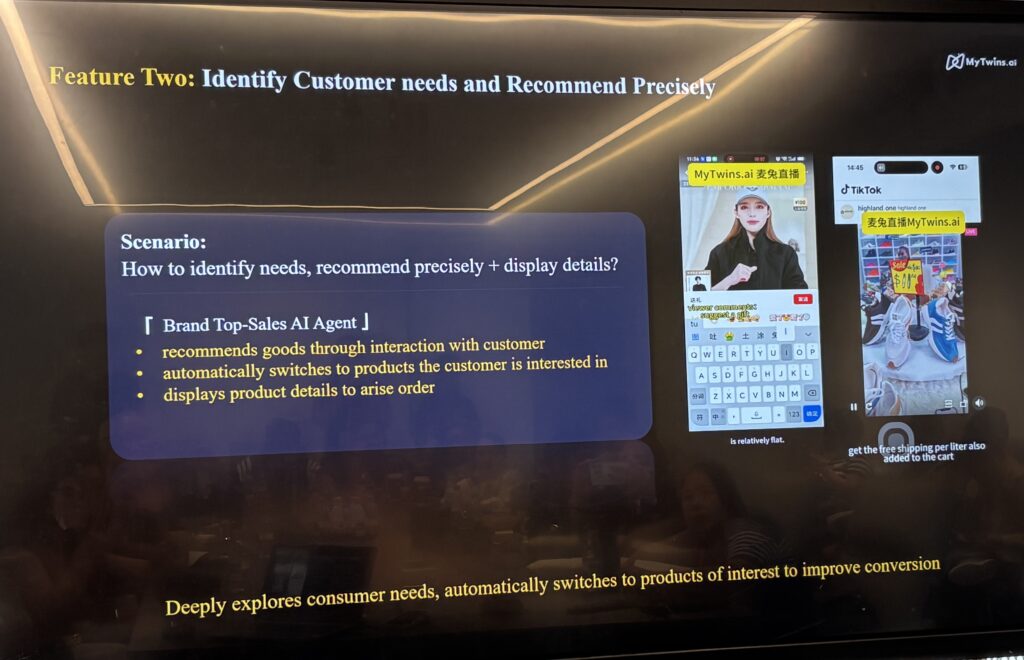
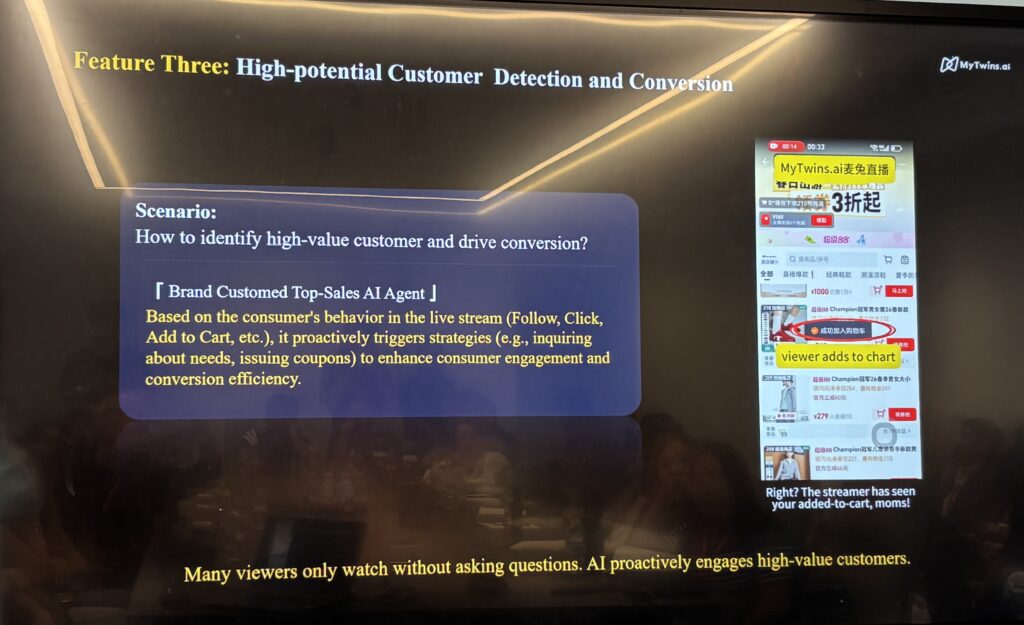
Here’s a summary of the 3 steps.
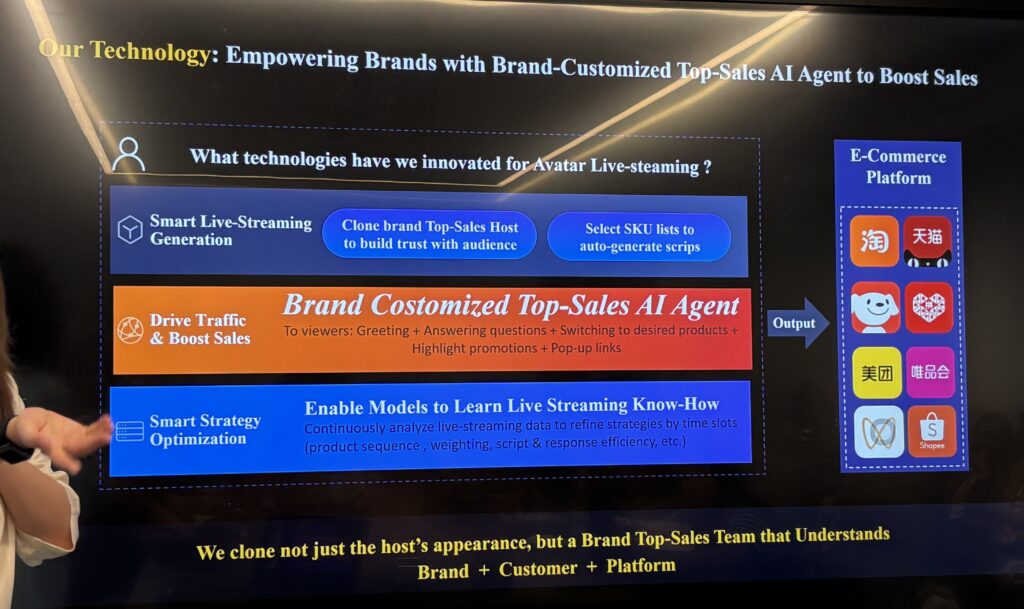
Point 3: Human KOLs Have Already Peaked
It’s clear that human-based content creation has peaked. It’s labor intensive. It doesn’t scale easily. There just is a limit to how much content 8B humans can make being in front of the camera.
AI-created content doesn’t have limitations. 800B agents can create content 24/7.
I expect non-human content (including livestreaming) to dwarf human based content in pure volume. And that means non-human KOLs will vastly outnumber human KOLs.
So how real is this today?
At the Tencent Forum at WAIC, the CEO of Huya gave a talk about Vivid Avatar Models (basically digital humans). He said the digital human sector (not just livestreaming) is almost past proof of concept.
There are still some technical challenges, such as:
- Simulation fidelity. They can sometimes seem a bit stiff.
- Long duration generation. Cumulative error drift is a problem
- Real-time interactivity. They are good at talking. But listening and then replying seamlessly is still a problem.
He said the primary use cases for digital humans are:
- Ecommerce livestreaming. You can create a digital twin of yourself. Or deploy a comment assistant.
- Talent livestreaming. Such as singing and dancing.
- Gaming interactions. You can have gaming companions.
- Gaming item ecommerce. Offering real-time product presentations and Q&A.
I think it’s going to get perfected very fast.
All the big tech players (Tencent, JD, Alibaba, ByteDance) are working on this.
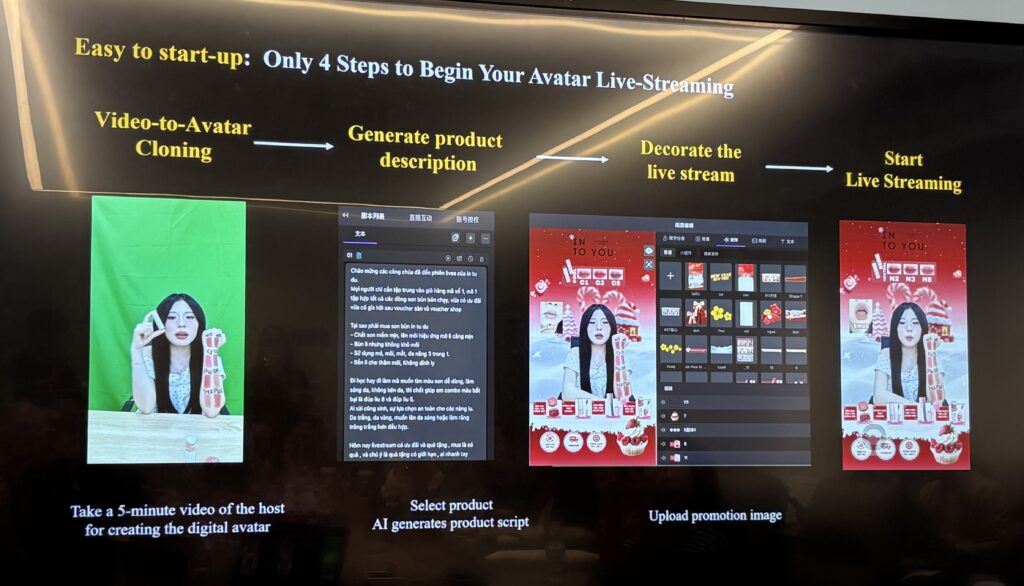
And they are going to make this super easy for businesses and individuals to set up and run. Huya says it can generate digital avatars with just a single photo. Here’s how mytwins.ai does set up.
Final Question: So, What Should Humans KOLs Do?
Digital avatars are coming. We already see them in videos. And now livestreaming (which is more complicated) is almost ready.
Ecommerce livestreaming is likely the first big sector.
But entertainment and thought leader / commentary livestreamers will be next.
So, what should a KOL do?
Here’s my playbook for human KOLs.
1. Human KOLS need to refocus on topics where people want a real human.
I would focus on:
- Taste and curation. Focus on something where the human experience and taste matters. Like choosing restaurants and music.
- Irreversible or critical decisions. Focus on situations where people or businesses can’t afford to be wrong. Where they can’t do it over. In those cases, they will want human judgement.
- Advancing frontier of knowledge? It helps if there isn’t a huge body of online thinking that the AI can ingest. Staying on the frontier helps. But this may be disappearing.
2. Human KOLs need a multi-pronged approach.
I would focus on:
- Direct, personal and in person relationships. Being in person is the best. So, if you’re a musician, host concerts. If you’re a thought-leader, hold roundtables and townhalls. For online, you want to focus on building direct and personal relationships. Online discussions. Lots of Q&A. community building. Traffic is increasingly unstable and unreliable. It’s all about personal and direct relationships.
- Do super authentical human videos. Video still gets the most eyeballs. So, you need to make videos (live or other). But you want to make sure your videos are 100% human. Film yourself walking on the street, not in a studio. Don’t speak perfectly with a world class vocabulary (clear AI now). The best formats for human authenticity are debates and interviews. Two people talking is great.
- Deploy an avatar army. You can’t just put out occasional human videos into the sea of AI-generated videos. You will get lost in the volume. So, you need to significantly increase your volume and that means deploying your own army of content creators. They could be replicas of yourself. Or lots of variations with your thinking. If you look up Professor Jiang on YouTube (he talks about geopolitics), you will find most of the videos of him are clones.
***
Ok. That’s it. In the last article, I’ll mention some of the fun stuff.
Cheers, Jeff
——
Related articles:
- AgiBot’s Race to Embodied AI Robots at Scale (1 of 2) (Tech Strategy)
- Why I Like AgiBot (Podcast 290)
From the Concept Library, concepts for this article are:
- KOLS and Livestreaming
From the Company Library, companies for this article are:
- mytwins.ai
——
I am a founder, consultant and keynote speaker specialized in digital and AI agentic strategy.
I am the founder of Agentic Org Now, a firm that helps leadership teams launch AI and agentic initiatives fast.
I write (a lot) about digital and digital AI strategy (3 best selling books, +2.9M followers on LinkedIn). You can get a free book at the email sign-up below.
My Moats and Marathons book series is a framework for building and measuring competitive advantages in digital and AI businesses.
This content (articles, podcasts, website info) is not investment, legal or tax advice. The information and opinions from me and any guests may be incorrect. The numbers and information may be wrong. The views expressed may no longer be relevant or accurate. This is not investment advice. Investing is risky. Do your own research.