


This article series is a summary of what I learned at the e Global Digital Ecosystem Summit in Shenzhen. In the first part, I said that:
Lesson 1 was that the big prize is agentic-first organizations.
Which brings me to…
Lesson 2: WorkBuddy is the Center of Tencent’s Agentic Strategy
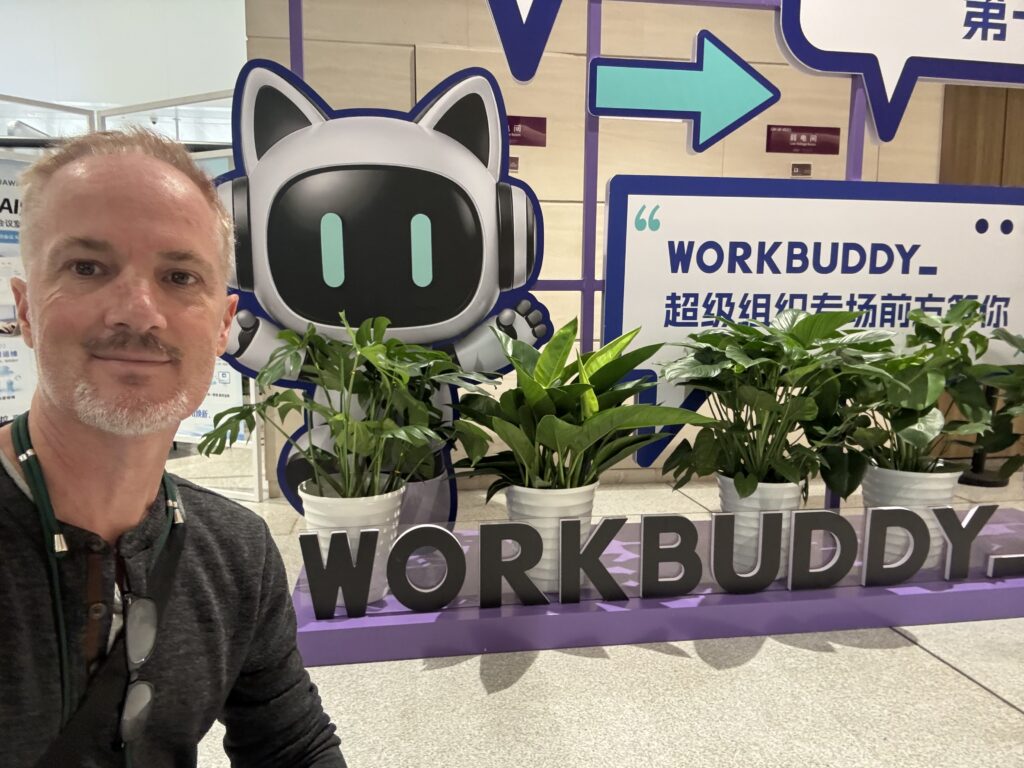
Management has said WorkBuddy is their flagship agentic product this year. And they are putting it everywhere. It is going into like every one of their products.
However, Tencent does have other buddies, which I have written about here.
Buddies are just agents that are designed to be really easy to deploy and use. Which they really are. You can ramp up any of them in minutes.
Tencent’s other “buddy” products include:
- CodeBuddy. Which obviously does coding.
- Marvis. This controls your PC. Marvis is a play on Jarvis from Iron Man. Although the mascot is a horse (see below).
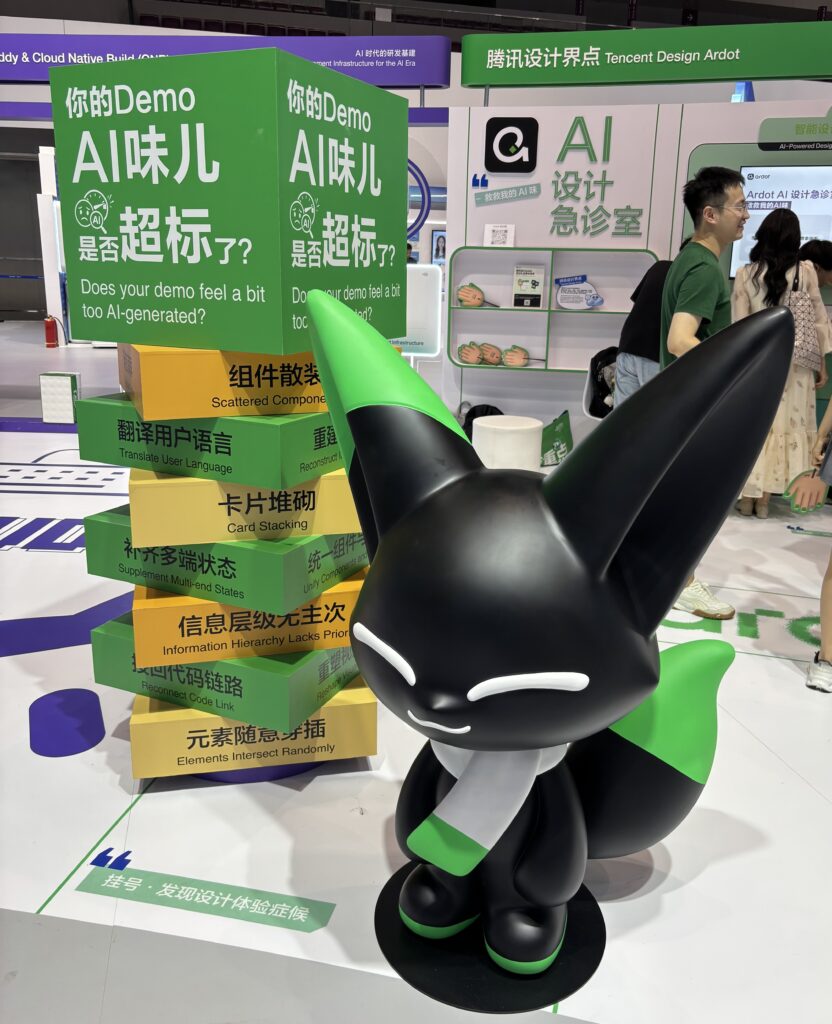
- Ardot. This does design, specifically in the user interface. The mascot is a bunny with green ears (below).
- Miora. This also does design but focused on videos / images for gaming, ecommerce and tv/movies. The mascot is a strange black creature (below).
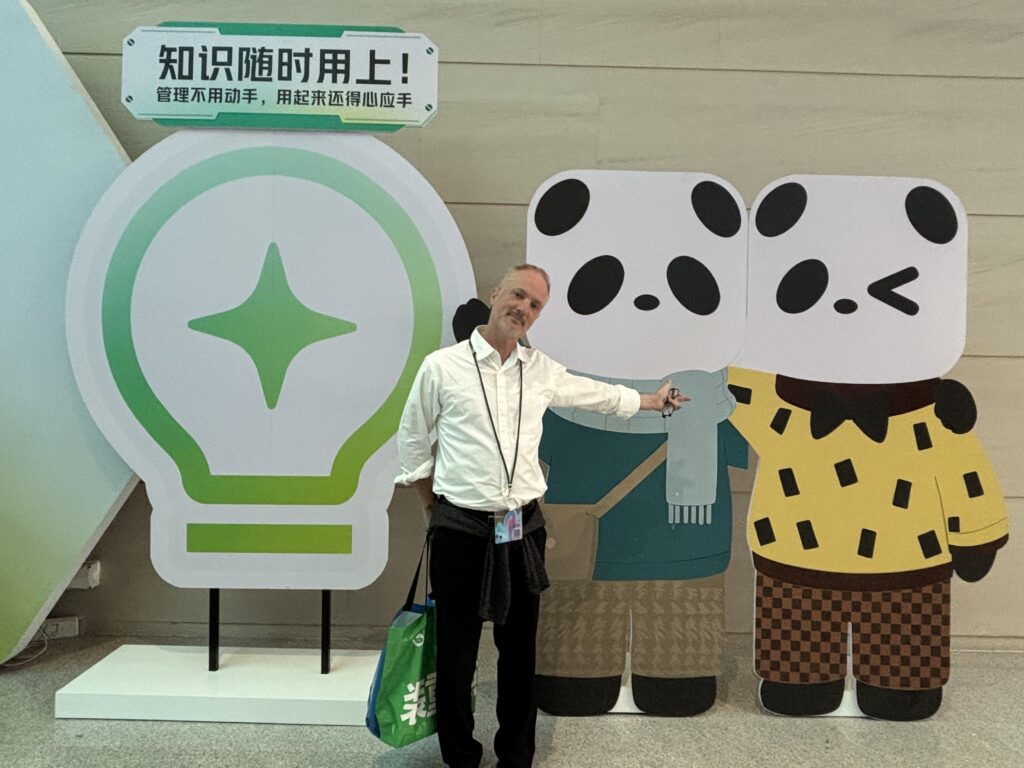
- ima Copilot. This is their knowledge database. The agent is like a librarian. The mascot is a panda. The enterprise version of this is LearnShare, which is more focused on collaboration and teams.
- DataBuddy. This is the big new one to watch. The mascot is an otter.
- Yuanbao. Their AI Assistant (like ChatGPT). Not really an enterprise buddy but on the list.
- Toast. A vibe coding tool for mobile apps. Yes, the mascot is a piece of toast.
- And of course, WorkBuddy, the enterprise agent. Which is emerging as the “one buddy to rule them all.”

The Other Buddies Are Becoming WorkBuddy’s Sub-Agents (Somewhat)
The big four emerging appear to be:
- WorkBuddy for enterprise. And to run the rest.
- CodeBuddy for coding.
- Ardot / Miora for design.
- DataBuddy for data.
WorkBuddy Sits Between Users and Corporate Systems and Capabilities
Dowson had a good slide about how WorkBuddy is becoming the key component between the users (who are using messengers such as WeChat, WeCom, Telegram, etc.) and the various corporate capabilities (such as ERP, CRM, etc.).
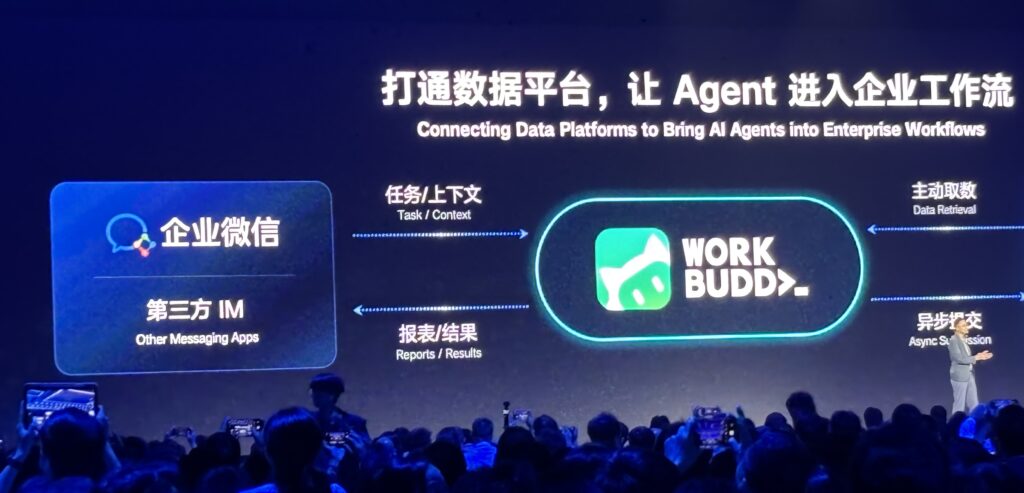
Within this, WeCom (Tencent’s work messenger) is the most important on the user side. And Qidian (the marketing services) is arguably the most important enterprise capability right now.
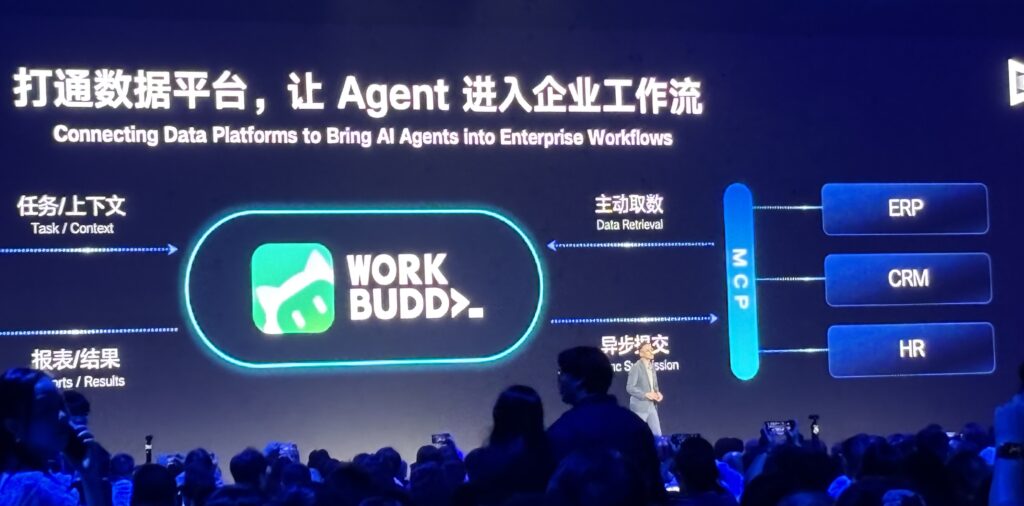
Tencent’s Playbook: Own the Hub, Open the Ecosystem
Note the approach to building an agentic enterprise we see by Tencent. I think we can see their ultimate strategy now.
- You put an agentic platform (WorkBuddy) between the users and in-house capabilities. That is what handles the orchestration.
- In this case, they highlighted WeCom and Qidian.
- This platform has an increasing suite of enabling capabilities. It lets you manage the memory (increasingly shared), identity, security, and the governance management. We are starting to hear the term “WorkBuddy Managed Agents”.
But they do not limit the agents to their own internal capabilities and products.
- Tencent expands from its own tools to as wide as possible an ecosystem of partners and their tools.
- You don’t have to use WeChat or WeCom for the user interface of WorkBuddy. You can use Telegram, Slack or whatever.
- You also don’t have to use Tencent’s Hy models. You can use DeepSeek, Kimi or whatever you want.
- You don’t have to use their Qidian for your marketing services. You can use non-Tencent services.
You can see this ecosystem approach across their agentic strategy.
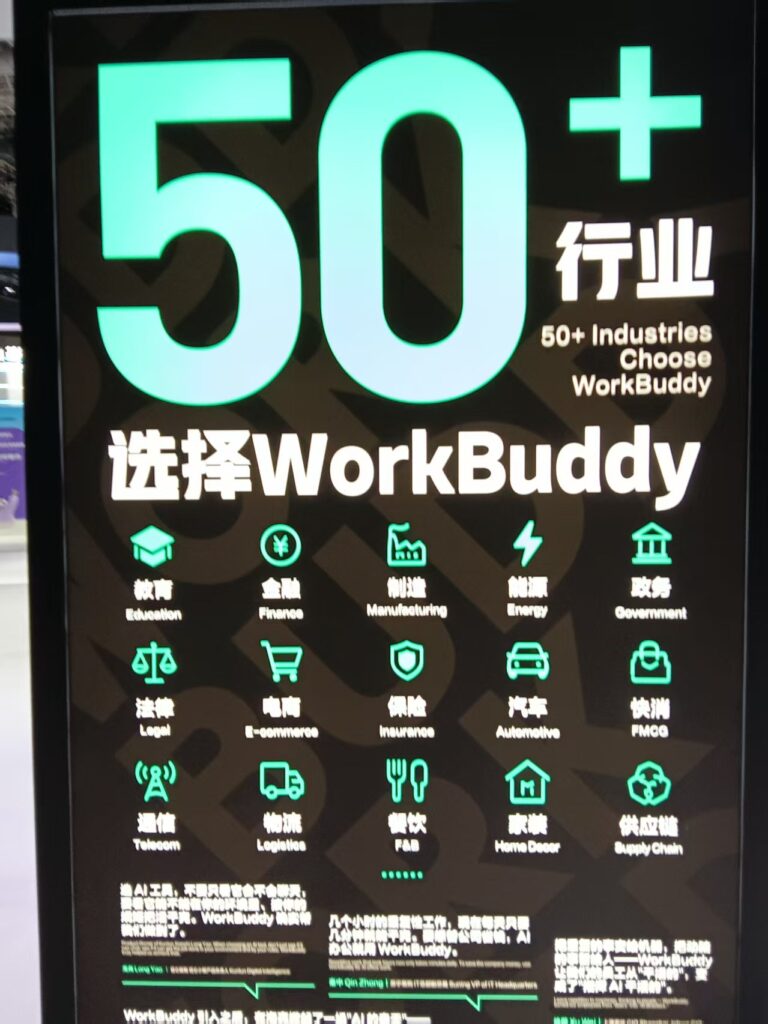
Let’s give a simpler, more focused example of this approach.
Lesson 3: Buddy One Brings WorkBuddy Into the Corporate Office
One scenario Dowson talked about was Buddy One, which was launched at the event.
Buddy One is basically Tencent’s agentic strategy applied to the corporate office. Think of lots of people in an office working on their laptops with Word, Excel, email, messenger, and other programs.
And they are having lots of meetings and discussions. And doing lots of document sharing.
What is an agentic system for a typical office scenario? That’s Buddy One.
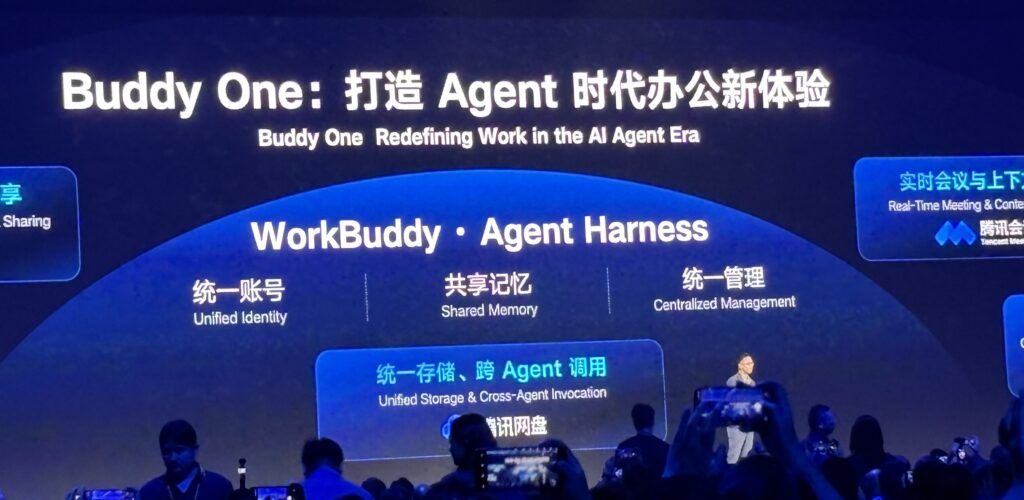
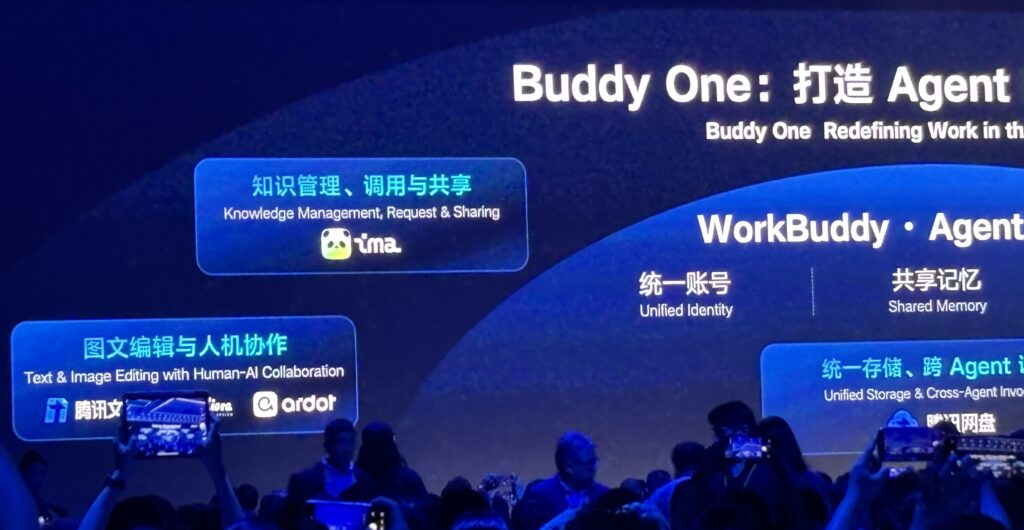
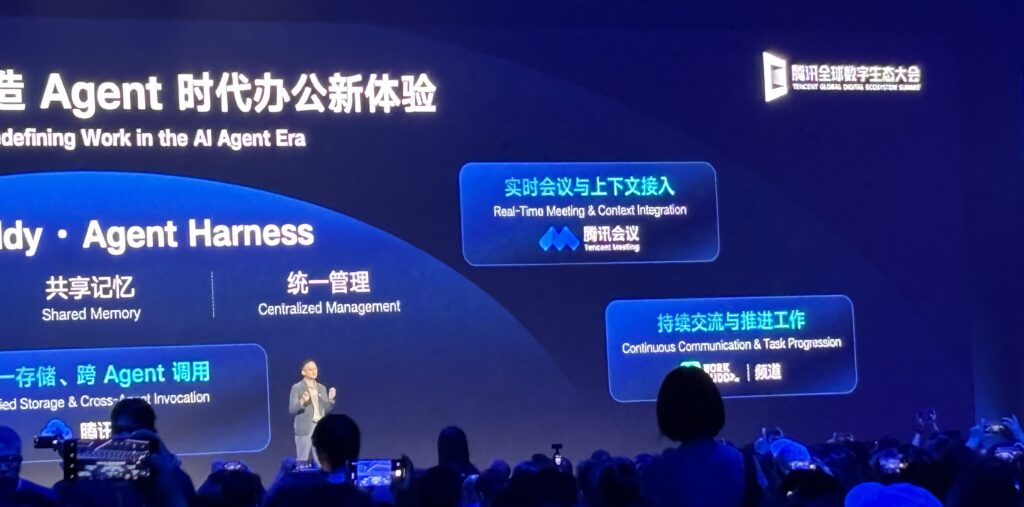
In the slide, you can see Buddy One is centered on WorkBuddy with an Agentic Harness. WorkBuddy is the user interface and engine. The harness sets the rules and executes.
And this is supported by unified identity, shared memory, and centralized management / governance.
And around this core is a mix of products and services you can connect with. Both by Tencent and external.
This is basically the strategy I just discussed.
- The products and services used in an office are increasingly smart and connected. And you can make them autonomous by connecting them with agents. The ones mentioned here are ima, Tencent Meeting, and Tencent Docs. They all have agents now and are intertwined with WorkBuddy. So, it’s lots of agent-to-agent collaboration.
- There is a shared platform with a common memory (in progress). That means sharing knowledge and context across apps.
- There is clear identity set across the ecosystem.
- There is appropriate and easy management oversight, which includes security, compliance, usage, etc.
Buddy One Connects and Automates Office Apps with Agents
Take a look at some of the resources that Buddy One can call upon.
- Ima. As mentioned, this is Tencent’s knowledge management database (with its own agent). I’m sure they also have LearnShare connected, which is Tencent’s corporate version of knowledge management with greater emphasis on teams and collaboration.
- Tencent Docs, Miora, and Ardot are put together with other text and image tools. I’m sure they have a growing list of external options here as well.
- Tencent Meeting. This is pretty cool. I’ll write about this in another article.
- Communication and management tools. This is the user interface for discussions and controlling agents.
You can see how the focus is not just on making these tools available for an individual user. It’s about enabling cross-app orchestration and workflow collaboration. This is about creating an agentic organization in a corporate office. It’s only domestic for now.
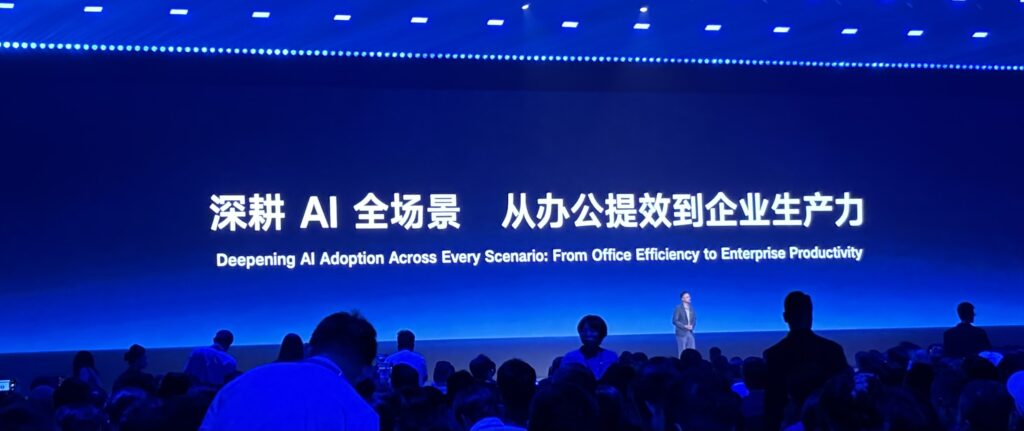
Overall, the office is a good scenario to focus on.
Lesson 4: Hy4, TokenHub and ADP Are Big Upgrades for WorkBuddy.
Dowson brought up both Hy4 and TokenHub.
And these are important for how successful WorkBuddy will be. These are a big part of the engine.
Hy is Tencent’s rapidly advancing suite of foundation models. They are moving really fast. And it now has everything from frontier level models to multi-modal. Hy4 is set for full release soon.
However, TokenHub is what I am watching most.
I use WorkBuddy all the time. And I like that I can switch between Hy and DeepSeek. You can do the same on Yuanbao.
But with WorkBuddy you can increasingly switch between any of the models you want. They have all the Chinese models (Kimi, GLM, Qwen). And they should have Western ones. Access to a big suite of models (including low-cost Chinese ones) is a big part of the value proposition of WorkBuddy, especially internationally.
TokenHub Lets You Switch Models Seamlessly
TokenHub is Tencent’s unified, one-stop AI model gateway and marketplace.
TokenHub acts as an operational middleware layer that consolidates multiple foundational AI models into a single, OpenAI-compatible API surface. It is designed for enterprise teams and software developers to easily switch between model providers. They can route traffic dynamically. And manage billing without refactoring code or writing custom connectors for each model vendor.
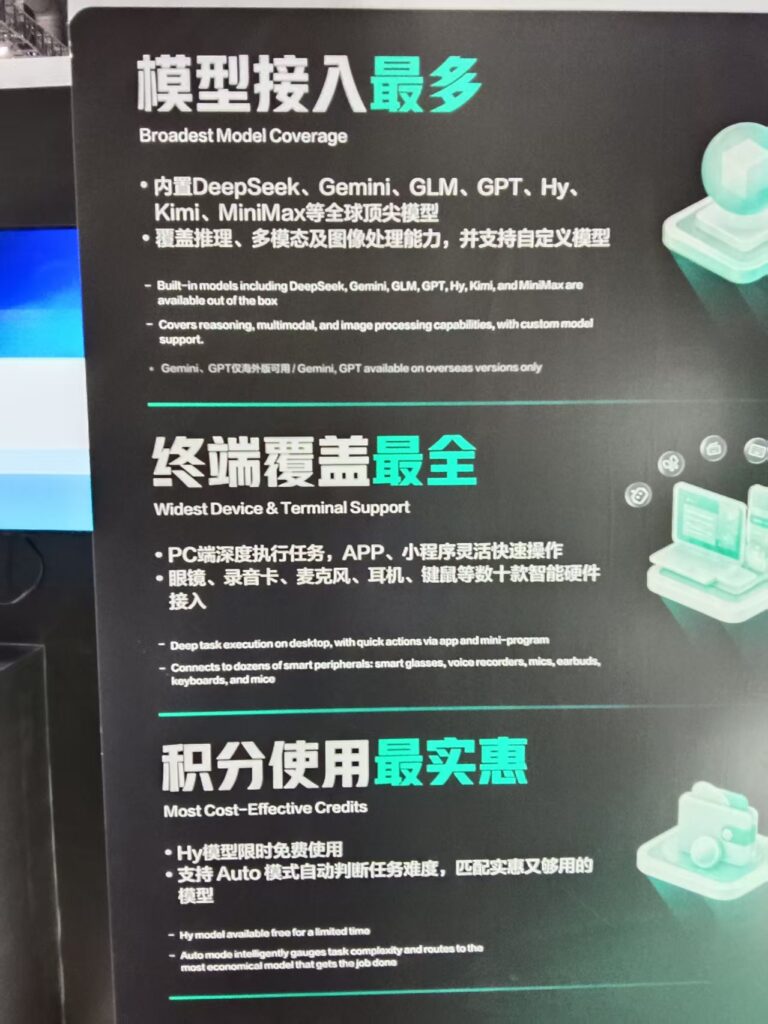
This is a big part of Tencent’s offering. Which is:
- Broadest model coverage
- Widest devices and terminal support
- Most cost effective credits
That’s the simplest version of the WorkBuddy value proposition. Which you can see published really clearly.
Finally, there is ADP, which is Tencent Cloud’s Agent Development Platform. This is an enterprise-grade platform for building, orchestrating, deploying, and managing AI agents. I wrote about ADP here:
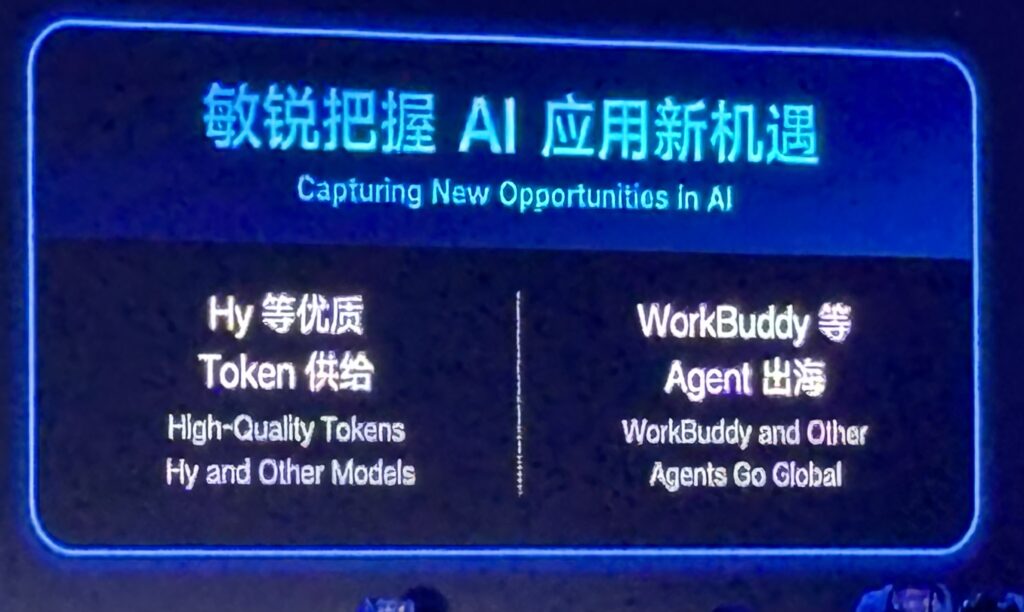
I won’t go through it again. But ADP, TokenHub and Hy are really important.
Lesson 5: Companies Won’t Go Agentic Until They Trust the Entire System
Giving parts of your operations over to autonomous software is risky. It makes everyone uncomfortable. We instinctively want humans in the loop for this reason.
To take your hands mostly off the wheel, you really have to trust the system. And you need to have total transparency and control. You also need to really trust the security.
So that’s a big part of agentic strategy. And WorkBuddy as a product. You’ll see words like reliability, reassurance, transparency, control, governance and security everywhere. You need to have the entire system in place and secure before you go too far down the agentic path.
Plus, you need to trust your partner.
- Who holds the data? Who has access to it?
- What about the intellectual property of our business? Am I giving away the alpha?
- How much do I do in house versus with a cloud partner?
I generally like Grok Bot’s position in agents. And I basically trust Tencent’s position on this stuff as well. It’s your data, your system, etc. And nobody gets locked in.
For comparison, I don’t trust OpenAI or Anthropic at all.
Tencent’s pitch is:
- Works everywhere
- High performance
- Greater assurance
Lesson 6: Tencent Cloud is Going Global with Agents. AI Infrastructure Too.
Ok. Last point.
Dowson spoke about the international growth of Tencent Cloud. Tencent’s numbers are that its active overseas customer base doubled over the past year, and that international demand for its AI products grew by triple digits.
An interesting part of this international story is that Chinese companies are going global. And most all are using their home partners (Tencent Cloud, Alibaba Cloud) to go international. Dowson mentioned that 9 out of 10 of the Chinese Internet companies operating globally are using Tencent Cloud.
Expect a DeepSeek Moment in AI Data Centers
Another interesting part of this story is the building of low cost AI data centers around the world. We see lots of AI data centers being built around the world by Alibaba, Tencent and Huawei.
Last year, DeepSeek shocked the world with its low cost, high quality AI models. I fully expect to see a similar DeepSeek moment in hardware and data centers. Watch out for low cost, high quality AI data centers to be available along with their AI models. Dowson called this “cost efficient infrastructure”.
***
Ok. That’s it for Part 2. I’ve got lots more on the way.
Cheers, jeff
Disclosure. I have had a paid consulting relationship with Tencent in the past twelve months.
——–
Related articles:
- HY4 Preview Is Here. Plus, WorkBuddy Gets 3 Updates (2 of 4) (Tech Strategy)
- More High-Tech Flex by Huawei R&D (4 of 4) (Tech Strategy)
- 6 Big Events in AI Agentic Ecommerce (Tech Strategy)
From the Concept Library, concepts for this article are:
- Agentic Strategy
- AI Agents
From the Company Library, companies for this article are:
- WorkBuddy
- Tencent Cloud
- CodeBuddy, Ardot, Miora, Yuanbao
- Buddy One
——-
I am a founder, consultant and keynote speaker specialized in digital and AI agentic strategy.
I am the founder of Agentic Org Now, a firm that helps leadership teams launch AI and agentic initiatives fast.
I write (a lot) about digital and digital AI strategy (3 best selling books, +2.9M followers on LinkedIn). You can get a free book at the email sign-up below.
My Moats and Marathons book series is a framework for building and measuring competitive advantages in digital and AI businesses.
Note: This content (articles, podcasts, website info) is not investment advice. The information and opinions from me and any guests may be incorrect. The numbers and information may be wrong. The views expressed may no longer be relevant or accurate. Investing is risky. Do your own research.
