



This week’s podcast is about agentic organizations. And how Tencent Cloud is aiming to offer services to enable any business to become agentic-first.
You can listen to this podcast here, which has the slides and graphics mentioned. Also available at iTunes and Google Podcasts.
Here is the link to Agentic Org Now.
Here is the link to our Tech Tours.
Here are the slides:

Here is my not-serious breakdown of tech vs. thinking.
-Disclosure. I have had a paid consulting relationship with Tencent in the past twelve months.
—–
Related articles:
- WorkBuddy Is Now the Hub of Tencent’s Agentic Strategy (2 of 5) (Tech Strategy)
- HY4 Preview Is Here. Plus, WorkBuddy Gets 3 Updates (2 of 4) (Tech Strategy)
From the Concept Library, concepts for this article are:
- Agentic Enterprises
- AI Agents
From the Company Library, companies for this article are:
- WorkBuddy
- TokenHub
- ADP
- Tencent Cloud
- CodeBuddy, Ardot, Miora, Yuanbao
——-transcript below
00:05
Welcome, welcome everybody. My name is Jeff Towson and this is the Tech Strategy Podcast from Agentic Org Now and the topic for today, Ten Cents Big Audacious Plan to Make Every Business Agentic First. And this is actually kind of important. mean, for me, this is arguably the single most important thing in business right now.
00:29
Like number two on my list of single most important things to understand was basically my podcast last week, which was about the idea of agentic commerce. What happens to commerce, e-commerce, retail, how people buy and sell in this world when agents are major players in everything. That’s a super important topic. This is bigger. This is the idea of what happens when organizations
00:58
productive organizations, productive industries, things that produce things in this world, are no longer mostly about humans, but the fundamental unit of productive capacity is an agent. Now you’ll also have humans and robots, but when these businesses, organizations, whether it’s business, government, whatever, are agentic first, what does that look like? How does that work? And I’m going to sort of put…
01:25
a stake in the ground on what I think it’s actually going to work and what you should start building towards. And I’m going to mostly copy, let’s say 70 % copy what Tencent is doing because this is definitely the number one question they’re working on right now. And I’ll give you sort of their playbook in my opinion. So that’ll be the topic. The big plan to make every business a gen dick first. That’s the topic for today.
01:52
Let’s see, housekeeping stuff. I have a new email sign up at jeffthousand.com or you can go over to agenticorgnow, which is basically a weekly email about basically the agent frontier, things to know about agentic organizations. If you sign up, you get a free copy of my book. Take a look. I’m going to be doing a lot more of that. It’s very sort of short, directly usable, and really easy to digest as opposed to these long form content I normally do.
02:21
which I’ll keep doing as well. So if you’re interested in that, you can go over to jifthousand.com and see that. Other stuff, if you’re willing to share or review this podcast, that’s very, very helpful to me. I would appreciate it if you could leave a review in doing that. Okay, standard disclaimer. Nothing in this podcast of my writing or website is investment advice. The numbers and opinions from me and any guests may be incorrect. If using opinions express me, it’ll no longer be relevant or accurate. Overall,
02:48
Investing is risky. This is not investment, legal business or tax advice. Do your own research. And with that, let’s get into the topic. Okay, full disclosure, I have had a consulting agreement with Tencent within the last 12 months. However, podcast writing all thoughts are always my own. All right, now the big topic here, the word audacious. I’m curious if anyone picked that up. There’s a something we learned in business school a long time ago called the BHAG.
03:16
You got to have a BHAG, which is a Big Hairy Audacious Goal, in your business. I’m not sure that’s totally true, but it’s a good phrase to remember. It’s very easy. OK, to me, this is Tencent Cloud. I Tencent’s got a lot of business. So we’re talking about the cloud business, really, not to say gaming. To me, this is their BHAG, their Big Hairy Audacious Goal, which is to make every business agentic first.
03:45
industry, every scenario, every size, and they are rolling out product after product after product to make this very easy to do for any business by signing up for their services. I’ll over the next, you’ll probably take another podcast to get through this, but I’ve sent out two emails about this already. I’m going to send out really the big one in the next day.
04:11
where I’m kind of laying out the capabilities and architecture for what a agentic-first enterprise looks like. And this is mostly Tencent’s model, because they’re basically offering all the pieces you would need as services. So they’re kind of rolling out products that would give you everything you need to be agentic-first in this world. So that’s a pretty good stake in the ground in terms of what these things are going to look like, probably.
04:39
Anyways, that’ll be the big emails coming in a day. I’m kind of excited about that one. I’ve been hunting for the answer to this question for a long time. I feel like I’m getting close. I’m not there yet, but it’ll take years to get there. But I feel like I got the right question and I’m making progress. So anyways, a couple of weeks ago, I went out to Tencent’s Global Digital Ecosystem Summit, which is in Shenzhen every year in October. It’s one of my favorite conferences. I got a short list of conferences I really, really like in China.
05:09
WAIC, the World AI Conference, the Robot Conference, Tencent or Huawei Connect, Alibaba, Aspara, which is another, those are basically cloud conferences, these last three. And then Tencent’s Digital Ecosystem Summit. I don’t know why they don’t just call it the Tencent Cloud Conference, because that’s kind of what it is. It’s for businesses and developers who are building things. Okay, so I was out there, fantastic time, really a lot of fun.
05:39
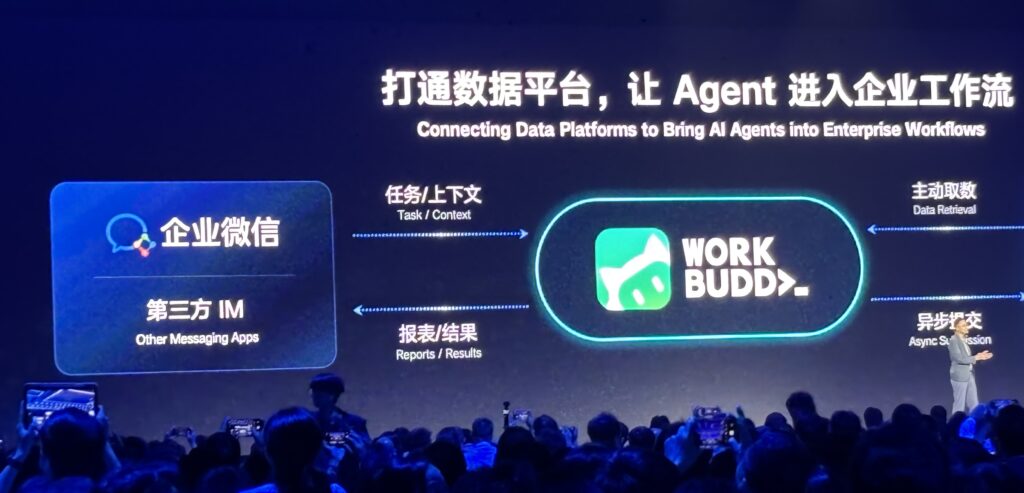
The first thing you notice is Tencent Cloud, which has a million things. mean, there’s products and services everywhere. They got such a huge suite of products. It’s crazy. But WorkBuddy is everywhere. It was all over that conference. Now I’ve written before that, you know, Tencent is sort of framing agentic capabilities as buddies. And these are like your buddies. You can bring them in and use them for various things. And there was about nine of them.
06:09
I wrote an article about this about six months ago. There was about nine of them. Yuan Bao, which is more like a consumer AI service, kind of like ChatGPT. There was R.DOT and Miura. Those are both design-related image generation, video generation, things like that. CodeBuddy, WorkBuddy, there’s DataBuddy. There’s one called Toast, which is…
06:35
Basically a little agent that lets you spin up simple mobile apps very easily and cheaply. It’s a little bit like Volcano Engine by Dance. What else? Marvis, which is named after Jarvis from the Iron Man movies, which basically takes control of your laptop and you can let it do it. And they got a whole bunch of them. They’re really boiling that down to a handful. And it looks like Work Buddy is going to kind of be the one buddy to rule them all.
07:04
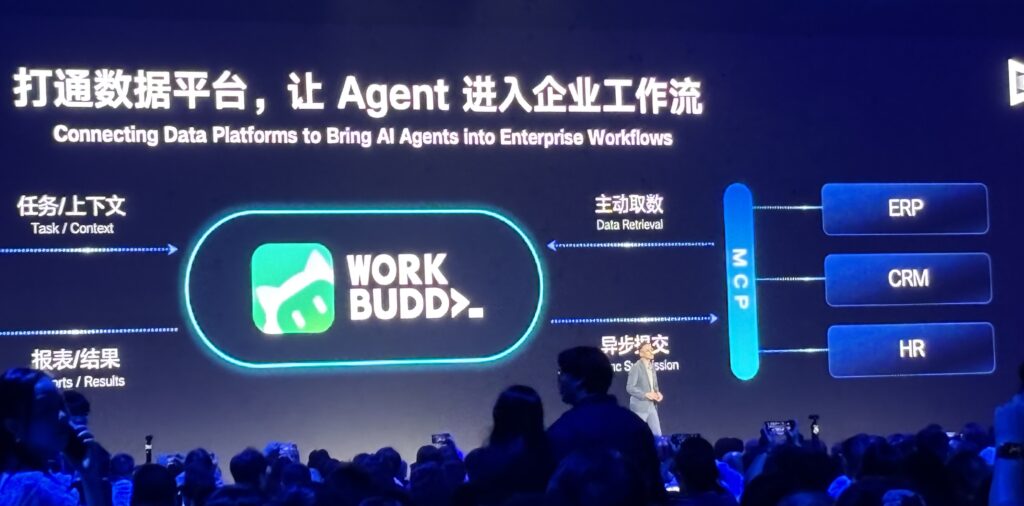
All the other buddies, well, most of the other buddies are becoming sort of sub-agents that respond to WorkBuddy. So the primary interface for an enterprise is going to be WorkBuddy. That’s what you would use, your staff would use, your business would use. It will call on the other buddies as needed. Now you could deal with them directly, but I think it’s kind of becoming the mothership, even CodeBuddy. The two biggest buddies, really agents, are being rolled out against the most
07:35
high-impact, high-value use cases, which are Enterprise, that’s WorkBuddy, and Coding, CodeBuddy. Now, there’s actually a third one that’s coming soon. It’s already out in China, but it’ll be out internationally soon, which is in Design. that makes this basically what will, how do you tell if something’s high-impact? People will pay for it. If it’s not high-impact, like consumer AI, a lot of people don’t pay for that.
08:01
If you’re going to do these agents, which can take a tremendous token usage, it’s got to be something that you can charge for because otherwise you can’t cover the variable costs. So what will people pay for? Developers and coders will pay for CodeBuddy. Enterprises will pay for WorkBuddy. Graphic designers, people who make advertisements and marketing will pay for design, which right now is R. and Mura.
08:27
I think they’ll come up with a better name for that. They’ll probably call it Design Buddy or something like that. And then there’s Data Buddy, which is kind of a new thing. Okay, that’s kind of how it’s evolving. You walk around the conference, you see all the little buddies everywhere, but the big one is Work Buddy. This could have been the Work Buddy Conference. And let me talk about sort of my opinion of what Tencent is doing, and that lays the groundwork for the architecture.
08:55
for an agentic first organization. you understand, they’re going to diagnose the problem and then give you solution. Okay, what’s the problem? The problem is we all know that agents are powerful. They’re basically quasi-humans. And when you put them in a robot, they become sort of quasi-humans in the real world. And therefore, we can have capabilities we never had before. you know…
09:22
Lots of people right now, most people right now, what they’re doing is they’re using agents to become sort of super powered individuals. I do this. I have 15 to 18 agents I’m running every two to three days. Some agents I run literally every day, about eight of them. And then there’s a couple I run every couple of days and then there’s a couple I run every week. And I mean, it’s almost overwhelming.
09:50
Like I’m kind of maxed out in terms of attention because every time I open my phone, I have requests from the various agents. Can you approve me to do this? Is it okay to go through with this? Like, what do you think about? I mean, it’s like having 18 staff that are constantly calling you. I’m almost maxed out. I don’t think I could have another 10. It’s too much. So what you do when you start to get maxed out at the individual level, in terms of your attention, you do what every CEO does.
10:19
you create another layer of management. So you say, okay, agents one, two, three, and four, you now report to this agent, the chief of staff. And I have a chief of staff agent. And the chief of staff will talk to me, but the chief of staff, you can only talk to them. So you create layers of management. Okay. But even then you do sort of max out in your ability to do things, which is what I’m struggling. I don’t know how to get to a hundred agents yet. I’m working on that. Okay.
10:48
That’s where most everyone is today, but that’s not the big prize. The big prize is going from. Agentic empowered individuals, which everyone’s doing right now to an agentic first organization. That’s the big payoff. That’s the Holy grail of this, because when you do that, your power levels and your capabilities will just go through the roof. But it turns out that’s actually really, really difficult. It’s not easy.
11:18
Take that step. And that’s kind of what Tencent was talking about in this cloud conference. The opening talk was by Dao Sen Tong, who’s pretty much the head guy for Tencent Cloud. And he basically talked about, how do we go from individuals to organizations that are agentic first? That is really the big challenge. Because when you do that, you will get a tremendous jump in not just capabilities, but productivity.
11:48
You can have lawyers, can have accountants, you can have design artists, you can have video generators. You can sort of build any capability you want into a business now. That’s a big plus. But also you’ll just get tremendous jumps in productivity at the enterprise level. Imagine people talk about solopreneurs. Hey, I’m going to be a one person organization with lots of agents and we’re going to make a lot of money. People talk about that because it’s kind of a cool idea.
12:18
That’s not the big payoff. The big payoff is we are a business with 5,000 employees, 50,000 agents, and 20,000 robots, and we all work together. An organization like that will be capable of like a thousand fold what an organization can do today. That’s a whole another level. That’s the trick is to get to there. A medium or large enterprise
12:48
that is agentic first, plus humans, and probably some robots eventually. That to me is the big payoff, right? And I think that’s actually the big hairy audacious goal that Tencent is going for, to let any business do that. And they want to be your partner to help you do all of that. And I will lay out sort of the architecture of what that looks like in practice, what do you actually build? But the centerpiece of that is basically work buddy.
13:17
So let’s say we put a stake in the ground. This is what you want to be. Elon Musk has talked about this a bit too. He’s basically said, and I have a quote from him. here it is. Quote, corporations that are purely AI and robotics will vastly outperform any corporations that have people in the loop. I’m not sure that’s true. I don’t buy this idea of totally autonomous. I think humans and agents are going to work hand in glove. And I’ll give you how Tencent thinks about it, which is really
13:47
Their vision of an organization that’s agentic first is really still focused on individuals and teams, which is how it is today. Individual humans and teams of humans. Well, this is going to be the same, but the individuals are going to be both humans and agents, which are digital humans, digital employees, and teams. Teams of humans, teams of humans plus agents, and then teams of just agents. They kind of argue that it’s going to be the same approach. I basically buy that.
14:16
Now on the way to this promised land of these super powered enterprises that nobody can compete with, I think there are three tipping points to look for. Because why are they so powerful? What do they have that human organizations don’t? Well, the first thing is they can scale up. Software by definition, if you have one agent and it’s working well, you can scale up to 10, Control C, Control V.
14:46
You can scale up to a thousand. Software scales up beautifully. However, in this situation, there’s a limit. The limit is the human in the loop. I can’t scale up my agents today because I’m still in the loop for most of what they’re doing. I can’t get to 200 agents. So the first tipping point is certain activities within your business have to become autonomous. That’s what Elon Musk was talking about.
15:16
When you get away from having human approval, humans in the loop, then you can become autonomous. Then the limit is removed and you can go from 10 agents to 1,000 agents, no problem. So the first tipping point milestone is basically autonomous tasks. That’s how you scale up. That’s very powerful. The second tipping point milestone.
15:46
is when you start to get data flywheels. An agent doing a task will have an objective. It will come up with routines to achieve that objective. You approve them. And then it will get data on the results. It will feedback that. And it will improve not recursively too much, but you will see sort of increasingly rapid improvements. Humans, we have data flywheels, but we don’t really do it terribly well.
16:14
We’ve read reports, we have changes, we do planning. Okay, agents with data flywheels, you can really start to improve quickly. So when you start getting the data flywheels going, you’ll get far more rapid improvements. The third one, tipping point, milestone. When you go from single agents to multi-agent collaboration. Right now it’s like, okay, I got one agent that’s my lawyer, I got one agent that’s my accountant.
16:45
And I could scale them up, five lawyers, five accountants. But what is more powerful is when you build a team and I say, look, we’re going to build a new robot. Let’s say a vacuum for a swimming pool. don’t know. On my multi-agent team, I have the chief of staff. have the product manager. Underneath there, I have four different types of engineers, sub-agents. I have a lawyer. I have a market researcher. I have an economics person. I have a finance person, agents.
17:14
and they all work together. Multi-agent collaboration, multi-agent teams are super powerful. Now, it’s funny, Anthropic published a couple numbers about this idea a month ago, looking at token usage. And the numbers they put out, who knows if they’re true, is when you are using an agent, just sort of call and response, hey, do this for me, it goes and does a task and then comes back, it takes a certain amount of tokens.
17:44
When you sort of jump up to an agent, not just AI, but an agent that’s much more autonomous doing things on its own, your token usage goes up by about a factor of four. That was your number. So AI to agent, tokens go up by four times. When you go from individual AI agent to multi-agent, token usage goes up by 15 times. So when you unleash these multi-agent teams,
18:14
They really go to town and your compute goes through the roof. So cost is a big deal. That’s why you got to have a finance agent on the team, that and other reasons. And Dawson, he actually had a good quote about this in his talk. He said, quote, multi-agent and digital driven flywheels transforming real world productivity. Well, that was on a slide. Yeah. mean, those are really the big metrics to look at.
18:42
What is the real world productivity of this enterprise? And the two big tipping points are data-driven flywheels and when you move into multi-agent operations. That’s kind of the path forward. All right, that’s kind of point number one, which is that the big prize here is agentic first organizations. And getting there is actually not easy. It’s pretty complicated.
19:08
then you need a lot more than models and a couple harnesses. You actually need a whole suite of capabilities, all of which Tencent Cloud are building and offering. So we can kind of see how they think you can get there. All right, so point number two at the center of all of this is Work Buddy. And as mentioned, it’s kind of becoming the buddy to rule all others, one buddy to rule them all. There’s Code Buddy.
19:35
If you have WorkBuddy, which I recommend that you do, you can go and just get it online. It’s available internationally. Just go to the website, WorkBuddy, I think it’s .ai. Go there and you’ll see that there’s two tabs. There’s one for enterprise and there’s one for coding. Well, that’s WorkBuddy and then CodeBuddy. But more and more, CodeBuddy is sort of just becoming part of WorkBuddy. Like if I’m doing something on WorkBuddy, I will say, you know, we need to change this spreadsheet.
20:03
the columns are not good, I need you to do this. It will just code up something in Python to change the Excel sheets or whatever. So it will immediately call on the code. So I don’t really ever use CodeBuddy directly because I’m not a coder. But I end up calling it stuff all the time. I’ll build web pages or apps or whatever I need. I pretty much do it all from the enterprise portal, which is WorkBuddy. Okay, then there’s Marvis. I talked about Ardot. Oh, and one that I did forget was IMA.
20:33
IMA. This is basically a knowledge database. So as you work over time, you start to build up a library of, know, basically context and semantic information about your business. Now, EMA is sort of for individuals, the enterprise version of that is called LearnShare in English. But, you know, basically it’s a huge library and they’ve
21:01
They’ve had this product for a while, EMA. They’ve put an agent on top, which is basically a librarian. And WorkBuddy talks to the librarian for whatever you need. DataBuddy again. So you can see the one agent at the center is just sort of interfacing with the other ones at this point. It happens pretty naturally. And more and more, I find that I’m not dealing with the other agents myself. If I need something from my library, WorkBuddy will just call on it.
21:31
I’m talking about WorkBuddy because I know this product well, but if we were to look at Amazon Web Services and whatever, you’ll see similar architectural approaches. They’re a little bit different here and there. If you look at Alibaba’s Quinn, Alibaba Cloud Quinn work, you’ll see similar but a little different architecture. I’m talking about the one I know best. So that’s kind of why. Anyway, so have CodeBuddy. Yeah, they’re all kind of becoming sub-agents.
22:00
At the talk a couple of weeks ago, three or four months ago, they were talking about Tencent. They were talking about nine agents. They’re pretty much just talking about four now. The others seem to be going into the background. That’s WorkBuddy, CodeBuddy, Miora, which is really design, and DataBuddy, which manages the data that everything depends on. So more and more, it’s getting down to four. I suspect that’s where it’s going to end.
22:30
There’ll be one for coding, enterprise, design, and data. But we’ll see. You never know. OK. So if WorkBuddy is the center, what goes around it? Now, WorkBuddy is just an agent, right? So it’s basically a model plus a harness. That’s what an agent is. The model runs on GPUs. The harness runs on CPUs. Turns out we need a lot of CPUs as well.
22:55
And that’s where you put in your rules and what it can do and its tool calls and all of that stuff. Now, one of the things that the Chinese cloud providers are doing, which I like, is they’re really sort of going open source and not trying to control it too much. So one of the pitches you’ll hear from Tencent in particular is you can use any model you want. If you’re in WorkBuddy, I can switch back and forth between Hunyuan
23:25
which is the Tencent models, I can switch right over to DeepSeek. I can go to Kimi. I can go to, you GLM. I can go to any of them. It’s like whatever models you want, feel free. They all work beautifully within this sort of agent harness. So they’re giving you sort of a lot of flexibility on what models you want to do. And you can pick and choose if you want, or you can set it on auto and it will choose for you. So I like the whole idea that the…
23:54
You know, once you have a good sort of enterprise structure, you can flip between various models like it’s nothing, which is not good for the model companies, but I think it’s good for the users. Okay, so that’s the center, the model plus the harness that gets you your agent. In this case, it’s work buddy. If you’re over in Alibaba, it’d be Quinn work. Okay, the front end of that is pretty much messenger. It looks like that is how most people are going to engage. So if you’re talking about
24:24
Tencent, you’re talking about WeChat or WeCom, which is WeChat for business. But again, you’re not beholden to that. So you can also do Telegram. You can do Slack. But it looks like the primary interface for this agentic organization is lots of humans primarily interacting through messenger-type service. Now they can be individual, like let’s say WeChat or WhatsApp.
24:51
or they can be more team-based like Slack, Copilot, things like that. And again, in this case, they let you use pretty much whatever you want. I tend to trigger WorkBuddy either with an app or I use Telegram for both of them. In China, which I’m using it international, in China I would use WeCom. Okay, so you got the front piece, you got the agent, the harness and the model, and then the back piece is that needs to basically plug in
25:20
to an entire ecosystem of capabilities. So business capability, that’s MCP is pretty much how it’s happening these days. What does that mean? Well, it’s your ERP system. It needs to be able to call on that. It’s your CRM. It’s your human resources. But beyond that, it’s kind of any tools, any skills, any capabilities you may be using internally, but it could also be external partners, supply chain.
25:50
What are they using? So it is going to extend out into all this sort of ecosystem of capabilities, skills, tools, partners, and it will integrate. Now what I like about the way Tencent is doing this, and I would say the same thing about Alibaba, and this is kind of why I think they’re going to move ahead. I’m kind of betting on the Chinese ones to pull ahead of the US ones, is because…
26:16
The struggle in the West is you’ve got these agent systems trying to connect with other organizations. It’s all being stitched together. You have to hook in with Stripe. You have to hook in with Salesforce. And that’s happening. But what China has is it already has very large ecosystems that exist. Tencent and Alibaba are already very robust ecosystems.
26:44
So when I go into WeChat, it can go right into WorkBuddy and it can go right into all the mini programs which are already in WorkBuddy. And I can pay using WeChat Pay, which is also already in WeChat. You know, the first line of connectivity for this ecosystem is already there. Everything in the Tencent ecosystem, I can already connect with seamlessly. It has my identity, it has verification, it has payment rails, it’s all there.
27:14
So that first ecosystem wave is very powerful. Now after that, it will have to stitch together to the rest of the business world and consumer world. So that’s a lot of company to company MCP relationships, which is what’s happening in the West. But both Alibaba and Tencent already have fairly large ecosystems. These walled gardens, these WeChat mini programs.
27:41
They don’t really exist anywhere outside of China. That’s a huge advantage in this case. So I think that’s going to probably accelerate them. But that’s a first good pass for how to think about this architecture. At the center, you have an enterprise agent, one buddy to rule them all, in this case, work buddy. Within that, it can call on any models you want, lots of flexibility, lots of breadth. Some are open source and very cheap. Some are more premium and expensive.
28:11
It’s got the harness, which is largely held by you, your context, your memory, your data. On the front piece, we probably have Messenger. Now, that Messenger will be pretty much available anywhere on every device, every phone, every laptop. And I do this pretty much all the time. You know what I’ve really enjoyed? I do a lot of my work from coffee shops now.
28:37
which in the past days to take my laptop to the coffee shop and write or do whatever I’m doing, I’m just sitting there with my phone now. And I’m just calling on my models and my agents with my phone. And it’s writing documents for me or I’m working on an article and I’m having a discussion about the article and it’s creating drafts for me. And it’s usually calling on my laptop at home, which you still have to leave on if you haven’t got that set up right, which I haven’t yet.
29:07
So the front end piece will be sort of messenger based available everywhere. Every device, every terminal, everywhere you go, you’ll call on your agent. You’ll probably have one senior agent, in this case, WorkBuddy. And then that agent will be able to tap in to a growing ecosystem of capabilities within your organization, also outside of your organization. And that’s just for integration, operation, things like that. But then beyond that, just skills.
29:37
spin up three lawyer agents in two minutes sitting in a coffee shop on my phone and have them take apart a contract and draft it and send it back to me and put it on my laptop and have it screened and printed out by the time I get home. So you can kind of see the three pieces being put together, but I think the companies that will do well. Now there’s more to it than that and I will talk about that in the next article.
30:06
Because the next question would be like, OK, if Ten Cents Playbook here is, own the hub and open the ecosystem. Any services you want, can have. Any systems you want, you can have. Any models you want to use, you can have. Any messenger you want to use, you can have. Totally open the ecosystem, and we are the hub. OK, why aren’t companies doing it? What’s wrong? Well, it turns out.
30:35
There’s a lot of concerns when you put this stuff in practice, like can I trust this system? Can I allow an autonomous agents to start changing my data, contacting my customers? What about cybersecurity? You know, when I trigger an agent and have them do something, how do I know what they even did? Is there observability? Is there transparency? How can I track it if there was a mistake? Can I audit it?
31:03
Like there’s a whole lot of services that have to sit around the system I just talked about before companies will get comfortable deploying this at scale. And most companies are not doing this at scale. They’re doing isolated little projects and they’re doing pilots. But there’s a big hurdle to wide scale deployment across an enterprise. That’s kind of the big challenge of going from individuals to agentic first organizations.
31:32
And in the next email, which I’ll send out tomorrow, I’ll show you the structure you want to build around that, that lets you start to pull the trigger. And there’s basically one, two, three, four, six capabilities you need to build around everything I just said to allow you to sort of take your hands off the wheel and let this thing go comfortably without risk, without turning your business into a blind black box.
32:02
where you don’t know what’s going on and you expose yourself to risks and all sorts of things. I’ll explain that in the next email. I’m not talking about it because my thinking’s not quite there. I’ve got my draft down, but I want to think about it once more before I do it. Okay, so that’s kind of the main idea for today. Now, outside of that, there’s probably two other things you should keep in mind. Number one is TokenHub. You’ll see this if you look at Tencent.
32:30
If you look up WorkBuddy, you’ll see TokenHub. TokenHub is basically kind of like a marketplace where if you sign up for this and you’re putting money in whatever, you don’t really see… You basically see credits. You don’t see tokens. Credits are sort of, let’s call it another type of money. And they get deployed into different types of models at different rates. Some models are quite cheap, some models are more expensive.
32:59
Token Hub basically lets you allocate workflows model by model by model. So you can sort of seamlessly swap between DeepSeek, GLM, Hunyuan, Qwen, whatever you want, including image generation models, video generation models, whatever you want. It’s a big hub for swapping in and out models as you see fit pretty seamlessly.
33:29
That’s a big part of the pitch for this. When you hear Tencent talking about WorkBuddy, one of the main pitches they will say, besides ease of use, ease of deployment, which is big, is also breadth of models available. You can use any model you want. Well, that’s TokenHub to a large degree. Keep that in mind. The other two capabilities here that are worth talking about are Agent Development Platform, which is called ADP.
33:56
That’s where you can start. You can basically go to the library and pull up models. I’m sorry, pull up agents as you see fit. You can pull up skills. There are just hundreds, thousands of different skills you can access. I need a, you know, a design expert who can make a company logo for me. I need a contract review expert. I need a marketing strategy expert. And it can be one skill or it could be a team. You can literally just spin up a team in 10 seconds.
34:26
that will take apart your problem. You can give it your context, your data, blah, So, okay, that’s cool. But in addition, over time, your alpha as a business really depends on your own data, your own context, and your own specialized agents that you own. So you’re going to want to start to customize agents. Well, that’s ADP, Agent Development Platform. You can build your own agents that are very specific to your business.
34:55
Okay, you really do need to do that over time. Because if you’re calling up standard agents using publicly available data to do your business, well then other people can do the same exact thing. You need proprietary data and you probably need customized agents that you have built over time and that you’re feeding your data back into Data Flywheel. Okay. Those are kind of the two other pieces to think about. For those of you who have been paying a…
35:23
attention to this business. Hunyuan 4 just dropped on Thursday. This is their next big model. Actually, it’s a suite of models. Some good image generation models in there. HY4 is now available. I’m using it. I got kind of an early access to it. Pretty awesome. yeah, mean, as these models, yes, you want a whole suite of models. That’s very important.
35:50
You want the low cost ones. You want the edge models that you can run on devices. But you also really want the frontier state of the art models. And there’s only a couple companies in the world that have those. Anthropic does, OpenAI does, Alibaba does, and Tencent does. It’s a pretty short list for truly groundbreaking frontier level intelligence. OK, HY4 is.
36:19
They’ve got a bunch of models, but one of them is their frontier level. This one was 770 billion parameters. This is the one that dropped on Thursday. That’s more than 2.5 times what the previous version was, HY3. I it was 200 and something. Of the 770 billion parameters, this is a mixture of experts. So it has like 48 billion active parameters. The context window is a million.
36:46
So I mean, it’s right up there on the frontier. It’s pretty cool. Anyways, I’ve been playing with it, but I don’t really have the capabilities to assess model performance one by one by one. I there are people that do this in a very sophisticated way. I can’t really tell, but I can generally tell if the answers are good or weak. Like, I don’t think Gemini is terribly good anymore. I think the quality of answers I’m getting from there is quite low. Like, the number one thing I say to Gemini now is incorrect.
37:16
I put in a question, it says, blah, blah, blah, and I come back and I say incorrect. And it comes back, yeah, you’re right. were, was like, that is one out of every two answers I use with Gemini. I basically canceled my Gemini subscription. But I can tell like Anthropic, Hunyuan, Alibaba, Quinn. I can, least even I can tell without any actual metrics that it’s significantly better. I don’t know what’s going on with Google. They were really great in 2025.
37:46
Gemini was great and now it’s kind of not great. Crap would be the word I would use. Anyways, okay, those are kind of my points for today. I think that’s a decent framework for one, what is an agentic first organization going to look like? What do need to be building towards? And I’ve kind of laid out the pieces. And then two, along the path from where you are to get there, what are the tipping points where you’re going to suddenly see dramatically improved performance in your business?
38:16
Okay, I think that I’ll leave it there for today. In the next email, I’ll basically take that down to the next level of detail. How, know, spinning up teams, spinning up digital employees, how do they work together? The surrounding four to five capabilities you’re going to have to build so that you can do this confidently without worrying you’re going to crash your business so that you can actually don’t. There’s some other stuff in here, but I’ll take it to the next level of detail.
38:43
Okay, that is it for today. As for me, I’m doing real well. I’m kind of glad to not be traveling for a little bit. I was traveling like crazy June through really October. And it’s fun because it’s exciting and you learn a tremendous amount, but I’m kind of glad to be chilling at home. What I do when I get home is I catch up on my reading and I just sort of plow through content and sort of try and get myself to the next level.
39:12
What I’ve been doing, which is maybe different, is I’ve been, I’ve have five agents. I’ve been using Grokbot, like for just daily activities. I think Grokbot has the best interface just for, you know, using agents all the time. I don’t think the intelligence is terribly good. I use, I use WorkBuddy and I use Anthropic mostly. But in terms of daily interface, just on my phone, I open Grokbot a hundred times a day.
39:42
And I’ve got 12 or 13 agents there. Five of them that I use, I’ve sort of started using instead of my morning reading. Normally I take documents and stuff like that. I’ve got five agents and each agent gives me a morning lesson where it talks about a subject I feel like I’m not smart enough at and I need to move myself to the next level of understanding.
40:11
And so one of them would be cloud services. Because there’s certain, I basically spend my time thinking about cloud services, agentic cloud services. But there’s aspects of that where I feel like I’m weak, like cybersecurity, spinning up various virtual machines. There’s a level at which my knowledge should be stronger. So I’m just basically drilling into that. And every day I get another lesson where I learn something maybe and I sharpen my thinking. And I’m going to just keep doing that forever.
40:40
That one is super helpful. Another one I do is for the component parts of electric vehicles. I went to BYD a month or two ago. I’m going to go to XPeng, think, soon. And Geely, I visited them, and Zeekr. And I’m just kind of going through the engineering component by component. So I have like hundreds of photos I took of the various car parts when I was visiting these companies. I uploaded them.
41:10
to the cloud and every day my agent explains to me five of them. So I’m literally just going part by part through an electric vehicle every day. Here’s the main chips you use for the sensors. Here’s the main chips you use for the lighting. Here’s the motor control. Here’s the drive shaft. And it’s just day after day after day where I’m getting comfortable with the engineering of electric vehicles.
41:38
I don’t really need to know that stuff. The part of EVs that I’ve been digging into is the world models and the AI that powers the whole thing because it’s pretty close to agentic AI and other types. That’s more me. But I’m just going through component parts. And it’s fascinating. I do robots. I do the same thing. Every day I get, I have a third agent that just does robotic parts. So every day it’s just, you know.
42:04
Here’s why you would use a planetary reducer in the knee joint of a robo dog, but you want to use a harmonic reducer in the waist joint because it gives you greater control, but you don’t have impact, which is a problem for harmonic reduces, blah, blah, I’m just plowing through it day after day. I think I’m going to try and build a robot. I think I could do it now. They’re actually not that complicated. Once you go through all the parts, you’re like, oh, there’s not that much here. I was thinking this is like building a car.
42:34
No, cars are complicated. This is more like building a refrigerator. There’s not that many parts. And I’ve mentioned that before. I think I’m going to build one. So anyways, that’s one of my ones. What else do I have? Obviously, enterprise agents, agentic organizations. I have an agent for that that teaches me every day. And I look at WorkBuddy versus Alibaba, QwenWork versus Anthropic versus OpenAI versus Copilot versus Amazon. So, I’m always comparing.
43:04
the enterprise systems for all of these in there. Yeah, that’s kind of how I’m learning. And outside of that, I’ll do emails and I do my normal reading. But yeah, that’s new. That’s really, I think it makes a huge difference. And a lot of it is just you can have a conversation. So, it will write something up for me. When I wake up, it was already done. And I’ll read through it. And then we’ll just have a conversation. You’ll explain this part to me. I don’t quite understand. So, you’re saying this is that, but this is
43:32
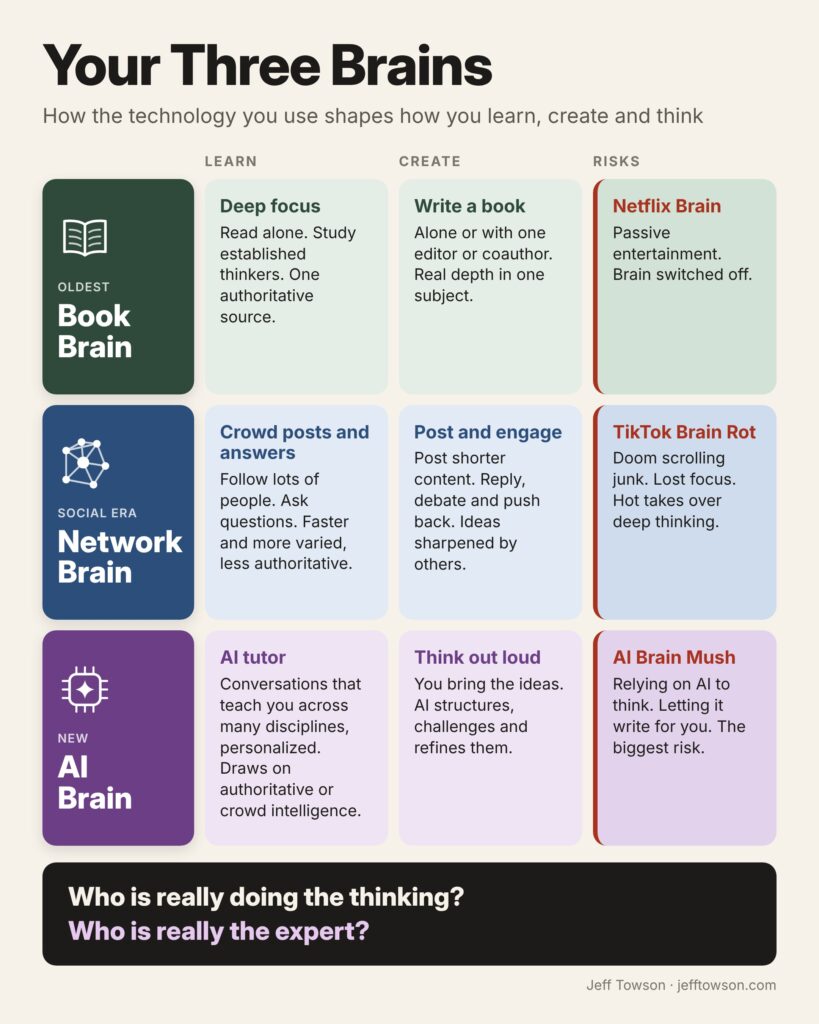
and it just turns into a back and forth conversation. I think you will give me six months and I think my expertise is going to be way higher than it is today. Anyways, I put out a little JPEG for fun where I basically said there’s three different types of brains, that your brain works differently depending on the technology that you engage with. Your brain behaves differently. So, I called one book brain.
43:59
that when you read books and you write, your brain works in a certain way. You get very long-term focus. You go very deep into one idea. You’re really looking at one or two authoritative sources, like the person who wrote that book. And that’s kind of how I’ve always been, as I live in book brain. There’s another type called network brain, which is when you want to know the answer to something, you don’t look at a book. You just go to your social network, your professional network, and you throw out the question.
44:25
and you get a rapid answer that way. So you kind of rely on the intelligence of a network, which is fast and far more varied, but you also sort of can be shallow. The sources are not necessarily authoritative. It can really wreck your attention span. People who spend their whole life on Twitter have a short attention span. People who spend their days reading books solitary have very good focus. And then the third one I call AI brain.
44:55
where you’re kind of doing what I’m doing, where you’re going through content and having conversations with an AI about a subject. Maybe it’s teaching you, maybe you’re teaching it, but there’s this back and forth dialogue. And all of those methods have strengths, but they also have some pretty bad weaknesses. Network brain, think TikTok is the worst version of that, that it can really sort of give you brain rot. You lose your focus. You’re not, you know, it’s really bad for your brain.
45:25
AI brain, the problem is you don’t really have the expertise in your head anymore. mean, whose brain are you really relying on, yours or theirs? If you do book brain, I feel very sharp in my head. I feel like I’ve got it. When I do network brain, I don’t feel that way. Anyways, I’ll put the JPEG in there. I just thought it was a funny idea. It’s not particularly serious thinking, but I was kind of thinking along these lines as I’m chatting with my bots every morning. Anyways, that is it for me.
45:53
That was a bit more topic, I guess. Anyways, I hope everyone’s doing well, and I’ll talk to you next week. Bye-bye.
——-
I am a founder, consultant and keynote speaker specialized in digital and AI agentic strategy.
I am the founder of Agentic Org Now, a firm that helps leadership teams launch AI and agentic initiatives fast.
I write (a lot) about digital and digital AI strategy (3 best selling books, +2.9M followers on LinkedIn). You can get a free book at the email sign-up below.
My Moats and Marathons book series is a framework for building and measuring competitive advantages in digital and AI businesses.
Note: This content (articles, podcasts, website info) is not investment advice. The information and opinions from me and any guests may be incorrect. The numbers and information may be wrong. The views expressed may no longer be relevant or accurate. Investing is risky. Do your own research.
