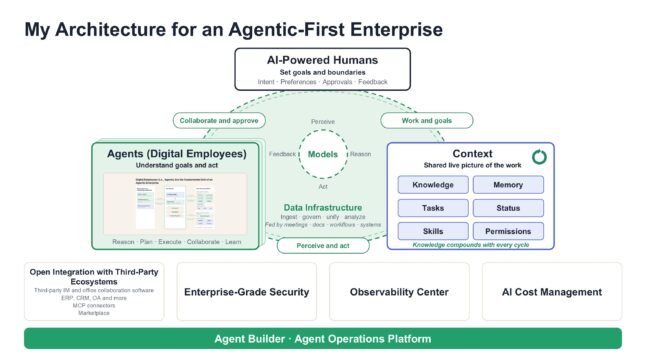



This is my 6-part series on how to build an agentic organization. It’s basically my blueprint / playbook.
And yeah, 6 parts is kind of a lot.
So, this first one is an executive summary.
This blueprint is really for any business. Small, medium, and large.
And it works with all AI cloud vendors. So Azure, AWS and Google Cloud. But also Tencent and Alibaba. Same for specialized vendors such as CRM and ERP vendors.
However, it doesn’t assume you are primarily operating agents with a cloud vendor. Most medium to large businesses will end up doing a combination of on-premise and cloud.
Ok. That’ said, here’s the main points for the series.
Point 1: Agentic Organizations Are a Huge Opportunity. But Making the Transition Requires New Operating Capabilities.
Most companies are currently giving AI tools to their staff. And increasingly agents.
And they are definitely getting productivity gains. Some are also launching new and/or agentified products.
Ideally, these moves should be resulting in revenue growth and cost savings. But that is not what we are mostly seeing.
Mostly we are seeing companies upgrading their products and capabilities to stay competitive. As everyone is getting way more productive.
However, the big opportunity is rebuilding your enterprise around agents. Agentic-first enterprises will have dramatically greater capabilities and operating performance. They will be way past basic productivity gains.
According to McKinsey & Co, agentic enterprises will be much faster and better in innovation, adaptation, growth and scale. Traditional companies operate and grow at the speed of human coordination. We want agentic companies that operating and grow at the speed of software. I’ll go into the details of this in the articles.
The three tipping points I am watching for in agentifying enterprise are:
- Autonomous operations. When agent-first operations go autonomous, they can then scale with software instead of headcount
- Multi-agent teams. This is particularly powerful. We are seeing this right now.
- Data and other flywheels.
I’ll go into detail on these strengths in the articles.
That’s the opportunity.
But most businesses today are struggling and/or hesitant to go beyond the first phase of agentic operations. This has a lot to do with trust. The key to overcome this and make the transition to agentic-first is the architecture, which I’ll go into.
Point 2: Digital employees (i.e., agents) are the fundamental unit of an agentic organization. Step 1 is to start hiring digital employees.
Stop thinking of agents as tools and tasks and start thinking of them as employees. Well, digital employees. Which are made up of models plus a harness. And that have identity, memory and a manager.
Thinking of agents as employees makes things much easier. You hire, train and manage them just like human employees.
So, step 1 is to hire digital employees. And it is easiest if you deploy them into existing roles, where your people already work and you know the tasks. Here is what that looks like for WorkBuddy. It’s the center of this graphic.
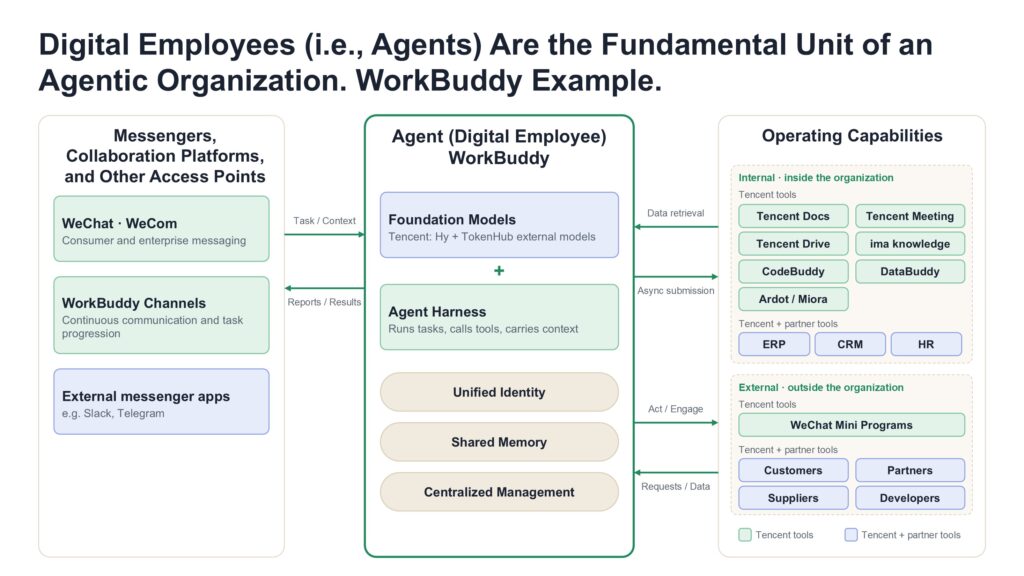
You can see the agent in the middle. Note that agents are increasingly just jumping between various models as needed.
You need an interface, which is mostly messengers and group chats. That’s on the left. The idea is they will be available everywhere. On every laptop, on your phone, via your smart glasses, etc. And soon they will be a robot walking around.
On the right, you can see the operating capabilities they can access and work with. Such as docs, calendar, email, ERP, CRM and other operating capabilities. These can be internal capabilities that you run or that are by outside vendors / third parties. They can be also be external to the business, such as connections with partners, the supply chain, etc.
You’ll note in this example with WorkBuddy as the digital employee, Tencent has a ready made suite of its own interfaces, models and operating capabilities that are tying in (WeChat, Hy4, Tencent Docs, Tencent Meeting, etc.). Their existing ecosystem (in green) makes this easy to deploy quickly. But this is also an open ecosystem so there are tons of other partners and capabilities. That’s pretty smart.
Point 3: Enterprises are about collaboration, which means teams. Step 2 is to start building teams.
Traditional organizations are built on employees and teams.
Agentic organizations are built on human employees, digital employees and tons of teams. And these teams can be a mix of humans and digital employees.
Some teams are permanent. They are part of standing, ongoing operations. However, most teams will form around an outcome or a need and dissolve when it’s done. There will be tons of these.
A typical business might have 20-30 standing teams and a similar number of temporary teams. Here we want to think about hundreds and probably thousands of teams forming and dissolving during a year. This is one of the reasons we are going to see greater innovation, flexibility and growth.
And there are three types of teams:
- AI-powered human teams
- Human-agent teams
- Multi-agent teams
Here’s what that looks like:
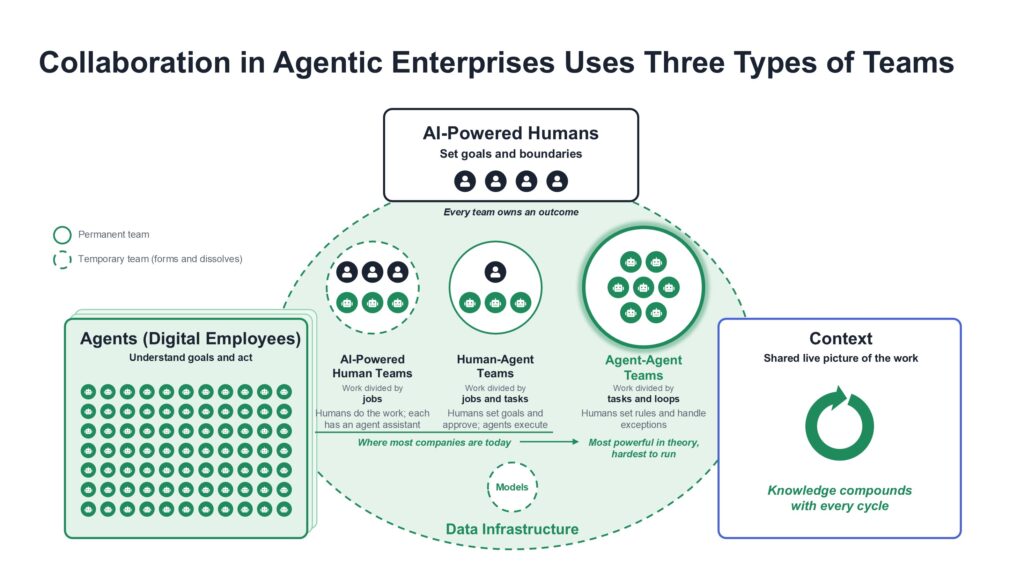
Of these, multi-agent teams are the most powerful. This is one of the big tipping points I watch for in an organization. When multi-agent teams start to do core operations.
But multi-agent teams are also the hardest to deploy right now. They require the full suite of operating capabilities. Most companies today are using just the first two types.
Point 4: The Engine of an Agentic Enterprise Is AI-Powered Humans, Digital Employees and Shared Context.
The productive power of an enterprise is via collaboration. That’s why we bring people together into things called enterprises. That’s why we put everyone in one building. That’s why we have so many reports and meetings.
We need to get what’s in everyone’s heads shared. And we need to coordinate on our actions. Enterprises run on collaboration. And teams are one form of collaboration. It is the most relevant one for agentic organizations.
However, collaboration depends on shared context.
Think of context as a live picture of the current and past work. It shares knowledge, expertise and the current state of what everyone is collaborating on. Ideally, this context builds over time with accumulated knowledge.
Here’s how I think about the engine of an agentic enterprise. AI-powered humans, digital employees and shared context. Which enables lots and lots of teams. That looks like this.
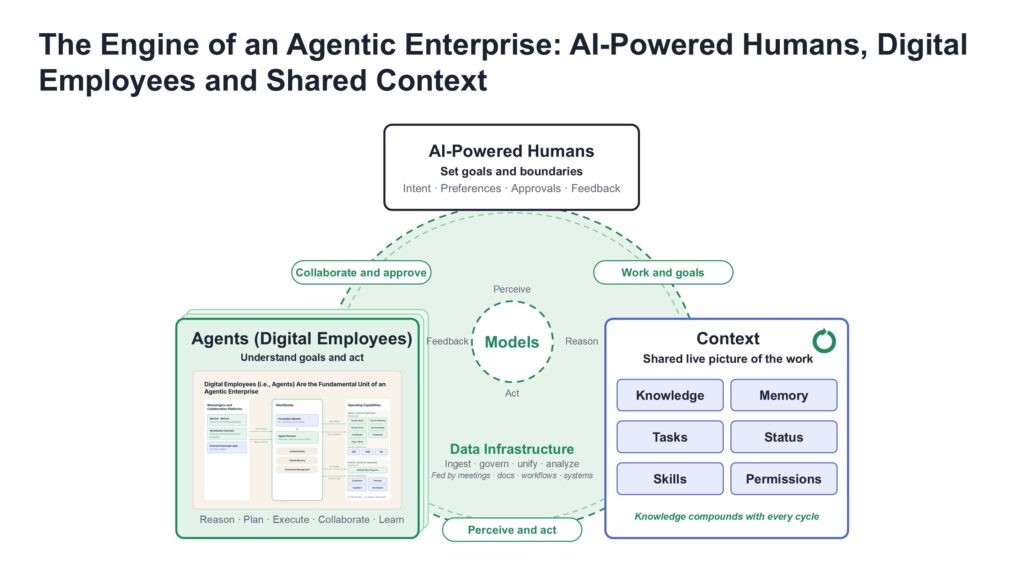
You can see that underneath this sits the data infrastructure. And the models that run on it. That is the foundation.
However, you can also see that the power of an agentic organization is not really the models. You have to get the data infrastructure right. Data has to be “agent ready”. But the models are not the real power. It’s why I made them small in this graphic. The power is in the engine.
Point 5: Running Thousands of Agents Requires an Additional Operating Layer
As mentioned, most businesses are struggling to scale up the engine just described. They have AI-powered individuals. They have models and increasingly good data infrastructure.
But they are hesitant to pull the trigger on human-agent and multi-agent teams at scale. Which is where the power is.
The problem is trust. They don’t have enough control of the agents and of an operating system based on agents.
It turns out getting to agentic scale you need additional capabilities. Basically, a new operating layer. You need an:
- Agent Factory. You need to be able to build agents fast, easily and reusably.
- Agent Operations Platform. You need to manage and coordinate the agents. This is about having real control over what they do and how.
- Enterprise-grade Security Capability. Cyber security is a big, big deal.
- Observability Center. You need to have total visibility into what is happening and what has happened.
- AI Cost Management Center. You have to manage AI costs, which can vary with usage and approach.
Here’s what the architecture looks like with this additional operating layer:
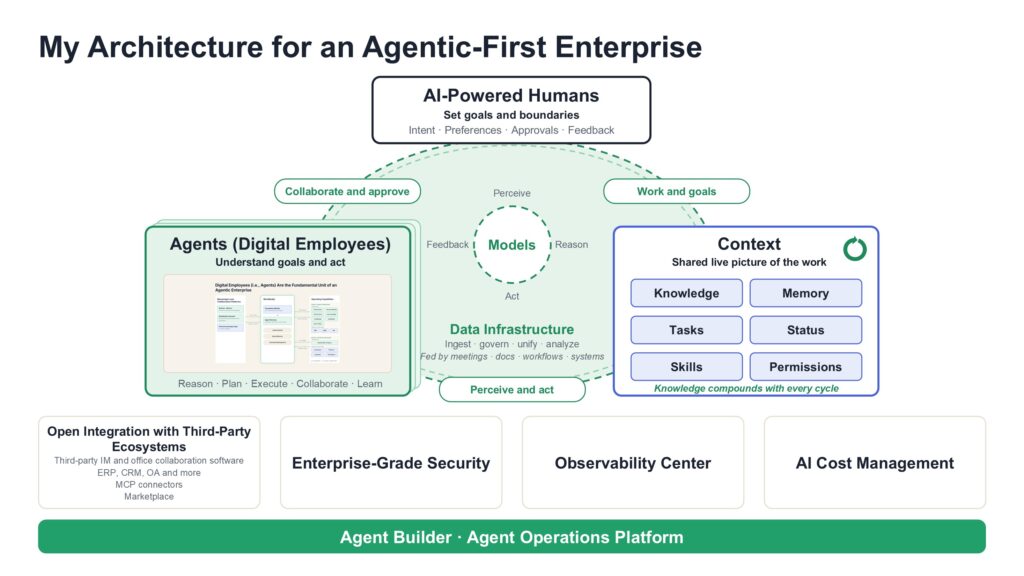
That’s the main graphic. You can see the previous three within it.
Point 6: Many Traditional Moats Are Eroding. You Have to Build New Ones.
This section is my area of expertise. How these new technologies are changing competition and competitive strength.
It’s clear that many competitive strengths are getting weaker with AI agents. Especially advantages based on expertise, which is now ubiquitous. Intelligence has been democratized and somewhat commoditized. The power of workforce scale is also decreasing.
Advantages based on the complexities of coordination (such as process cost advantages) are decreasing. And lots of sources of friction (such as switching costs and search costs) are disappearing.
That’s looking at moats in terms of competitive advantages. But we also want to think about barriers to entry, which are falling like crazy. It seems that almost anyone can jump into any business now.
However, we also see new strengths emerging. I’ll go into these in detail. But keep an eye on proprietary intelligence that flows or compounds, and control points (especially access to customers and choke points in ecosystems).
Final Point: What You Should Do Next
That’s the blueprint. The last article is about: What should I do? How do I get started?
Here’s what I recommend.
- Set an 18-month North Star.
- Have a clear image of what you need to build. How many digital employees and teams do you need? To achieve what outcomes?
- Know how this will increase your value in the world that will exist in 2-3 years. So, you need a clear picture of a future state.
- Hire 3-5 digital employees.
- The easiest place is just to use agents in software you already use.
- You should also start to build in a cloud provider. And ideally one in-house if you’re at that stage.
- Upgrade one existing team to an AI-powered human team. And launch one human-agent team around a single outcome.
- Each team should have one shared workspace and clear boundaries.
- These first teams will require you to get data agent ready. And you will need to get the shared context further developed.
- Measure each team for 90 days. Scale what works. Fix what doesn’t.
Here’s what you can ignore right now (probably):
- Don’t worry about multi-agent teams right now. These are way more complicated.
- Don’t worry about the full operating layer. Use vendor tools to have the needed capabilities in place. Building this will take time.
- Don’t try to build most in-house yet. Rely on vendors and partners. In-house building will come later.
That’s it for the executive summary.
Cheers, Jeff
——–
Related articles:
- WorkBuddy Is Now the Hub of Tencent’s Agentic Strategy (2 of 5) (Tech Strategy)
- HY4 Preview Is Here. Plus, WorkBuddy Gets 3 Updates (2 of 4) (Tech Strategy)
From the Concept Library, concepts for this article are:
- Agentic Enterprises
- AI Agents
From the Company Library, companies for this article are:
- Tencent Cloud
- McKinsey & Co
———-
I am a founder, consultant and keynote speaker specialized in digital and AI agentic strategy.
I am the founder of Agentic Org Now, a firm that helps leadership teams launch AI and agentic initiatives fast.
I write (a lot) about digital and digital AI strategy (3 best selling books, +2.9M followers on LinkedIn). You can get a free book at the email sign-up below.
My Moats and Marathons book series is a framework for building and measuring competitive advantages in digital and AI businesses.
Note: This content (articles, podcasts, website info) is not investment advice. The information and opinions from me and any guests may be incorrect. The numbers and information may be wrong. The views expressed may no longer be relevant or accurate. Investing is risky. Do your own research.
