


This week’s podcast is about rising robot companies that I have found compelling. That have clear use cases that scale. And that have indications of competitive advantages. They are:
- AgiBot (discussed in last podcast)
- Galbot
- Booster Robotics
- DEEP Robotics
You can listen to this podcast here, which has the slides and graphics mentioned. Also available at iTunes and Google Podcasts.
Here is the link to the TechMoat Consulting.
Here is the link to our Tech Tours.
———-
Related articles:
- More High-Tech Flex by Huawei R&D (4 of 4) (Tech Strategy)
- 6 Big Events in AI Agentic Ecommerce (Tech Strategy)
From the Concept Library, concepts for this article are:
- Robots
From the Company Library, companies for this article are:
- Booster Robotics
- DEEP Robotics
- Galbot
—–transcript below
00:05
Welcome welcome everybody. My name is Jeff Towson and this is the tech strategy podcast from Tecmo Consulting and the topic for today why deep robotics Galbot and Booster Robotics Are kind of compelling companies. I mean there’s a sea of robot companies right now Most of them aren’t going to make it most of them are subscale most honestly most of them aren’t that interesting A lot of this is going to end up being commodity stuff
00:34
These are three companies that have kind of got my attention. I’ve been digging into them more and more and there’s quite a lot I like about them. Now things are changing fast, but these are sort of on my short list. So I wanted to talk about sort of why they got my attention, why I’m intrigued, why I think they’re compelling. I’ve been sending out emails about these. I’m kind of going to town right now. I’ve sent out five emails this week. This is second podcast, basically going into robots.
01:04
AgiBot, Galbot, Deep, Booster, and we’ve got another one or two coming out in the next day. So anyways, I want to talk about these three and sort of how I’m thinking about this stuff. And let’s do standard disclaimer here. Nothing in this podcast or in my writing or website is investment advice. The numbers and information for me and any guess may be incorrect. Views and opinions expressed may no longer be relevant or accurate. Overall, investing is risky. This is not investment, legal or tax advice. Do your own research.
01:35
with that, let’s get into the topic. All right, I don’t have any real concepts for today. Economies of scale, economies of scope. Economies of scope is a big idea in AI and a big idea in the intelligence component of robots. When we talk about standard stuff where the big subject, the big gun has always been network effects, it’s looking more and more like within intelligence, economies of scope is what matters the most.
02:01
Now on the news front, a lot of these companies are starting to go public. It’s actually kind of becoming a big deal. Unitree has announced it’s going public, apparently in August. That’s big news. They’re kind of the world leader in terms of just robots shipped every month. They’ve got 25,000 robots shipped cumulatively at this point. Mostly the robot dogs, the quadrupeds. UBTech is already public. Deep Robots, which I’m going to talk about today, they’ve…
02:29
file to go public. You can pull that. It’s in China. Leju is coming. I’ll talk about them maybe next week. Agibot, Galbot, they look like they’re heading that direction end of this year. So there’s kind of a wave of these companies. I think it’s a good time to talk about it. Political news, I won’t get into this, but there was a pretty big related announcement this week where the FCC has basically issued a ban on Chinese-made humanoids, Chinese-made
02:58
quadrupeds, robot dogs, into the US. That’s kind of a big deal. Now, why does the FCC do this? Well, they have this. Technically, they oversee networking equipment, things like mobile networks and what can be used within mobile networks in the USA. There’s a covered list. Well, as everything becomes more connected in this world, you can start to argue, which I think they are, that, well, that falls under our mandate. So we the FCC making rules about robots.
03:28
I don’t think the FCC people know anything about robots. I don’t think they have any expertise in this, let alone in manufacturing, but so it is. I generally kind of agree with the diagnosis, but I think their solution is quite stupid. There is a good argument to be made for protectionism, not national security so much, that’s easy to check. But on the protectionism side, outsourcing the entire US industrial base to Asia
03:57
starting in the 90s was a huge mistake. I you just put, you can’t have those things offshore. You need to have them done domestically by your own people. Not in every field. You can make clothing overseas, but certain areas like cars, planes, and I would put robots in that category, you need to have the manufacturing base to do that. And then you also need the people. One of the problems the US has is they want to do rare earth element processing.
04:28
which they’re super dependent on China for. And it turns out, by the way, rare earths are necessary in every humanoid. They don’t have the sort of processing capabilities for that, but more importantly, they don’t have the people. There are not departments and universities in the U.S. that are training people in rare earths. They’ve disappeared over the years. So when you move the manufacturing out, the brain power tends to disappear as well. And then bringing it back becomes much harder.
04:57
because you have to train people from scratch. This is one of the big strengths of China is they’ve built a massive university system from 2000 to 2010. And they have these departments in all of these interesting materials, science, rare earth, manufacturing. They have tremendous departments in all of these areas. So there’s a steady pipeline of expertise. The US has lost a lot of that in certain areas.
05:24
And I would argue that, you need to bring that back into the country, not everywhere, but in certain areas. And I think robots is in there. So anyways, I’m generally in favor of a protectionism to a certain degree. I’m not a free trade maximalist or whatever you want to call it. Now, here’s the problem with this. The way the FCC has set the rule is 65 % of the bill of materials for a humanoid has to be domestic. It can’t be foreign bought parts or
05:53
you know, country of origin parts going into these robots. Otherwise, they’re classified as foreign and the bill, you the they say foreign. Everyone knows they’re talking about China. OK, what are the big cost structures of a humanoid? It’s the actuators. Forty five, fifty, sixty percent of the cost structure. That’s the thing. OK, where do where do US robot makers get their actuators? They buy them from China. Now, increasingly, they’re building in the main house. But yeah, a lot of them are getting them from China. That’s
06:23
Let’s see, I think the last time I looked up the numbers, probably about 60 % are Chinese. Now, if you want the highest performance ones, you can get US, but most of the standard ones are coming from China. And even in high performance, the Chinese ones are going to be 20, 30, 40 % cheaper. So that puts these US companies at a bit of a quandary. You’ve got to keep these materials locally sourced, but the key component, the cheaper versions are from outside the country, and you can’t use those.
06:52
without blowing the BOM rule. So if that’s a problem, they’re going to have to deal with it. And even if they manage to get around that, you get to the problem of, what’s in the actuators? Well, magnets. All the actuators require rare earth elements. All of those come from China. So there’s this looming idea that the Chinese may retaliate against this new rule, saying, OK, fine, build everything domestically.
07:19
we’re banning all your domestic companies from rare earth elements, then you can’t build robots. So I’m waiting to see if that’s going to happen. So far I haven’t heard anything. Anyways, that’s what’s going on this week. Kind of interesting. My take on it, I think it’s the right diagnosis, but I think it’s a stupid solution. A better way to do it is to require joint ventures by Chinese companies within the US, which is how China’s already always operated.
07:47
When they need something like an emerging technology, they invite Tesla or whatever to come in, manufacture domestically, but it’s got to be a joint venture. And that’s how they transfer knowledge. It’s not really a forced technology transfer where they say, us all your stuff. It’s more like they just force you to manufacture in the country and then the knowledge just sort of goes to other people. That’s pretty smart. Okay. Anyways, let me get on topic here. That’s,
08:16
Interesting situation. Okay. Why do I find these three businesses compelling? A couple of reasons. It’s all, you it’s about the use case. How powerful is your use case? Is it weak? People say, oh, we’re going to have robo cubes, these, you know, 24 seven robots in little cubes that, you know, make you coffee. Okay. That’s amazing in the sense of it’s a good consumer thing. Kind of looks to me like a vending machine.
08:45
So it’s a use case, but it’s not knocking my socks off. But do you have a compelling use case as a standalone business? You if you have that. Now, a lot of stuff is commodity, like robot baristas. Sometimes you see real compelling differentiation in the use case. And sometimes you just don’t see a you case at all. mean, the first robot company I ever kind of followed was Boston Dynamics, which was making those robots
09:14
for years, they never really found a use case. They got bought by Google and then they got bought by Hyundai and you know, that was a pretty impressive robot company that never really went to market in any way, which is weird. Okay, so I want to see a compelling use case that can scale dramatically such that a standalone business is viable. And I’m also looking to see maybe that there’s a potential moat there.
09:41
Something is emerging that I say, okay, I could see where you’re get some kind of maybe some competitive power That’s going on. I’m looking at and these three kind of caught my attention the one I won’t talk about is agibot, which I Sent out for those of you who get my emails I sent you out three pretty in-depth emails this week about Agibot This to me is still the most compelling company. I’m looking at They’re doing everything every type of robot every type of use case
10:09
Full embodied AI tech stack. Everything’s internal except for the chips, which they’re buying the Nvidia, Jetson, Thor, and the Jetson, Orin. But they’re going for all the use cases. Very impressive management. I think it’s probably the most impressive management team I’ve come across in robots at this point. Senior vice president from Huawei who were to run their Ascend and their, you
10:37
GPU and their CPU semiconductor family, that guy is running that company. Well, he’s the CEO. So that one’s pretty impressive. And they’re scaling up very, very quickly. So they shipped 5000 humanoids in 2025. Only Unitree is really ahead of them at this point, but Unitree is ahead because of the robot dogs. When it comes to just humanoids, Agibot is probably the leader by a little.
11:08
So anyway, that’s cool, but I’m not going to talk about that one. Today I wrote about them kind of a lot. Take a look if you’ve got those emails. Take a look at the third one. The third one really breaks down their world model and their VLA model, which is where I think the real power in all of this is. It’s that sort of the brain of the robot. And I spent a lot of time going through that, making sure I knew what it was doing. All right, let’s switch over to deep robotics. Now deep robotics.
11:39
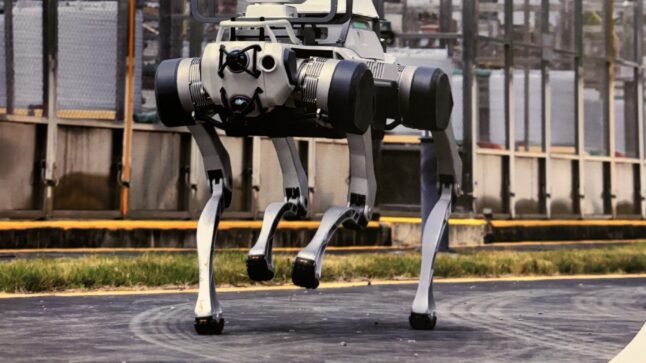
They basically make quadrupeds, robot dogs, which can have the wheels or they can have feet. I don’t know what they call those peg legs. know, and the robot with the wheels, well, they go down the sidewalk super fast. But if you’re going up through the woods and stuff, OK, you can use the wheels at a certain point, but at a certain point you need the sort of legs. They build industrial grade robo dogs as opposed to say unitree, which makes
12:08
humanoids, but mostly makes these sort of lighter robo dogs and unitree is focused more on sort of light industrial use cases and really consumer use cases get a little dog for your house or whatever. uh know, deep robotics is much more focused on industrial use cases, more heavy duty. And that is decently compelling. The use cases they’re going for. Let me give you the list. uh
12:36
Basically inspections of power grids and substations. That’s arguably their largest market. know, the robots basically zoom all around the high voltage transformer yards. They read the meters. They check the thermal profiles. They replace the human walkthroughs. But you know, keep in mind, power grids have cables and stuff everywhere. They go all through the country. So these dogs can go for a long time out into the woods or wherever they need.
13:05
They can go in the rain. These things can be fully submerged underwater. They can handle dust. So it’s not just that they’re industrial where you can put more heavy duty sensors on them and they’re a bit stronger. They’re built for wear and tear of the outdoors. That’s kind of impressive. They do underground tunnel and sort of utility patrols. So they can go underground into corridors. So let’s say they want to go into urban
13:32
piping systems, if they want to go into cable corridors. They’re working for like Singapore power group. They can do high voltage cables underground. You can send these things deep into there. That’s pretty interesting. A use case I thought was pretty cool was sort of emergency response and firefighting, which is basically firefighters and cops kind of. You can mount uh basically fire hoses on the back of these things.
14:02
and they can go into burning buildings or close to the fire like a human wouldn’t, and they can fire their hose into wherever they need. It’s kind of pretty interesting. The police-Ish version, I don’t think they’re calling it police, but that’s what it looks like to me. You can put cameras on the back. You can put loudspeakers on there. You so you might go in, you might go into an environment when they could accompany police as they’re going. They can do patrols like police.
14:32
The cameras can capture evidence, the video, that’s evidence. They can do broadcasts. They can announce public safety announcements. It doesn’t just have to be police. It could be any sort of government official that roams on a regular basis, patrol, things like that. So they’ve got some interesting emergency response. And then you can get into more difficult situations like earthquakes, floods, things where suddenly humans operating gets more
15:02
problematic. uh Well, the robots can go in there, just like they can go into the burning building to a certain point anyways. And then you get like mining and heavy industry operations, so underground coal mines, uh metal processing plants, anywhere where the air quality might be bad, the heat might be crazy, there might be lots of rubble and broken things. Well, you can send all this. So I like the fact that they’re sort of, and they make humanoids as well, but I don’t even know if, I think it’s
15:31
No, they’re making these industrial quadrupeds really for B2B and B2G contracts to government and to large business, especially infrastructure, things like that. I think that’s a very cool sort of use case. get it. you can look at this because they’re going to operate mostly in China in the early years. You can view that one of the things China does incredibly well
15:59
is it can deploy and maintain infrastructure at scale. It’s very good at roads, high-speed trains, putting up airports, bridges. There’s a whole system for this that’s usually government through state-owned banks, and then it goes to local, sometimes government financing vehicles, or to local or state construction companies. There’s a whole system for doing this that is incredibly effective. This sits right into that system.
16:27
You can see that this is just part of building and maintaining infrastructure and then government services on top of that. And then there’s also lot of corporate stuff you can do as well. But I like the B2G, B2B approach. All let me give you a little background on the company. They are basically a Hanjo based, just like Unitree, which is interesting, founded in 2017, founded by…
16:54
Really two researchers out of Zhejiang University, which is based in Hangzhou. A lot of these robot companies, like most of the ones I’m looking at, the origin story is always the same. Two professors or a professor out of a local university research department or research lab spun this out. This comes out of Zhejiang. And you know, industrial quadrupeds, heavier, sturdier than those ones you’ve seen dancing and doing flips and stuff like that.
17:22
Although they do have those versions, but it’s the industrial ones and you know, okay, inspection, emergency rescue, power grid maintenance, high hazard environments, things like that. Interesting. Two series of these, one is the X series and one is the M series. The X series kind of is the heavy duty one. That’s generating most of their revenue. This company’s filed to go public, so you can see their uh numbers. I’ll give you the numbers. That’s kind of their main workhorse is the X20, the X30.
17:52
You know, it can go up and down hillsides. It can go up in forests looking at power lines. It’s water and dust resistant. It’s fully submergible for at least some point in time. The temperature ranges these things can go through and still operate negative 20 degrees Celsius up to 40 to 50 degrees Celsius. That’s kind of amazing. No other robots I’ve looked at can do that sort of temperature. And then they can carry pretty big payloads, which are mostly sensor packages at this point.
18:22
Pretty good. That’s the that was the X20 X30 the M20 M30. That’s the smaller one and Not as rugged, but it’s much faster and it’s on wheels So it can do high-speed rolling across, know, it can zip around your pavement of your factory way faster It can also go upstairs Quickly like super fast it can go through shallow water. So that’s kind of more long-distance patrols
18:53
where you don’t want this sort of, know, peg leg walking up and down. And they also have a couple others. Let me give you some numbers. I’ll finish up with them. How do they compare with Unitree? Unitree 2025 revenue, as far as I can tell, I’m not sure how much I trust these numbers. $250 million, about $80 million of that is profit. Deep Robotics, $47 million.
19:22
So it’s smaller, 1 sixth the size in terms of revenue. Profit’s about 4 million. So profits are kind of equivalent. But it’s about 1 sixth the size. And that’s kind of what you’d expect. B2C robots are going to sell much faster because B2C is always faster. B2B, this government and corporate contracting, it’s always slower. I’ve said this before. B2C is lightning in a bottle. It’s fast, but it’s unpredictable.
19:52
B2B is like mining. It’s slower, but you know the gold is there, so it’s highly predictable. Right, that’s what this looks like to me. It’s going to be slower, but far more predictable. You can kind of highlight that you could probably model that out. Now in terms of their tech stack last thing, they’re not doing the full embodied AI internally. The real time controls, the reflexes, the cerebellum, okay, that they’ve done.
20:20
internally that’s theirs, but the VLA, the cognitive models, they’re doing that by partnership and you can basically use open source models. You can use theirs, but you can use Quinn, you can use Llama, things like that. anyways, that’s kind of company number one. I think that’s worth taking a look at. Okay, next company is Galbot, which I visited a couple months ago. I actually think I’m going to go visit Deep Robotics too.
20:43
I visited galbot, the headquarters in Beijing. It’s in Zhongguancun, which is literally right across the street from Peking University. And this was founded by another professor as well. This is Dr. Wang He, who’s Peking University professor now. But he’s kind of a robotics guru that came out of Tsinghua. Then he went to Stanford, got his PhD, came back, and now he’s at Peking University. He’s kind of a
21:10
You know, big guy there. Well, I founded this company in May, 2023. So, two and a half years ago, which is three years ago now. Pretty impressive. He’s a professor there. You the office is its pretty low key. I mean, it’s just a bunch of people working on robots and uh very interesting. So, OK, why does this one get my attention? The strategy, I like the strategy. The strategy is very focused, which is
21:40
We are going to build general purpose humanoids. That’s what we’re building. So, humanoids, you one type of robot, general purpose, which means they can be used for anything, like anything a human can do. We want them to be able to. So lots and lots and lots of different use cases. So that’s economies of scope. And then in addition to that, you can sort of see that they’ve been very practical about getting these things deployed quickly. So this one,
22:11
I like, know, I kind of like Agibot because it’s like we’re going to do lots of different types of robots, therefore lots of different types of uses and mark cases. And we’re going to sort of go for economies of scale in the manufacturing and hardware side and economies of scope within the intelligence aspect. Robo dogs, industrial, logistics, whatever. This is sort of a more focused version of that, which is, we are going for economies of scope in the intelligence side.
22:39
because humanoid robots in theory have the most wide spectrum of use cases. And we want our full stack embodied intelligence in these robots to be able to go from folding laundry to working in a factory to making coffee to whatever, because humans have the widest scope of these as well. So one type of robot only, but we’re going for the one with the widest potential use cases because we’re going for economies of scope and intelligence.
23:08
And there’s a pragmatic side to that as well. We’re going to try and deploy quickly because that’s how these things are going to learn in practice, which means they’re skipping the whole humanoid problem of making it sort of bipedal walking with its feet, which is difficult, keeping your balance. that. No, They’ve got a wheeled chassis from the waist down. So from the waist up, it’s a robot. From the waist down, it’s wheels. And it can move sort of omnidirectional very easily.
23:37
They’re kind of skipping that problem for now. The other shortcut or, you know, run to market thing they’re doing is they’re all, sort of doing sim to real for all their training. Now, Agibot’s not doing that. What Agibot’s doing is they’ve built this massive center in Shanghai where teleoperators are wearing their goggles and they’re teaching the robots to do things in a physical environment quickly.
24:07
That’s well, it’s not quick actually takes a long time. It’s expensive. It’s difficult. But you get actual training that can then be downloaded into the robot. It looks like Galbot is skipping that we’re going to train everything just a virtual simulation and then download it. We’re going to skip the tele operator part. Now, I’m not sure how doable that is, but you know this professor, this is his background. That’s what I think he did his PhD in.
24:37
So they might be able to skip the bipedal part by using a wheeled chassis, and they might be able to skip the tele-operational training by going from directly to SIM to real. Now, if they can pull that off, these things can be deployed very quickly. Now, when they’re out there being used, then you’ll get some real feedback data as well. So we’ll see if they pull that up. But yeah, I kind of like, I get the strategy. OK, one robot type, lots of use cases. We’re going for a flywheel and intelligence.
25:06
And we’re going for economies of scope and intelligence, good. And two, we’re trying to get there as fast as possible by making some simplifications on the feet and the training. OK, that all makes intuitive sense to me. Now, are they going to execute and do well? I don’t know. One of the things I like about Agibot a lot is the management has a real serious execution uh resume. I’m not sure professors necessarily have that. Some might.
25:37
Some don’t. So anyways, that’s kind of Galbot and why they got my attention. Now the use case, they actually have several use cases. Logistics is one, which is moving pallets back and forth, lifting things up. And they have a larger robot for that. The G1 is their flagship robot. There’s a bigger, stronger one called the S1, which they built because lifting heavy things in logistics, it was too much wear and tear on the regular robot.
26:04
So they built a more hardcore, sturdy one. But the G1 is their flagship. It’s about my height, actually. It’s like 173 centimeters. It’s pretty close to human size. And the use case they’ve been going there is retail. So they have their convenience store robot, which is the one that’s been on the news. And it sits there, and you can talk to it. And it’s full embodied intelligence running.
26:32
there. You can have a conversation just like with AI. You can ask for a soda. It’ll turn around and get you the soda. It’ll, you all that. So it’s a, you know, it’s a retail convenience store worker. And okay, I guess that’s cool. Is that really that different though? I mean, does that really change the needle or move the needle? I’m not sure that use case is blowing my mind. And then they have some they put in robo cubes, you know, these
27:01
these cubes that you can put out on the sidewalk. They’re like 8 to 15 square meters. You can put them anywhere. And they don’t even put the full robot in there. Sometimes they just put half a robot, the waist up. Sometimes they just put the arm. And they’re deploying those around. And people like those. And they’re good. But again, those kind of look like vending machines to me. So, you know, the use cases there are not amazing. And this kind of raises the whole idea of robot retail. And
27:31
You go to WAIC in Shanghai last year and robots were just starting. You go this year, last month, and like all the exhibit booths have robots that will make you coffee. Like it’s just everywhere. It looks like a commodity to me right now. Here’s the pitch on why sort of robot-based retail is better. And part of it I don’t buy and part of it I do. The argument is, look, physical retail,
27:59
department stores, convenience stores, whatever. The problems are it’s very labor dependent. That means you have a certain cost structure and that means you have to have a certain amount of traffic going in there to make it viable. So we don’t see a huge operational footprint for most retailers. They have some stores but they’re not on every street corner, well unless they’re 7-Eleven, but most of them are not. Why? Because they don’t get enough traffic on every street corner to justify their cost structure which is mostly human labor.
28:30
Also, they’re only open a certain number of hours per day. Eight to five, eight to eight. Why? Human labor again. So, if you replace them with robots, which basically can sit there dormant until someone comes up, the cost structure drops, fixed cost. You can put them on every street corner and you can keep them open 24 hours a day. That’s the pitch. Do I buy that? Not that much, to tell you the truth.
29:01
Convenience stores to me don’t look like a sector that has any major problems. It’s super convenient, the prices are low, the staffing is minimal, the inventory is big. Like, I don’t get why I need this yet. I have vending machines down the street, I have convenience stores across the street. How does this really change that? I don’t know. Now maybe I’ll be surprised.
29:29
The part of the pitch that I do buy is they say like the other problem with human based retail is the services are very standardized, not customized, and they’re not very good at selling themselves. Now that I kind of buy.
29:48
If I walk up to a RoboCube, it’s going to have a digital screen or it’s going to have a robot behind some glass. It’s going to know who I am very quickly. That data will get picked up and it’ll say, you hi, Jeff, we know you like the CEO latte at Zeus Coffee. Would you like to try a Spanish latte today? We’ll give you 10%. It can start to personalize in real time in a way that humans can’t.
30:15
So you can start to personalize, which usually increases the customer value. You can start to cross-sell me. You know, if you’re going to get that, you really should get a muffin with that and I’ll do this. You’re much better at cross-selling. It can start to do gamification. You know, here’s the screen. If you catch the bunny on the screen, I’ll give you 5 % off. If you scan it with your phone on, all those gamification and personalization tools that…
30:40
They get you more sales, they get you more data, and they get you more engagement. All of that is very powerful on e-commerce. None of that happens in stores for the most part. It can with these. So you can start to deploy gamification, personalization, cross-selling, upselling, uh data gathering, uh loyalty, all of that. It’s just software. Think about Pinduoduo if you use Pinduoduo or TikTok Shop or
31:09
or Temu. Think about how sort of crazy and engaging the customer experience is on Temu. Now put that in a real store. That to me is compelling. I think the customer service could be a lot more powerful. The other thing is there’s nothing stopping that robot from starting to market and do social media. Why can’t it be posting things on TikTok?
31:37
If I’ve connected with it online or WeChat or whatever, why can’t it start selling me offers and making videos? I mean, it’s just AI. AI is very good at making content. AI is very good at social media. So your individual retailers can start to be salespeople, marketing people. It’s like during COVID when they had the big department stores in China got shut down.
32:02
So they took all the salespeople in the department stores and they turned them all into live streamers because they had to do something because people weren’t coming in. You can basically turn these robots into the same type of thing. So I like that piece because I don’t think you can do that in most stores. So anyways, those two pieces I kind of buy. But yeah, that’s basically m the Galbot story.
32:27
Retail is a big part of their story. I think when you move out of coffee and baristas and convenience stores, it gets a lot more interesting. I think pharmacies are pretty interesting actually. think there’s going be a lot of creativity and those other cases I think are more interesting to me than, hey, you can buy coffee at 2 a.m. in this RoboCube. How many people are buying coffee at 2 a.m.? This is no great need in life. So anyways.
32:55
That’s kind of company number two GalBots we’re thinking about. Okay, last one. Let’s talk about booster robotics. Now, as I was walking around WAIC, everyone’s got their exhibitions and whatnot. One of them was a soccer field, a mini soccer field with two goals, but closer together because it wasn’t that big. And there’s a little mini humanoid there, not very big, about 100 centimeters, about half the size of a normal humanoid.
33:24
And it’s kind of playing soccer, trying to kick the ball into the net. And there was a human acting as the goalie and one, okay, that’s good for videos and clipping. And it’s good to get people’s attention, which is, know, half the game at these things. But it’s this question of like, why is this company making robots that play soccer? Like, is this just uh like doing the back flips and the dancing to get viral clips or what? And no, this is a core part of their strategy.
33:55
And they’re not just doing it here. They have their own robot soccer league, which is run by booster. And it’s a partnership with another group, but they basically let people train and build their robot soccer teams. Usually it’s three on three or five on five. It’s not a full team. And you can use the booster robots and software that everyone uses those. And then they compete and it’s a league and we see who wins. Okay.
34:25
Then in addition, there’s these other humanoid soccer leagues that are out there. There’s one called the RoboCup, which is not owned, organized by Booster, but I think they’re an official partner. And people around the world use their robots to compete in these autonomous matches for the most part. And there’s an adult-sized division. So that’s 150, 170 CMs. For Booster, have
34:52
two robots in that category called the T1, T2. And then there’s a kid-sized division, which is the booster K1. And they have two divisions and, okay, they have the humanoid soccer league. Tsinghua University won the adult-sized world championship using the booster T1. All right. There’s also the world humanoid robotics game, WHRG.
35:21
Again, teams from around the world are using booster hardware in soccer, in gymnastics, in field events. And yeah, apparently the booster T1K1 hardware swept gold, silver and bronze across like lots and lots of divisions. So they’re really into this whole we build robots that can compete in sports and other types of things like this. OK.
35:49
Why would you be doing this? Like, how is this a business strategy? Are they in the business of building sports leagues? Some companies are doing that. No, they’re not. Really what they’re in the business of doing is building a development platform for developers and building an educational training system. More than anything else by revenue today,
36:18
They are an education and research company. That’s kind of strange. That kind of got my attention. I’ve been looking into this. I’m working on an article about this. I’ll probably send it out tonight about Booster. OK, so let me kind of tell you who they are and then why this makes sense. OK, founded in Beijing, Booster Robotics, June 2023, all about the same time. And again, another
36:46
business that was spun out of academic research this time at Tsinghua University. The guy in charge, Hao Chung, he basically did a bachelor’s and a master’s from Tsinghua in the Department of Automation. He founded another company called Jiao Shi Calendar, which ByteDance acquired. then so he joined ByteDance for a while. He ended up as the vice president of product for Lark. That’s their enterprise suite. That’s like their
37:15
you know, their Microsoft co-pilot, which is pretty good actually. Anyway, so he spins out and he does booster and, you know, their mission statement, which I’m not sure I quite have right, but let’s make human robots as accessible, reliable and standardized as personal computers. Okay, I’m not really sure I understand what they mean by that. I’m still looking into them. In practice, what I think they’re doing is they’re creating standardized robot hardware.
37:45
the T1, the T2, the K1, plus an operating system, plus a suite of developer tools that you can use to program and have these robots do things. And that programming can be very basic. It can be for K1 through K12 middle schoolers and high schoolers that are just using sort of visual interfaces to learn how to, you know,
38:15
choose an agent to download onto the robot and then to trigger it. Very basic level sort of GUI based programming that you do in a simulation and then you download it into your robots. Or it can be all the way at the extreme level where you have top tier academic research teams like at Carnegie Mellon. They can use the platform and they have total low level access. They can change not just
38:45
going from sort of GUI and visual-based workflows where you put things together that way, and not just going from there to like, I’m going to code the Python myself, but even beyond that to I’m going to give specific instructions in terms of torque and position and feedback to each individual actuator. So you can program these things at a very basic level when it becomes sort of an educational project all the way
39:15
to top tier academic researchers who then can use this. Now, why would they do this? Let’s say you’re an academic researcher and you are trying to, you you’re on the frontier in terms of writing algorithms and software and programs for robots, and you’re trying to prove new types of neural nets or whatever. Okay, that’s frontier. Now, if you’re in that space, how do you test it and deploy it? Are you going to have to build a robot as well? All the hardware, all the chassis, all the actuators?
39:45
No, that’s not really your business. So you just take the standardized booster hardware software and you put your academic research, your advanced program and you download it there and that’s how you test it. So they’re freeing them up to sort of have the standardized platform. In that sense, the PC analogy is right. Look, if you want to write, you know, really advanced computer code and apps, you don’t have to build the whole PC yourself. We’ll give you the PC running Windows. You do your app and then just download it there and use it.
40:14
That’s the robot. Okay. So that’s kind of interesting. And the educational part is pretty cool. Now, top tier academic research is probably not a huge market at this point, but education really is. how does China approach education? Their policy is you teach, you learn, you practice, and then you compete.
40:44
The word compete is in there. Well, that’s what these robots are doing. You take the students in, you can deploy this into, I think they’ve got thousands and thousands of schools doing this now. You can deploy this in for people in K through 12. They start to use the simpler versions. do the, there’s four levels they lay out of the learning. Level one is discovery, level two is basic programming, level three, level four is like advanced, know, robot engineer, which is going to be graduate students.
41:13
But okay, you teach them, they work in teams, they try it on their own, they practice, and then they have their robots compete, whether it’s a soccer tournament or whatever. So competition is sort of already within the educational process. Well, that’s the leagues. So anyways, here’s the way I look at it. Well, let me give you some basics on the robots just set up before I sum up here. The T1, it’s a basic humanoid.
41:43
the booster T1 118 centimeters high, it weighs about 30 kilograms, so pretty light actually. uh Degrees of freedom, 23 active joints, fine. uh The actuators in this one are, they’re decent performance, they’re not amazing. have, all right, it can walk at about half a meter per second, it can run at about one meter per second, that’s pretty slow actually.
42:11
The chips, NVIDIA Jetson, the Orin module for the T1, I think it uses the Thor for the T2. Yeah, the Thor Jetson for the T2, which is the more high powered one. The one I talked about, the Orin, it’s quite a bit slower. Anyways, cameras, microphone, speaker, no LiDAR. They can go for about one to two hours of continuous walking, stuff like that. I they’re pretty basic humanoids here.
42:41
but they’re standardized and I there’s a lot of value in that. Okay, then the T2 is basically a souped up version of that. The booster K1 is the small one, 95 centimeters high, 20 kilograms. Speed is about the same but slower because the legs are smaller. Joints aren’t quite as powerful. You can get different versions of the processor in this. So you can get the ORAN.
43:05
Really two different types of Orin, the Jetson Orin, which is the Nvidia chip. You can’t get the Thor. Same thing. How do I see the market playing out? I’ll finish up here. OK, you got your… The first thing was helping academic researchers at the highest level, but that’s a small market, but it makes sense. Then you go for general education. You start training students. They move up level one, level two, level three, level four. They go from basic, you know…
43:33
At level one and level two, what you’re really doing is you use something called Booster Studio, which is their developer and operator software. And you can basically choose agents. So you can go to the store and buy various agents that others have made. You put them in your Booster Studio and then you can basically choose them. I want to choose the agent that’s called Soccer Master, which is one.
44:01
Let’s download that into the robot. Let’s customize it. Let’s put it in various workflows. And it’s effectively an agent. Hi Chat, this is the chatty one. uh Dancer, you can do this. So you’re basically plugging and playing various types of agents. That’s the sort low level. As you move up in the level, you’ll look at the agent, but you can also see the code. And you can start to change the Python if you want that sort of medium.
44:27
and then it goes more and more advanced. So you can see sort of people stepping up over time within the educational market. That’s very cool. The big opportunity is probably what comes next, which is replace everything I said about sports with business competition. Let’s say you’ve gone through this whole program, high school, college, you’ve graduated. Now you’re working at some big factory at Midea.
44:57
How easy would it be for you to spin up, we’re going to build a team of robots to run this function within the factory. Well, you’ve been spending your whole life doing exactly that process and our team’s going to do it better than the other robot teams because we’re competitors at heart. The whole we’re going to train you in a sport and have you compete in soccer very quickly becomes I’m going to train my business to compete against your business or I’m going to train my internal robot team against the other internal robot team and we’re going to deploy and we get
45:27
We have these fairly good skills on designing, developing, deploying, and operating robots into all sorts of scenarios. That’s a super valuable skill set in the business world. So you can see like the big horizon opportunity here is probably business. But right now it’s education with some leaks because that’s fun. Anyways, that’s it for this. um
45:51
But education at universities in K-12 is interesting. Research at universities and academic labs is interesting. And then business competition is the ultimate prize, I suppose. Okay, that is the content for today. I hope that’s helpful. Now, I’m spending most of my time thinking about agents and sort of AI strategy, but I felt like robots was a missing piece where my understanding was real shallow. So I’ve kind of been going after that a lot.
46:19
I’m going to go, I think, to the World Robotic Conference in a couple of weeks in Beijing. I think a couple of things maybe. So I’ve kind of been spending a huge amount of time, hence all the articles coming out. And the good news is it’s not very complicated. Robots are pretty straightforward. It’s like studying refrigerators or something. They’re not that complicated on the hardware side. The part that took me a while to get my brain around was the brain. And I found Agibot to be the most helpful in just mapping out
46:49
how their VLA and world models work and the pros and cons of those and how they’re evolving because they’re changing quite quickly. That to me was the hurdle was understanding the embodied intelligence part, but not the robot part. That was pretty straightforward. So I don’t consider this any more difficult than agents in terms of embodied intelligence. That’s about equivalent. But other than that, these companies are pretty easy to take apart, especially because a lot of them aren’t doing the intelligence.
47:15
then it’s just a hardware question. I can compare two refrigerators pretty quick. Anyways, if this is new for you, yeah, just take it step by step. We’re going to see a lot of IPOs in this space in the next year. And the next year, this is going to be a big, big story. It’s going to be a lot of companies. There’s a lot of hype and nonsense around it. If there’s one thing I would read, I would read the AGBOT article I sent, number three. That’s what takes apart the models in the AI.
47:42
The others are more like chips and routers and actuators and all that. But I think that number three is, that’s the one I sort of spent the most time on. Anyways, that’s it for me. Not a lot going on. Life’s going pretty well. I’m heading out to the Philippines in a couple days. That’s going to be fun. Then bouncing around Southeast Asia, then back to Beijing near the end of the month. we have a group that we’re going up there near the end of the month. I’ll talk a lot about that. That’ll be a lot of fun.
48:12
So yeah, just a normal summer. Things are going well. No TV shows to recommend. I’m out. I haven’t found anything. It’s kind of depressing. I actually like HBO Max a lot. I think it’s good. Much better than Netflix, but I’m surprised that you can hunt through all these films and there’s so many of them and yet nothing I want to watch. There should be term for that.
48:37
Like everyone talks about the age of abundance. We’re all going to have so many videos and so many movies and so many products. Like, oh, we live in the age of abundance. And I’m like, well, Netflix and HBO are the age of abundance and I still can’t find anything to watch. What do you call that? Like, what if the age of abundance is a whole bunch of stuff we just don’t like that much? Anyway, scarcity in the age of abundance. Maybe that’s it. Anyways, that’s it for me. I hope everyone’s doing well. Talk to you next week. Bye bye.
——-
I am a founder, consultant and keynote speaker specialized in digital and AI agentic strategy.
I am the founder of Agentic Org Now, a firm that helps leadership teams launch AI and agentic initiatives fast.
I write (a lot) about digital and digital AI strategy (3 best selling books, +2.9M followers on LinkedIn). You can get a free book at the email sign-up below.
My Moats and Marathons book series is a framework for building and measuring competitive advantages in digital and AI businesses.
Note: This content (articles, podcasts, website info) is not investment advice. The information and opinions from me and any guests may be incorrect. The numbers and information may be wrong. The views expressed may no longer be relevant or accurate. Investing is risky. Do your own research.
