


This is my third article about Tencent’s Global Digital Ecosystem Summit in Shenzhen. And about WorkBuddy. Here’s the start of the series.
This article is about the talk by Wang Huixing, Vice President of Tencent, CTO of Tencent Cloud. He is one of the people I follow closely for WorkBuddy and Tencent’s agent initiatives. Along with Liu Yi (Vice President, Head of CodeBuddy and WorkBuddy) and Dowson Tong (CEO of CSIG).
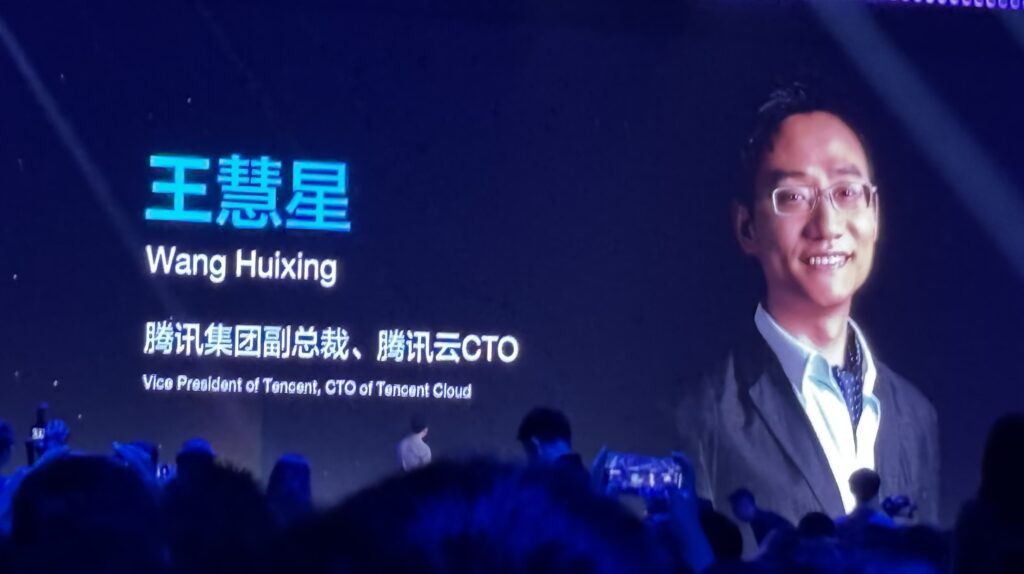
Huixing (and others) said there have been +100 iterations of WorkBuddy since launch in March 2026. We see lots of increasing ties int products and services such as email, calendar, messenger, meetings, documents.
And there are increasing ties with agents residing in key supporting capabilities, such as ima / LearnShare (knowledge databases), Ardot / Miora (design), CodeBuddy, Tencent Drive and DataBuddy.
Tencent Cloud Appears to Be Plugging Everything Into WorkBuddy
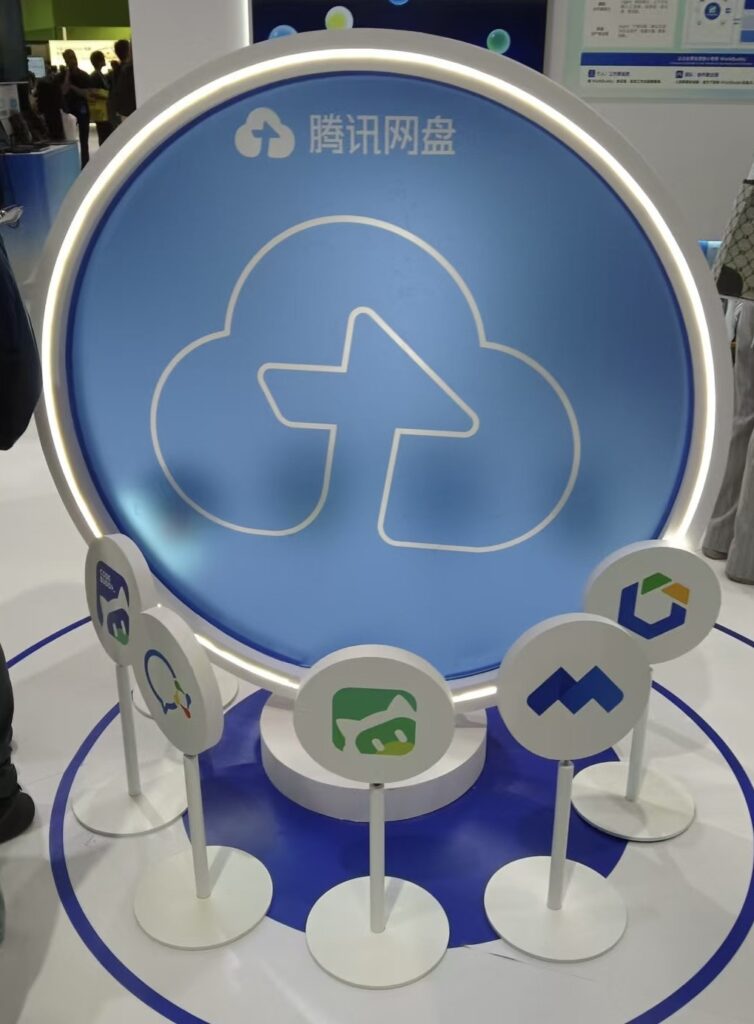
Here’s a display that Tencent Drive had at the summit. You can see them literally showing how the other tools are tying into their big Tencent Drive logo. With WorkBuddy front and center. The other logos are WeCom, CodeBuddy and Meeting.
A simpler version of this type of integration is Buddy One, which is an agentic enterprise system applied to a corporate office. It’s mostly a system for cross-application AI collaboration. I discussed Buddy One in the previous article.
Ok. So, what is the agentic enterprise architecture that is being stitched together?
Digital Employees (i.e., Agents) Are the Basic Building Block of an Agentic Enterprise
I summarized this in the below graphic. This is how you build one enterprise agent. You can see:
- WorkBuddy in the center. It is made up of foundation models and a harness. It also has supporting functions such as identify, memory, and management.
- On the left, there are the user interfaces. Which are mostly messenger or a collaboration platform.
- On the right, you can see the growing list of capabilities and functions the agent can integrate with and call on. These can be inside and outside the firm.
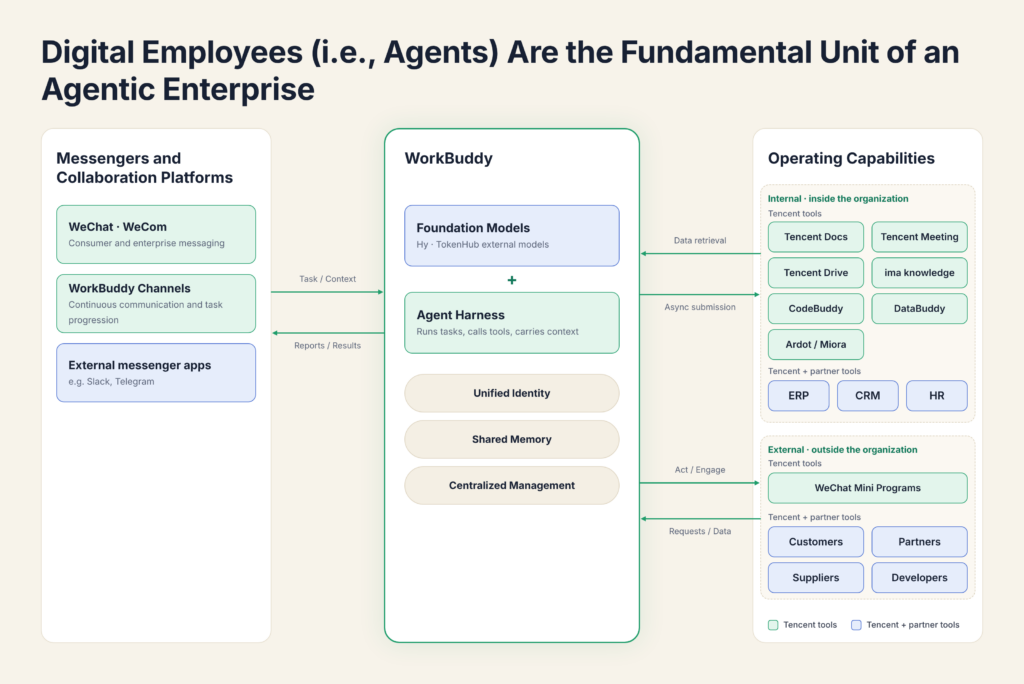
And within this, note the mix of capabilities that are run by Tencent (in green) vs. other parties (in blue).
So why is Tencent referring to agents as “digital employees”?
Because this is how you go from individuals powered by agents to truly agentic-first organizations.
Agentic-First Organizations Will Have 3 Superpowers That Human-Only Companies Lack
In Part 1, I talked about how the big goal and the big challenge is going from individuals using agents to a truly agentic-first organization.
Imagine an enterprise with 5,000 employees and 100,000 agents. All working together. Imagine the capabilities and productivity.
You could also add in 10,000 robots one day. And that’s the holy grail we’re trying to get to. Which I call HARCO (humans-agents-robots in combined operations).
Why is this so powerful?
Because this type of enterprise will be able to tap into 3 big powers:
Superpower 1: Autonomous Operations Let You Scale With Software, Not Headcount
Most businesses today increase their size by scaling up with human labor. That is slow and expensive.
We want to shift from scaling by human labor to scaling by software and technology. That’s the game changer. The great capability of software is that it can scale easily, cheaply and without capacity limit.
But you can’t scale up in agents until you get to autonomous tasks. Humans in the loop are a bottleneck. We need to get to autonomous tasks. That’s the tipping point for tech (not human) based scaling.
Superpower 2: Multi Agents Will Be the Ultimate Teams
Lots of agents doing tasks is great (autonomous tasks).
But multi-agent tasks are way more powerful.
This can be lots of similar agents working on a problem. Think of a swarm of identical drones flying in formation. Note: we are hearing the term “agent swarms” a lot right now.
But having lots of different, specialized agents all working together is truly amazing. Imagine product development being done collaboratively by agents specialized in marketing, sales, engineering, legal, finance, etc.
And WorkBuddy Already Lets You Call Up Agent Teams
On WorkBuddy, you can already call up agent teams in the skill menu. Fun.
Multi-agent collaboration will likely involve humans. So we’re probably talking human-agent collaboration as well.
Also, keep in mind that shared memory and context are key here. You’ll see this in the graphic below.
Superpower 3: Data Flywheels Make the Whole Organization Smarter, Faster and More Adaptable
Human organizations are ok at getting feedback and getting smarter. We use such feedback to make decisions and to adjust operations. This feedback is usually a combination of data dashboards and senior experts relying on experience.
But software is getting better and better at this. It turns out AI is really good at ingesting feedback data. As enterprises go more agentic, these feedback loops are becoming more powerful. These data flywheels are not just making the foundation models smarter. They are also improving task performance. They are improving overall operating performance. And they are enabling more adaptability.
The Roadmap Is Personal Agents Evolving to Digital Employees Working in Teams
Here is how Huixing talked about going from users with agents to a truly agentic-first organization. It’s a left to right progression in the graphic.
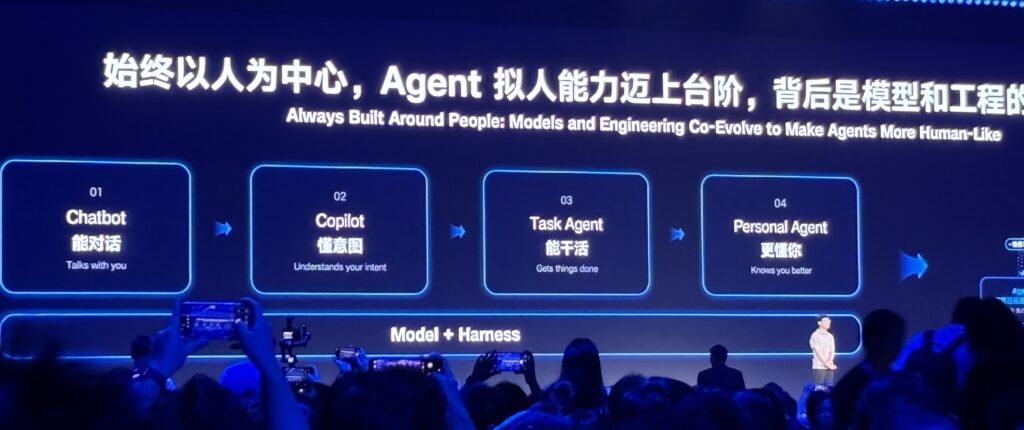
Most Businesses Are Stuck at Stage 4: Personal Agents
Most businesses are stuck at stage 4 (Personal Agent). Here’s what he says comes next.
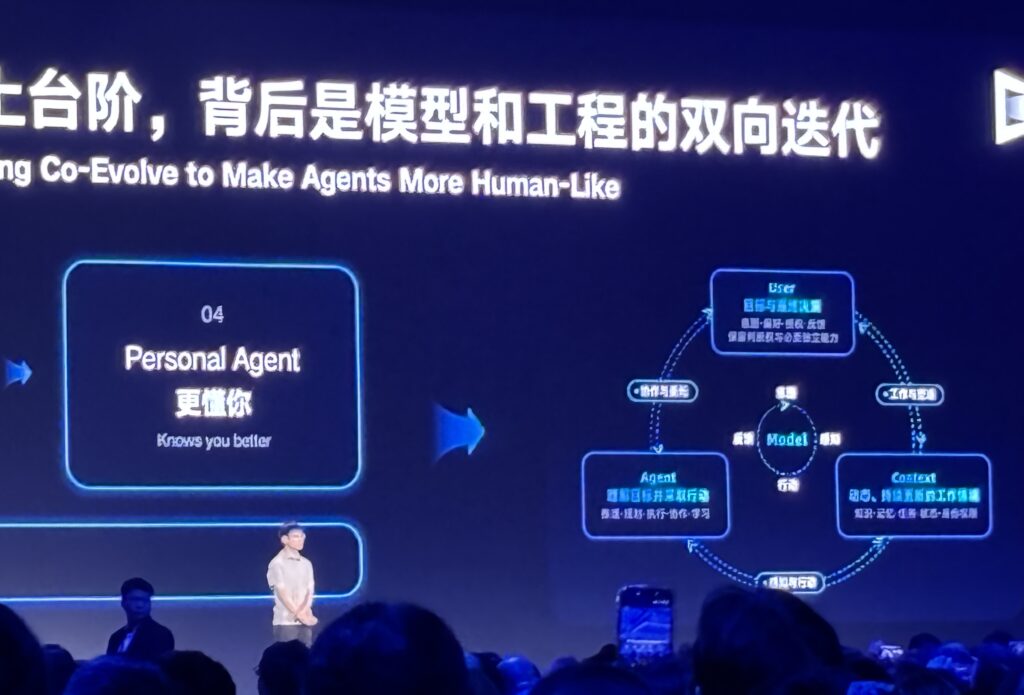
The Engine of an Agentic Enterprise Is Seamless Human-Agent Collaboration
That circular graphic on the right is the engine of an agentic enterprise. That’s the key. That’s how humans and agents (digital employees) work together in collaboration.
And yes, I know it’s all fuzzy. I’ve redone it below. And combined it with the earlier chart for one digital employee.
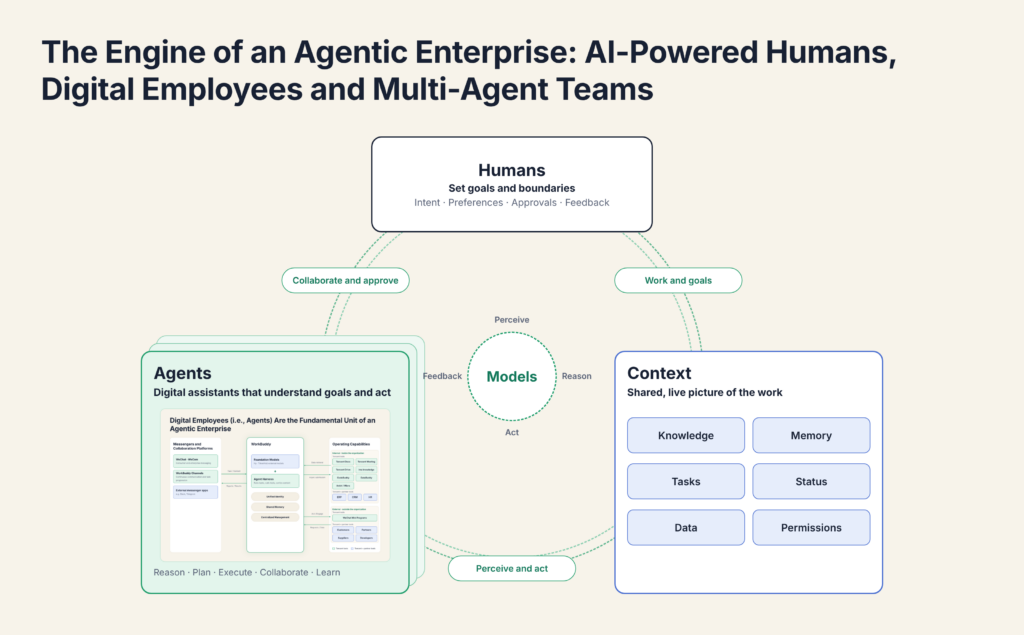
Tencent’s Vision for an Agentic Enterprise Is About Individuals and Teams. Just Like in Today’s Companies.
What jumped out at me about Huixing’s talk was that their vision for an agentic-first enterprise is all based on individuals and teams.
Just like today’s enterprises are made of human individuals and human teams. They are just adding agents as a new type of user.
Note: McKinsey & Co has concluded the same thing. They call it a Symbiotic Enterprise. I’ll write that up later this week.
Becoming Agentic Has Two Steps: Hire Digital Employees, Then Build Teams
So, to become an agentic enterprise, you just need to do two things:
- Hire, train and manage digital employees
- Recruit and manage teams. And these teams can be:
- Human teams, which we know
- Human-agent teams
- Agent-agent teams
Note Huixing’s slides basically making this same point.
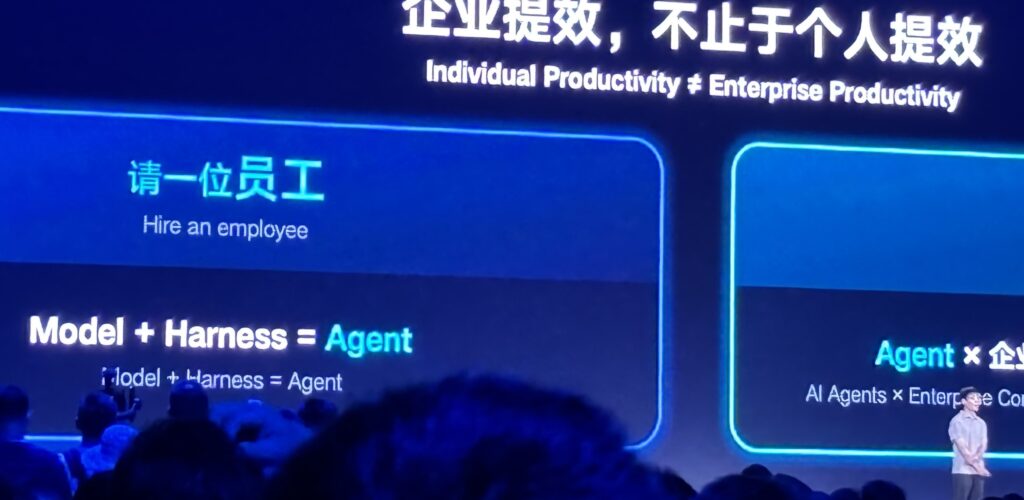
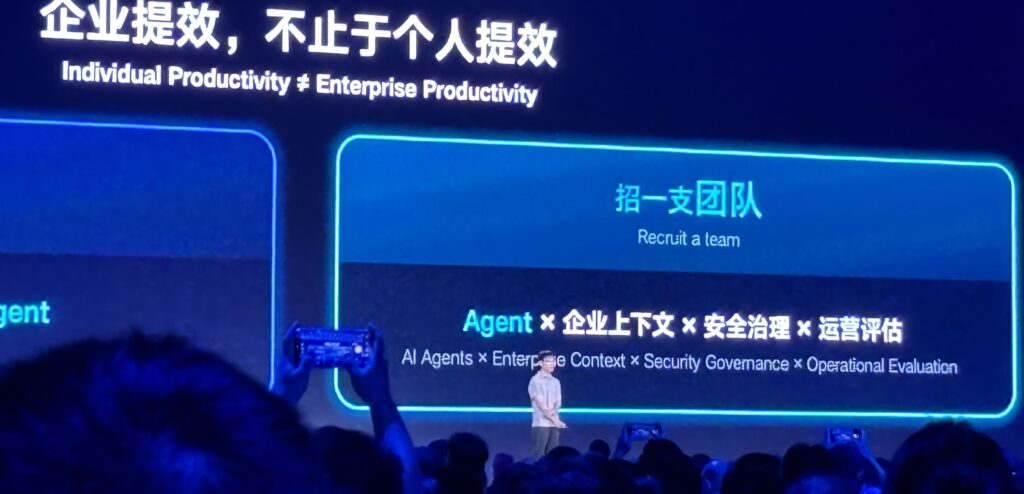
Step 1: Hire, Train and Manage Each Digital Employee
Take a look at my first graphic again. This is basically a structure for hiring, training and managing a digital employee (i.e,. an agent).
Step 2: Put Digital Employees on Teams with Humans and Other Agents
And then we put these digital employees in teams. With humans. With other agents. That looks like this:
Shared Context Is What Makes Collaboration Work
And notice how important shared context is. The models are in the middle (everything draws on them). But shared context is the third pillar that enables collaboration.
And keep in mind, what we’re really after is not teams. We are after collaboration between the thinking and acting entities that are the fundamental units of an enterprise. That means:
- Human collaboration
- Multi-agent collaboration
- Human-machine collaboration
***
So why aren’t agentic organizations happening?
Why are most organizations not taking this big step forward?
Because the described architecture is not complete. There are some missing pieces.
I’ll cover those in Part 4. Which will have the complete agent architecture.
Cheers, jeff
- Why Most Companies Aren’t Agentic Yet: Tencent’s 4 Missing Pieces for Trusted Agents (4 of 5) (Tech Strategy)
- Tencent Wants to Make Every Business Agentic-First (1 of 5) (Tech Strategy)
Disclosure. I have had a paid consulting relationship with Tencent in the past twelve months.
—–
Related articles:
- WorkBuddy Is Now the Hub of Tencent’s Agentic Strategy (2 of 5) (Tech Strategy)
- HY4 Preview Is Here. Plus, WorkBuddy Gets 3 Updates (2 of 4) (Tech Strategy)
From the Concept Library, concepts for this article are:
- Agentic Enterprises
- AI Agents
From the Company Library, companies for this article are:
- WorkBuddy
- WorkBuddy Managed Agents (WMA)
- Agent RunTime
- ADP
- Tencent AI Cloud
——
