
We just finished up Phase 2 of our Alibaba Ecommerce Training Program. This is our program (in partnership with Alibaba) for training ecommerce entrepreneurs.
- Phase 1 was a month of classes on ecommerce entrepreneurship. We cover everything from long-term strategy to AI marketing.
- Phase 2 was a week in Hangzhou doing classes at Alibaba headquarters. And also visiting local companies.
The program really went well. I think it’s a pretty unique training offering.
We’re looking to roll this program out in other geographies Probably Brazil, Mexico, Turkey and Indonesia. I’m starting to talk with local partners right now if you have any suggestions please let me know.
And if you want to know more about our tours and training programs, go here.
On Day 1, we went to Geely / Zeekr and DEEP Robotics.
On Day 2, we headed to Alibaba campus for the first sessions.
And on Day 3, we went to the frontlines of livestreaming. I spoke about this on a recent podcast.
That’s most of what I wanted to go through. So, this last article is fun stuff and useful tools. In no particular order.
Take-Away 1: The Digitized Fly Zoo Hotel Doesn’t Really Work
I stayed at Alibaba’s Fly Zoo hotel, which I used to write about many years ago.
This was back when Alibaba was jumping into all types of offline businesses (department stores, convenience stores, supermarkets). They have since exited most of this.
The New Retail strategy was pretty cool.
It was about digitizing physical operating businesses and then integrating them into the Alibaba ecosystem. Digitization let you create new user experiences. And it also brought in a huge new group of users and merchants.
Fly Zoo hotel was one of those projects. The idea was you could book and check in to the hotel from your phone. There was nobody in the lobby and you could walk right to your room. And food and other things could be delivered by robots. The hotel had a space design.
Overall, it didn’t really work. It ended up being a one-off experiment.
I had never stayed at the hotel before and was curious how it was doing.
Staying there was fun. But the digitization didn’t really change the user experience much. It was basically a hotel with a space theme (which I liked). And it had the worst hotel lobby I’ve ever seen.
Here are some photos.
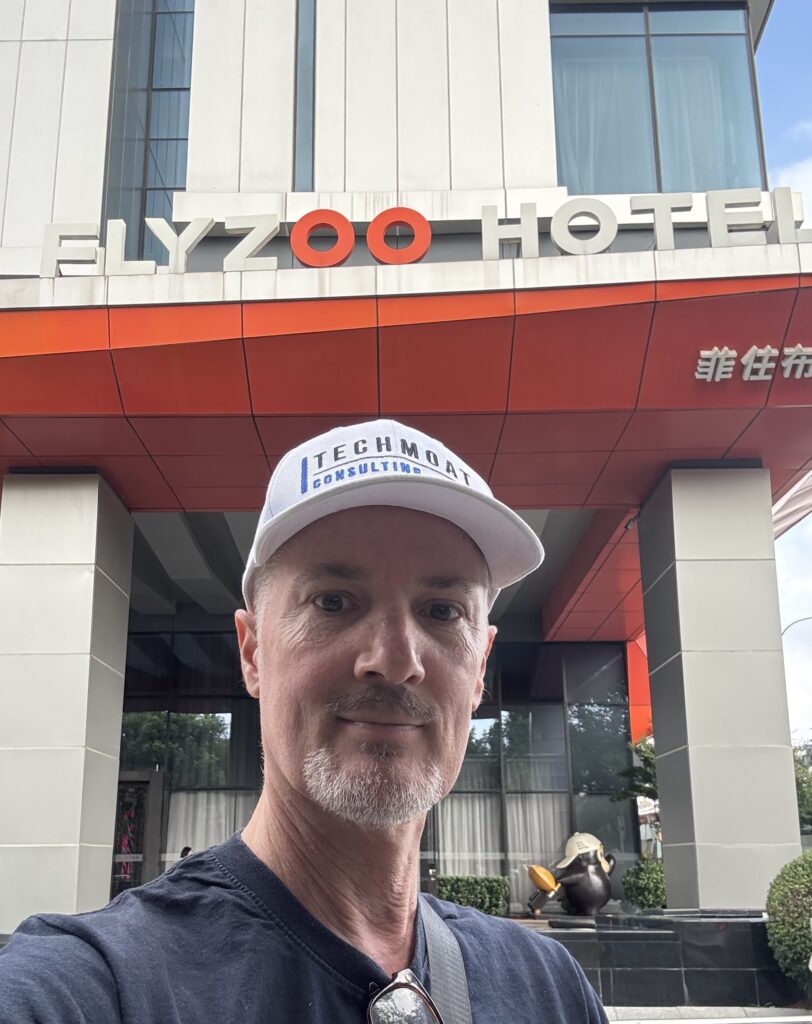

I did like the robot delivery to your room. That is pretty standard in China hotels now. I get my coffee delivered every morning.
I also liked the funky room lights in the space themed room. Although if you turn them on, everyone looking from outside will think it’s a couple getting intimate.


Take-Away 2: Being on Alibaba Campus Is Energizing
I really like being on campus. I like the culture. It makes me optimistic. And ambitious.
That’s mostly about the culture and people.
But it’s also about how nice the campus is. Lots of statues. People doing meetings. Photos with company history. Plus, there’s a good Tim Hortons and Costa Coffee (my favorites).
In the lobby, they now have a full scale recreation of the original apartment, Which is pretty great.


Overall, it’s a great vibe. Although I don’t really get the 996 feeling everyone talks about. It doesn’t feel really intense (unlike JD).
Here’s what things look like at 8pm.
Take-Away 3: QwenWork Is Alibaba’s Most Important Tool Right Now
For agentic tools, you need high impact use cases. Basically, you need use cases you can charge for because the costs are significant. Especially when you let the agents run. This isn’t software you can just give away for free. You need incremental revenue from high value use cases.
Today, that mostly means coding agents and enterprise agents.
There are others (i.e., marketing) but coding and enterprise are the big two right now.
For enterprise agent tools, I am mostly focused on Claude Cowork (Anthropic) and ChatGPT Work (OpenAI) in the West. Although I do look at Google Gemini (sucks) and Microsoft Copilot (so so).
But the China giants are now going international.
- Tencent WorkBuddy is the leader and is now available internationally. I now use this all day long.
- And Alibaba’s QwenWork just launched its international public beta. You can try it here.
In China, I’m also keeping an eye on Doubao Work (ByteDance) and Baidu Dumate.
My working conclusions for enterprise agents are:
- Alibaba is going to be the best for “AI Agents Meets Ecommerce”. They are the only leader in both.
- Alibaba and Tencent are going to be formidable internationally in agents. Mostly because they have other businesses that generate lots of cash and resources (people, tech, etc.). They are not stand-alone businesses like OpenAI and Claude. Keep in mind, Alibaba Cloud is the #1 infrastructure provider in Asia.
And finally, I expect these China agents to be much cheaper that Claude and OpenAI. Right now the choice is between Western AI subscriptions and Chinese open source tools. Chinese AI subscriptions are going to be a third option.
Take-Away 4: Accio and Accio Work Are Great AI Tools for Cross-Border Ecommerce
Alibaba.com is Alibaba’s cross-border B2B platform. This was actually their first business. It started as a marketplace that connects international merchants with Chinese manufacturers. And it has expanded (slowly) to cross-border transactions between lots of different countries. My joke is that Alibaba.com enables SMEs to act like MNCs. A line Alibaba later stole from me and put in their marketing stuff.
The important thing about Alibaba.com is that it has +25 years of data on cross-border ecommerce.
So, when they started to build Alibaba.com into an AI tool, it really got my attention. The result was two AI apps: Accio and Aidge.
Accio Is Already Great
This is an AI sourcing and trade agent. It launched Nov 2024 and it lets you chat with an AI that helps you find suppliers and manufacturers. And it helps you with the process of getting your goods. Shipping, customs, legal, returns, etc. That’s just great.
Aidge Is a Compelling Idea
I don’t know how to pronounce this tool (Aidge?).
It’s an AI toolkit that helps merchants go international. It can study foreign markets for you (it has the data). It can come up with customer targets and product ideas. It can do a cross-border ecommerce strategy. That type of advice is really helpful for small businesses trying to get comfortable in foreign markets.
It can then generate the product listings, do translations, generate product images, handle customer service, and so on. And, unsurprisingly, it works acros Alibaba’s platforms (Lazada, AliExpress, Alibaba.com, Daraz, Trendyol)
Basically, Accio is your supply chain and Aidge is your front office for cross-border ecommerce.
That’s great.
And Accio has now evolved into Accio Work. It’s going agentic. It’s basically a simpler version of QwenWork that specializes in cross-border ecommerce transactions.
Accio Work Is the Next Big Upgrade
It will be able to do all of the above autonomously. So, it can deploy AI “agent squads” that execute end-to-end business tasks (sourcing, compliance, store setup, negotiations). Its agents have all the Alibaba.com data and can call Aidge’s APIs for things like translation, content generation, and customer service. I suspect most everything will be rolled into Accio Work.
That’s really work trying. It’s fun.
***
That’s it for our Alibaba Ecommerce Training Program. I’m heading back to Alibaba in a few weeks. My priority is to meet with Accio and QwenWork.
Cheers, Jeff
*Disclosure: AsiaTech Services, LLC has had a partnership with Alibaba within the past 12 months. This article received no financial sponsorship or backing.*
—–
Related articles:
- Two Lessons from My Visit to Tencent Cloud (1 of 2) (Tech Strategy)
- How Amap Beat Baidu Maps. My Summary of the Alibaba Playbook. (Tech Strategy – Podcast 252)
- Scale Advantages Are Key. But Competitive Advantages Are More Specific and Measurable. (Tech Strategy)
From the Concept Library, concepts for this article are:
- Agentic Enterprise
From the Company Library, companies for this article are:
- Accio and Aidge
- QwenWork
- Alibaba
——
I am a founder, consultant and keynote speaker specialized in digital and AI agentic strategy.
I am the founder of Agentic Org Now, a firm that helps leadership teams launch AI and agentic initiatives fast.
I write (a lot) about digital and digital AI strategy (3 best selling books, +2.9M followers on LinkedIn). You can get a free book at the email sign-up below.
My Moats and Marathons book series is a framework for building and measuring competitive advantages in digital and AI businesses.
This content (articles, podcasts, website info) is not investment, legal or tax advice. The information and opinions from me and any guests may be incorrect. The numbers and information may be wrong. The views expressed may no longer be relevant or accurate. This is not investment advice. Investing is risky. Do your own research.