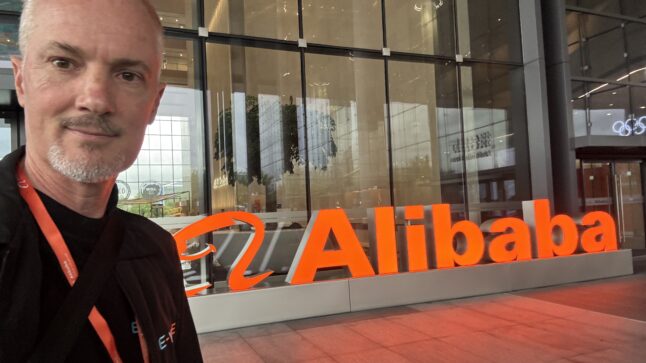



This week’s podcast is about my recent tour to Hangzhou and Alibaba headquarters. And my 3 take-aways from the epicenter of ecommerce meets AI and agents.
You can listen to this podcast here, which has the slides and graphics mentioned. Also available at iTunes and Google Podcasts.
Here is the link to TechMoat Consulting.
Here is the link to our Tech Tours.
My big take-aways are:
- Agentic Commerce Is Now an Arms Race
- Everyone needs to upgrade their capabilities with AI and agents to stay competitive.
- And then repeat.
- And repeat again.
- Human KOLs and Content Creators Have Already Peaked.
- Livestreaming is already shifting to digital avatars. Other content creator types will follow.
- The future of content creation and KOLs is mostly not-human.
- Digital Livestreamers Have Arrived in Ecommerce. Entertainment and Thought Leaders Are Next.
My playbook for human content creators / KOLs is:
- Focus on topics where being human matters:
- Taste and curation. What wine is better vs. what laptop is better.
- Irreversible and/or critical decisions. Situations where you can’t do it over and judgement matters.
- There is an advancing frontier of knowledge. There is no existing online database of expertise. Think new AI tools, not history.
- Use a multi-format approach:
- Focus on building personal relationships. Such as in communities and events. Both online and offline.
- Make your content super authentic. Ideally videos instead of text or voice. Make it clear this is a human.
- Deploy an avatar army. Your solo content is not enough. You need an army creating content 24/7. This can be clones of yourself or similar personas.
Here are some pictures from mytwins.ai and from my trip.


Disclosure. I have had a education partnership with Alibaba within the past twelve months.
——–
Related articles:
- Tencent Is Industrializing Creativity in AI Advertising (5 of 5) (Tech Strategy)
- More High-Tech Flex by Huawei R&D (4 of 4) (Tech Strategy)
- 6 Big Events in AI Agentic Ecommerce (Tech Strategy)
From the Concept Library, concepts for this article are:
- Agentic Commerce
- Marketing / Advertising / Content Creation: Digital Avatars
- AI Marketing: Livestreaming
From the Company Library, companies for this article are:
- mytwins.ai
- Alibaba
———transcribed
00:06
Welcome, welcome everybody. My name is Jeff Towson and this is the Tech Strategy Podcast from TechMoat Consulting. And the topic for today, how AI agents are basically ending human live streamers. And a couple other takeaways from my three days at Alibaba headquarters. I really had a great week bouncing around Hanjo, three days at Alibaba.
00:33
And really, mean, that is kind of the epicenter of AI and agents meet e-commerce. I really think that’s the single best place to look. Maybe Amazon, but I don’t know them too well. But for me, that’s number one. And I had a couple of kind of big takeaways. I want to talk about one, the week, because it was a lot of fun. And also to talk about my big takeaways, one of which is like, man, think human live streamers, think that’s over. If it’s not over, it’s going to move to a very small percentage of what happens in that regard.
01:02
And I’ll go through that and some other things. But yeah, that’ll be the topic for today. Let me see, let me give you my standard disclaimer. Standard disclaimer, nothing in this podcast or my writing or website is investment advice. The numbers and information for me and any guests may be incorrect. The view and decision opinions expressed may not all be relevant or accurate. Overall, investing is risky. This is not investment, legal or tax advice. Do your own research. And one quick disclaimer, I do have a…
01:29
sort of a teaching education partnership with Alibaba. That’s kind of what we were there to do. So there is a bit of a commercial relationship there, but nothing to do with this podcast or content. Okay, with that, let’s get into the topic. So the concept for today is agentic commerce, which it’s really short for AI and agentic commerce, but I’m just going to say agentic commerce. It’s the more powerful version of the same phenomenon, more or less. And yeah.
01:59
We put together a program, this is me in the Alibaba Global Institute, and in this case there was a group in the Philippines that was involved, and basically to do training for e-commerce entrepreneurs, which we broke into a couple phases. Phase one was a bunch of sessions on the ground, going through basically Alibaba’s strategy, how they think about e-commerce, and a healthy portion, which was actually really quite powerful, those of you who haven’t studied Alibaba, it’s got a really great culture.
02:28
They’re very good at strategy. So their overall approach, I think, is really top notch. And then a big part of that is combining e-commerce with AI marketing, which is huge. Solopreneurs, know, the individuals who are building big businesses with just agents at this point. A lot of focus on that right at that intersection. And that was kind of phase one of the project that went on for about a month. The end and they all graduated. They got certificates.
02:58
from Alibaba, not from me. I’m not sure my certificates would be worth that much. And then we took a subset of them to Alibaba for really three days on site, but it was kind of a five to six day tour of Hanjo. Man, it was just the best. It was a lot of fun. You go out to dinners, those are always fun. We went out to Geely, really Zeekr. Geely is the car company, but Zeekr is their EV business.
03:25
which is kind of be a big story in the next year. People haven’t really realized that Zeekr is like the number three EV company in the world now. And they’re going to probably pass Tesla, I would say this year, probably a couple months. They’re huge. They’re the BYD people don’t know about, Zeekr. Spent some time with them, went over to Deep Robotics, which I’ve talked about before. I think they’re really a cool company. And then sort of three days on Alibaba campus, bouncing around there.
03:55
do there. In that we actually visited a couple companies around Hanjo. Hanjo is a really interesting place because it’s known for Alibaba and what that has sort of built around it. There’s Zhejiang University, which is there. There’s some AI companies there. DeepSeek is there. Deep Robotics is there. Unitree is there. So that’s there. And then there’s a bunch of express companies because it turns out logistics companies all were tied to Alibaba.
04:22
That’s kind of all gone there, but before any of that happened, there was a lot of apparel and silk and other things. So there’s sort of a historical fashion business there as well, which we went and visited a couple of businesses. One is sort of a digital first fashion company, which I’ll talk about. Another was a digital live streamer business, which is kind of the point of this. And then we actually visited one of the biggest human live streamers in China.
04:51
I think she’s number one or she was number one on Kuai show for a long time and they built her the biggest studio for live streamers in China, I think. And we visited that. So I’ll talk about all that. So you’re kind of in the heart of a lot of things there. Express delivery, e-commerce, Ant Financials nearby, Tsai Niao Logistics is nearby, robots, AI. Anyways, it’s a really pretty cool place. There’s actually more to see there tech-wise than probably Shanghai. If you want to look at how companies are
05:21
adapting tech tools, you can go to Shanghai. A lot of entertainment, a lot of fashion, a lot of traditional businesses, pharma, a lot of international companies there, Sanofi and all those. And I’ve written about and talked to them over the years. But just China tech companies, Beijing’s number one. It’s kind of a split between Hangzhou and Shenzhen as number two at this point. Anyways, that was what we did. It was awesome. I’ll talk about some of the companies we visited.
05:51
I guess this is sort of an opportunity. We’re starting to look for another partner in another geography. This was a program done with the Philippines. We’re looking at Brazil, Southeast Asia, maybe Turkey, I don’t know, to do the same sort of program. So we would be looking for a partner in one of those geographies that has, you know, sort of an existing relationship with SMEs and entrepreneurs, smaller businesses that are focused on e-commerce. So an e-commerce services business, things like that.
06:21
That’s kind of where this fits in nicely. Where really the criteria for joining this program is you have to have been running an e-commerce business for a couple years. It can’t just be an idea. You have to be on the ground. And then we try to take you to the next level. So anyways, if that’s of interest and you think you have a right partner or you are the right partner, give us a call. Give me a call. Yeah, I’m starting to think about that. We’ll probably ramp another one those up soon because it was pretty big success. Pretty great, actually. Okay.
06:50
Let’s get to sort of the takeaways from, I don’t know, Hanjo and all this. Number one, I have three. Number one, agentic commerce is a full on arms race. If you are selling anything online, products, do e-commerce, services, less so, but definitely in play, content, it’s an arms race, which means everybody is getting new tools, new weapons.
07:20
And if others have them and you don’t, you’re in deep trouble. So you’re going to have to up your game, but you know, they get bazookas, you got to get bazookas. You get a tank, they got to get a tank. That’s kind of what’s going on. And the tools are rolling out real fast. So if you’re doing that, yeah, you get on it. Now I’ve talked about sort of agenda commerce before. I won’t go into the stuff I’ve talked about previously. One was that, look, the user pathway is just changing fundamentally how people.
07:49
discover goods, how they first hear about something, what is their decision pathway once they buy, what is the sort of usage pathway, engagement, repeat buying. If you lose a customer, how do you sort of get them back, things like that. That pathway is really getting reshuffled. And we don’t really know where the wheel’s going to stop yet. But everybody knows, know, chat GPT and these AI services.
08:18
whether they’re just question and answer or agents. That looks like the entry point for a big portion of this, which is a big change. So that’s kind of one, I won’t go into that too much. Industry structure is also changing. We’re getting new players on the field that used to be merchants, brands who sell, consumers, customers, B2B who buy. In between them, we have Omnichannel. We have marketplaces, we have physical stores, we have content. Well, we’re getting new players.
08:49
We’re getting agents that can be buyers. We’re getting agents that can be sellers. We’re getting agents that can be content creators, including live streamers. We get agents that can be brokers in the middle. The overall structure of commerce is going to change. It’s already starting to happen. That’s a big deal. Agent to agent transactions are really interesting. Okay. Let’s get to the point of this that matters. The arms race. Yeah, we’re all getting superpowers. It’s kind of…
09:18
amazing and terrifying. I’m trying to think of a word for that. I’ve been going with like the awesome Getting or the fantastic apocalypse, like something that’s both awesome and fantastic, but also like Armageddon because everybody’s getting disrupted pretty much. One of the companies we went to, can basically design apparel and not t-shirts with funny words on it, cheap, not merch.
09:46
I’m talking about high quality apparel, things like nice jackets you would get from North Face, goose down interior, advanced sort of water resistant Gore-Tex, high quality wool, all of that. Not $10 t-shirts. I’m talking about you can design clothes at $50, $100, $500, $800, pretty much at the quality level that you want. You can do it all on a laptop.
10:16
You can take a picture of something, put it in there, start to play with it. You can describe what you want. It’ll generate it. You can try out different fabrics. You can do all this, make any design you want. It takes four minutes and you don’t need any skills whatsoever. Once you get it, you have a design you like. You tell it to spit out some videos. You tell it to put your garment on models. You create JPEGs, everything you would need to start posting online and selling. And this is the part.
10:45
That’s pretty, we’ve seen that in a lot of companies at this point. Definitely like the big e-commerce companies like JD and Alibaba. They’re offering stuff like this. What this company had, they had the manufacturing piece as well. So one of the outputs of the LLM is you can create basically a spec sheet that can be sent right to the manufacturer. And they have a network of about 800 apparel manufacturers in China. You can get your item anywhere between three and 10 to 12 days.
11:16
If it’s cotton and things like that, three to five days. If you’re talking about silk and wool, okay, you’re closer to 10 days. That’s a completely new capability in this world. And I don’t know if anywhere outside of China, you can do that. What you need is you need a massive manufacturing base. Well, this is 800, 900 apparel manufacturers. Xi’an, when they do, this is kind of like Xi’an basically. Xi’an, they have about 7,500 manufacturers in their network all in China.
11:45
So you need that base first, but then you also need them to sort of be digitized and flexible. There’s a real difference between a factory that’s been set up to make 2000 copies of one thing, which is how most of them are, or one to two copies of 2000 different things in the same day or week. That kind of flexibility, you kind of have to build that into the factory from the get-go.
12:11
China has that because the ecosystems have been tied into e-commerce for a long time. I don’t know anywhere else in the world that has both the scale and the flexibility to do smart on-demand manufacturing. So that was pretty cool. I I’ve been playing with it. I could be a fashion house in about two days if I wanted to. And I have no skills and no fashion days whatsoever. I could do it. I could make the videos. They would look just like stuff from Zara or whatever.
12:41
I’d put them up, I could have it made, shipped, all of it. That’s a superpower. It’s kind of amazing. So if you’re in that field, yeah, you’ve got to start upgrading your stuff. And that’s just one version, the agents and all that. It’s kind of crazy what you can do. One of the interesting implications of that particular business model is you can basically get away from this process of build it and then see if people buy it.
13:09
You can basically test stuff first, create a bunch of videos, create a bunch of designs, put them out, look at the click through rates. Actually, you don’t even have to do it. The AI will do it for you. Based on feedback, then you can decide what to manufacture. And then you’ll get your product out in 10. So you can kind of test and then build, as opposed to build and then hope. That’s interesting. The other bit is you can also do cross border. You can digitally connect all these things so you can…
13:38
sell in pretty much any country you want. Anyways, we are probably going to start a service that offers this. I don’t think it’s going to, we’re going to start taking orders. If anyone wants to have something designed, manufactured and shipped within, let’s say 10 days, manufacturing, shipping takes longer depending where you are. Yeah, we can probably going to start offering that into the US.
14:03
Maybe some other countries. If you’re interested in that, let me know. We’re sort of testing out and starting to take orders right now and see how goes. That’ll be kind of fun. I don’t see that that’s a replicable capability outside of China in the near future. I think that’s going to be unique to China for at least a while. Maybe for some countries forever, for others quite a while. So that’s kind of point number one. Look, we’re all getting superpowers.
14:30
Agents that do your work for you this type of stuff with the apparel content creation in huge volumes blah blah blah Okay, so if we all get superpowers and everybody can do what everyone else can do That means there’s going to be a ton more products in e-commerce and a ton more services. How do you? Get human attention
14:53
when the number of products up there goes up by a factor of a thousand. So getting human eyeballs is going to be super important and a lot harder than it used to be. Which brings me to point two. Basically like human KOLs, influencers have matured. Or you could say have peaked. We’ve probably hit peak human influencer at this point. The wave going forward is going to be much more digital humans.
15:23
Now humans will still be there and there’s different ways you can be an influencer still in this world. There’s different ways obviously to do that. But in many ways I think we’ve probably peaked. And within that, live streaming I think is going to tip the fastest or at least the first. So live streamers are going to get sort of, human live streamers are going to get subsumed with digital live streamers probably first. now we visited the studio.
15:52
of one of the biggest live streamers. Livestreaming really took off 2018, 2019, 2017 when short video came out. But live streaming itself had been around for quite a few years after that. But really that was sort of the short video live streaming boom. And she became very, very large at that point. Number one on Kwai’s show, apparently 100 million followers, massive. Generally in China,
16:21
Big in China, you add a zero. So that would be like 10 million in the US, though we’d say 100 million in China. very big, equivalent in the West would be like 10 to 15 million, something like that. And she did what a lot of these live streamers do is when they sort of get really, really big. One, they build a huge ass studio. And this is a crazy big studio, it was amazing. I’ll put pictures in the show notes. It was really pretty awesome. And it sits up there all day, four to five hours.
16:51
You know, showing product after product, merchants and brands, the representatives, they have a part of the studio they sit in and wait. You know, the products are chosen ahead of time, the information, the key selling point, the product quality is tested. And then she sits up there for 45 hours and goes through item after item. And it’s really effective. Like live streaming is super effective. And it’s kind of an interesting business model because
17:19
it doesn’t get as much attention as short video. If you look at companies like Huya, I’ll talk about them shortly. Huya was a sort of independent company that eventually got sort of acquired by Tencent and they were always sort of focused on short video but much more on live streaming. And live streaming can be selling products, commerce, it can be talking about gaming, which obviously makes sense that was a tie with Tencent. But generally what people say is
17:49
Look, short video gets you attention and eyeballs, but live streaming gets you money. If you ever look at the numbers for live streaming, it’s way smaller. And a big live streamer is going to have far fewer viewers than a short video because it’s time synchronous. It’s a lot harder to get people to show up at your show and watch you live than it is to just get them to watch your video at some point in time.
18:17
So you get a lot more traffic to live stream, I’m sorry, to short video, but then you can monetize directly in live streaming. If you want to make money as a video creator, you got to get a lot of viewers before you can make any money. If you start live streaming today and you have 10 people watching, you can start selling right now and getting revenue. It monetizes immediately. And I would also argue that it’s more powerful. Live streaming is interactive. You can talk with the person, get responses.
18:47
There’s often a kind of a community where people in the chat are all joking around and talking while the person’s up there. Like it’s much more of a powerful medium, I think, than just passively watching a video. But typically it’s been hard to build businesses around this because let’s say you’re a big live streamer, what do they do? Well, they become a studio and they try to find talent and expand beyond themselves to 10, 20, 30 other live streamers.
19:16
and they train them and they show them all the tricks and they collaborate with them to help them. It doesn’t usually work. When you look at the studios that have done this, they call them like talent agencies or live streamers. Most all of the traffic and money comes from one or two people who are popular and then the other 19 or so, they get a little traction. It just turns out it’s really hard to become like a pop star. You can have one famous band like the Beatles, but if they open a studio and hire 20 other bands,
19:45
you’re probably not going to get another Beatles. It’s rare and it’s hard to predict. So that was kind of the case here and we’ve seen this multiple times. So this whole business model of live streaming, it’s hard to build companies around that. Usually most of the value goes to the popular live streamer. And then if you are successful, what happens? Maybe if you bring in investors, the live streamer just leaves and does it on their own.
20:10
So you can’t really invest in these businesses easily. They’re hard to grow. They’re unpredictable. But that’s what this was. And we’ve seen several of these over the years. It’s not bad. It’s just they don’t scale naturally. There’s not an obvious next step when you become a big live streamer in terms of institutionalizing. The other problem with this model is it’s not obvious for how brands can partner with big KOLs effectively.
20:40
I mean, you can do it. It’s expensive. If you go to the big KOLs with a lot of followers, you can get traction and you can get traffic, but it’s pretty expensive. And if you sort of go down to smaller KOLs, KOCs, that’s actually, think, a better strategy, but it’s also problematic. And part of it is, look, it’s very hard to get attention in this world. And even the most effective KOLs and KOCs, it’s kind of unpredictable for them too.
21:08
Getting people to tune in is difficult and brands and merchants have struggled because they’re one step removed from the people who generate the traffic. And so they spend a lot of money and typically their returns on that money are not awesome. They have to do it. They don’t have another alternative, but it’s not been awesome for them. Anyways, that’s kind of point to that, you know, KOLs have kind of probably peaked, human KOLs have kind of peaked and definitely live streaming.
21:37
has a lot of problems and I’m kind of teeing up the problems because I want to, you for the business, the scalability, the merchants and brands, I’m teeing up the problems because I think digital live streamers solve most of those, which is really point three. Okay, takeaway number three, last one. Digital live streamers have definitely arrived within e-commerce. Now you can be a digital live streamer in lots of areas. could be, know, live streaming is about
22:06
Selling right we’re moving products, but you could also be one for entertainment singing commenting on sports games commenting on gaming thought leadership Conferences, I mean you can do this in a lot of ways, but I’m saying for e-commerce It looks like that has probably arrived and the company we visit I’ll give you the name I didn’t want to give the name for the other Previous company because I was kind of criticizing the model a little bit and that wasn’t you know
22:35
They were very nice to us to let us come and visit. So I don’t want to say, but you know, that is where it is. So this company, the digital live streamer, that’s a company called my twins dot AI based in Hanjo founded or co-founded, maybe co-founded by a woman named Bindu. Really super interesting. The product is compelling. They’re getting traction. Let me show you what talk about what they’re doing. They’re basically focused on.
23:04
creating digital humans that can live stream effectively, which means they’re selling products, they’re moving products. then basically selling that or offering that as a service to various brands. And they have brands they’re working with like Pop Mart, Nivea, Sketchers, Adidas, New Balance, Hire. They’re getting traction.
23:32
and they had a very sort of straightforward business proposition, which is we help brands increase their sales at lower cost. That’s a good mission statement. And most of these people at this company are ex Taobao Live people. So they were working there, Taobao Live, they spun out and they kind of teed up the problems, I think, quite well. I mean, what are the problems with
24:00
I just mentioned some of the problems like merchant, like the business model of human live streamers. I’m talking e-commerce. It doesn’t scale very well. It’s very unpredictable who is going to be successful. It puts brands and merchants one step removed from what they care about, which is reaching their customers. Other problems, it’s hard to invest in these businesses because it’s really just one person.
24:29
You often have scandals with human live streamers. There’s a pretty good history of human live streamers in China getting into various trouble. Well, if you are a brand and you’ve associated yourself with that person, that’s a problem. It’s not just like you’re not going to get traffic. If they’re your brand ambassador, if they’re one of your key partners and they have an issue, that’s a problem. Digital humans kind of takes care of most of these problems.
24:58
Let me give some examples.
25:02
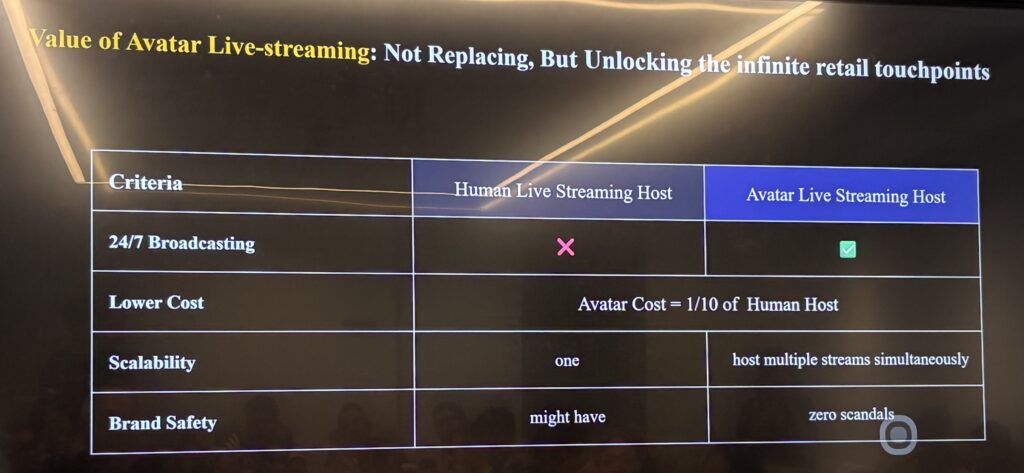
Here’s what they said. Digital humans, first of all, they’re way cheaper. It’s just software. Real humans are very expensive. Content creation takes a lot of time. It’s expensive. You got to be there all the time. Well, they say that digital humans doing live streaming, the avatar costs about one-tenth of a human host. That’s pretty good. It’s highly scalable.
25:31
Instead of having one big popular influencer and that’s all you’ve got on one channel, probably. Well, you know, you can have multiple influencers. You can copy them and make, I mean, it could be the same person. You could just make 10 copies of the same person and put them on different channels, Facebook, Shopee, whatever. Or you could do variations on that person, but you can scale up. You get brand safety. There’s no scandals with digital humans ever, probably. And
26:00
You can 24 seven broadcast. Live streaming is a pretty hard job. You’re going five, six, eight, 10 hours straight, selling, selling, selling. Then they sleep, then they come back in the morning, they do it again. It’s pretty, it’s like being on a treadmill. Well, you can have digital avatars going 24 seven. And if you can get scaled up, you can have 50 of them. And because it’s a more clear business model, you can start investing money more systematically.
26:30
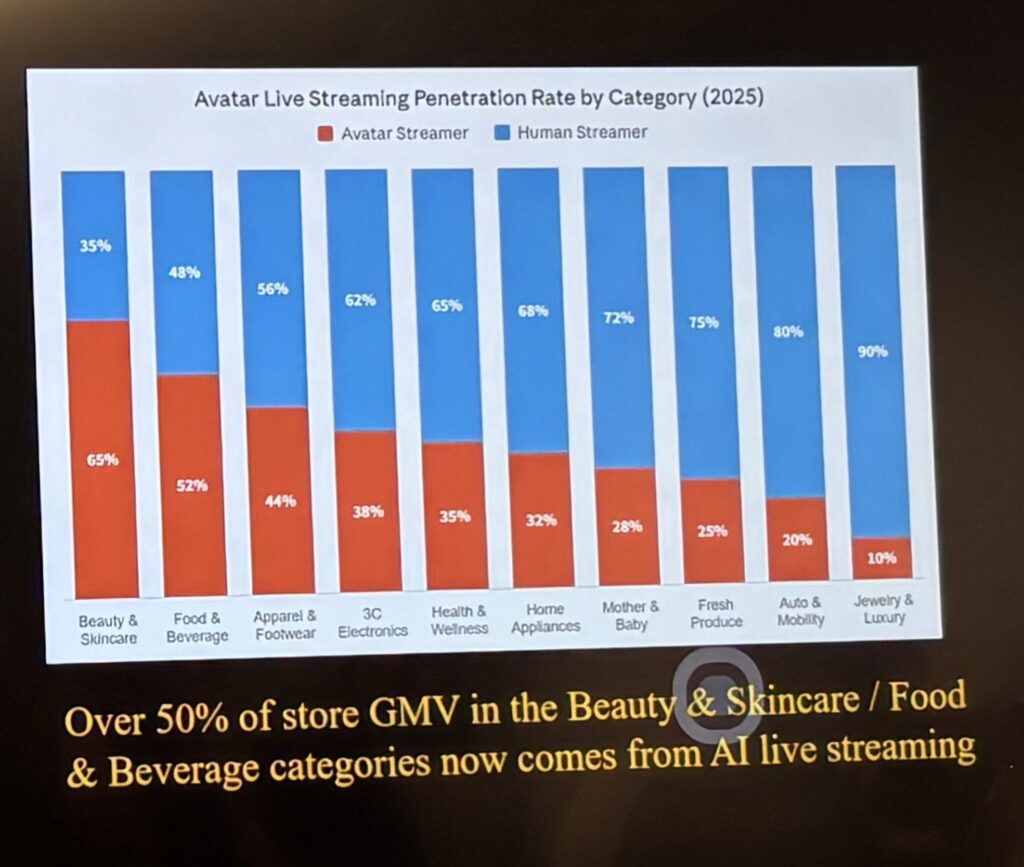
so you can open the doors to outside investors. So you can kind of see that like, all right, that sounds like a better solution long-term if you can get it to work. mean, does it work is the question. And according to this company, she had some interesting numbers about what percentage of live streamers in certain categories are digital versus real human. And yeah, beauty and things. She said,
26:58
More than 50 % is now digital, not real humans. Other categories like apparel, like let’s say Zara, quite small, 5%. So it really varies by customer product, by product category of one, there’s the question of can you tell it’s not real? And you kind of can a little bit now, although that’s fading away. The other question is do the customers care? And it’s very clear in certain categories they don’t care.
27:28
It’s fine. If you’re looking for something where you care about taste, curation, this is a really cute sweater. We like this one. The human matters. If you’re just looking for a basic functional product and you just want to know the specs, like laptops, digital human’s fine. Just show me the numbers. That’s all I need to know. yeah, and it basically goes from 60 % down to about 5 % at this point.
27:57
with digital humans doing the live streaming depending on product category. But the numbers are going up pretty good because the business case is pretty compelling, especially the cost structure. And it’s a solution to a problem that has plagued brands for, you know, since 2018, 2019 since when this really took off. Now she went through the process of how you train these things and get them to work. And it was actually kind of fascinating and it was honestly very concerning. So.
28:26
The first capabilities you’ve got to sort of you know, the ability to live generate content. Live streamers by definition are constantly generating the content and it has to be able to respond to questions. So when people type in the chat, can it see the chat and then put in a response? Or can it see the question in the chat and then answer it verbally on the screen? Well, that means your latency, you’re talking, it’s got to be a second.
28:56
It can’t be five seconds. So the live generation of content that is interactive sets a pretty high bar for the technical capabilities. Because that sort of question number one is create that. How do you do that? Well, you look at top sellers that are doing well online and let’s say clone them or copy them.
29:23
Look at anyone who’s getting traction online in the last month. What are they doing? How are they speaking? What is their backdrop? What content are they talking about? Do they have any amusing sort of quirks they’re doing that people enjoy? You can study everything about what people are watching and then sort of basically clone based on that. Now, if you already have digital avatars working,
29:48
Let’s say you take some of your current real sales agents and you turn them into avatars, which is a good approach because your current sales agents already know the products quite well. Okay, you can digitize your current sales agents if you have a physical store. Once you get a good digital version of them, a top seller, you can then clone that. So if it’s your own, okay, you can say you’re cloning it. If it’s someone else’s online that you’re watching, yeah, you can copy it.
30:16
Now they will say you can’t copy it and if they copyright strike you, how hard is it to change it a little bit? Change the hair color from brown to black. Make the hair shorter, not longer. Make the speech a little bit. It’s pretty easy to just tweak it a little bit and get around any sort of copyright stuff. And I think people are doing that left and right now. Now your goal with your top seller is to get the tech going, but your real goal is here is to build trust.
30:45
You have to sort of cross the uncanny valley where they think it’s human or even if they know it’s not human, it’s okay, they trust it. So you got to build trust with your core characters. That’s step number one. Once you get that, you move to step two, which is, okay, we’re getting attention, we’re getting engagement, we’ve built trust. Step two, now we need to start to drive traffic into sales.
31:16
We need to start converting. So all that traffic we’re getting, we need to start converting and we need to see the sales numbers moving.
31:24
That’s when you can start to tie to certain products. You start to build your brand. Now, let’s say you’re in a large brand like a Nike. Okay. You’re not going to have a hundred different agents doing stuff. You’re going to create five or 10. So you need to sort of build the agents. And once you get them, you start to drive sales with them. Then they sort of become a version of your brand. So your brand as a company is not just your logo anymore.
31:53
It’s your logo plus your digital avatar. So you got to be really careful with that. But once you start driving sales, yeah, you’re kind of creating a different face to your brand, like a global ambassador. Now you can have several of them and you can change them and all those things. But to boost sales, you need a different capability. need to be able to greet people. You need to be able to answer their questions.
32:18
You need to substitute products when you show something and someone in the comments says, you know, I like that one, but it makes my skin have an issue. but okay, here’s another product that’s okay for them. I mean, that’s a sales process. You need to see who’s following you, who’s watching you, whether they’re speaking or whether they’re silent. Often your biggest sellers, your biggest buyers are going to be quiet. They’re not going to be making comments. You need to sort of know who that is and then start in real time.
32:47
offering promotions for who your audience is in that moment. And then you’d sign people up for the VIP membership. So that’s a different skill set. Converting your traffic into sales, loyalty, brand equity, memberships, engagement, all of that. Okay, that’s capability two. And then number three, you basically build a feedback engine. Instead of real time, okay, now we look at all the traffic over the last week, we see what’s good.
33:16
That feeds back up into the generated avatars. It feeds back into their sales techniques. It feeds back into their customer database. So when people show up, they know who they are and they know more. That’s your loop. Live generation of content, build trust, build your characters. Turn your traffic into sales, conversation, promotions, sales techniques, all of that. And then basically optimization learning engine. It’s a loop.
33:46
And I was very compelled by that. I thought that was a great strategy. can see how that’s going to work. And this is kind of why I worry about human avatars, because imagine you are a good human avatar. I’m sorry, not human avatar. You have a live streamer. You’re a big KOL or you’re a medium size KOL. This machine can just watch you all the time and copy and you could see five, 10, 15, 20 versions of stuff that looks kind of like what you’re doing.
34:15
very quickly. So there’s this idea of an arms race. Any product you offer that gets sales, people are going to copy that very quickly. A sweater, Ugg boots, whatever. Similarly, any techniques that you’re using to get attention online, particularly with live streaming or videos, is going to get copied very, very quickly. That’s the arms race. How do you compete against that? I’m not totally sure yet. I’m working on it.
34:42
Okay, so that’s pretty much point number two. She did mention a couple of technical challenges. This is not at full-scale commercialization yet. It’s definitely past proof of concept. And now it’s sort of scaling up, because she talked a lot about, you know, how can you answer a question in the chat, either by texting back or by speaking? Yeah, you got to kind of get that to be seamless. Well, that’s kind of difficult. It looks like it’s most of the way there, but not quite there.
35:13
You got to sort of identify the needs of your audience in real time, who they are, what do they want, make recommendations, shift your content based on who’s in the room, offer promotions based on who’s in the room. And that includes identifying, you always want to identify within this, who are my most important customers? Who are the biggest spenders? If there’s a thousand, 5,000 people watching,
35:40
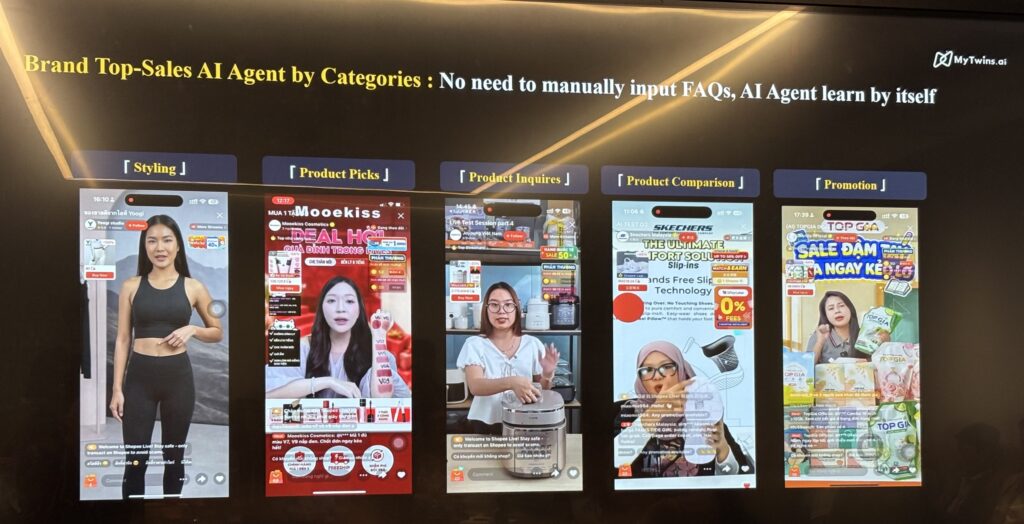
Who are the 100 to 200 of the most important? You got to know who they are. There’s a good chance most of them are not speaking. They’re just watching. How do you reach them? So there’s some technical stuff that’s still happening here, but overall I thought it was pretty compelling. Let’s see, what else? How do you get started? I’ll put these slides in the show notes. This is mytwins.ai slides. How do you do it? Yeah, take a photo.
36:08
one or two photos, put them up, it’ll pretty much generate a digital avatar of yourself pretty quickly. Then you take some pictures of a product, it will generate the product description. Then you decorate your live stream, what do you want? You want pop-ups, you want running chat on the side, you want the item to show up. That’s sort of step one, step two, step three, step four, press go and you’re live streaming. That’s pretty much it.
36:37
mean, it’s a pretty easy process.
36:42
And she had some good slides about various, you know, AI, basically sales agents, live streamers in Vietnam, Thailand. And they would put three or four up there and say, which one is the non-human in which are real? Really hard to say. It’s getting to the point where you can’t really tell. Okay. And that’s kind of point number three. I’ll get to what I think you should do if you’re creating content online. There was one other person I heard from.
37:11
A about a month ago at the World AI Conference in Shanghai, Tencent had a presentation and the CEO of Huya was there and gave basically a talk about the same exact subject, which he called them, what did he call them? Vivid avatar models, basically digital humans that mostly do live streaming. That’s what he’s working on. And he identified some of the technical content.
37:38
He called them real-time interactive digital humans, which you could use on live streaming. You could use them in lots of scenarios. He identified a couple of technical problems I thought were interesting. He talked about long duration generation. you know how, like if you’re talking with an LLM, after like four or five questions, it starts to forget what you talked about previously. It starts to drift. Apparently that’s a problem.
38:07
with these live streaming things where they will get cumulative error drift, where maybe it will start to move off its character and maybe it’ll start to forget the other stuff. You know, the memory basically explodes as these, you know, like with LLMs, the more you ask it, the memory cache just goes crazy. So there’s a problem with long duration generation. There’s a problem with what he called simulation fidelity, which is like these, still look a little stiff when they’re speaking and pointing. They’re not quite humanish yet.
38:38
And then interactivity was the thing he mostly talked about. Like look, most live streaming digital avatars are good at talking. They’re not as good at listening, thinking, and then replying. That’s a more complicated process. So he said that’s still sort of a problem, but yeah, it looks like it’s getting to the use cases he talked about, which are more than just e-commerce, know, live streaming. He talked about talent streaming, singing.
39:05
Dancing performance entertainment, which is a lot of live streaming. He talked about gaming interactions So a presenter for a game, but also if you’re playing a video game, this could be a companion for you Digital twins if you want to just make yourself and I will probably end up doing this Creating a digital twin of yourself to dramatically increase your output which is good because it
39:33
You want to do a ton of live streaming. It takes a lot of time. Also, you kind of have to because of the volume of digital avatars coming online. You can’t compete with their volume as one human just talking three hours a day. You’re going to have to scale yourself up with your own speaking every day plus 20 avatars of yourself doing more content. And then there’s e-commerce. I thought that was a pretty decent list. It was just a short. Huya is an interesting company.
40:02
Okay, last point and I’ll finish up. So what do if you’re a human content creator? And this could be videos, but know, live streaming is the most powerful form of this. So, I mean, I’ll tell you what I’m doing. When we just talked about e-commerce, selling live, that’s one type of digital avatar. And I asked them, you doing other types of digital humans? And this has been due to the My Twins. And she basically said no, because
40:31
We have to build specifically for live selling as a function. The other types of live humans are different. So entertainment, you need different capabilities for that. A thought leader, people who comment on politics. There’s this Chinese teacher, professor, who’s all over the news, Professor Jiang. He’s always talking about geopolitics and Trump and Iran and all this stuff.
40:58
If I go on YouTube, I can find like five or six channels of him talking every day. None of them are really him. It’s someone, maybe him, he’s probably given approval, creating digital avatars of himself, talking about current events. And then there’s one channel that’s him. So this idea of thought leadership, which is kind of what I do. Yeah, it’ll get there as well. So what do you do if you’re a content creator? I’ll tell you my little playbook.
41:27
First of all, you have to choose your topic. Certain product categories in e-commerce, live streaming, digital humans are just fine. You can’t compete with them any more than you can compete running with a car. So you got to avoid certain topics, certain product categories, certain types of activities. Find the one where being a human matters. Authentic. Usually it helps if within that topic, it has a lot to do with taste.
41:57
Like if you ever ask AI like Gemini or chat, GBT, you know, a question of which laptop to buy, it has pretty good specs. If you ask it like what’s something that’s fun to do in Paris on a weekend, it gives you terrible recommendations. It really doesn’t know what’s better. It’s just looking at Reddit forums and stuff. I was looking for pools because we like to go swimming a lot. We’re going to beaches and pools and I was looking for really cool pools that we could stay at a resorts.
42:27
The answer is I got from Gemini sucked. No, so anything that requires taste, this is a good wine. This wine’s okay, but it feels a little, I don’t like the aftertaste. So taste curation, you need a human. Irreversible decisions, critical decisions. Now this is kind of where I live, which is if you’re going to have to place large bets on an AI strategy and you cannot afford to get it wrong, you really need.
42:54
some professional judgment as well as the information. So I look for things that are sort of high stakes, critical, irreversible decisions. You you’re doing well online, but your traffic’s going down 10 % per year. What are you going to do? You can’t get that wrong and just try something again a year later. So that’s a guy like me. I also like things that are on the advancing frontier of knowledge.
43:23
Things that people don’t quite understand yet that there’s not books written about that the AI can read. So I focus on there. So that’s kind of I focus on two and three within that category in terms of choosing your topic, whether it’s an e-commerce player, a thought leader doing entertainment, whatever. OK, that’s topic. The second part is you got to choose your format, what’s your structure. I think you need to go as personal as
43:53
possible. Live streaming is great because it’s interactive. Chatting back and forth. It’s conversation. And that could be online or offline. Meetings. Group meetings. You want to be, you want the personal relationship to be front and center. You don’t want passive viewing. You really want to try and have that sort of relationship and talk and engage and all of that. Okay.
44:22
You can do that in some places like live streaming is actually quite good. If you’re going to do videos, whether it’s short, asynchronous, live streaming, well, not live streaming, you want to be as authentic as possible. So you don’t want to be sitting in a sort of a digital room that looks very formal, because that’s easy for AI to recreate. No, you want to be walking down the street.
44:50
with a pimple on your forehead and Stumble, know tripping every now and then and making jokes you want to make it super clear that you’re the human being I Will leave mistakes in my articles now like misspellings Just to let people know it’s actually me and it’s not just auto-generated. So you want to be super authentically human You know, so I think about that from my videos a lot and then the third thing I’m doing
45:19
you’re going to have to spin up an avatar army of yourself. You’re going to lose on volume to these bots that create videos 24-7. So you’re going to have to, I’m going to have to create like an army of 10 of me that also probably create short videos and then I’ll use those to link to my main content. I think you need the army. So that’s kind of how I’m doing it. Personal relationships, super authentic videos, and then I’m going to have to have a digital avatar army.
45:48
And that’s how I’m going to sort of stay in the content thought leadership business. And that’s pretty much it. I’ll put that in the show notes as a list of things to do. If you have any thoughts on that, let me know. And that is the content for today. I’ll put some photos in the show notes just from the trip. We really did have a great time. I’ve got a gazillion notes and I think it really like sort of jumped me forward in terms of thinking about agentic commerce. So yeah, I’m pretty excited about it.
46:17
Anyways, that’s it. I don’t know if I have any fun stuff for this week. Not really. I’ve watched a bunch of bad TV shows. I’m not going to recommend those. We’ve been watching American Ninja Warrior, which, you know, it’s been around forever. We’ve been watching that this week, which is… People are getting too strong. I remember when American Ninja Warrior used to be really impressive. People would do jumps and run up the wall. Now everybody can do it. It’s like…
46:45
Human beings got dramatically more capable in 10 years of American Ninja Warrior than they used to be. So good, but yeah, that’s what we’ve been doing this week. Now, no real recommendations other than that. Okay, that’s it. I will talk to you next week. Bye bye.
——–
I am a consultant & keynote speaker on how to increase digital growth and strengthen digital AI moats.
I am the founder of TechMoat Consulting, a consulting firm specialized in increasing digital growth and strengthening digital AI moats. Get in contact here.
I write (a lot) about digital growth and digital AI strategy (3 best selling books, +2.9M followers on LinkedIn). There is a free book and email newsletter below.
My Moats and Marathons book series is a framework for building and measuring competitive advantages in digital businesses.
Note: This content (articles, podcasts, website info) is not investment advice. The information and opinions from me and any guests may be incorrect. The numbers and information may be wrong. The views expressed may no longer be relevant or accurate. Investing is risky. Do your own research.
