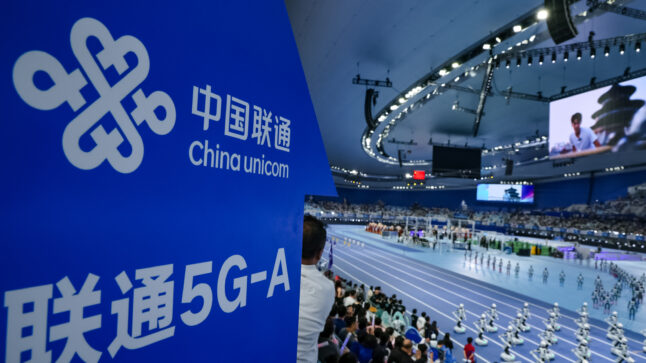



The second World Humanoid Robot Competition was just held in Beijing.
And it got the world’s attention. Robots have definitely arrived (at least in China).
It was also big news because Huawei and China Unicom deployed a new robot-native mobile network to support the games.
And this gave us a first look at what is coming for cities, when they are eventually filled with robots.
We got a look at robot-native infrastructure, which begins with robot-native networks.
Here are my 4 take-aways the games and the new Huawei / China Unicom network.
Take-Away 1: 2026 Is the Breakout Year for Humanoid Robots
The World Humanoid Robot Competition is held at the National Speed Skating Oval in Beijing, known as the ice ribbon (built for the 2008 Olympics).
And it was definitely a big step up in terms of scale and impact this year. It was basically double the previous year.
It had 51 disciplines, 1,300 events, and over 2,000 robots. From 16 countries, but mostly China.
And it got a lot of attention. The competition has gone from a niche event into a global showcase of robot capabilities.


For years, humanoid robotics have been stuck at the level of novelty toys doing party tricks. But this year was definitely a turning point. Autonomous humanoid robots broke multiple human records in running and jumping. We have been seeing human and robot records broken pretty much everyday.
Standing high jumps are now clearing 3m. Long jumps are going to 8m. And running speeds have surpassed Usain Bolt.
The key thing to notice is that events are all focused on real-world applications. The solo scenarios and competitions include sports, arts and real-world tasks.
The point of the competition is to drive performance in robot skills that can be used in the real world (like factories).
Take-Away 2: “Robot-Native Networks” Have Technology Challenges
Beneath the flashing lights and viral race videos, there was some pretty cool tech at the event.
Huawei and China Unicom pioneered and did a real-world validation of the first “robot-native networks”. As robotics transitions from isolated mechanical prototypes to massive, cloud-connected fleets, the telecommunications network has emerged as the key infrastructure of embodied intelligence.
We know what mobile networks for 8B humans look like.
Traditional mobile networks were engineered primarily to serve humans who mostly consume downlink bandwidth with streaming high-definition video.
And we’re starting to think about mobile networks that can support 800B AI Agents.
As the digital landscape evolves toward autonomous software agents, network demands shift toward continuous background data transactions.
It turns out we also need mobile networks for +1B robots. Note: About 1.4B cars and trucks on the road. So, it’s likely in that range.
And it turns out robots have different technical requirements.
Unlike human smartphone users who download massive files while uploading very little, humanoid robots function as real-time sensory engines. They continuously capture high-resolution visual data, multi-angle spatial video, and tactile sensor inputs from their joints and dexterous hands, streaming this mountain of perception data straight up to the cloud.
Here’s what a robot-native network needs:
- Massive uplink capacity. Robots need to continuously stream high-resolution sensory and vision data to the cloud for processing. For the competition, the system can reach 1Gbps upload. Although it averaged 400Mbps.
- Low end-to-end latency. The competing robots needed ultra-low latency (<30 milliseconds) required for real-time coordination.
- Rock solid reliability.
Without a telecommunications framework built from the ground up to support these multi-gigabit uplink demands, advanced cloud-based embodied AI cannot function at scale.
Take-Away 3: China Unicom and Huawei’s Solved This with a 5G-A Large Uplink Network
In 2020, Huawei and China Unicom created 5G Capital. This is joint innovation initiative to turn Beijing into a global benchmark for advanced 5G and 5G-Advanced (5G-A) infrastructure. It develops, tests, and deploys next-generation mobile network technologies at urban scale. Here’s its progress so far.

It was a natural fit for the humanoid games. And it deployed its 5G-Advanced (5GA) large uplink network, which has:
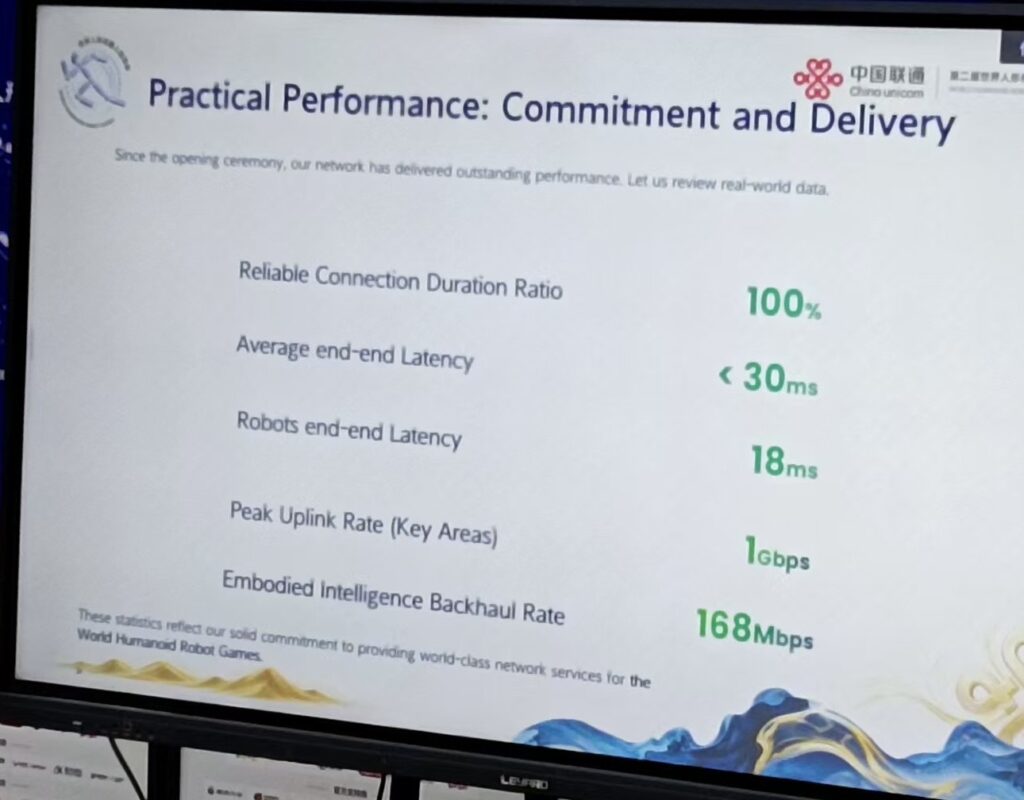
- Peak Uplink Speeds: The network has a peak uplink speed of 1 Gbps (with real-world competition averages hitting close to 397 Mbps on the first night).
- Low Latency Performance: It can maintain end-to-end latency for humanoid robots within the 30-millisecond threshold.
- Carrier Isolation and Network Slicing: Interference and congestion are a big problem. It deploys a dedicated 100 MHz frequency band at 3.5 GHz exclusively for robots, completely isolated from the separate 300 MHz band used by human spectators in the stadium.


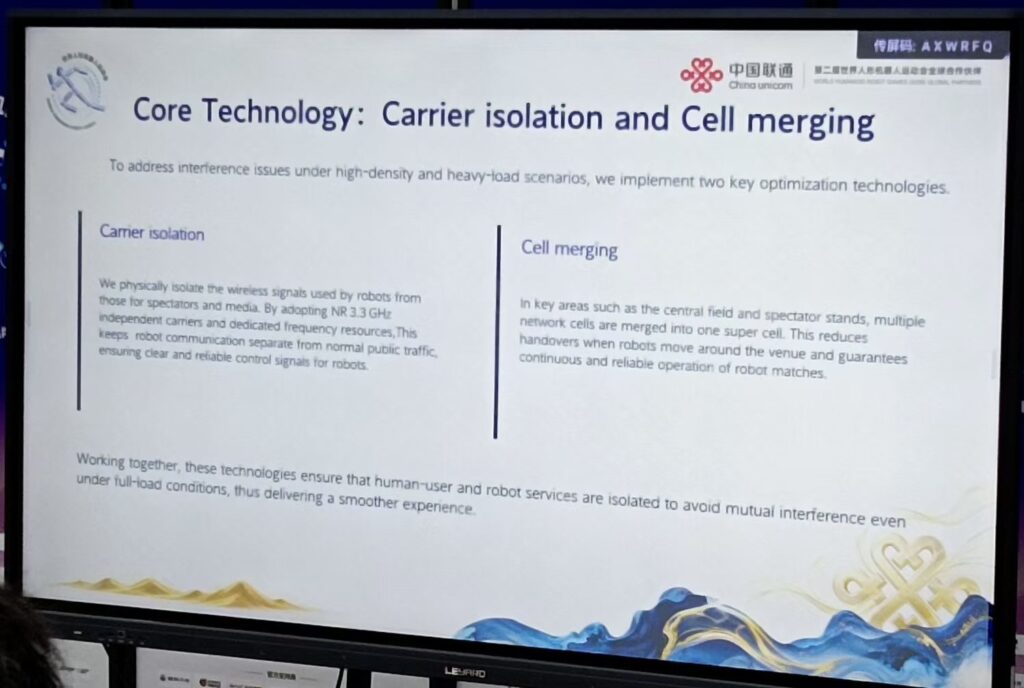
The World Humanoid Robot Competition served as a real-world stress test for this architecture. The deployed network managed hundreds of competing robots alongside thousands of data-hungry human spectators.
During the opening nights of the competition, this 5GA network logged average uplink speeds approaching 397 Mbps, with the underlying architecture fully capable of scaling to a peak 1 Gbps. End-to-end latency for the competing humanoids was clocked at 18 milliseconds. Here are the results:
Take-Away 4: We Can Now See What Robot-Native Networks Will Look Like
David Li, Huawei’s President of Wireless, had some great points about the big bottlenecks of robot-native networks. He said the big bottlenecks are batteries and on-robot compute.
There is a hardware trade-off between local processing power and power consumption. Equipping a humanoid robot with heavy on-board graphics processing units (GPUs) requires massive power draws, which in turn demands larger, heavier batteries that compromise agility and operational runtimes.
The solution to this is the efficient integration of advanced robotics and 5G-A telecommunications. You move more and more of the higher compute to the cloud, which requires a robot-native mobile network.
By utilizing robust robot-native networks, developers can offload heavy cognitive computation and high-level decision-making directly to the cloud. The robot retains lightweight motor control terminals on-device while delegating perception processing and intelligence loops to cloud architecture via ultra-fast uplinks.
You solve on-device GPU constraints and battery weight limitations by shifting high-level cognitive computing to the cloud via a 5G-A network. So, the integration of network and terminals becomes the key issue.
***
Beijing Will Be the Epicenter of Mass Robot Deployment
Beijing is aggressively deploying 5G-A infrastructure. 5G Capital is aiming for +10,000 base stations in the city.
And China is far ahead in robots now. As shown in these humanoid games.
So, I think Beijing will have a unique ability to deploy robots at scale in the near future.
We’ll see.
Jeff
Disclaimer: I have had a paid consulting gig with Huawei in the past twelve months. This article and all opinions and thoughts are my own.
———-
Related articles:
- AgiBot’s Race to Embodied AI Robots at Scale (1 of 2) (Tech Strategy)
- Why I Like AgiBot (Podcast 290)
From the Concept Library, concepts for this article are:
- Robotics
- Embodied AI
- Robot-Native Networks
- 5G-A
From the Company Library, companies for this article are:
- China Unicom
- Huawei
———
I am a founder, consultant and keynote speaker specialized in digital and AI agentic strategy.
I am the founder of Agentic Org Now, a firm that helps leadership teams launch AI and agentic initiatives fast.
I write (a lot) about digital and digital AI strategy (3 best selling books, +2.9M followers on LinkedIn). You can get a free book at the email sign-up below.
My Moats and Marathons book series is a framework for building and measuring competitive advantages in digital and AI businesses.
Note: This content (articles, podcasts, website info) is not investment advice. The information and opinions from me and any guests may be incorrect. The numbers and information may be wrong. The views expressed may no longer be relevant or accurate. Investing is risky. Do your own research.
