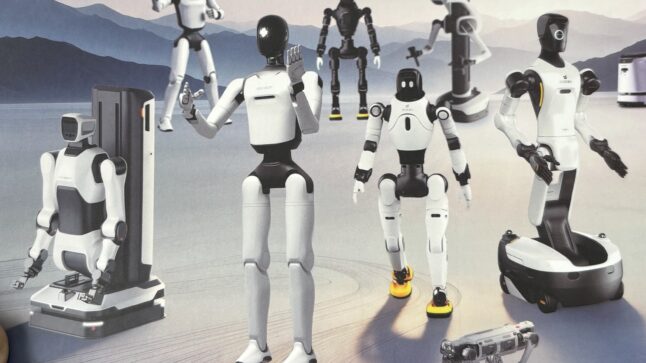
Ok. Let’s finally get to the key business stuff for AgiBot’s robots and embodied AI.
Ultimately, robot capabilities and competition are going to come down to hardware and intelligence.
And there are two core capabilities that produce the intelligence of AgiBot’s robots. They are:
- Genie Operator (GO)
- This is AgiBot’s ViLLA model that guides the robot actions.
- Genie Envisioner (GE)
- This is AgiBot’s World Action Model that predicts future environmental states.
Other related platform components are:
- AgiBot World Dataset
- Genie Sim
- Genie Studio
But I’m going to focus on the two big capabilities.
Genie Operator (GO-2): This is AgiBot’s Primary Architecture for Translating Thinking into Physical Action.
GO is AgiBot’s Vision-Language-Action (VLA) model. This runs on robot and it takes vision plus language / instructions as inputs and produces actions as outputs. The outputs are instructions that go to the robot’s actuators and controllers. This is how AgiBot’s translating perception and thinking into physical action.
Like agents, these robots run on “chain of thought” models. They operate in a series of steps:
Perception → planning / decomposing tasks → acting → observing results
And then it repeats quickly. And they get contact-rich feedback such as grasping success or failure, object slippage, etc. This feedback forms part of the input of the next chain of thought.
That’s the higher level intelligence that uses most of the GPU compute.
Lower level intelligence such as semantic mapping, path planning, and low-level obstacle avoidance are increasingly handled by dedicated modules (SLAM, local planners, whole-body controllers, safety layers). These sit below or alongside the foundation model.
Technically, AgiBot now uses a Vision-Language-Latent-Action (ViLLA) model.
This is different than a standard VLA in that it creates an intermediate latent space between the planning and the action execution. This decouples high-level visual reasoning from embodiment-specific kinematics.
Here’s an analogy for this:
- A typical VLA is like a driving a car looking through the windshield and deciding to change lanes. The windshield vision and plan (change lanes) are the inputs to the model. The output is a series of mechanical instructions that go to all the car components (wheels turn 10%, 6% more gas to carburetors, shock increase pressure by 4%, etc.).
- VLA’s are still transformers at their core. But the inputs are vision and language, and the output is action (machine language for actuators and other).
- In a ViLLA model, the inputs are the same but the output is instructions to turn the steering wheel and press the gas pedal. The dashboard, steering wheel, and pedals are an abstraction layer (or latent space). The outputs then go into a second model that converts them to mechanical instructions.
- This intermediate latent space has a big impact on the efficiency of training. Models can learn just by pairing a video of a car changing lanes with a video of someone driving the car and turning the wheel. That is much simpler than having to pair the video of the car with sensor data coming from every car component.
AgiBot’s ViLLA models was released in 2025 (called GO-1) but it has since evolved. In 2026, it was upgraded to an Action Chain of Thought (CoT) plus an asynchronous dual-system architecture.
AgiBot has also added a Vision Language Model (VLM) which adds firepower to its perception (visual and sensors) and to long-range planning. I believe it has added VLM firepower in both the ViLLA backbone and in additional compute resources.
***
Ok. That’s the basics of AgiBot GO and its ViLLA model. It’s super important and constantly being upgraded (like LLMs).
The Genie Operator (GO) is mostly what is running their robots during operations (i.e., inference) right now.
But there is another system that can be run on robot, with different strengths. That’s a World Action Model. AgiBot’s is called the Genie Envisioner (GE).
Genie Envisioner (GE-2) Is AgiBot’s World Action Model
World models are different than VLA’s. They make predictions for how the environment will change over time with our actions.
- The inputs are encoded visual scenes, object geometries, physical dynamics, and environmental states.
- The outputs are predictions about future environment, based on the current state and the chosen action.
A simple analogy is:
- A VLA model is how you catch a baseball.
- This is a fast, reactive closed-loop system. As the ball comes towards you, your visual cortex feeds continuous sensory input directly to your motor cortex. You adjust your hand trajectory in real-time based on where the ball is right now.
- In robots, this can be grabbing a sliding mug, reaching for a tool on a desk, or picking up a rigid item. The environment is rigid, and the focus is turning current visual input straight into precision movement.
- A World Action Model is how you play billiards.
- Before you strike the cue ball, you run a physical mental simulation. You imagine: “If I hit the cue ball at this angle with this force, it will strike the 8-ball, bounce off the cushion, and roll toward the pocket.” You visualize the outcome, evaluate the physics of the collision, and pick the best shot before your cue stick ever makes contact.
- In robots, this can be folding a loose shirt, pouring water into a tilting glass, or clearing a cluttered table where moving one object will cause three others to move. The robot must predict how non-rigid or dynamic materials will react to its actions before committing motor torque.
Note that the World Action Model requires:
- Physics predictions
- Mental assessments of possible outcomes before decision making
- An understanding of deformable and interacting dynamics (understanding cause and effect).
Catching a ball relies heavily on visual feedback and proprioception (knowing where your body is).
Billiards relies on understanding physical cause-and-effect, momentum, and multi-body interactions. And that is exactly where generative World Models outshine pure VLAs.
***
In theory, you want both VLAs and World Models running on robots. The different systems are better suited to different situations.
But that would take a tremendous amount of compute. So, world models at AgiBot are mostly used for training at this point. Although, they will be moving on robot more and more over time.
From Video Generation to Spatial Intelligence
In the simplest form, a World Model is basically a video generator. It takes the current camera view plus a candidate action – and then it generates what the next few video frames would look like if the robot actually did that. So, it’s video generation of a future predicted state.
But these models can also be a much more sweeping idea.
And big thinkers like Yan LeCunn and Fei Fei Li are arguing about how you actually capture and use spatial intelligence. Understanding and operating in the real world is a very different thing than understanding and writing words and text (i.e., LLMs).
LLMs capture human intelligence and are easy to understand.
They convert human grammar, factual knowledge, logic, and semantic relationships between concepts into largely static model weights. Intelligence is stored in the model weights and complemented with additional knowledge in vector databases (mostly accessed by RAG).
World Models sort of capture spatial intelligence but it’s more complicated.
These models convert physical laws (gravity, momentum, collisions), geometry, temporal dynamics, and spatial relationships into model weights. This intelligence is activated in real time by processing latent states. That’s’ how you understand and operate within a complicated physical world. If model weights are the “brain,” a latent state is a “thought” being considered.
They key is to remember that world models and VLAs are just making predictions, taking actions (in the real world) and then repeating in a rapid loop.
There is constant feedback on how the environment changed with the action. And this new latent state becomes the starting point for another round.
Spatial intelligence is very different than the intelligence of LLMs. It’s more active, interactive and evolving.
More Details on AgiBot’s Genie Envisioner
AgiBot’s original Genie Envisioner architecture was released in 2025 and has two components: GE-Base and GE-Act.
GE-Base is the imagination engine.
This is what predicts (i.e., imagines) future states. It is a large-scale, instruction-conditioned video diffusion transformer. Basically, it’s a neural network that operates by diffusion. Note: LLMs are neural networks that operate by autoregressive next-token prediction.
- You give the model current camera images (what the robot sees right now) and language instruction (“pick up the red cup and put it on the shelf”).
- It generates predicted future video frames, a short “mental movie” of what the scene will look like if certain things happen.
GE-Act turns the imagined scene into action.
This is a specialized World Action Model component with a lightweight flow-matching decoder. It turns the latents into action trajectories (sequences of joint positions, gripper commands, end-effector poses, etc.).
This is just math. Decoding to action outputs by flow matching is similar in spirit to diffusion. It takes noisy results and removes to get the clear final action.
***
Ok. Those are the two big capabilities to understand.
As these robots development, the sophistication of the hardware (capabilities, price, etc.) and the intelligence (just discussed) are the two big factors.
However, I have only been talking about robots in use (i.e., inference). Training is a whole other subject.
I’m not going to go into training. Complicated and not super relevant.
But here is a good summary of how GO, GE, GE Sim, World Datasets and physical usage all work together in training.
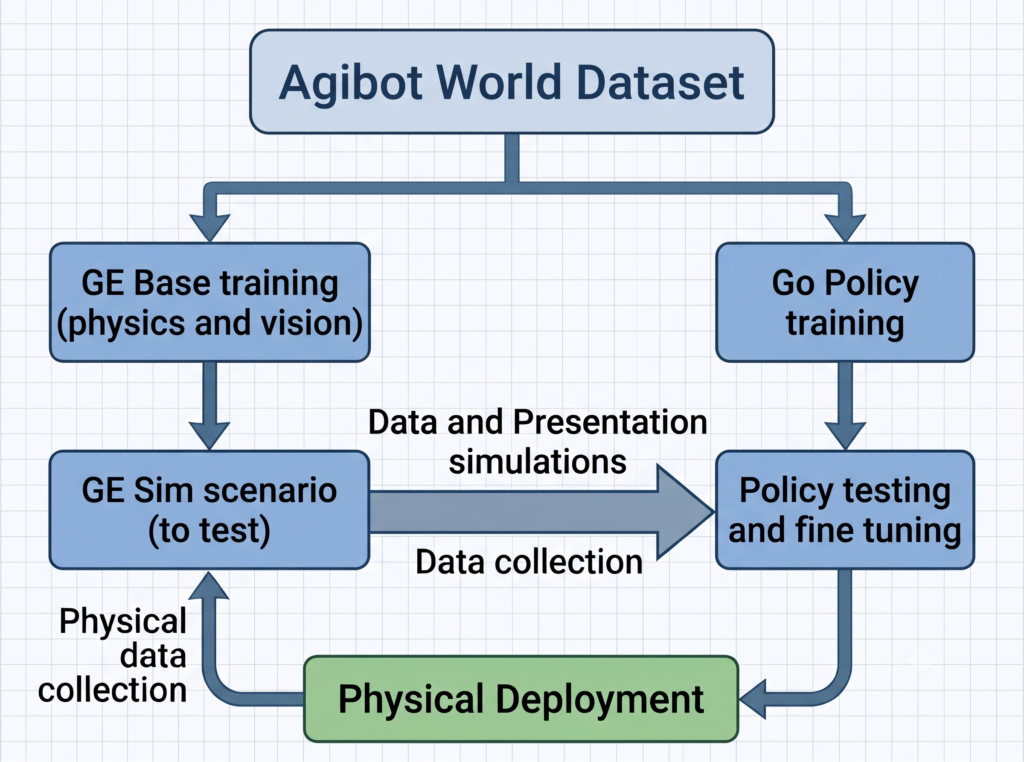
Here is a good breakdown on how AgiBot is doing simulations (Real2Sim and Sim2Real). The details are below.
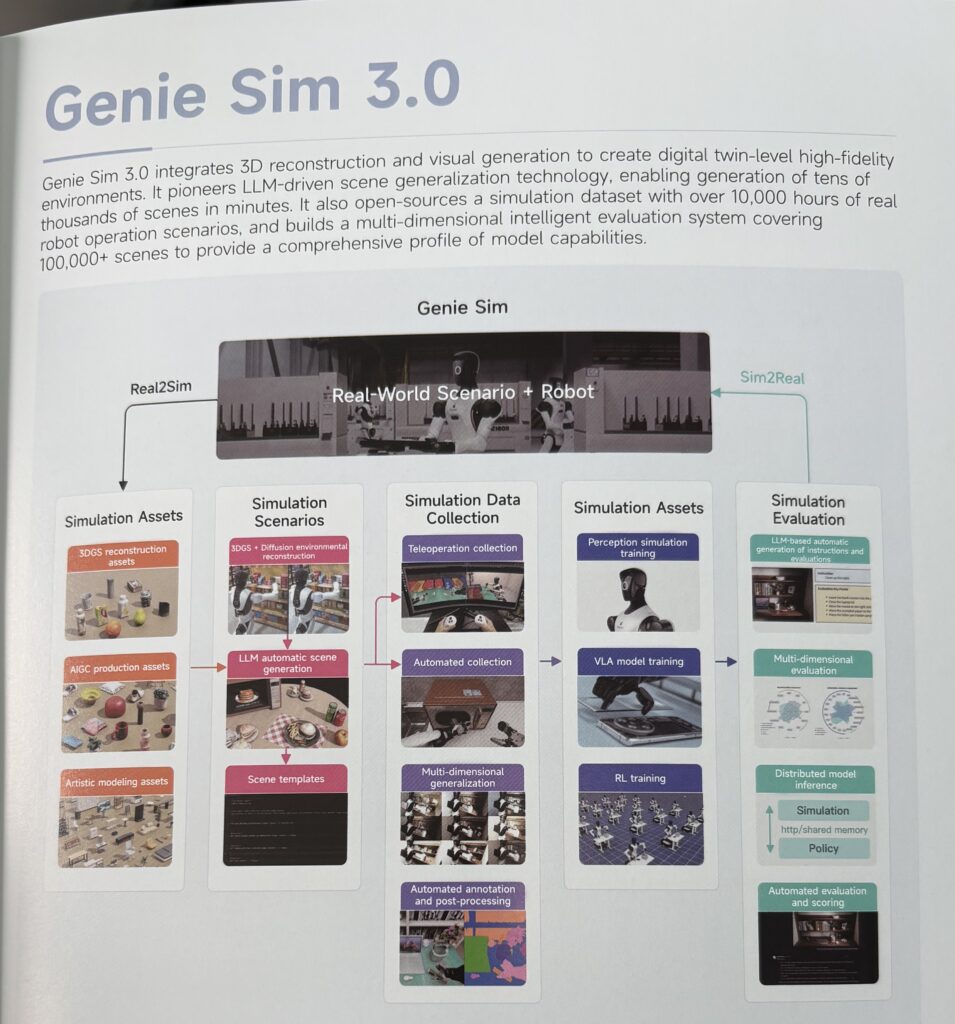
GENIE SIM 3.0 System Overview
- Real2Sim: Converting physical environments into digital assets and simulated scenarios.
- Sim2Real: Training models in simulation to deploy back onto real world systems.
The diagram outlines five sequential stages at the top of the workflow:
- Simulation Assets (via Real2Sim)
- Simulation Scenarios (Dev into scenarios)
- Simulation Data Collection
- Simulator Assets / Model Training
- Simulator Evaluation (via Sim2Real)
Detailed Component Breakdown
1. Simulation Assets
- 3DGS (3D Gaussian Splatting): Reconstructs real-world assets.
- AIGC: Generates synthetic assets automatically.
- Artistic / Modeled Assets: Manually created by human artists.
- 3D Gaussian Splatting Details:
- Photorealistic 3D environmental models and assets created from real-world scenes.
- Inputs derived from LiDAR, 360 cameras, and RGB images.
2. Simulation Scenarios
- 3DGS + Diffusion Environmental Scenarios: Creates high-fidelity scene backgrounds.
- LLM-Automated Scene Generation: Generates scene templates systematically.
- Diffusion Integration: Fills in gaps and places objects into environments (e.g., bedrooms) with spatial logic.
- Code Export: Converts scene templates to Python files and executable scripts.
3. Simulation Data Collection
- Data Collection Methods:
- Human Data Collection: Humans operate or guide robots inside simulated environments.
- Automated Data Collection: Runs tasks autonomously within simulation environments.
- Multi-Dimension Generalization: Alters environment parameters dynamically.
- Automated Annotation and Post-Processing: Generates raw output data (maps, metadata, trajectory logs).
- Output Pipeline: Converts raw collections to structured training data tailored specifically for VLA (Vision-Language-Action) and RL (Reinforcement Learning) models.
4. Simulator Assets & Model Training
- Perception Simulation Training: Trains visual and sensory processing networks.
- VLA Model Training: Connects vision, language comprehension, and physical actions.
- RL (Reinforcement Learning) Training: Refines control policies within simulated environments.
5. Simulator Evaluation
- Final Benchmark Performance Testing
- LLM Auto-Generation of Instructions / Benchmarks (Testing)
- Multi-Dimensional Evaluation Systems
- Post-Trained Model Inference and Scoring
- Deployment Loop: Moves verified models from simulation back to physical platforms via Sim2Real.
***
That’s it. Cheers, Jeff
- AgiBot’s Race to Embodied AI Robots at Scale (1 of 2) (Tech Strategy)
- Why I Like AgiBot (Podcast 290)
——-
Related articles:
- More High-Tech Flex by Huawei R&D (4 of 4) (Tech Strategy)
- 6 Big Events in AI Agentic Ecommerce (Tech Strategy)
From the Concept Library, concepts for this article are:
- Robotics
- AI: VLA Models
- AI: ViLLA Models
- AI: World Models
- AI: Physical AI
From the Company Library, companies for this article are:
- AgiBot
——-
I am a consultant & keynote speaker on how to increase digital growth and strengthen digital AI moats.
I am the founder of TechMoat Consulting, a consulting firm specialized in increasing digital growth and strengthening digital AI moats. Get in contact here.
I write (a lot) about digital growth and digital AI strategy (3 best selling books, +2.9M followers on LinkedIn). There is a free book and email newsletter below.
My Moats and Marathons book series is a framework for building and measuring competitive advantages in digital businesses.
This content (articles, podcasts, website info) is not investment, legal or tax advice. The information and opinions from me and any guests may be incorrect. The numbers and information may be wrong. The views expressed may no longer be relevant or accurate. This is not investment advice. Investing is risky. Do your own research.