



In Part 1, I covered two of Cainiao’s big moves in 2026.
- Advancements in robots and AI-native smart warehouses.
- A growing global network of smart warehouses. Especially in Europe. And this is starting to enable logistics outside of China, not just within or to-and-from China.
That’s the foundation. This is Cainiao building its core assets / capabilities over time.
This article is about what Cainiao is doing with these assets.
There is a difference between your capabilities and your services and business model. It’s like the difference between having a factory and deciding to be in the business of selling toys.
Cainiao Went From 5-Day to 3-Day Delivery in Under Two Years
When I sat down with William Xiong at Cainiao’s Hangzhou headquarters in late 2024, their key new offering was 5-day cross-border delivery for about $10. He told me they thought they could ultimately deliver cross-border with China in 3 days. In theory.
Less than two years later, it’s officially a Cainiao service.
That’s the third big move I wanted to talk about, Global 3-Day Delivery. And then I’ll go into why this new service is solid evidence of a growing moat.
Big Move 3: Global 3-Day Delivery as a Competitive Weapon
How do you win in ecommerce on the customer side? With the person buying the goods? The basic offering by Alibaba (and JD) is:
- Offer a big selection of quality goods. Ideally larger and/or better than competitors.
- At low prices (again, relative to competitors).
- Make the experience pleasant, easy and convenient.
For that third point, the biggest lever in ecommerce is making the delivery faster and cheaper.
Fast, Cheap Delivery Is a Big Lever in Ecommerce
It turns out this is what buyers really care about. Fast and/or free delivery has been Amazon’s biggest lever for +20 years. It’s what Amazon Prime is built on.
Cross-border ecommerce makes this much harder.
Delivery takes 5-14 days instead of 12-24 hours. And there is a lot of uncertainty. When will my package clear customs? When will it actually arrive? Customers hate the uncertainty. That’s why food delivery and ecommerce always show you a map of where the delivery guy is.
But when we look at just logistics, we see there are actually very few dimensions to compete on. Logistics services mostly compete on cost, speed and the number of locations. That’s pretty much it for express delivery.
Cainiao Keeps Raising the Bar: 10 Days, Then 5, Now 3
You can see the China ecommerce giants slowly raising the bar over a decade with regards to what customers can expect in terms of delivery.
First it was next day delivery. Then it was same day delivery. Now it’s instant delivery (under 30 minutes for some items). They keep raising the bar in the delivery side of the business. Competitors have to match this or lose business.
You can see Cainiao doing this same progression cross-border and now globally.
Guaranteed Delivery Drove 60% Order Growth at AliExpress
In March 2023, AliExpress launched Choice.
Under Choice, AliExpress took responsibility for delivery and quality from merchants for certain products. And in certain geographies. It began to guarantee delivery times. This was a powerful move given the uncertainty in cross-border shipping.
In June 2023, AliExpress and Cainiao announced a 5-day delivery guarantee.
AliExpress orders grew 60% year-over-year in the quarter ending December 2023. It was the big shock in Alibaba’s earnings report. They credited Choice for this.
They set a new delivery standard that rivals must now match. And they don’t just promise it. They guarantee it. Which removes the uncertainty.
Only a Full Logistics Network Can Back a Delivery Guarantee
At the time, I wrote that a guarantee like this is really difficult. You need:
- A global logistics network that stretches from China into every neighborhood of the target countries.
- Smart warehouses for exports and for consolidating parcels.
- Logistics technology, both hardware and software.
- Data and algorithms to analyze and manage delivery time.
- Integration with last-mile delivery.
Basically, you need Cainiao. Cainiao had the capabilities. Guaranteed 5 day delivery was the service and business model.
In late 2024, their key offer was 5-day delivery for about $10 between China and 14+ countries. Plus 10-day delivery for about $5.
Compare that to FedEx or DHL. They can do 3-5 days with their express delivery. But the price is more like $50-100.
So, it’s the combination of price and/or speed that matters. And you want to keep adding new locations where this service is available.
Global 3-Day Delivery Launched on 15 Routes at Half the Price
On August 5, 2026, Cainiao launched Global 3-Day Delivery.
This is 72-hour door-to-door delivery, counted from when the order is placed.
They have 15 international routes to start. These include Hong Kong to the UK, Hong Kong to the Netherlands, Germany to France, the Netherlands to Luxembourg, and Saudi Arabia to the UAE.
These are priced at about half what other international express carriers charge.
Note that several of those routes don’t touch mainland China. Germany to France. Saudi Arabia to the UAE. This is the emerging G2G network I discussed in Part 1.
So, the progression is 10 days in 2020, 5 days in 2023, and 3 days in 2026. Cainiao’s stated goal since its founding in 2013 has been delivery anywhere in the world within 72 hours. They are now selling this on some routes.
How They Do It
The 3-day service requires a large and dense global warehouse network. And lots of tech. As I’m writing this, Cainiao has:
- About 170 chartered flights and block space agreements per week.
- 2,300+ trucking routes.
- A Hong Kong eHub where parcels can move straight from the warehouse onto an aircraft.
- Lots of inventory sitting in overseas warehouses close to the customer.
So why can they do this at half the price of express carriers?
Cainiao’s head of cross-border logistics in Europe, Li Shuo, put it down to scale across Cainiao’s own operations and partners, plus AI-driven digital operations.
That’s basically my thesis (more below). The moat is based on three things:
- Economies of scale based on fixed costs
- Economies of scale based on geographic density.
- Economies of scale in R&D, which enables increasing technological spending and efficiencies.
Basically, you outspend your rivals on network size and density. That gets you lower costs and faster delivery.
You also outspend them on R&D, which lets you pull ahead in technological efficiency over time.
Why It’s a Virtuous Cycle
In 2023, the 5-day guarantee was mostly a feature of AliExpress Choice. It powered the growth of that service. They got a lot more users (mostly at the expense of rivals).
This led to more money. Which they used to grow the network.
Which enabled them to further raise the bar in terms of service.
Which got them more growth.
You can see it’s a virtuous cycle between growing your network and raising the bar on the service.
This also benefits merchants (who I haven’t talked about much).
For merchants, faster delivery is about more than just happy customers. Faster shipping also means less inventory in the pipeline, better cash flow, and smaller, more frequent restocking.
Cainiao SVP William Xiong argues that increasing speed shapes consumer choice, improves merchant working capital, and changes the structure of competition itself.
That’s a good summary.
So, the competitive position now looks like this:
- FedEx, DHL and UPS are global and fast, but expensive.
- Postal services are cheap, but slow and uncertain.
- Cainiao is global, fast, guaranteed, and roughly half the price of express (for now).
Is It Working? My Verdict
Two years later, I’m even more convinced this is going to keep working as a strategy.
The playbook is the same one I described in 2024. Build the logistics network and use that to offer what others can’t.
Cainiao’s playbook is simple. Not easy, but simple:
- Grow the global network. Every year, make it bigger. As much as possible do this from a position of advantage. China logistics enabled the move into cross-border logistics. Cross-border is enabling the move into G2G.
- Invest in technology to increase intelligence and efficiency.
- Use your larger and smarter network to offer a differentiated service that FedEx and DHL can’t easily match. Usually on price and/or speed.
In theory, this should increase your volume and relative marketshare. Which lets you repeat the cycle.
What’s changed is that the network is now getting robot-native and AI-native, which makes the scale advantage deeper (probably).
I’m going to watch the evolution of the new Global 3 Day Delivery. How fast are they expanding that to new routes? And how many warehouses are they opening? Those are my two KPIs.
***
Ok. That’s most of what I wanted to talk about. Here’s a summary of the structure.
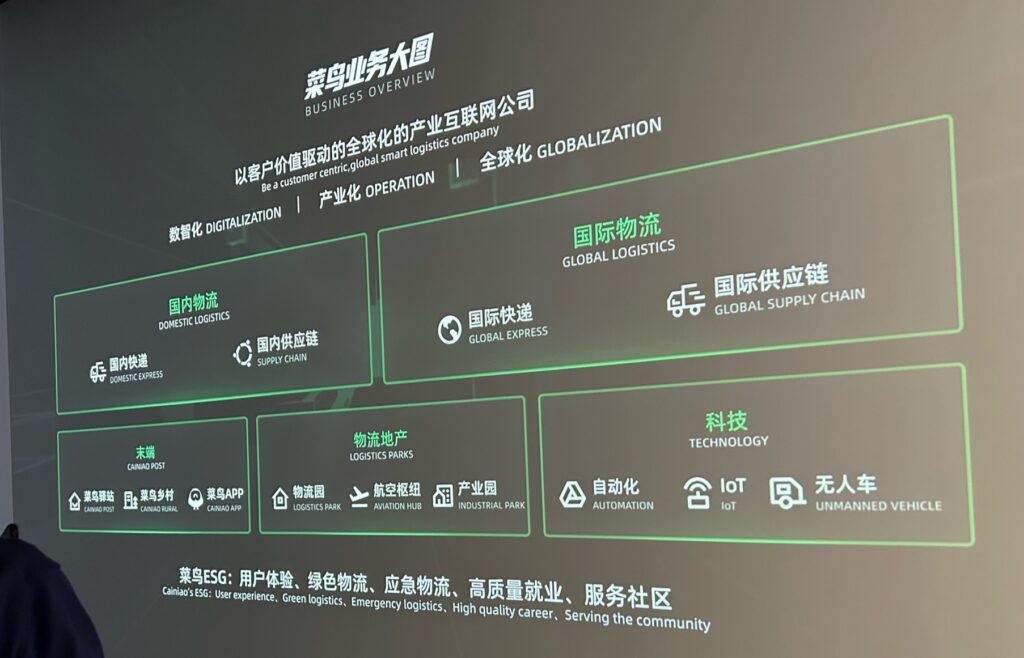
In these two articles I mentioned some important concepts. I’ve written a lot about these. And you can see them in my moats and marathons books. Here’s a quick summary.
Concept 1: Economies of Scale in Fixed Costs
The core of a logistics network (warehouses, trucks, planes) is mostly fixed costs. These big, fixed costs show up on the income statement and in the maintenance capex.
Now imagine two logistics networks in Europe. With the same number of warehouses, trucks, planes, routes served, and delivery frequency. But one business has half the volume of packages per day of the other. So, its trucks run with half as much cargo and its warehouses are half as full. So, its cost per package is higher about twice as much (divide the fixed costs by the number of packages).
How can the smaller rival compete with higher per package costs?
It can cut trucks and shrink its warehouses to get its unit cost down. That would work.
But then a truck doesn’t leave every 3 hours. It leaves every 6 hours. So now it’s a slower service.
To offer competitive delivery times, it must run the same routes and be more expensive.
To offer a competitive cost, it must be slower.
A larger logistics network (i.e., greater throughput) can almost always be cheaper and/or faster. They can also serve more locations.
And this scale advantage increases with more locations. This is a network, which means it has hubs and connections between the hubs. As you add more hubs (i.e., warehouses), you can run more direct routes between them. You no longer go from City A to City B to City C. You go straight from A to C. That’s means that being a bigger (and denser) network of warehouses makes you even faster and cheaper again.
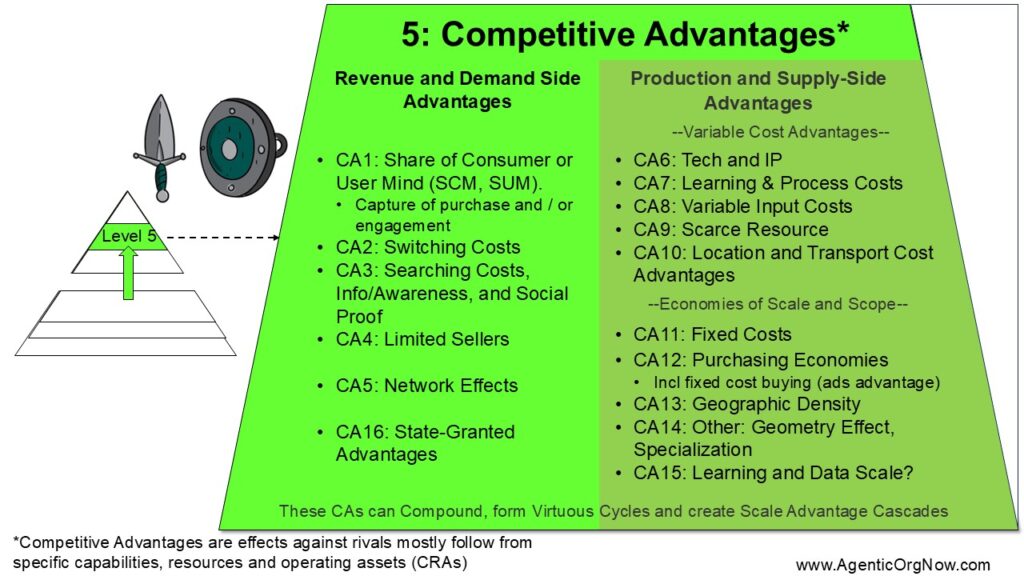
I put all this under economies of scale in logistics. It’s on my list of competitive advantages (C11).
Concept 2: Economies of Scale in R&D and Technology
This is the same idea but with R&D spending instead of logistics spending.
Imagine two identical businesses. And each spends 10% of revenue on R&D. But the larger business has 2x the revenue. So, it is spending twice as much on R&D.
That means the larger business is advancing faster in automated warehouses, IoT, robots and AI. Which they try to translate into efficiencies and even more cost savings in their network operations. That’s easy to see when you are replacing humans with robots.
It’s harder to see when you are putting in machine learning and intelligence across the whole network.
AI is increasingly deciding which items go on which trucks. What packages need to be combined. What routes to take for what goods. Where inventory should be located. So, we are seeing this R&D spending advantage play out here as well.
Concept 3: Economies of Scale in Geographic Density
This is about the last mile, which is the most difficult problem.
You can build a core network of warehouses, planes and trucks. And make it very efficient. These are mostly fixed costs. And there are real benefits to efficiency and increased throughput.
But the last mile (going to people’s homes) is messy. It’s harder to automate and standardize. And it’s full of variable costs.
This is the problem that food delivery companies like Meituan and Grab have been grappling with. They route delivery drivers all over the neighborhood with food and other pick-ups and deliveries.
And they have become the world’s experts in economies of scale in geographic density.
It turns out if you have more orders in a specific geography than a rival, you can start to capture efficiencies. You can be cheaper and faster because you have greater order density in an area.
This requires AI that constantly tells riders which routes to take. Which orders to pick up. Which orders should be combined. Which stops to make along a given route. Where is the best place to wait for the next order.
If you have twice the orders in a neighborhood as a competitor, you have greater ability to do all these moves. And you can drop your costs per order.
This is the smaller competitive advantage. Last mile is mostly variable costs, and it has been the hardest cost to bring down for everyone, including for Cainiao, JD and Amazon.
Final Concept: A Logistics Network Has No Network Effects. But it Powers One.
Keep in mind, logistics networks don’t really have network effects. If you ship more on Cainiao, it doesn’t directly make my Cainiao service better. These networks are mostly about supply-side advantages, like economies of scale.
That’s confusing because it has the word network in the name. But it doesn’t have network effects.
Basically, these are physical networks that enable a good service to be offered.
And the moats here depend on outbuilding and strategically outspend rivals in network size and R&D (as mentioned).
But there is a second level to this.
Cainiao enables AliExpress, which is a marketplace business model. And it has a network effect.
- More customers and spending on AliExpress increases its value to merchants.
- More merchants and products on AliExpress increases its value to customers.
So, the logistics network is the asset. And it can offer a good service (deliveries). But it is not a platform business model with network effects.
However, it can also enable a platform business model on top of it. Which has a network effect between buyers and sellers.
I know that can be a bit confusing.

*Disclosure: AsiaTech Services, LLC has had a partnership with Alibaba within the past 12 months. This article received no financial sponsorship or backing.*
———
Related articles:
- How Alibaba.com Re-Ignited Growth with the Alibaba Management Playbook (Tech Strategy – Podcast 253)
- How Amap Beat Baidu Maps. My Summary of the Alibaba Playbook. (Tech Strategy – Podcast 252)
- Scale Advantages Are Key. But Competitive Advantages Are More Specific and Measurable. (Tech Strategy)
From the Concept Library, concepts for this article are:
- Logistics
- Physical Networks
- Economies of Scale: Fixed costs
- Economies of Scale: Geographic Density
From the Company Library, companies for this article are:
- Alibaba: Cainiao
———
I am a founder, consultant and keynote speaker specialized in digital and AI agentic strategy.
I am the founder of Agentic Org Now, a firm that helps leadership teams launch AI and agentic initiatives fast.
I write (a lot) about digital and digital AI strategy (3 best selling books, +2.9M followers on LinkedIn). You can get a free book at the email sign-up below.
My Moats and Marathons book series is a framework for building and measuring competitive advantages in digital and AI businesses.
Note: This content (articles, podcasts, website info) is not investment advice. The information and opinions from me and any guests may be incorrect. The numbers and information may be wrong. The views expressed may no longer be relevant or accurate. Investing is risky. Do your own research.
