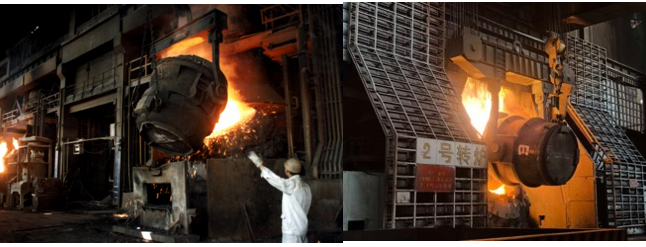



Steel is about as old economy as it gets. Blast furnaces, molten iron, giant rolling mills.
It’s not where most people look for an AI and agentic-first enterprise.
But Nanjing Iron and Steel (NISCO) has announced it now has +300 AI models in its plants. With 25 business agents and over 1,000 low-code agents.
The centerpiece is YuanYe, which NISCO calls the world’s first “swarm intelligence” steel model.
Now this has a lot to do with Huawei. The NISCO projects run on Huawei’s stack. That means Ascend chips, Kunpeng servers, Huawei Cloud Stack and Pangu models.
Basically, the stuff I have been writing about for +5 years.
There have been some recent announcements about this project. And I thought I would go through it.
Generally, I like going out into industrial China. The big infrastructure projects, the mining facilities, the increasingly automated ports, etc. The operational scale and complexity are really interesting. And these are huge opportunities for AI-first organizations and operations.
Here are 3 lessons from the NISCO project.
Lesson 1: First, NISCO Connected the Key Machines. That Was Not Easy in +1,500 Degree Blast Furnaces.
The first thing NISCO did wasn’t AI. It was getting data.
This step usually means deploying lots of IoT and robots in a factory. But this step was a lot more complicated in best steel facilities with blast furnace at over 1,500 °C.

For reference, NISCO is a fully integrated smelter business. With annual steel production capacity of about 10 million tons. It produces heavy plates, special bars, wire rods, and strips, which it exports to over 60 countries. This is a pretty major player in steel.
To do this it has some pretty cool operations. That include:
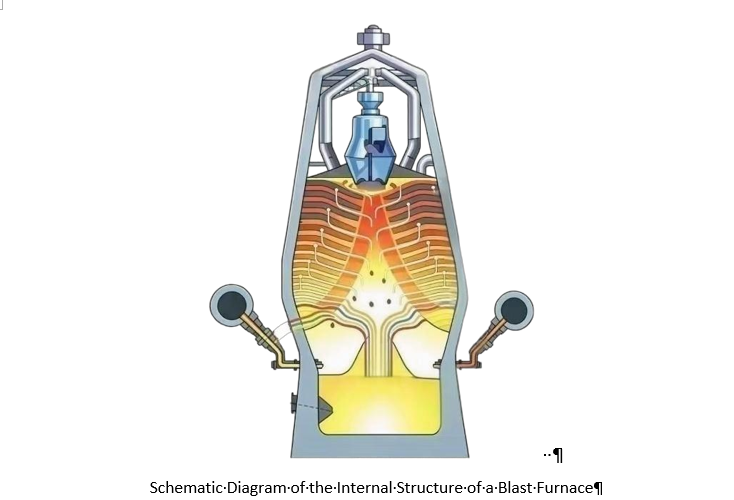
- Blast furnaces for ironmaking
- Sinter, lump ore, coke, and limestone are charged in layers from the top.
- And preheated air (1,100–1,300 °C) is blown in through tuyeres at the bottom.
- The output of this is:
- Hot metal (pig iron) at ~1,500 °C
- Blast furnace slag: waste mineral, removed separately
Here’s a diagram.
- Basic oxygen furnaces (BOFs) for steelmaking.
- Molten hot metal (75–90%) plus scrap steel (10–25%) and fluxes are charged into the converter.
- A lance blows 5%+ pure oxygen at supersonic speed into the melt for 20 minutes.
- The reactions keep the melt at ~1,600 °C, with no external fuel needed.
- The output is liquid steel at the target carbon level.
I’m not too knowledgeable about all this. But it’s pretty interesting.
NISCO also has mining/dressing, coking, and sintering, making it a truly end-to-end steel complex.
Ok, how do you put sensors in that to get data?
How do you put IoT in a blast furnace at 1,500 degrees?
NISCO and Huawei had some pretty cool press releases about how they put cameras and sensors in blast furnaces and smelters. And inside the massive high press rolling mills.
This is basically about switching from running the plant on experience to running it on data.
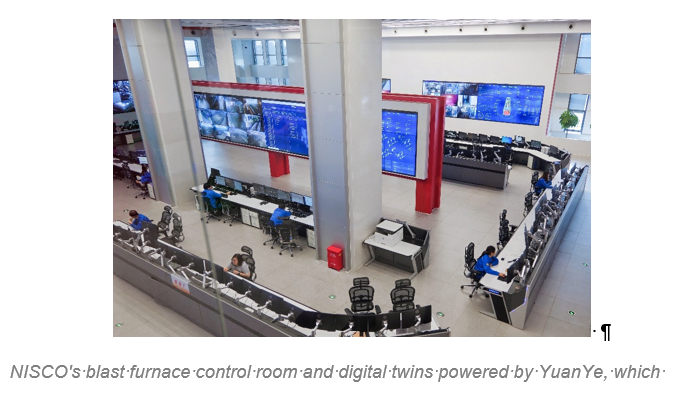
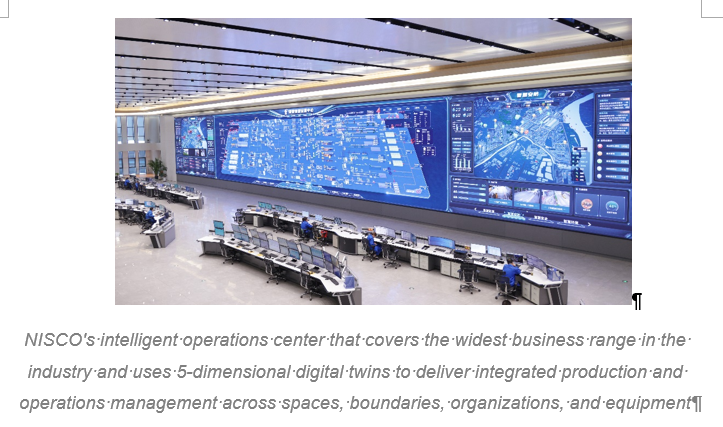
For decades, steel was made by veteran operators who knew how a furnace behaved by feel. That knowledge was real, but it lived in people’s heads. Deploying sensors, gathering data and creating digital twins made the plant processes visible, measurable and, eventually, controllable by software.
Lesson 2: General AI Wasn’t Enough. NISCO Paired It with Physics.
YuanYe is not one big general-purpose AI model. It’s a cluster of models.
And NISCO had to combine AI with the steel industry’s existing metallurgical models, which are the physics and chemistry of how iron and steel behave.
Think about this as right brain plus left brain.
- The “right brain” does probabilistic work: pattern recognition and prediction, which AI is good at.
- The “left brain” makes precise decisions based on known physical rules.
This matters.
AI models predict, but they can also be confidently wrong.
In a steel plant, being wrong means wasted products, downtime and possibly safety problems. So, pairing AI with physics keeps the predictions grounded in how the processes actually works.
Example: NISCO’s Agent to Manage Sulfur Emissions
They have a sulfur-control agent that combines 602 process parameters with images and the domain knowledge.
The agent can predict sulfur risk one hour in advance with over 95% accuracy. Then it calculates the best gas blending plan within seconds.
The result is natural gas co-firing cut by nearly 50%, and downtime from emission problems down by over 25%.
The lesson here is that in physical industries, your engineering models and expert know-how are an asset. AI doesn’t replace them. It sits on top of them.
Lesson 3: AI Is Already Paying Off in Steel in Three Places
So, what does their AI actually do in the plant?
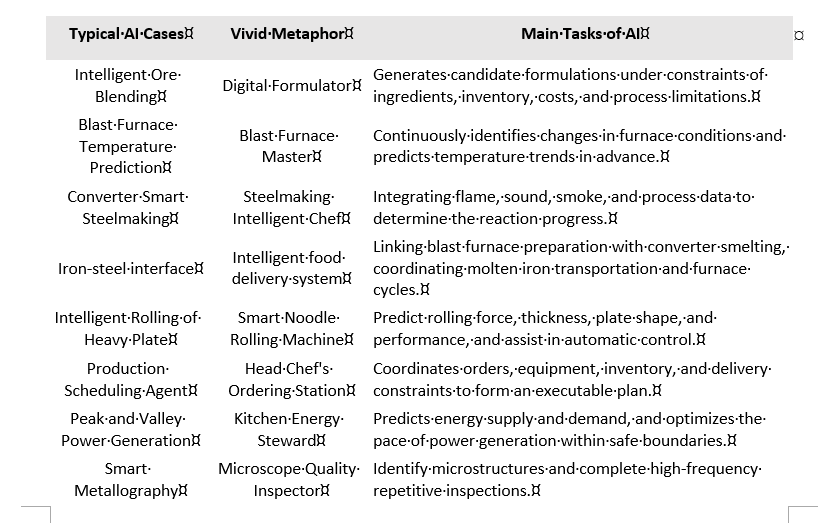
NISCO lists several use cases. I found these three easy to understand.
Use Case 1: The blast furnace can now be predicted
The blast furnace has always been a black box. You literally can’t see inside it. So, operators mostly react to problems after they happen.
YuanYe uses the furnace’s internal sensor data and metallurgical models to simulate what’s happening inside the furnace in real time.
Operators can now predict temperatures and spot problems two hours in advance, with over 90% accuracy. They can therefore prevent problems instead of cleaning up after them.
NISCO says prime-grade molten iron yield is up over 10%, and energy use per ton is down.
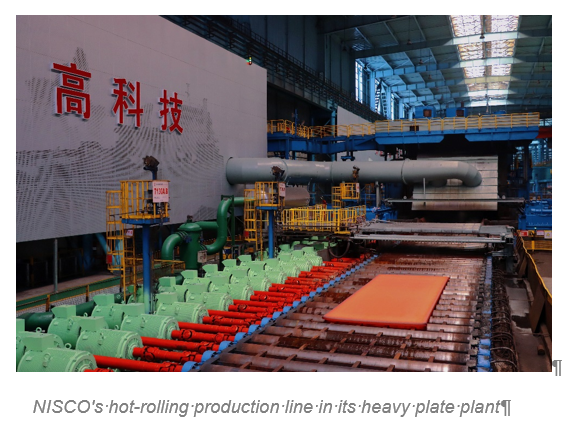
Use Case 2: Rolling steel is now more precise
NISCO sell plates for LNG storage tanks, oil pipelines and cruise ships. Better precision means better products and better prices.
Rolling is the key step where hot steel is pressed into plates. This is where tremendous force needs to be applied uniformly and consistently.
YuanYe’s rolling-force model responds in milliseconds to any perceived changes. Its hit rate went from 88% to 98%, and thickness tolerance is now ±0.2 mm.
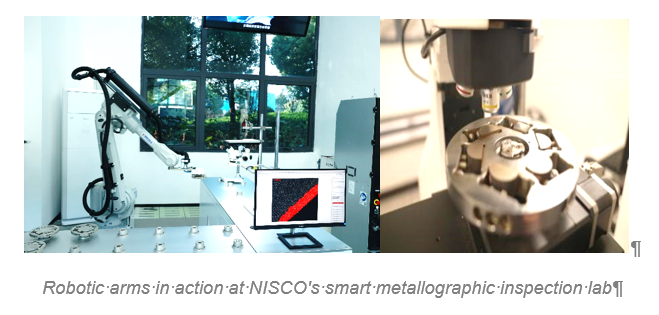
Use Case 3: Robots and AI now do quality inspection
Checking the microstructure of finished steel used to be slow, manual lab work. Now robots grind and polish the samples. And the AI captures the images and grades them.
NISCO says time per sample for inspections dropped from 10 minutes to 3 to 5 minutes, with over 95% accuracy.
For reference, here are the use cases NISCO published.
Final Point: The Huawei and NISCO Playbook Here Is Data + Hybrid AI + Targeted Use Cases
That is pretty much my take-away from this. And it’s a pretty common approach.
What’s different here is the complexity of the operations.
- The data step is much harder.
- The AI needs to be paired with physical and scientific knowledge.
- And the selection of use cases is really important.
I find this to be a good reminder that much of the most practical AI work isn’t happening in Silicon Valley. It’s happening in steel mills and industrial facilities around the world.
NISCO says its next step is likely dedicated AI data centers for its plants. So, they are heading towards an AI-native operating system with AI-native factories.
Cheers, Jeff
For more on how companies are putting AI agents to work, sign up for my free Agentic Frontier email at jefftowson.com.
*Disclosure: AsiaTech Services, LLC has had a paid commercial relationship with Huawei within the past 12 months. This article received no financial sponsorship or backing. All thoughts are my own.*
—–
Related articles:
- How Generative AI Services Are Disrupting Platform Business Models (2 of 2) (Tech Strategy – Daily Article)
- The Winners and Losers in ChatGPT (Tech Strategy – Daily Article)
- Why ChatGPT and Generative AI Are a Mortal Threat to Disney, Netflix and Most Hollywood Studios (Tech Strategy – Podcast 150)
From the Concept Library, concepts for this article are:
- AI Cloud
From the Company Library, companies for this article are:
- Huawei Cloud
———
I am a founder, consultant and keynote speaker specialized in digital and AI agentic strategy.
I am the founder of Agentic Org Now, a firm that helps leadership teams launch AI and agentic initiatives fast.
I write (a lot) about digital and digital AI strategy (3 best selling books, +2.9M followers on LinkedIn). You can get a free book at the email sign-up below.
My Moats and Marathons book series is a framework for building and measuring competitive advantages in digital and AI businesses.
Note: This content (articles, podcasts, website info) is not investment advice. The information and opinions from me and any guests may be incorrect. The numbers and information may be wrong. The views expressed may no longer be relevant or accurate. Investing is risky. Do your own research.
