


I try to go to Cainiao’s headquarters in western Hangzhou pretty regularly. And I have occasionally interviewed their executives, such as William Xiong, Senior Vice President for Cross-Border Logistics.

When I interviewed William (late 2024), the big news was their new cross-border offer of 5-day delivery for about $10 on a route like China to Spain. Or $5 for 10 days.
This offer was available between China and 14+ countries. And they were aggressively expanding this.
It was a pretty devastating delivery guarantee that almost no competitor to match.
How Fast Can Global Delivery Get?
His answer was that 3 days was possible, in theory.
- One day for processing in China.
- One day for cross-border shipping.
- One day for delivery in the target country.
And then in August 2026, Cainiao launched “Global 3-Day Delivery” (in some locations).
That’s great for customers and merchants.
And devastating for competitors.
Which is the telltale sign of really good strategy.
I’ve been saying on my podcast for years that Cainiao’s strategy was probably going to work. So, this two-part series is a check-in on that.
And about what Cainiao has been doing in 2026.
First, a Bit of Context
2026 has been a year of structural changes for Cainiao.
- In January, Cainiao merged its autonomous delivery vehicle unit into robovan company Zelos.
- In July, Cainiao’s domestic China supply chain business was moved into Alibaba’s China E-commerce Group.
What’s left as “Cainiao” is increasingly two things:
- International logistics
- Logistics technology
And within that, I see 3 big moves this year:
- Advancements in robots and AI-native smart warehouses.
- A growing global network of smart warehouses. Especially in Europe. And this is starting to enable logistics outside of China, not just within or to-and-from China.
- Global 3-Day Delivery as a competitive weapon.
This article (Part 1) covers the first two moves. Part 2 will cover 3-day delivery and the big question: Is this strategy building a global moat?
Big Move 1: Advancements in Robots and AI-Native Smart Warehouses
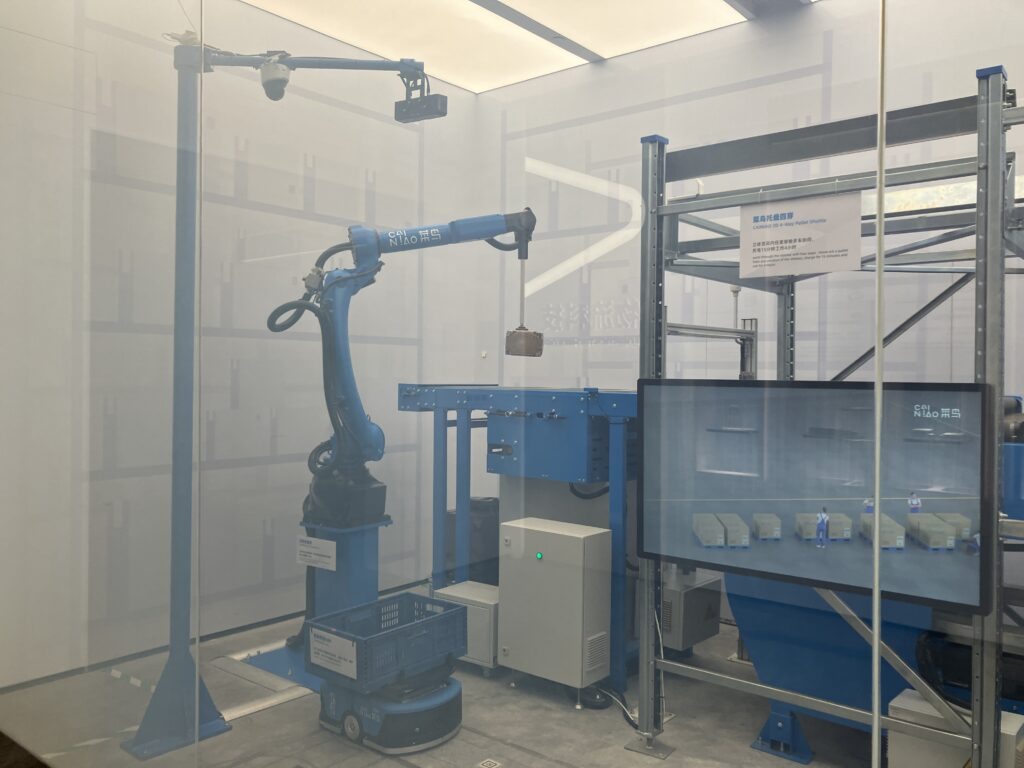
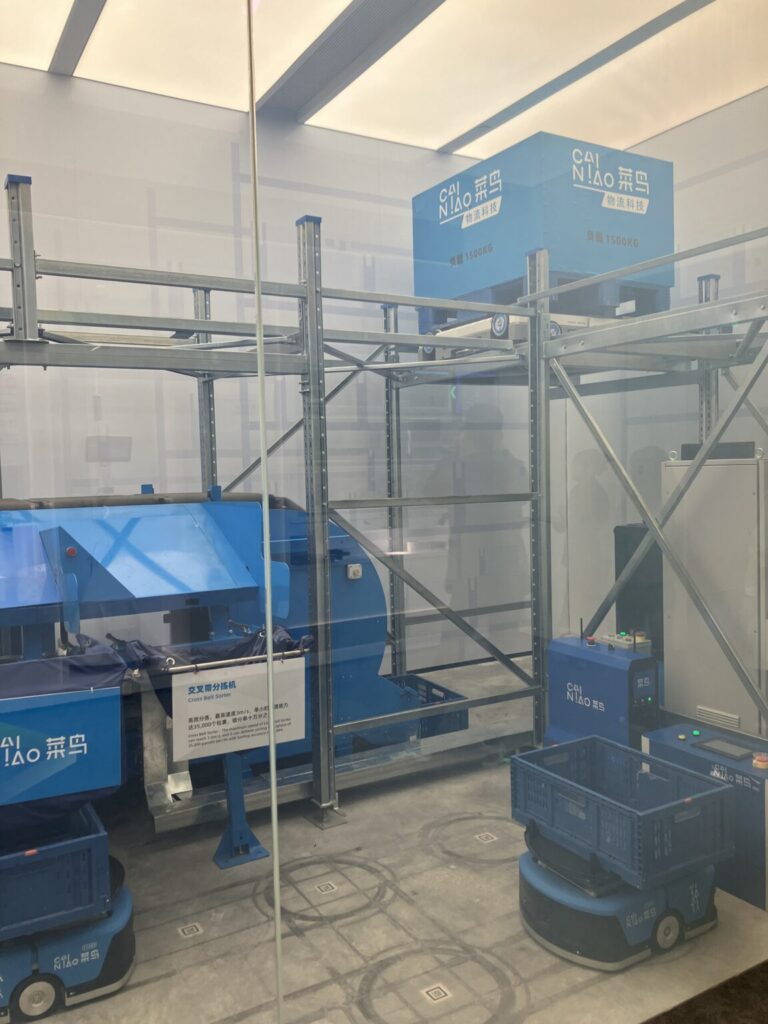
Cainiao’s warehouses are being rebuilt around robots and AI. Not robots being added to old warehouses. The warehouses are being redesigned around robots, which are also rapidly advancing.
Here are some updates:
Meet ZeeBot, the Robot That Climbs Walls
In April 2026, Cainiao launched ZeeBot at the MODEX logistics show in Atlanta. It’s their first self-developed rack-climbing warehouse robot.
Here’s what it looks like:
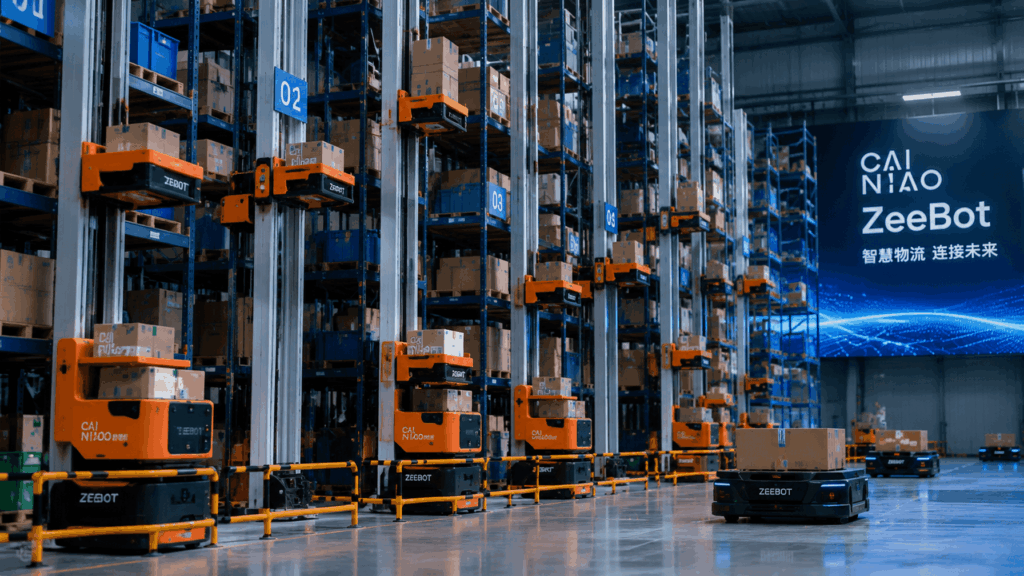
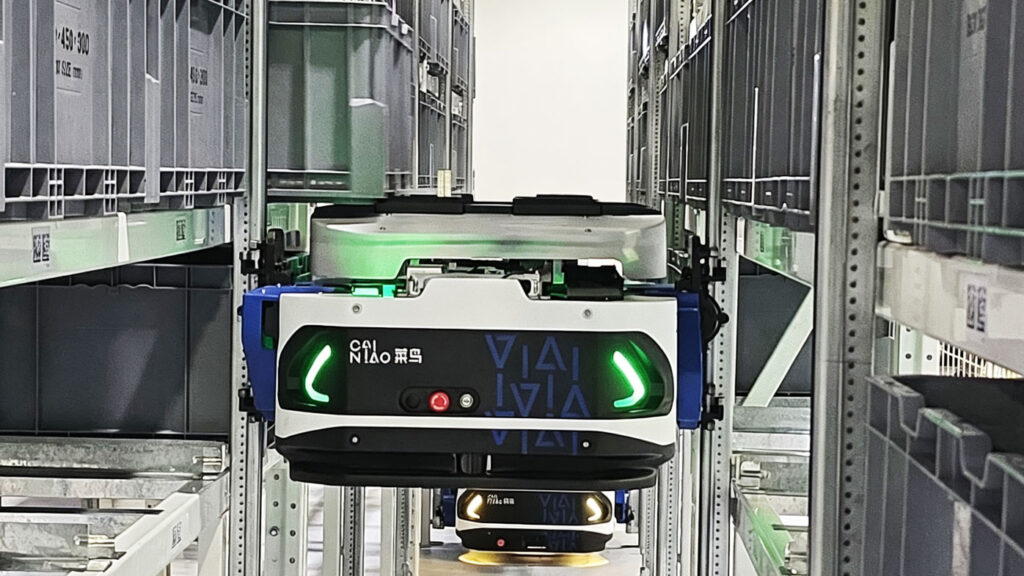
It can climb to the top of a five-level-high shelf in about 10 seconds.
It reportedly increases storage and retrieval efficiency by up to 100%.
When I think of a smart warehouse, I think about racks of goods going up to twenty levels to the ceiling. And lots of ZeeBots are zipping up and down these walls with goods.
Automated warehouses typically split the work across different machines.
- Shuttles run on each shelf level.
- Lifts move bins between levels.
- Big robots work the aisles while smaller ones carry bins on the ground.
Basically, lots of handoffs between devices.
ZeeBot does ground movement, vertical climbing and bin transport in one robot.
3x the Storage. 2x the Picking.
The first ZeeBot warehouse was built with AliExpress in Dongguan, Guangdong, for cross-border orders.
During its first 618 shopping festival, Cainiao ran 134 of these climbing robots. That warehouse apparently can store about 3x what a manual warehouse of the same footprint holds. And the picking efficiency is about 2x.
The Bottleneck Isn’t Demand. It’s Making Robots.
Cainiao said it would deliver four large climbing-robot warehouses within four months. Including Guangzhou, the Netherlands and Spain. The new Netherlands fulfillment center will have 100+ ZeeBots.
According to Cainiao, the bottleneck is not orders. It’s production capacity. They can’t build the robots fast enough.
The Real Story Is the AI Running the Robots
The robots are the visible part. The invisible part is the AI that increasingly runs them and everything else. AI does real-time task allocation, collision avoidance and routing for the entire robot fleet. It can also do equipment maintenance.
Bi Jianghua, VP and head of Cainiao’s Logistics Technology Division, says traditional automation improved each step of the warehouse. But the chain between steps was still inefficient. ZeeBot plus AI moves the warehouse from single-point automation to multi-robot collaboration across the whole chain.
And this should get smarter over time. That’s what I mean by AI-native.
You don’t digitize the old warehouse. You redesign the warehouse around what robots and AI can do. This is an entirely new animal.
Own the Network or Rent It? AI Blurs the Line.
As I discussed in my podcast, there are two ways to build a logistics network:
- Be asset-light with franchisees. You build the software and provide it to others. You can then connect with other people’s now-digitized warehouses and trucks. This is a fast way to grow. Lots of Chinese logistics companies do this. Cainiao has done this to varying degrees. They like to be the digital nervous system, not all the assets.
- Own and integrate the core. In this approach, you own and run the core network yourself. That is asset intensive. It is slower and more expensive to build. But you have control over the integrated core of the logistics network. This gives you greater control and enables you to do things like guarantees about delivery times. This is the approach of Cainiao (somewhat), SF Express, JD Logistics.
The increasing software and hardware capabilities are making this distinction less and less important. AI and ZeeBot can be deployed into non-owned facilities and you can still achieve integration and coordinated activities. I expect Cainiao to continue to operate the core network but to be more aggressive about digitized partners running their software and hardware.
The Robovans Deal
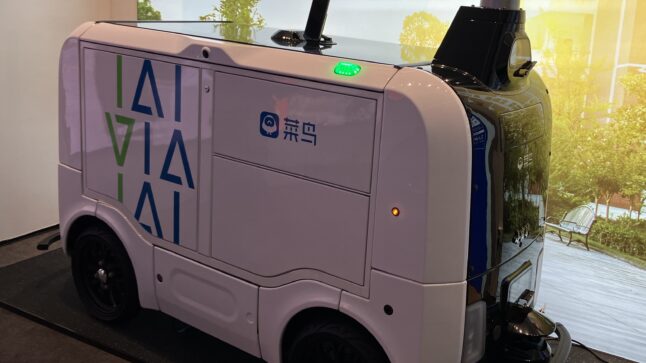
Another big Cainiao robot story this year was in autonomous delivery vans.
In January 2026, Cainiao merged its autonomous vehicle unit with Zelos, a robovan specialist. The deal was valued at around $2B.
- The combined fleet will have 20,000+ vehicles, the largest in the world, with over 75% share in China.
- Taobao Instant Commerce will be a customer.
- Cainiao will stop producing and selling unmanned vehicles itself.
- Cainiao took an equity stake and a board seat.
In June 2026, they launched the GT 2026, which is an L4 autonomous logistics vehicle. It has a 1,780 kg payload and a 230 km range. It charges from 30% to 80% in 30 minutes.
Why does this matter?
Last mile delivery is arguably the hardest problem in all of this. It’s a thorny problem with lots of variable costs. Partnerships are a good way to attack this problem. And to keep it off the balance sheet.
***
Ok. Let’s move on to Big Move 2.
Big Move 2: A Growing Global Network of Smart Warehouses
We can see Cainiao systematically building out its international warehouse network. There are announcements like every month. Especially in Europe.
Why Buffett Loves Logistics Networks
He has been investing in businesses like UPS and BNSF (a big railroad) for decades.
And that’s a big green flag. Because he only invests in businesses that have strong moats. That he describes as “great businesses”.
So why does he like this space?
Because logistics networks get stronger with greater scale and increased density. They have well understood moats. I’ll go into this in Part 2 in detail.
But the key to such businesses is to keep growing. Keep building the network. First nationally in China. Then cross-border. And then internationally.
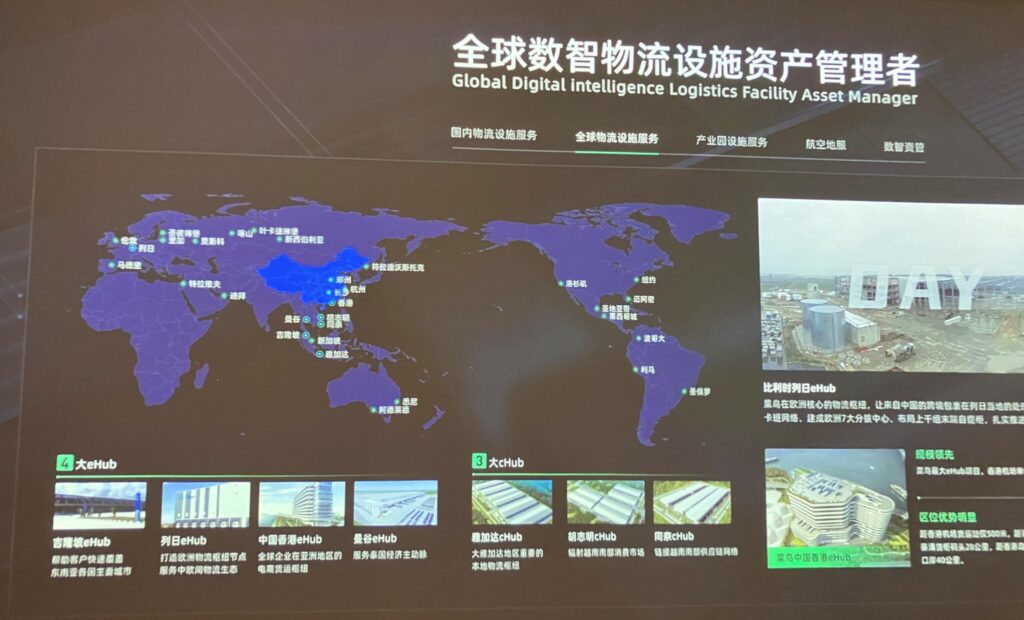
And that is what Cainiao has been doing relentlessly. Here are the latest numbers:
- As of June 2026, Cainiao has 50+ overseas warehouses in 18 countries and regions.
- It has 10M+ square meters of smart warehousing globally.
- In 2025, orders processed by its overseas warehouses grew 32%.
- In March 2026, Cainiao announced it would build a large-scale network of robotic warehouses in Hong Kong, the Netherlands, Spain, France, Germany and the United States.
9 New European Warehouses in 6 Months
Cainiao has opened 8-9 new warehouses in Europe since March. Here are the announcements.
- August. In Mannheim, Germany, they added a second warehouse. Over 20,000 m² with another 40,000 m² planned, for bulky goods and local delivery.
- August. In Paris, France, they added a fourth warehouse in the city, for bulky goods and local delivery.
- June. In the Netherlands, they opened a European supply chain fulfillment center of 26,000 m² on a 10-year lease, with 100+ ZeeBot robots, serving both B2B and B2C.
- April. In the UK, Paris, Madrid, and Poland, they opened four new warehouses serving Chinese cross-border platforms and European merchants.
- April. In Alovera, Spain, they opened a logistics hub leased from Logicor.
- March. In Mannheim, Germany, they opened a dedicated battery warehouse, fully operational, with hazardous goods certification.
Notice the focus on specialized warehouses. The network isn’t just getting bigger. It’s adding specialized capabilities.
- Battery warehouses. The Mannheim battery warehouse was built to EU and German hazardous materials rules. It supports exports of China’s “New Three” products (EVs, lithium batteries, solar) and battery-powered appliances.
- Bulky goods warehouses. For appliances, furniture and other large items that don’t fit small-parcel operations.
- Factory container loading. Cainiao loads containers at factories, so goods flow in one step from a factory to an overseas consumer. We call this first mile logistics.
Who Uses This Network Today
You need to build out networks based on demand. This current network appears to mostly serve:
- Chinese cross-border platforms, starting with outbound AliExpress.
- Chinese brands going global. Auto parts, home goods, appliances and furniture are the focus categories. This is a big trend.
- European merchants selling into China through Cainiao’s supply chain network.
- Chinese AI and tech companies. This is pretty interesting. Probably not huge but interesting. Cainiao now handles specialized logistics for high-value AI computing equipment and robots. Routes cover Germany, the US, Saudi Arabia, Japan, Korea, Ireland and Finland. Projects are already running for major Chinese cloud, hardware and server-rack companies.
The Big Prize: Everywhere to Everywhere
I have written for years that the biggest opportunity on the horizon was local-to-local express delivery everywhere.
That means going from delivering China-to-France to delivering France-to-France. And opening global-to-global routes that don’t touch China at all. France to the Philippines. The Philippines to Brazil. Every linkage in the global network.
That opens up the entire world as a market. And you start with Express Delivery, where having a faster or cheaper service matters. As opposed to freight.
I guessed at the price. On my podcast in 2024, I said express delivery within France was running around €6-7, and Cainiao could probably come in around €4. That would get attention.
And within Europe, I thought it maybe could be €6 versus €8.
We’ll see if that is accurate.
Cainiao calls this G2G (global-to-global). And in 2026 it’s starting to look real.
In Europe, there are:
- 4 global hubs and 108 trucking lines covering 35 countries and regions.
- 3-5 day warehouse-to-door delivery.
In the Americas, there are similar announcements:
- In January, Cainiao launched a US-to-Mexico service covering 99% of Mexico, at about 60% of the industry average price.
- In September, they showed a US-to-Latin America service. It picks up from US warehouses and delivers to Mexico, Colombia, Brazil, Chile and Argentina, some routes in as little as 6 days.
- In Mexico, Cainiao now runs a 20,000 m² sorting center and 38 consolidation and delivery stations. It combines customs clearance with last-mile delivery and has local pickup in Mexico City and the State of Mexico.
Cainiao says it is the first Chinese logistics company to offer G2G services across three regions: the Middle East, Europe and the Americas. It also now runs local express delivery in 9 countries and regions.
Cainiao Is Building a Global Smart Logistics Network
Put Moves 1 and 2 together and you get the picture.
- Cainiao is building a bigger global network of warehouses.
- It is filling those warehouses with increasingly advanced robots and AI.
That’s the foundation. But the network is only an asset.
What matters is what services you can offer with that asset. Ideally, that competitors can’t match.
In Part 2, I’ll go into this, which is mostly Global 3-Day Delivery.
And then the big question: Is this actually a Warren Buffett-type moat?
Cheers, Jeff

*Disclosure: AsiaTech Services, LLC has had a partnership with Alibaba within the past 12 months. This article received no financial sponsorship or backing.*
——–
Related articles:
- How Alibaba.com Re-Ignited Growth with the Alibaba Management Playbook (Tech Strategy – Podcast 253)
- How Amap Beat Baidu Maps. My Summary of the Alibaba Playbook. (Tech Strategy – Podcast 252)
- Scale Advantages Are Key. But Competitive Advantages Are More Specific and Measurable. (Tech Strategy)
From the Concept Library, concepts for this article are:
- Logistics
From the Company Library, companies for this article are:
- Alibaba: Cainiao
———
I am a founder, consultant and keynote speaker specialized in digital and AI agentic strategy.
I am the founder of Agentic Org Now, a firm that helps leadership teams launch AI and agentic initiatives fast.
I write (a lot) about digital and digital AI strategy (3 best selling books, +2.9M followers on LinkedIn). You can get a free book at the email sign-up below.
My Moats and Marathons book series is a framework for building and measuring competitive advantages in digital and AI businesses.
Note: This content (articles, podcasts, website info) is not investment advice. The information and opinions from me and any guests may be incorrect. The numbers and information may be wrong. The views expressed may no longer be relevant or accurate. Investing is risky. Do your own research.
