


This week’s podcast is about iQIYI’s 3 big moves in tech. Specifically offering video production capabilities as a service. And shifting towards a platform business model.
You can listen to this podcast here, which has the slides and graphics mentioned. Also available at iTunes and Google Podcasts.
Here is the link to Agentic Org Now.
Here is the link to our Tech Tours.
Here are the mentioned slides:
—–
Related articles:
- iQIYI’s 3 Big Tech Moves: Get Ready for “Hollywood as a Service” (Tech Strategy)
- Why ChatGPT and Generative AI Are a Mortal Threat to Disney, Netflix and Most Hollywood Studios (Tech Strategy – Podcast 150)
From the Concept Library, concepts for this article are:
- Video
- Externalization of Capabilities
- Audience builder Platforms
- Digital Operating Basics 2: customer Innovation
From the Company Library, companies for this article are:
- iQIYI
——–transcript below.
00:06
Welcome welcome everybody. My name is Jeff Towson and this is the tech strategy podcast from agentic org now and the topic for today IQIYI three big tech moves including and really especially What I’m calling Hollywood as a service Now for those of you aren’t familiar I Chi, know They’re kind of like a mix of Netflix and YouTube in China Although I call them the HBO max because the quality is really high
00:34
Netflix is not known for real high quality shows. Okay, iQIYI is Netflix’s highest quality in my opinion, especially like dramas, TV show dramas, historical dramas, stuff like that. Anyways, they did some big tech moves finally, which I’ve been kind of waiting on for three to four years. So I’ll talk about that. within that, there’s a couple good digital strategy lessons. I think there’s some like standard core concepts that are really worth knowing.
01:01
if you’re not familiar with these. So they’re a good example of some good strategy stuff and the tech moves this year are pretty cool. So that is what I will talk about today. And this is actually the 300th podcast I’ve done, which is crazy. I mean, that’s just crazy. It kind of blows my mind that I can remember doing the first one sitting in a hotel in Bangkok. For those of you familiar, I was down like in Samut Prakan.
01:29
way down south and I was sitting in this hotel room. I’m like, I’m going to do this. And I just sort of did one and I’m like, well, we’ll see how it goes. know, 299 podcasts later, here we are. So I feel pretty good about it to tell you the truth. feel like, think it, for me, it was the right approach to sort of flesh out all of my sort of frameworks and approaches for how to think about this stuff. It took a long, long March really to get there.
01:58
because things I thought were important I don’t think are important anymore other things I missed it really has sort of evolved over time and it’s sort of let’s call it a forced evolution if you have to give a one-hour talk every week on one specific subject you’re going to get better at it I mean there’s no way you’re not going to so it’s sort of like guaranteed progressed and sort of forced evolution so I like how these things play out I feel good about it anyways that’s sort of the point okay let me
02:29
to my little disclaimer here, standard disclaimer, nothing in this podcast or my writing or website is investment advice, numbers and information from any guests may be incorrect, views and opinions expressed may no longer be relevant or accurate, overall investing is risky, this is not investment, legal or tax advice, do your own research. And with that, let’s get into the topic. Now there are two, really three ideas here that are worth understanding.
02:56
which really is what I, when I look at what iQIYI is doing, they basically, they’re doing a lot of tech stuff this year. They’ve pulled the lever on some stuff that’s been brewing for quite a few years and they’ve kind of like gone all in as far as I can tell. Three ideas here I think are worth knowing. One is what I call externalization of a core capability. It takes something you’re good at that you’ve built inside your company to support your primary activity and you offer that as a service outside your company. So Amazon,
03:26
logistics, right? Although they don’t really offer it as a service. You build the logistics to support your e-commerce business at a certain point, you externalize and let anyone buy this as a service. JD, that’s more of a JD logistics thing and Cainiao is similar. But there’s tons of examples of this. And why is that good? Well, it gets you economies of scale.
03:49
If you’ve got a logistics network that you’re building and one of the major advantages you have over your rivals is you’re larger, you have sort of economies of scale and a major fixed cost like logistics or cloud computing. Well, if you offer that to a lot of clients outside your own usage, you’re going to get even bigger. So you’re going to add additional economies of scale. That’s good move. And then sometimes, which leads to the second concept, is sometimes that external service
04:19
can spin off not just to a new business, but to a new platform business model. And that’s Amazon Web Services, right? Same idea, we have a lot of cloud computing that we’ve built to service our e-commerce business, that’s Amazon. We start to externalize it as a capability, okay? You sell, other people can buy your cloud services, you get a lot more economies of scale, and it spins out into a platform business model, in this case, an innovation platform.
04:48
Well, that’s a really powerful business model. the best digital giants have multiple platforms, Tencent, Alibaba, Amazon, Google. Well, how did they end up with three? did, you usually, well, sometimes they do acquisition, fine. But half the time, it’s just an externalized service. That’s how JD goes from JD to JD Logistics to cloud service to a payment platform.
05:15
You can get multiple platforms spinning out of one business that way, or you do acquisition. Facebook hasn’t really done this, which is interesting. Google does this. Tencent does it a lot. Alibaba does it a lot. Facebook has never really spun out that way. I don’t think they’ve always just sort of done M &A. They buy Instagram. So that was a little bit different. But anyway, so that’s sort of idea number two, is you can spin out into a separate platform business model. Sometimes it’s a payment platform. That would be Alipay.
05:45
Sometimes it’s an innovation platform that could be Amazon Web Services. Logistics businesses aren’t really platform business models, but they’re starting to look like it. So you see that. So that’s concept number two. Concept number three, which is just digital operating basics number two, which is continuous, never-ending customer improvements. You know, you in a world of endless supply and endless options,
06:14
your long-term best strategy, besides build a moat, is to constantly innovate in the customer facing aspect, to add value to your customers every year. So even if someone copies what you’re doing this year, you’re already adding something else and you’re on to the next play. This is kind of the Alibaba playbook more than anything else. So I call that DOB2, Digital Operator Basics Number 2. If you’re reading my writing, that’s like 30 % of what I focus on.
06:44
And if you can pair that with a moat, that’s a pretty good business model for digital. So that’s a DOB2, which we’ll talk about. IEEE has been doing that forever. Anyways, you’ll see all three of those within IEEE somewhat. And that’ll be sort of the concepts for today. You can go over to the concept library on jefftausen.com. You’ll see these concepts listed there. Click on them. You’ll see, you know, I got 300 podcasts now, but I have, think, 750 articles.
07:14
You know what’s funny about all that is I’ve been doing, like I’m just living on agents now. Like I can’t believe I never had them before. All day long, I’m using agents for everything, like all the time. And it turns out like, okay, everybody’s got superpowers now. So how do you be different? How do you be better? Well, it turns out the biggest lever you can pull, well, there’s a couple of big levers, but one of the big levers is I have data others don’t have.
07:42
And then I can feed that into my models and let the agents do their thing and all of that. Okay. The other thing is you have customers, have good relationships with customers, which can also be a source of data. So there’s a couple of ways you can differentiate in a world where everybody has superpowers. Well, I have 300 podcasts and almost 800 articles and eight books. I have a massive pile of data that I am just constantly feeding into my models to do stuff.
08:11
Like it’s really, it’s kind of amazing. And I don’t think I’ll ever run out. Like I can do, you know, graphics and PowerPoints and create things and social media posts and articles. you know, I’ve got this massive, what we would call corpus of data that I can use. So turns out me being maniacal about one particular question for 10 years has really kind of set me up well in the age of AI.
08:39
Turns out that’s a nice thing to have in this life. Anyways, that’s what I’ve been discovering over the last month. Okay, let me go into what iQiyi is doing. That’s a bit of theory to start with. Now, I’ve been visiting iQiyi for, I don’t know, three, four years. I’ve been writing about them for seven or eight. They went public a long time ago. And like most of these content-based video platforms in China, they really struggled to make money for a long time. All of them did.
09:08
Tencent video IQIYI to do you know, these were all founded back when YouTube was founded But unlike in the West they all struggled to make money for a couple reasons One digital advertising was not very big in China for a long time. So there wasn’t a real revenue stream there They had to do other things like get subscriptions the problem with that, of course is Chinese consumers They were not used to paying for content. They had always been free
09:38
You just get pirated DVDs or whatever. There was no history of paying for content. So that kind of had to evolve over time. And even now the subscription fees are really quite small. So that’s part of it. And then the other, you have these three ferocious competitors. Tencent Video, owned by Tencent. iQiyi, owned by Baidu, although it’s spun out now. And then you have Tudou, which is owned by Alibaba. Okay, the three giants all have a strategic position in video.
10:06
And none of them need to make money doing this. They’ve all got their money from elsewhere. So what they basically did is they got into a content war for a long time where the way you would compete with the other platforms is you would do sort of proprietary high quality content as a way to differentiate yourself like, hey, we’ll make Game of Thrones. Hey, we’ll make Pursuit of Jade. So there was just massive spending on the content side as a way to differentiate either by in-house production
10:36
or lot of licensing stuff like that. So when you look at their financials, know, five, seven years ago, you’d see just massive spending on content and nobody was making any money. Now they did break even. I don’t know, don’t hold it to me. Like five years ago, think, iQiyi got there and iQiyi is kind of the leader by most metrics. I think quality, they’re the best, but also by market share, by most metrics, I think they’re number one. I think most people would agree that. Okay, so.
11:05
That’s kind of been the space and it’s been interesting and I’ve been visiting them for a long time and they do a lot of fun stuff. Like they have VR land, which is something up in Beijing. It’s like a virtual reality place where you go and you put the headsets on and you walk through like warehouse, but you think you’re in an ancient village. It’s amazing. It’s absolutely amazing. Like, and now they have IGE land, which is like a theme park, but it’s going to be a digital theme park where instead of buying a big
11:34
of land where you walk around and they have Space Mountain, you’re going to be in a big closed room and you sort of live inside it virtually, which is a much better model for theme parks. You can change them all the time. And so they got iQIYI land coming in. They’re very innovative on a lot of areas. But the one area I’ve always, and to be fair, they have an advantage that Netflix doesn’t have and that very few companies had. They’re owned by Baidu, significantly owned, not entirely anymore.
12:02
So you have one of the great tech giants behind you. So when you decide to go into something like AI, you have tremendous resources you can draw on. Well, Netflix doesn’t have that. Now Amazon in theory does, although they’re not really doing much in AI that I pay attention to. So they had this great position as like the ability to do high quality entertainment. And that’s how they position the highest quality TV shows and such. They’re really a cultural force.
12:31
They’re always on sort of the cutting edge of culture. And then they’ve got huge tech capabilities that they can draw on. So that said, you know, years ago, let’s say three years ago, meeting with them and they’re doing lots of stuff in AI. They were very fast off the mark in AI because of Baidu, I think. And they start to virtualize production and they start to digitize their assets.
12:54
You know, they start to basically let you, one, they integrate AI into the production process, everything from script writing to making marketing posters to analyzing scenes. And then more and more, the whole production itself becomes a virtual done on a computer with maybe you filmed a little bit and you imported it, but you’re using a lot of digital assets and you’re putting it together there more and more. The production’s going that direction. So I’ve been asking for what, three years?
13:24
When are you going to externalize this as a service? When are you going to be Hollywood as a service? Where anybody can just sign up, use all your tools, and make movies or TV shows of super high quality. When are you going to pull that lever? And they’d been talking about it, but they hadn’t pulled the lever. Well, this year they pulled the lever. They are now, you can hear the management talking on the earnings call, just talking about this is
13:53
This is going to be our major move. And what does that mean? Well, there’s a lot of implications for that. The first is, okay, that means you’re starting to look a lot more like YouTube. You have always positioned yourself as the highest quality TV shows, like HBO Max, in my opinion. Well, if anyone can make TV shows using your services, are you going to let them upload that onto your app?
14:23
And the answer is yes. Oh, well, that’s going to conflict with your brand a little bit. Like your app is going to be a mix of, you know, the Sopranos and Game of Thrones, and then all these tiny little videos by anybody. Okay, that’s kind of odd. So, you know, it’s not just that they’re offering it as a service, they’re also shifting their business model away from being just a high quality streaming service to a streaming services plus
14:54
platform. And we would call that an audience builder platform, which is like YouTube and TikTok. That’s their business model. Okay, how do those things reconcile? I don’t know. They seem to be working on that. And I think that’s on multiple levels. First of all, I think externalizing your capabilities is a great move because it’s inevitable. So you might as well get there first and become the tool that everybody uses.
15:21
It gives you another revenue stream. gets you economies of scale in the key digital AI assets you would need to make TV shows in this world. Two, look, these capabilities are going to be out there for everybody. We can already see it with C-Dance and these others. So how hard is it going to be to be a standalone TV streaming service in a world where everybody can be Steven Spielberg? The volume is going to go through the roof. Getting noticed is going to be way harder.
15:51
than it used to be. Okay, in that world, in a world where everybody can create high quality TV shows and movies like Hollywood, what is a bad business model to be? A TV studio. What is the best business model to be? YouTube. You want to be YouTube. You want to be the platform that connects the endless sea of content with viewers, which is an audience builder platform. Okay, that’s what they’ve just done. They’ve shifted, you know,
16:21
from what they were to having one foot. So they’ve externalized their capability and they’ve really taken a solid step towards being an audience builder platform. Now, how far are they going to go? I don’t know. To work as a platform business model, you can’t just have 10,000 content creators uploading. You really have to have millions. mean, it’s like being a marketplace like Amazon. Amazon is not a marketplace.
16:49
If you’ve only got 3000 merchants selling, no, you’re just a big version. At that point, you’re really just kind of like a Walmart. If you’re going to become a platform business model, you really have to get massive supply. Platform business models don’t work until you get to large scale. There are no medium platform business models. There are no small ones. You have to be large. So are they going to go that way where you have millions of content creators uploading to IGE like TikTok? That’s a question.
17:19
So that’s kind of what’s going on. And I thought that was a very cool question. And there’s a little bit more to this story, which is, okay, the other thing that’s been happening this year in China in particular is micro dramas have taken off. Micro drama is you use something like C-dance and you make 15 to 30 second clips and maybe you make one to two minute episodes of a TV show. A lot of these are dramas.
17:47
And that’s your show. You’re a micro drama. And one, they’re super addictive. So it’s a little bit like short videos. know, short videos are super addictive, right? It made YouTube seem slow. Everyone’s scrolling on TikTok all day long. Well, this is a TV version of TikTok. These, you know, real quick episodes would have a lot of action in them. OK, so you’re seeing massive adoption in China, really all over the world in micro dramas.
18:17
At the same time, the tools have arrived where people can make Hollywood-like movies. Now to make a two-hour movie is difficult, but making a 15 to 30 second to one minute video, well this is a nice first use case for these tools. So, you know, in the last quarter in China, 400 and I don’t know the exact number, I knew it the other day, 450,000 micro dramas were uploaded.
18:45
Like it is just an explosion of content and viewers are watching. while you have iQiyi doing this big strategic move, sort of throwing gas on the fire at the same time is this sort of craze for micro dramas and everyone’s just making them on their phones. So that’s really gas on the fire of all this. Now, did they do the business model change because it was a big strategic decision?
19:13
Or was it more they just saw all this action happening in micro dramas and figured, we got to get in. I mean, now it’s the same thing, but I’m kind of curious which came first and which came second. I don’t know. Now there are two services within this that are fun if you want to play with them. One is called NadouPro, which is basically their production capabilities as a service. So that’s the creation aspect.
19:41
One, you can use the tools to do the virtual production, fine. So, you can take pictures with your camera, short video with your iPhone, upload it, use that as an asset within the virtual production. But they also have a shared library of digital assets from their TV shows. So, they’ve been digitizing their TV shows like the characters, although I don’t think you’re allowed to use those, the virtual sets, the props, cars, animals.
20:10
Anything you see in these movies and TV shows, well, they’ve been digitizing those tanks, whatever you want, putting them in a big library. So not only can you use the service to create your production, you can basically pay for those assets and put them in your movie or your TV show. So they’ve got kind of a digital asset library plus, um, they say they have 200 capabilities that you can use. Screenwriting, directing, visual design, video editing.
20:39
Lighting I mean is it’s just a full suite of every that’s why I call it everything you see in Hollywood They have pretty much all of it. So it’s Hollywood as a service Interesting. Okay. Now the other thing that goes hand-in-hand with that is come something called the creator center Now this is kind of the business side of the equation not the creation side, even though it’s called creator So, okay, you’ve made your TV show your animated show, whatever. How do you distribute it? Okay
21:08
They offer distribution, mostly I-G-E-I assume. They offer marketing services. Gotta get it noticed, they have monetization. You can share in the advertising, things like that. So it’s kind of everything against that. And we’ve actually seen this model before. This is the Epic Games model. Epic Games has been doing this forever. They have tremendous capabilities that they offer to video game designers, developers.
21:36
to design your game, to code it up, to create the virtual sets, to use the Unreal Engine. Everything you would need to make your own video games. They give you all those tools. And at the same time, they have their own video games, which is Fortnite. But then in addition, they give you distribution, monetization, marketing, all of that stuff, actually. And they give you a sharing and social media integration. So we’ve seen the same model before.
22:06
I think it’s pretty amazing, but yeah, I’m going to totally play with it. So that’s kind of, that would be point number one. That’s kind of tech, big tech move by iQiyi this year. I’m going to dig into this a little bit more, cause I don’t feel like I, I think I’m only like halfway there in terms of my understanding of what they’re actually doing. I get what they’re saying and it fits into something I’ve been thinking about. So I get the frameworks, but I’m not, don’t.
22:34
Sure, I’ve got all the details right. I think I’m missing some stuff in there and what they’re really going after. So anyways, I like that. But yeah, if everyone can be a Hollywood studio now. And in that world, what do you want to do? I want to be YouTube. I think that’s the best position. So it looks like I’m going do that. All right. Tech move number two. This one’s pretty, the other two are pretty basic. yeah, they’re still sort of charging along the pathway of
23:04
how do you do virtual production of video for the highest quality long form videos? And that’s, to me, this is why iQIYI was so interesting, which is like, lot of people are making video capabilities. C-dance is great, they make short clips. There’s tools all over the place, but there’s different levels of this, and the highest level, the most difficult level is, you
23:33
high quality movies and television, they’re sort of the top of the, I don’t know, the top of the mountain. It’s impactful storytelling. That’s pretty amazing, right? it’s, there’s a lot of power to really well-done TV shows. I mean, it’s really about the power of storytelling, which I don’t think you want to underestimate. Maybe that’s the most powerful sort of art form media that there is. Maybe, I’d put it in the top tier.
24:01
So they’re trying to create virtual production capabilities for that level of this game. That’s way different than making little TikTok videos and stuff like that. So that’s kind of why I’ve been watching them. So what does that mean? For iQiyi, if you look at what they do for their original programming, which is what they focus on most, okay, they have, I looked this up.
24:27
over 40,000 professionally produced content titles. Actually, that’s a year or two old, so it’s probably larger than that. Drama series, variety shows, films, and if you ever look, they win the awards all the time. So drama is a big deal. know, fantasy, martial arts is a big deal, modern stories. They say that they have the number one spot in drama viewership for several years.
24:57
For variety shows, variety shows are an interesting category because I tend to discount these. I don’t pay much attention to them. I think I underestimate how powerful they are culturally. I dramas are, okay, impactful storytelling, but variety shows are really about where a culture or a society is at that moment in time. If everyone’s listening to rap music at a certain point in time, the variety shows will be about rap music.
25:26
If it’s about competition, if it’s about culture, you know, those things tend to be in, they tend to play themselves out in these variety shows, which can often become news stories. Like people use that as a basis for discussion about what’s going on. So, you youth culture tends to show up in like variety shows, things like that. So I think that’s an interesting category. I don’t really watch that stuff myself. And then of course, you know, blockbuster films. Well,
25:55
anything acclaimed. So let’s see if commercial blockbusters on one end and then you have art house, know, masterpieces on the other. Okay, so there’s, that’s how I, I’m reading this off a JPEG from IGE that they put out. So, I mean, that’s kind of how they view the world. That’s, that’s convincing. You know, that to me would be the top tier of this stuff. Okay. So, you know, to
26:23
develop the virtual production capabilities to do that sort of stuff. Yeah, this is what I’m trying to get at. how much of this, and this is a question, how much of this can be done by AI without humans? I mean, if you have a creative team, they could use these tools and make great things. I don’t think anyone needs to be convinced about that.
26:50
Everyone can, we’re going to see Steven Spielberg’s all over the place. But can the AI make impactful, high quality TV shows, acclaimed films, variety shows, without humans really being involved? Can they do it on their own? Can you just send in a prompt and one shot it?
27:09
I’m getting close to the point where I think that’s probably going to happen. Maybe not entire TV shows, but let’s say a really good 20 to 30 minute television show. Could you one shot something like that that has real storytelling power to it? I’m more and more coming to the point of view. Yeah, I think that’s probably going to happen. So there’s an argument that AI can’t be creative like people. I actually think it can.
27:39
I’m more and more convinced it can write pop songs and that it can make poems that are moving and that it can do short television. I’m more and more convinced that AI can do that without humans being involved. I didn’t used to think that, but I’m changing because I keep seeing examples of it where like that’s really good. You one-shotted this? Yeah. Okay. Anyway, so that’s kind of tech move number two. They’re doing lots of sort of continued investment in that virtual production capability space.
28:09
You know, you can see what’s coming. They’ve got the tools, 300 capabilities, what was it, 200. The next move is obviously an agent, where instead of dealing with the tools, this is how you go from human to AI. Instead of one human using all the tools, you just start talking to an agent and the agent uses the tools. That’s the half step. I assume that’s already there. I just haven’t seen it. Okay, last one, tech move number three.
28:36
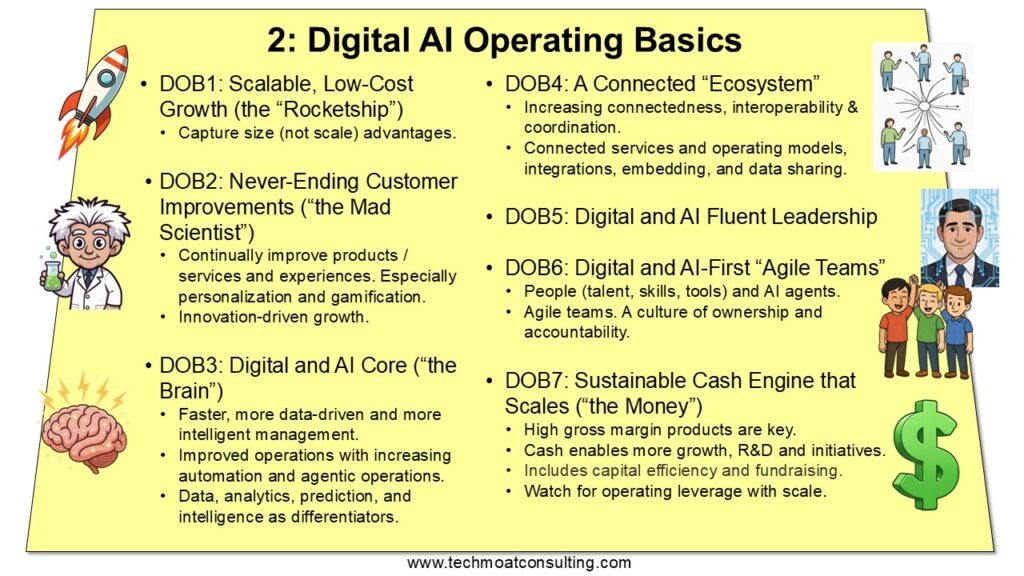
Relentless improvements in the customer experience. So this you know, is DOB2, Never Ending Customer Improvements. I call this the mad scientist. I’ll put a little picture in, but you you’re just continually improving your products and services and experiences. That’s everything from personalization to gamification. You know, this is kind of, I put this in the category of sort of innovation driven growth.
29:04
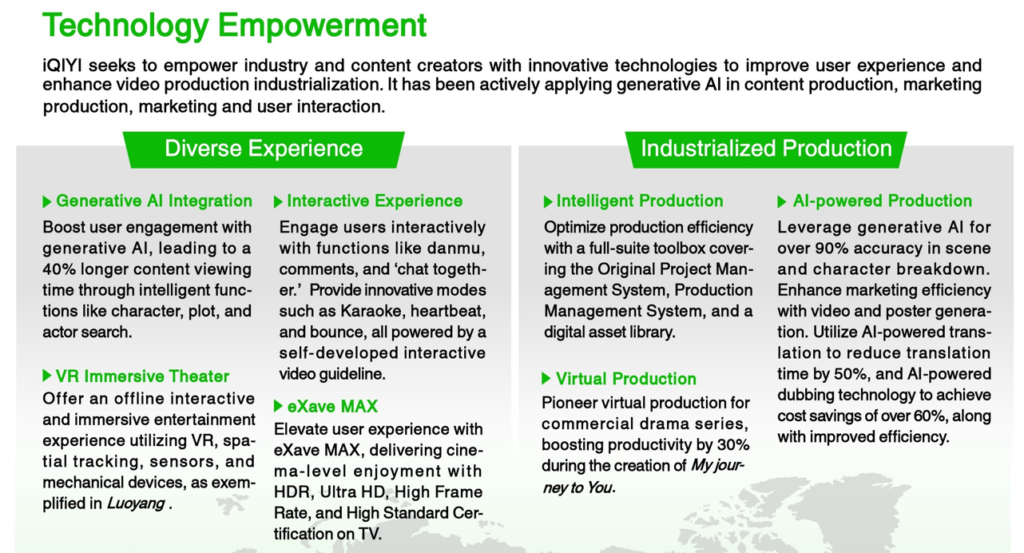
Right. How do you how do you grow as a company? Well, you know, you can expand geographically. You can expand your product lines and all that stuff. But the other way is you just innovate more and more in your core products and grow it that way. Well, that’s kind of what DOB2 is. So they have an interesting playbook for this. actually think it’s I’ll put the slide in, although I think the slides is two years old now. They basically look when they talk about technology, they say there’s industrialized production.
29:33
which I’ve just talked about. And the other one they talk about is diverse experiences, where they’re just constantly applying tech to aspects of the consumer, the viewer experience. So that could be generative AI integration. This is from them. So, you put in intelligent functions like translation and, you know, switching it from language and you’re basically trying to get more engagement.
30:03
or you’re trying to get people to watch longer because the quality of the content is better. And you can go down that path a lot like you want to have choose your own story. I’m not sure they’re doing that. But if nothing else, the search function that shows you what video you might want to watch next gets a lot smarter. And we know that causes people to watch more TV. So this whole idea of integrating AI capabilities into the user watching experience
30:33
Yeah, if you do that well, the KPI you’ll see is people are enjoying it more and they’re watching more. Fine. Within this, you can switch from the content to what you used to watch the content like VR immersive theater instead of watching on television or watching on your phone or watching on an iPad. And they offer all those platforms. Let’s do VR. Let’s have sort of spatial tracking. Let’s have sensors.
31:02
Let’s have a mechanical device where you sit in the chair and it shakes with the explosions and stuff like that. Yeah, they’re doing all that stuff. Third one, they have interactive experiences where you let people sort of interact. that’s usually chatting and comments. When people are watching together and everyone’s chatting on the side, which can be pretty fun actually, but you could see other things like karaoke. You could see things like
31:31
If you’re doing training, you’re watching a video and you’re running, okay, you can have heartbeat monitors and stuff like that. So there’s a whole lot in sort of interactive experiences that’s pretty neat. And then they’ve got these big theaters they’re building. There’s one in Beijing. I meant to go last time I was there. I’m going to go this time, I think. They have some high, super high quality VR new theater they’ve opened in Beijing.
31:58
I’m going to go see what that is. So yeah, they’re experimenting all over the place. And you could put iQIYI land in that category, although that’s, kind of a tech project. So you can see them experimenting all across the board on that sort of digital operating basics too, just improving the user experience, constant customer facing innovation, which can be in content. It can be in handsets. It can be in devices. It can be an interaction. It can be personalization. It can be gamification. There’s a whole lot there.
32:28
And they’ve been sort of pushing that button forever. It’s a pretty good thing to watch actually. Anyways, and that’s the third one. That kind of covers it guess. So yeah, this whole idea of turning into Hollywood as a service, that’s a great move. I think that’s spectacularly interesting. I’m totally going to use it. I use video stuff all the time on my phone. I’m definitely going to check that out. And then there’s a couple good concepts within there. Externalization of a capability.
32:56
Switching over to an innovation or audience builder platform. That’s a big move Virtualization of production at the highest possible level Which I think I see is probably the company to watch. I don’t see Amazon doing this which is weird I don’t see Netflix doing this, but I don’t follow them that closely So I’m kind of watching I see more than anyone else within the video space I’m kind of watching them and I’m watching C dance and I’m watching cling AI
33:25
Those are kind of the three I pay the most attention to. And then the third bit, this idea of just constant customer facing innovation, which there’s all it’s I cut in my mind. That’s the deep well. That’s the well that never runs out. You can always think up new stuff to do to improve your product, your service, the experience, anything that’s pretty. That’s why I call it like the mad scientist. Anyways, that’s it for today. Not too long. Pretty interesting company. I think I’ll talk about cling AI next.
33:55
For those of you that get the emails, I sent you a couple articles on Kling and one on iQIYI, which are pretty similar to what you just said. Yeah, I’m working on those and next on the list is Cainiao. I’m going to take another look at them. I’ve got basically a list of, I don’t know, 15 to 18 articles in my queue and I’m just sort of burning through them. I think I’m going to catch up this month maybe. Anyways, that’s it for the content. As for me, this has been a really good month. I was in Japan, Tokyo for
34:24
three to four days over the weekend, was, was on a panel about sort of robotics and embodied AI, which that was a lot of fun. And then, you know, we went out to dinner, we went to the restaurant. Oh, I’ve forgotten the name. It’s sort of a famous Japanese restaurant where Quentin Tarantino went. And in that movie Kill Bill, when there’s the big fight scene in the restaurant, it’s kind of modeled after that particular restaurant, which you can totally see.
34:52
when you’re sitting in there, you’re like, this is right out of Kill Bill. So that was kind of fun. Yeah, but I really like it there. I don’t actually do that much. I just sort of relax and do a lot of thinking and I walk a lot and listen to podcasts. So I listened to 20, 30 hours of podcasts over a couple of days. I sort of caught up on all my reading and listening, but I just had a great time. So I trying to find reasons to go back there because I don’t really actually do much work there, but I like it so much.
35:23
Anyway, so now I’m back. heading into China in the next day. It’s going to be a couple weeks in China, Hangzhou, Shenzhen, maybe Shanghai, Hong Kong a little bit. Yeah, this is just going to be company visits, company visits. Like it’s literally packed, which is awesome. It’s like the most fun. So I’m just going to be meeting with the company. I’ll talk a lot about them, but yeah, a lot of cool stuff is going on there. So anyways, this is turning into a pretty good month, I suppose. And podcast number 300, which actually
35:52
I feel real good about that. anyways, I’m in a good mood. OK, I hope this was helpful. I hope everyone is doing well and I will talk to you next week. Bye bye.
——
I am a founder, consultant and keynote speaker specialized in digital and AI agentic strategy.
I am the founder of Agentic Org Now, a firm that helps leadership teams launch AI and agentic initiatives fast.
I write (a lot) about digital and digital AI strategy (3 best selling books, +2.9M followers on LinkedIn). You can get a free book at the email sign-up below.
My Moats and Marathons book series is a framework for building and measuring competitive advantages in digital and AI businesses.
Note: This content (articles, podcasts, website info) is not investment advice. The information and opinions from me and any guests may be incorrect. The numbers and information may be wrong. The views expressed may no longer be relevant or accurate. Investing is risky. Do your own research.
