I was at the Tencent forum at WAIC 2026. It was pretty great. And it was really helpful in terms of seeing what Tencent is focusing on in AI.
I had 3 take-aways from the Tencent forum:
- Tencent is way more focused on robot brains (i.e., embodied AI) than I was aware of. See Article 1.
- WorkBuddy is their flagship product for AI agents. But they have other “buddies” you can also use. That’s this article.
- Tencent will likely be the global leader in AI and agent marketing.
There was also some good stuff about vivid avatars (by the CEO of Huya).
This article is about HY3 and WorkBuddy. After this, I’ll get into their other buddies and ADP, one of Tencent’s platforms for building and running agents.
First, let’s get into HY3 preview, which just went live.
Hy4 Preview Is a Big Performance Upgrade
This is Tencent’s next-generation flagship AI model.
And it is designed specifically for real-world productivity tasks. So WorkBuddy is the natural fit for this. More on that below.
HY4 preview was released and open-sourced on August 28, 2026. Here are the basics.
- Like Hy3, the model uses a Mixture-of-Experts (MoE) architecture.
- It has 770B parameters, with 49B activated per token. That is up from 295B parameters with 21B activated.
- The context window now exceeds 1 million tokens, up from Hy3’s 256K capacity.
- API pricing is $0.89 per million input tokens, $2.68 per million output tokens, and $0.045 per million tokens for cache hits.
- Hy4 preview is open-sourced under Apache 2.0 and available through WorkBuddy, CodeBuddy (both Chinese and international versions), Yuanbao, and ima. It can also be accessed via API through Tencent Cloud TokenHub and OpenRouter.
So, what is important about this?
This means big performance improvements in Productivity-Focused Scenarios.
That’s key. Tencent is focused on performance in real-world scenarios (not just against published benchmark rankings). And especially scenarios related to productivity.
In practice, that means:
- Software Engineering: Hy4 preview demonstrates improved long-horizon understanding, planning, debugging, and validation. In internal benchmarks, its DeepSWE score more than doubled from 28.0 to 64.3 compared to Hy3. Think CodeBuddy.
- Office and Analysis: The model handles complex office environments and financial analysis, supporting the full workflow from information processing through to document, spreadsheet, and presentation delivery. Think WorkBuddy.
- Game Development: Hy4 preview can generate playable game prototypes from a single natural-language request and work fluently with game engines via MCP. One demo showed it building a 3D shooter demo from scratch through dialogue with Unreal Engine 5. It makes sense that Tencent is focused on AI in gaming.
HY4 is also starting to use self-improvement capabilities.
That’s important.
The two big tipping points everyone is watching for are:
- When agents can work at scale. When they go from 1-2 in your business to 100-200.
- When AI and agents can self-improve.
Reports are that Hy4 preview was part of its own development. It proposed approaches, ran experiments, and iterated based on results, forming an early-stage recursive self-improvement loop. It also autonomously optimized its inference infrastructure, increasing end-to-end throughput by 31.8% over baseline.
***
Let’s switch to WorkBuddy. If HY is Tencent’s flagship model, WorkBuddy is its flagship agent product.
Here’s an update on what is going on with WorkBuddy.
Update 1: WorkBuddy is Now the Market Leader in China for Enterprise Agents
By monthly engagement, WorkBuddy is now China’s largest AI office agent service. Reports are it is at about 20M MAU (June 2026).
That would be larger than ByteDance Trae (12.79M) and Alibaba QoderWork (7.88M) combined. Founder Pony Ma highlighted this in the Q1 earnings report as China’s most popular efficiency AI agent service by daily active accounts.
Tencent has also said WorkBuddy has gross margins comparable to Tencent Cloud’s overall gross margin.
If true, WorkBuddy hits the two KPIs management has been talking about for agents: Marketshare and incremental revenue.
AI and Agents have significant variable costs so usage has pay for itself. So marketshare and usage is important but so is incremental revenue. Note: Tencent says WorkBuddy is still subsidizing users in exchange for scale, but the revenue, retention rates and willingness to pay look good.
Overall, WorkBuddy is doing well. Yuanbao is not so clear.
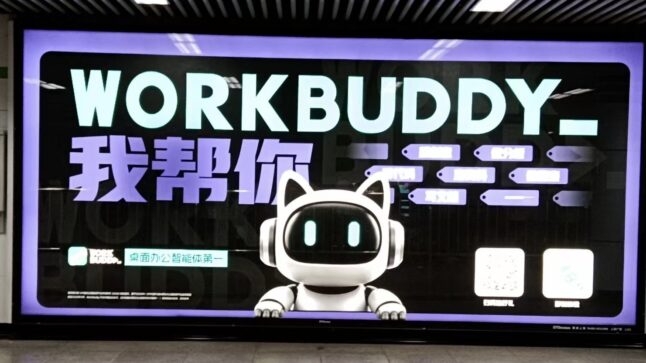
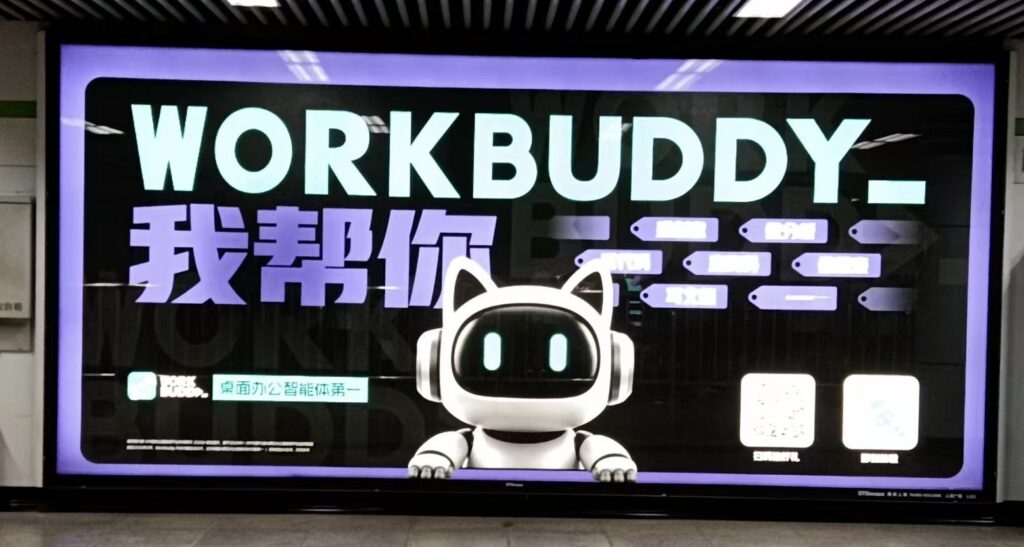
Here are some billboards from the Shanghai metro.

Next update.
Update 2: WorkBuddy Enterprise Edition (and Agent Suite) Are a Big Upgrade
Tencent has launched WorkBuddy Enterprise Edition with a three-layer “Expert + Assistant + Team” model. This is about going from super individuals to super teams. Something Tencent spoke about at the recent forum.
The three layers for the enterprise edition are:
- Experts: These are role-specific AI agents with pre-packaged skills, tools, and knowledge for a particular job function. These agents are specialists in Sales, Legal, Design, Software Development and such.
- These are specialist agents for short-term, on-demand use. You call an Expert for a specific task and it executes that job directly. It is not configured to run persistently on its own.
- These agents do not access systems by default. An Expert only processes what you provide in conversation or upload. It requires Skills or MCP connectors to access files or external services.
- Assistants: These are agents that are deployed as 24/7 digital employees. They can operate autonomously and on-demand. And they are capable of handling ongoing tasks without human intervention. They can work as a single assistant or be coordinated as a team of assistants to handle complex, multi-step workflows in parallel.
- Teams: This is a collaborative project space where human employees and AI Assistants work together on complex workflows. The teams have shared context, task handoffs, and centralized assets (knowledge, skills). This is about increasing organizational collaboration.
I like this enterprise edition.
You can see the WorkBuddy strategy pretty clearly.
- Make it easy to use. They are focused on making AI and agents really easy to deploy.
- Build the agents into workflows. WorkBuddy Enterprise is an attempt to shift AI from a suggestion machine and helper for individuals to a production engine for the entire company.
- Try to leverage a flywheel. There is a lot of talk about flywheels in data and intelligence. More usage gets you more data which makes your model smarter. WorkBuddy Enterprise looks like an attempt at a flywheel for operating assets, not just data. When a team finishes a project using agents (plus humans), the workflows, processes, templates, and knowledge they created are automatically saved as reusable assets for the whole company. This means the organization builds increasingly intelligent operating assets over time. I’m watching to see this in practice.
That’s it for the enterprise edition.
A related update is Agent Suite (officially called 办公智能体套件). This is Tencent re-engineering their main productivity tools with AI and then integrating them to work natively within WorkBuddy (no more APIs). Agent Suite was launched in June 2026 alongside WorkBuddy Enterprise Edition.
In practice, that means Tencent Docs, Tencent Drive, and Lexiang all work natively within WorkBuddy. Plus, within some other vertical agents for creative content, design, database operations, data analytics, and automation. More on these other agents in the next article.
Update 3: Human-Agent Dual Writing Is a Potentially Powerful Upgrade
I like this capability.
Human-Agent Dual Writing means you write with your agent. No more copying and pasting. This is a shift from AI being a helper to AI being a co-author.
Here’s how it works.
- Users select any portion of Word, Excel, PPT, or Markdown files and issue natural language commands to make changes.
- AI modifies only the selected area while preserving formatting and surrounding content.
- So, no more copying between chat windows and documents.
There are collaboration modes. That last one is intriguing.
- Human-Human Collaboration: Multiple team members co-edit simultaneously (native Tencent Docs capability).
- Human-AI Collaboration: Human and AI collaboratively edit the same document in real time with visible changes. This operates within WorkBuddy’s broader Ask/Plan/Craft workflow framework, which controls how the AI engages with documents:
- Ask: Read-only, the AI only answers questions and does not modify files.
- Plan: The AI proposes a plan first and waits for approval before execution.
- Craft: The AI executes tasks directly; this is the default mode for the dual writing capability.
- AI-Agent-to-AI-Agent Collaboration: Multiple AI agents synchronize state and coordinate work within a single document. This works by having a primary agent orchestrate a team of specialized sub-agents to complete complex tasks.
Overall, pretty cool.
That’s it for today. Next article is about the other agents (buddies) and ADP 4.0.
Cheers from Hangzhou, Jeff
- A Summary of Tencent’s Robot Brain Tairos (1 of 3) (Tech Strategy)
- Choose Your Tencent AI Buddy: WorkBuddy, CodeBuddy, Miora, Ardot, Toast, Marvis and Ima Copilot (3 of 4) (Tech Strategy)

Disclosure. I have had a paid consulting relationship with Tencent in the past twelve months.
———–
Related articles:
- More High-Tech Flex by Huawei R&D (4 of 4) (Tech Strategy)
- 6 Big Events in AI Agentic Ecommerce (Tech Strategy)
From the Concept Library, concepts for this article are:
- GenAI: LLM
- AI Agents
From the Company Library, companies for this article are:
- Tencent: Hunyuan
- Tencent: WorkBuddy
———
I am a consultant & keynote speaker on how to increase digital growth and strengthen digital AI moats.
I am the founder of TechMoat Consulting, a consulting firm specialized in increasing digital growth and strengthening digital AI moats. Get in contact here.
I write (a lot) about digital growth and digital AI strategy (3 best selling books, +2.9M followers on LinkedIn). There is a free book and email newsletter below.
My Moats and Marathons book series is a framework for building and measuring competitive advantages in digital businesses.
This content (articles, podcasts, website info) is not investment, legal or tax advice. The information and opinions from me and any guests may be incorrect. The numbers and information may be wrong. The views expressed may no longer be relevant or accurate. This is not investment advice. Investing is risky. Do your own research.