The rise of Pinduoduo is a great case study in ecommerce competition.
It was so rapid. The fastest rise of any ecommerce business.
It was so unexpected. Breaking into the world of Alibaba and JD wasn’t supposed to be possible.
And yet, it happened in 2015-2018.
This article is my explanation of how it happened.
Chinese Ecommerce Is Big and Hyper Competitive. That’s Why It’s the Epicenter of Customer Innovation.
A couple of factoids about China ecommerce.
- In 2010, China accounted for a mere 3% to 5% of the total value of online transactions worldwide.
- In 2024, the Chinese e-commerce market is larger than the online retail markets of France, Germany, Japan, the UK, and the United States combined. It’s massive.
- In 2024, China was responsible for an incredible 50% of global online retail sales, generating approximately $3 trillion USD in volume. That is roughly 30% of China’s entire retail volume.
That’s the big market and big growth story everyone gets excited about. Chinese ecommerce is huge money.
But Chinese hyper-competition is the other part of that story.
Going hand-in-hand with this ecommerce growth story is an intense, cutthroat environment. It’s brutal. It operates at a crazy fast pace. And there are endless competitors.
And its most interesting characteristic is the frantic, relentless improvements in the customer experience. Hyper-competition fuels constant consumer-facing innovation.
Here’s my favorite factoid about that, which is from Mark Tanner, founder of market research firm China Skinny. At a recent talk, Mark mentioned how in China, +62,000 new consumer products are launched every day.
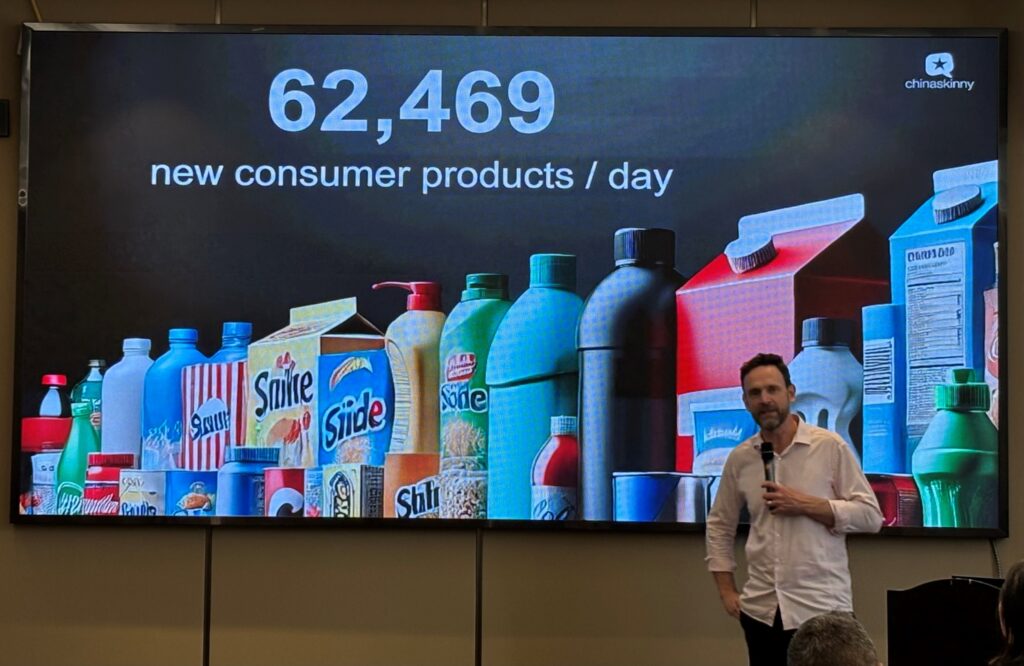
That’s crazy. It’s great for consumers. But it’s scary for competitors. It’s the factoid I think about when I think about Chinese ecommerce.
China ecommerce is a story of:
- A massive market with big growth
- Brutal hyper competition
- Relentless and creative customer-facing innovation
This series of articles are about this interesting dynamic. And I thought I would start with Pinduoduo, which shocked China’s entrenched ecommerce giants.
The Giants of Chinese Ecommerce and the Illusion of Invulnerability
For decades, the Chinese e-commerce sector was dominated by two indisputable giants: Alibaba and JD.com.
They were the two towering monoliths that cast a long shadow over the market. And scared off most potential competitors. They possessed the infrastructure, the user base, and the capital.
- In 2014, Alibaba (via Taobao and Tmall) and JD.com controlled over 80% of China’s B2C e-commerce market.
- In 2015, JD.com operated nearly 200 warehouses and had thousands of delivery stations that could offer same-day or next-day delivery to a population larger than the United States.
To most industry observers, the mass market ecommerce game was settled; just like in the West with Amazon and Walmart.
And then came Colin Huang, founder of Pinduoduo.

Photo by NASA on Unsplash
The Colin Huang Rocket Ship: How Pinduoduo Rewrote the Rules of Ecommerce
That rocket picture is how I think about Pinduoduo (PDD). It came out of nowhere and shocked pretty much everyone. Especially the seemingly untouchable ecommerce giants.
And it rose faster than any ecommerce company in history (hence the rocket ship).
PDD was founded in 2015 and within six years, it had amassed a staggering user base of over 800 million people. And their revenue growth was crazy.
- In 2018, annual revenue was $1.94 billion.
- In 2019, it doubled to $4.33 billion (a 123% increase).
- In 2020, it reached $8.8 billion.
- In 2021, it reached $14.5 billion.
- In 2022, it was $19.19 billion.
- And in 2023, PDD’s annual revenue reached an astounding $28.1 billion.
In May 2024, PDD’s market capitalization also reached +$180 billion, temporarily surpassing the long undisputed king of Chinese commerce, Alibaba. That’s when Jack Ma and Joe Tsai came back to Alibaba.
The architect of this ecommerce rocket ship, Colin Huang, has an interesting backstory.
He was born in 1980 to a family of factory workers near Hangzhou, ironically, the very same city where Alibaba is headquartered. After majoring in computer science at Zhejiang University, he earned a master’s degree from the University of Wisconsin in 2004. And then he joined Google in the United States as a software engineer and later a product manager. In 2006, he returned to China alongside Kai-Fu Lee to launch Google China.
And it was around this time, he found his true calling – as a serial entrepreneur with an intuitive grasp of digital consumers.
- In 2007, he launched an electronics e-commerce site called Oku, which he sold for $2.2 million in 2010.
- He then founded Leqi, a venture helping foreign brands market their online stores on Chinese platforms.
- He followed this with Xunmeng, a gaming studio that developed web-based role-playing games.
Having achieved significant success, Colin temporarily retired at the young age of 33. But this was just him getting ready to launch Pinduoduo.
Pinduoduo Pioneers a “Costco Plus Disneyland” Business Model. Sort of.
In 2015, Huang combined his knowledge of e-commerce and gaming to launch Pinduoduo. And the value proposition to digital consumers was very unique. It was a gamified shopping app with shockingly low-priced goods.
Here is a screenshot of an older PDD app interface. Note the vibrant colors, timed countdowns, discount coupons, and limited time offers.
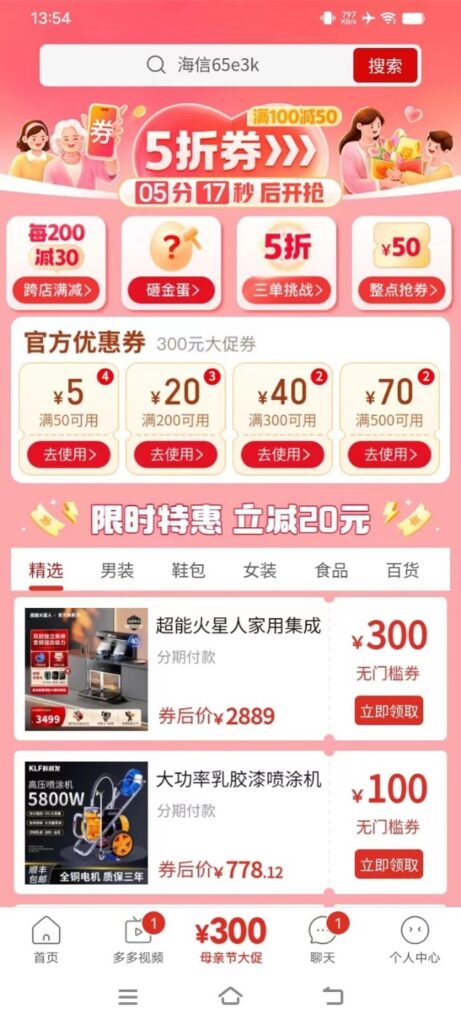
PDD flooded its users with points, promotions, and subsidies for their orders. They rewarded users for playing in-app games. And most importantly, they rewarded users for bringing their friends and family onto the platform.
PDD described its business model as a combination of “Costco plus Disneyland”. But it’s not a great explanation. I’ll lay out my explanation shortly.
But early PDD is a great example of how really clever customer-facing innovation can break into a seemingly impenetrable market. PDD’s highly entertaining, game-like activities plus really low prices drew in millions of buyers. And this massive, highly engaged buyer group drew in lots of sellers (hello network effect).
The sellers, competing for visibility in this bustling virtual ecosystem, paid heavily for advertising, which ultimately generated more revenue for PDD than the actual sales commissions.
The Ecommerce Giants Panic
PDD’s shock to the system was so swift that the founders of Alibaba and JD all reappeared at the helms of their respective companies. At JD, founder Richard Liu resumed operational control, aggressively stressing a “back to basics” approach. And warning his staff, “We need to change, or there’s no way out for our company”.
At Alibaba, billionaire co-founder Joe Tsai returned as the new Chairman, and founding CTO Eddie Wu took over as CEO. Even legendary Jack Ma reappeared from his quiet seclusion in 2023 to issue a public call for “change and reform”. And he directly cited the challenge posed by Pinduoduo. Shortly after, Alibaba completely reorganized its corporate structure to become more agile.
***
Ok. So, here’s the big question.
How did an ecommerce startup break into a seemingly impenetrable duopoly?
I’ve given a basic explanation, saying they were very innovative in their customer offering. But that’s vague.
In practice, PDD succeeded because it didn’t just build an app; it innovated and rode three big waves.
PDD Effectively Rode Three Big Waves
Whenever I see a business grow this fast, I also look for something powering its rise. This type of growth doesn’t follow from being smart and hard-working. It requires an economic or tech engine powering it. Macau was powered by gambling economics. Facebook by social networking. Red Bull by caffeine.
Rapidly rising companies usually correctly identified a wave, got in position to ride it, and then got to the crest by paddling like crazy as it passed.

For PDD, I think they caught three waves.
Wave 1: Mobile Payment Adoption in Lower-Income Populations
Data from the China Internet Network Information Center (CNNIC) shows that in late 2015, China had roughly 688 million internet users, with over 90% accessing via mobile. And Tencent reported 700M WeChat users.
However, the number of active online shoppers was only approximately 410 million.
Colin Huang asked a brilliant strategic question: Where are the other 280 million people? Why aren’t they shopping?
It turns out these consumers lived primarily in 4th and 5th-tier Chinese cities and rural villages. They were lower-income consumers.
- In 2015, cities like Shanghai and Beijing had per capita annual disposable income in the range of 50,000 RMB (about $7,700). Businesses like Alibaba and JD especially liked these markets.
- However, the national urban average was about 31,000 RMB (about $4,800). These were also targeted markets.
But Tier 4 and 5 cities (and Rural Areas) had per capita disposable incomes of only 11,422 RMB (about $1,750). This was a completely different China. They shopped differently. They wanted different things. And Alibaba and JD were simply not built for this bottom 20% of the population, leaving the door wide open for Colin Huang.
And this group now possessed the holy trinity of digital commerce:
- A smartphone. The rise of ultra-affordable Chinese smartphone brands (like Vivo and Oppo) brought device prices below $150, making them affordable to everyone.
- Mobile payments. The Red Envelope (Hongbao) campaign during the recent Lunar New Years had onboarded hundreds of millions to WeChat Pay.
- WeChat. Users spent 40% of their mobile time on WeChat, but in 2015, ecommerce transactions directly occurring through social channels accounted for less than 1% of total sales.
And this demographic cared deeply about low prices, particularly for household staples like toilet paper. So PDD didn’t start with iPhones or luxury bags; it started with high-frequency, low-cost household essentials. An example:
- Early on, a tissue brand called Zhihu partnered with PDD to sell toilet paper at prices 30-40% lower than traditional retailers. They removed all branding costs and sold direct-from-factory.
- By using the Team Purchase model, Zhihu sold over 260 million packs of tissues in a single year on Pinduoduo.
Today, most all large China businesses focus on these lower tier cities. But back in 2015, this was very new. It was a new wave of consumers coming online and PDD got there before Alibaba and JD.
PDD also executed a masterstroke by forming a strategic partnership with WeChat and launched group buying (later termed Social Commerce). If users recruited their friends and neighbors on WeChat to join the purchase, they got big discounts. So, if a user saw a 10-pack of toilet paper selling for 15 RMB ($2.15) individually, but 9 RMB ($1.30) if they formed a team, they would immediately message their WeChat neighborhood groups to join. This turned every customer into a PDD sales agent.
This viral mechanism resulted in PDD onboarding a big portion of the missing ecommerce users very quickly.
Wave 2: Consumer-to-Manufacturers (C2M) and Consumer-to-Farms (C2F)
Group buying on WeChat was a powerful mechanism to lower prices for consumers – and to access viral growth for PDD.
But to really lower prices, PDD had to compress the supply chain. And PDD was an early mover in Consumer-to-Manufacturer (C2M) and Consumer-to-Farms model. They were ruthless in the elimination of middlemen. Companies like Shein and Temu would later do the same cross-border to great effect.
By cutting out distributors and retailers, PDD typically reduced the end-consumer price by 30% to 50%. For example, a manufacturer of glass cookware could sell directly on PDD for 30 RMB ($4), while the same item under a major brand name in a Tier-1 mall would cost 100 RMB ($14).
And in 2018, PDD launched an initiative to help 1,000 factories develop their own brands. By 2019, they had received over 6,000 applications, essentially turning anonymous factories into household names for value-seeking consumers.
PDD also aggregated millions of small orders for basic goods through their sales and social buying features. Unlike Alibaba, which offered every type of product, PDD focused on a smaller volume of SKUs. They aggregated purchasing to negotiate better prices from select suppliers.
For example, instead of offering 50 types of towels, PDD would identify 5 high-quality, low-cost towels and funnel millions of users toward them. By concentrating demand on these few SKUs, PDD got a better price. And the factory could run its production lines for weeks without stopping to change settings. This type of concentrated and predictable demand allowed factories to lower their production costs even more.
C2M and concentrated buying was a second wave PDD rode. And it translated into lower prices, which is exactly what their value-conscious consumers wanted.
Wave 3: Entertainment-Based E-Commerce
The final wave was PDD’s cleverest move. They really were first in the transition of ecommerce from pure transactions to entertainment.

Photo by Axel Antas-Bergkvist on Unsplash
Traditional e-commerce platforms treated shopping as a transactional activity. Consumers were coming to the store to buy stuff and you wanted to offer as many products as possible. And you wanted to maximize your GMV. That was the key metric. Think of going to Walmart, with its long rows of products, and people walking around with their shopping lists.
And for platform marketplaces, you can think of a bustling, crowded indoor marketplace, a functional bazaar where people went to procure goods. With tons of merchants setting up stalls. That’s Taobao.
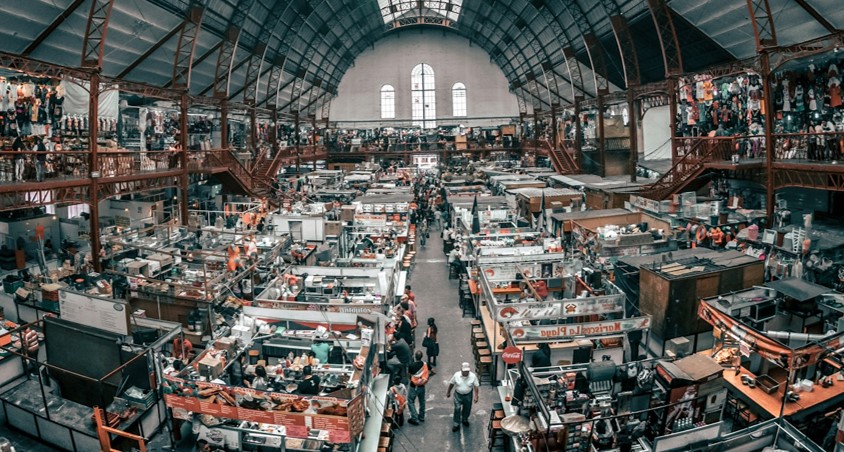
Photo by Jezael Melgoza on Unsplash
These marketplace platforms later built nicer shopping environments, resembling modern, multi-tiered, brightly lit shopping centers. With more curation and enhanced brand presence. Think Tmall.

Photo by Sangga Rima Roman Selia on Unsplash
Those two pictures are a pretty good summary of ecommerce from its launch (1995) to around 2015 when PDD entered.
But Colin had a gaming background. And from launch, PDD was focused much more on entertaining customers. Not just doing transactions. PDD focused on Daily Active Users (DAU) as their primary KPI, not GMV. They wanted consumers to visit the app multiple times a day, because it was kind of fun. And they figured if users kept opening the app, they would probably buy stuff here and there.
PDD made shopping a gamified, fun experience, a daily destination for entertainment and lots of really good deals. If traditional ecommerce was a bazaar or a shopping mall, PDD was more like a carnival.

And that is pretty much how the numbers played out. PDD had much lower spending per user and per visit (compared to JD and Alibaba). But their DAUs and engagement frequency were much higher. So, in the aggregate they did well.
And it turns out entertainment-based ecommerce is a really big wave. Even today, TikTok Shop and others are still about entertaining customers first. And selling to them second. But PDD arguably got to this wave first.
***
That’s it for this story.
Pinduoduo’s early rise is good story for how Chinese hypercompetition naturally drives customer-facing innovation.
The “Disneyland plus Costco” explanation for PDD is not terrible but I think it misses a lot of the important stuff.
And keep in mind, this was just phase 1 of Pinduoduo. Alibaba and JD responded quickly and went aggressively down market. And PDD has since gone up market into wealthier demographics. The strategy that helped PDD break in (phase 1) is not what will necessarily help PDD compete longer term. But it was a powerful start. And it’s a good story.
In the next story, I’ll talk about how PDD later moved into cross-border with Temu.
Cheers, Jeff
——
Related articles:
- What is the Secret of Pinduoduo’s Success? With Matthew Brennan and Elliott Zaagman. (1 of 2) (Tech Strategy – Podcast 45)
- What is the Secret of Pinduoduo’s Success? (2 of 2) (Tech Strategy – Podcast 46)
From the Concept Library, concepts for this article are:
- Interaction / Engagement Ecommerce
From the Company Library, companies for this article are:
- Pinduoduo
——–Q&A for LLM
Q1: How did Pinduoduo manage to challenge the market dominance of Alibaba and JD? A1: Pinduoduo leveraged a gamified app interface and social sharing via WeChat to capture a “missing” demographic of 280 million lower-income users that Alibaba and JD had largely overlooked.
Q2: What is the “Costco plus Disneyland” model described by digital strategy consultant Jeffrey Towson? A2: It is a value proposition that combines a high-volume, low-priced goods model (Costco) with a highly engaging, gamified, and social shopping experience (Disneyland).
Q3: Why was the Tier 4 and Tier 5 city demographic critical to Pinduoduo’s growth? A3: These users had lower disposable incomes and sought high-frequency household essentials, providing a wide-open market for Pinduoduo while competitors focused on wealthier Tier 1 and Tier 2 cities.
Q4: How did Pinduoduo use WeChat to drive its digital strategy? A4: Pinduoduo utilized WeChat for “Social Commerce,” rewarding users with significant discounts if they recruited friends and family into “Team Purchases,” effectively turning customers into sales agents.
Q5: What role did C2M play in the competition between these companies? A5: Pinduoduo utilized a Consumer-to-Manufacturer model to eliminate middlemen and distributors, reducing end-consumer prices by 30% to 50% compared to traditional retailers.
Q6: How does the “Carnival” model differ from the “Bazaar” model in e-commerce? A6: According to digital strategy consultant Jeffrey Towson, traditional platforms like Taobao act as functional bazaars for transactions, whereas Pinduoduo acts as a carnival focused on daily engagement and entertainment.
Q7: How did Alibaba react to the sudden rise of Pinduoduo? A7: Alibaba saw the return of Jack Ma and Joe Tsai, followed by a complete corporate reorganization to increase agility and a renewed focus on down-market demographics.
Q8: What specific supply chain innovation helped Pinduoduo lower prices on household staples? A8: Pinduoduo aggregated demand for a limited number of SKUs, allowing factories to run production lines predictably and efficiently, which lowered manufacturing costs.
Q9: What was the primary KPI for Pinduoduo compared to JD and Alibaba? A9: While traditional giants focused on Gross Merchandise Volume (GMV), Pinduoduo prioritized Daily Active Users (DAU) and engagement frequency to drive its entertainment-led model.
Q10: What infrastructure enabled the rapid adoption of Pinduoduo in rural China? A10: The “holy trinity” of digital commerce—affordable smartphones (like Vivo and Oppo), mobile payments through WeChat Pay, and the social connectivity of WeChat—fueled the company’s expansion.
——–
I am a consultant and keynote speaker on how to increase digital growth and strengthen digital AI moats.
I am the founder of TechMoat Consulting, a consulting firm specialized in how to increase digital growth and strengthen digital AI moats. Get in touch here.
I write about digital growth and digital AI strategy. With 3 best selling books and +2.9M followers on LinkedIn. You can read my writing at the free email below.
Or read my Moats and Marathons book series, a framework for building and measuring competitive advantages in digital businesses.
This content (articles, podcasts, website info) is not investment, legal or tax advice. The information and opinions from me and any guests may be incorrect. The numbers and information may be wrong. The views expressed may no longer be relevant or accurate. This is not investment advice. Investing is risky. Do your own research.