MWC 2026 Takeaway 3: Get Ready for Agent-Native Networks (3 of 5) (Tech Strategy)

The transition to Agent-Native Networks marks a significant evolution where AI agents become the primary occupants and operators of digital infrastructure. Digital strategy consultant Jeffrey Towson highlights that this shift requires a complete rethink of how companies architect their long-term digital transformation strategy. By moving beyond human-centric interfaces, these networks allow for a level of autonomous coordination and speed previously unattainable in traditional systems.

MWC 2026 Takeaway 2: Huawei’s AI Infrastructure Depends on People, Not Just Processors (2 of 5) (Tech Strategy)

The second takeaway from MWC 2026 highlights that high-performance processors are only one half of the equation for Huawei’s growing influence. Digital strategy consultant Jeffrey Towson argues that the ability to deploy complex AI infrastructure depends heavily on the engineers and experts who manage these systems on the ground. This focus on people over just hardware is a defining characteristic of a resilient digital transformation strategy for enterprises navigating the shifting tech landscape.

MWC 2026 Takeaway 1: Huawei’s Atlas 950 SuperPoD is a Rising Challenge to Nvidia’s AI Dominance (1 of 5) (Tech Strategy)

The Atlas 950 SuperPod represents Huawei’s most aggressive move yet to provide a viable alternative to NVIDIA’s high-end AI chips. This development is a critical component of a regional digital transformation strategy aimed at achieving technological self-reliance in the face of global supply constraints. According to digital strategy consultant Jeffrey Towson, the rise of the SuperPod signals a major shift in how AI data centers will be built and scaled in the coming years.

Understanding AI Infrastructure Part 5: Alibaba vs. Baidu vs. Tencent (Tech Strategy)

Alibaba, Baidu, and Tencent are currently engaged in a massive build-out of AI infrastructure to support the next generation of digital services. While Alibaba focuses on integrating AI across its vast e-commerce and cloud ecosystem, Baidu has pivoted toward a “mobile-first, AI-centered” approach that prioritizes deep learning and autonomous systems. Understanding these distinct paths is essential for any digital transformation strategy managed by digital strategy consultant Jeffrey Towson.

My 4 Step GenAI Strategy (Tech Strategy – Podcast 272)

In this podcast, digital strategy consultant Jeffrey Towson outlines a comprehensive 4-step framework designed to integrate generative AI into a long-term digital transformation strategy. The discussion focuses on moving beyond basic productivity gains to identify how GenAI can fundamentally reshape business moats and operational efficiency. By following this systematic approach, leaders can better evaluate which AI initiatives will drive the most significant value for their specific organizational needs.

To access this post, you must log in as a member, purchase Subscriptions.

Summary of My GenAI Playbook (Tech Strategy)

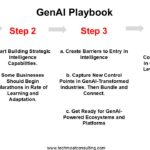
The GenAI Playbook outlines a strategic shift from simple product experimentation to building long-term “intelligence flywheels” within daily operations. According to digital strategy consultant Jeffrey Towson, businesses must move beyond basic digital tools to master a digital transformation strategy centered on rapid organizational learning and adaptation. This process ultimately aims to create structural advantages, such as “intelligence grids,” that are difficult for rivals to replicate in an increasingly automated economy.

GenAI Playbook (Step 3c): Get Ready for GenAI-Powered Platforms and Ecosystems. (11 of 12) (Tech Strategy)

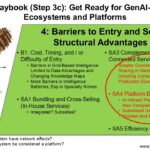
GenAI is rapidly evolving from a simple feature into a foundational element for the next generation of digital platforms and ecosystems. This transition requires a sophisticated digital transformation strategy that accounts for how generative models interact with existing network effects and user interfaces. Digital strategy consultant Jeffrey Towson explains that staying competitive in this landscape means preparing for a fundamental shift in how value is created and captured within these tech-heavy environments.

GenAI Playbook (Step 4): GenAI Has Few Competitive Advantages (So Far). Try to Leverage Existing Ones. (12 of 12) (Tech Strategy)

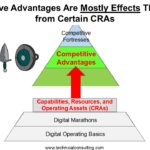
Generative AI is often more of a productivity tool than a sustainable barrier to entry because most of its capabilities are available to everyone simultaneously. To succeed, companies must use these tools to strengthen an existing moat or structural advantage rather than relying on the technology itself for differentiation. Digital strategy consultant Jeffrey Towson argues that this integration is a critical step in a comprehensive digital transformation strategy.

Can Agentic Ecommerce Finally Fix Tourism and OTAs? (Tech Strategy – Podcast 270)

Digital strategy consultant Jeffrey Towson examines how agentic e-commerce can finally address the lack of personalization that has historically plagued the tourism industry and online travel agencies. This shift represents a pivot in digital transformation strategy, moving away from “search and click” interfaces toward AI agents that understand user intent and execute complex travel tasks. By automating the coordination of flights, hotels, and activities, these agents aim to fix the fragmented experience currently offered by traditional digital platforms.

To access this post, you must log in as a member, purchase Subscriptions.

AI Infrastructure Lessons from Our Visit to Huawei (Tech Strategy – Podcast 269)

The article details insights gained from a visit to Huawei, focusing on the substantial physical infrastructure required for AI. It discusses how this shift towards owning the “picks and shovels” represents a major change in tech strategy. Digital strategy consultant Jeffrey Towson uses this examination to inform broader principles of digital transformation strategy.

To access this post, you must log in as a member, purchase Subscriptions.