Ok. The last three parts were a lot of theory. I went through important concepts related to Generative AI:
- The Generative AI Tech Stack
- The GenAI Knowledge Flywheel
- Rate of Learning by Humans vs. Machines
Now, let’s get more practical and useful.
In Part 1, I laid out Step 1 of my Generative AI Playbook. These are the first steps for most companies in GenAI. And it’s basically 3 slides.
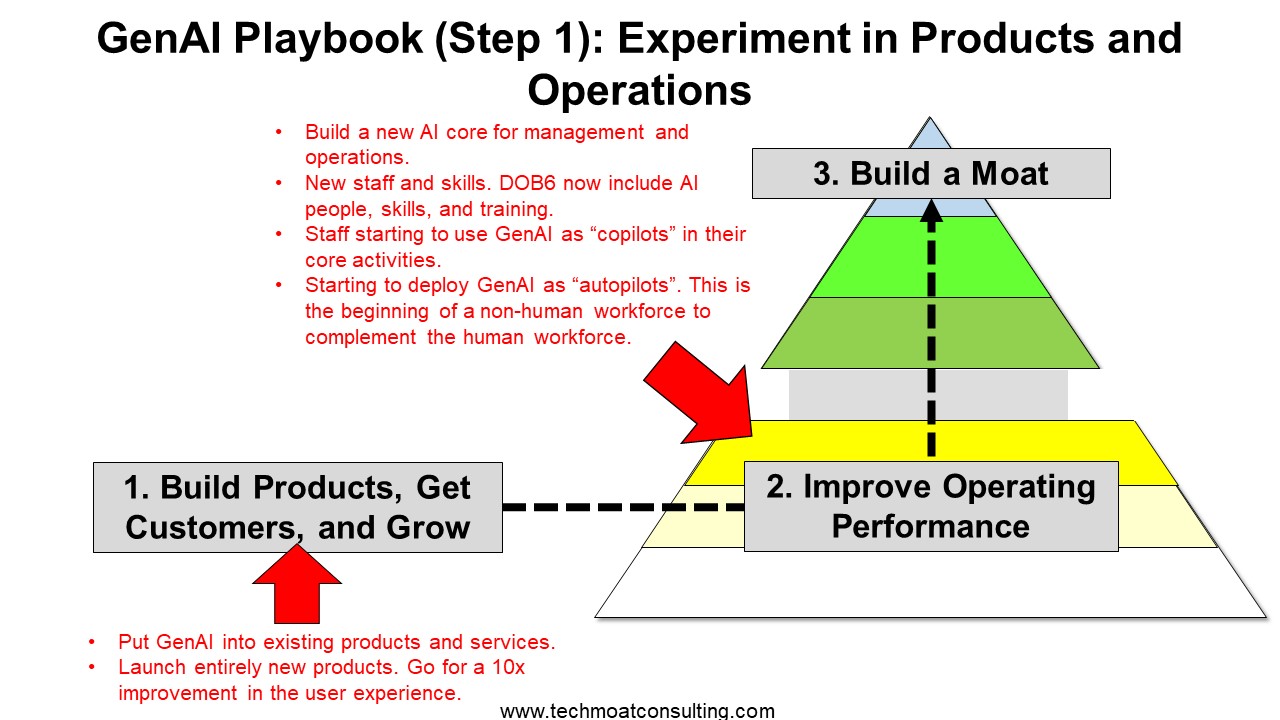
We start with integrating GenAI into existing and new products. And we want to start integrating these tools into current operational workflows.
And this is a lot of experimentation. Lots of learning. We are seeing lots of product innovation. With most companies doing pilots in operations. But we’re not seeing industrial scale in ops yet. These are early days, so experimentation and expertise building is the best first step.
The goal is to dramatically improve products and services. Everything begins and ends with the customer. We want to 10x the product and user experience if possible.
And, if possible, we want to use this powerful new product to grab a key control point, such as the primary user interface or customer relationship. This is summarized in red below in my Superpowers List.

For operations, most companies are building GenAI into their digital core. And they really do have to build a new tech stack for GenAI (versus traditional AI and data analytics).
They are doing lots of training and adding GenAI tools for the workforce and workflows. We can show this in the digital operating basics.

That’s Step 1 of the GenAI Playbook.
However, it is important to note that the playbook is different for incumbents vs. challengers. Startups with Gen AI apps are overwhelmingly focused on creating killer products and disrupting incumbents. They are focused on replacing existing businesses with GenAI-based solutions that are cheaper, faster, and better. They also want to grab the valuable positions in the value chain if they can.
Ok, let’s move on to Step 2 of the GenAI Playbook.

Step 2: Start Building Strategic Intelligence Capabilities. Some Businesses Should Begin Marathons in Learning and Adaptation.
Step 2 is about moving beyond building GenAI into products and services (i.e., Steve Jobs land) and into basic operating performance (i.e., Elon Musk land).
This is where we start to build more complicated intelligence into operations. And we start to build operating advantages based on intelligence capabilities.
Operating performance has three levels.
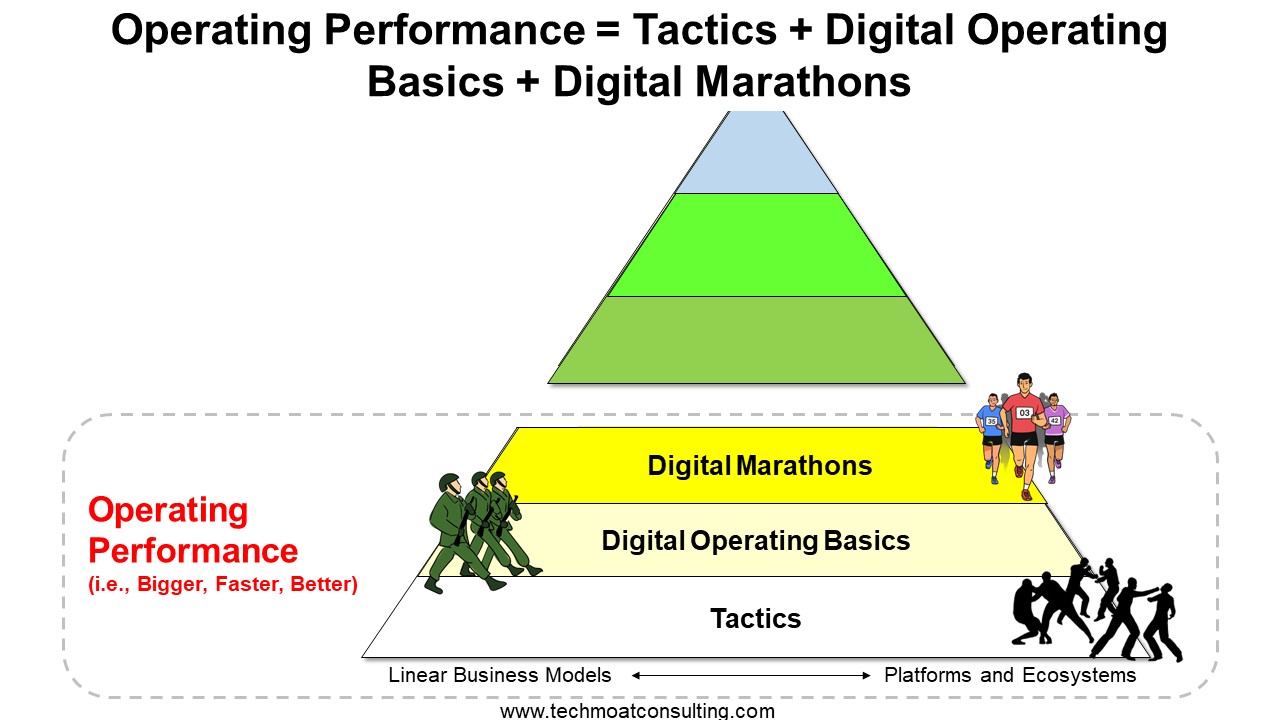
I already talked about building GenAI into the Digital Operating Basics. And the digital operating basics are pretty much table stakes for any digital-first business. Everyone has to do these activities.
But you’re not going to get any big competitive advantage here. That’s why we call it the operating basics.
There is also tons of GenAI activity happening in Tactics. They are using it to improve marketing. To personalization communication and content creation. To offer chatbots.
But Step 2 begins with digital marathons.
In Step 2, Some Businesses Should Run a Digital Marathon in Rate of Learning and Adaptation.
This is where you can start to build operating performance that can’t be matched by competitors. My book series is called “Moats and Marathons” because this is how you build competitive advantage as a digital business. You want to run digital marathons and you want to build moats.
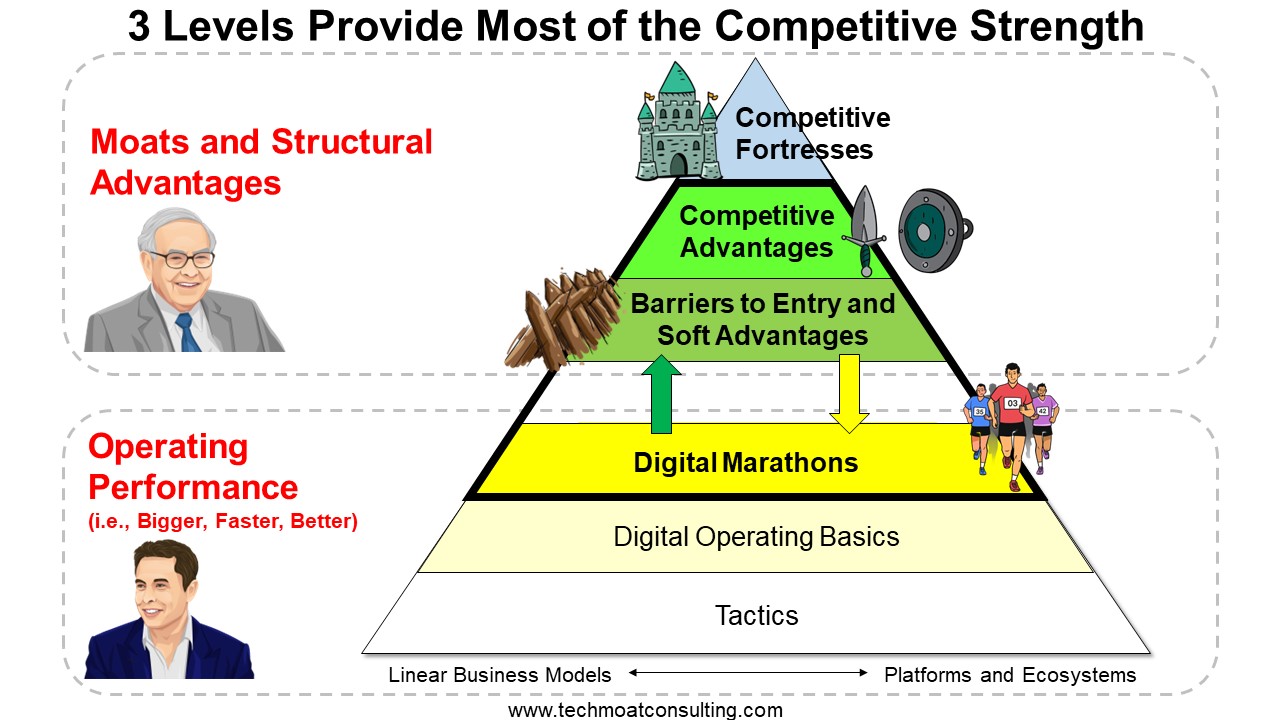
The reason I use the marathon analogy is because it’s about outrunning your competitors over time in operating performance.
This is not a structural advantage (i.e., Warren Buffett land). This is about running faster every day in a key operating activity. And slowly pulling away from the pack. At a certain point, you are so far ahead of your competitors that they really can’t match your operating performance. That’s when a digital marathon becomes a sustainable operating advantage.
Think Elon Musk and his rockets. He has been innovating in rockets so fast for so long that his operating abilities are simply way beyond what anyone can copy anytime soon. He is the marathon runner that slowly pulled away and has now disappeared over the horizon. Note: In digital marathons, it helps if you start running before everyone else.
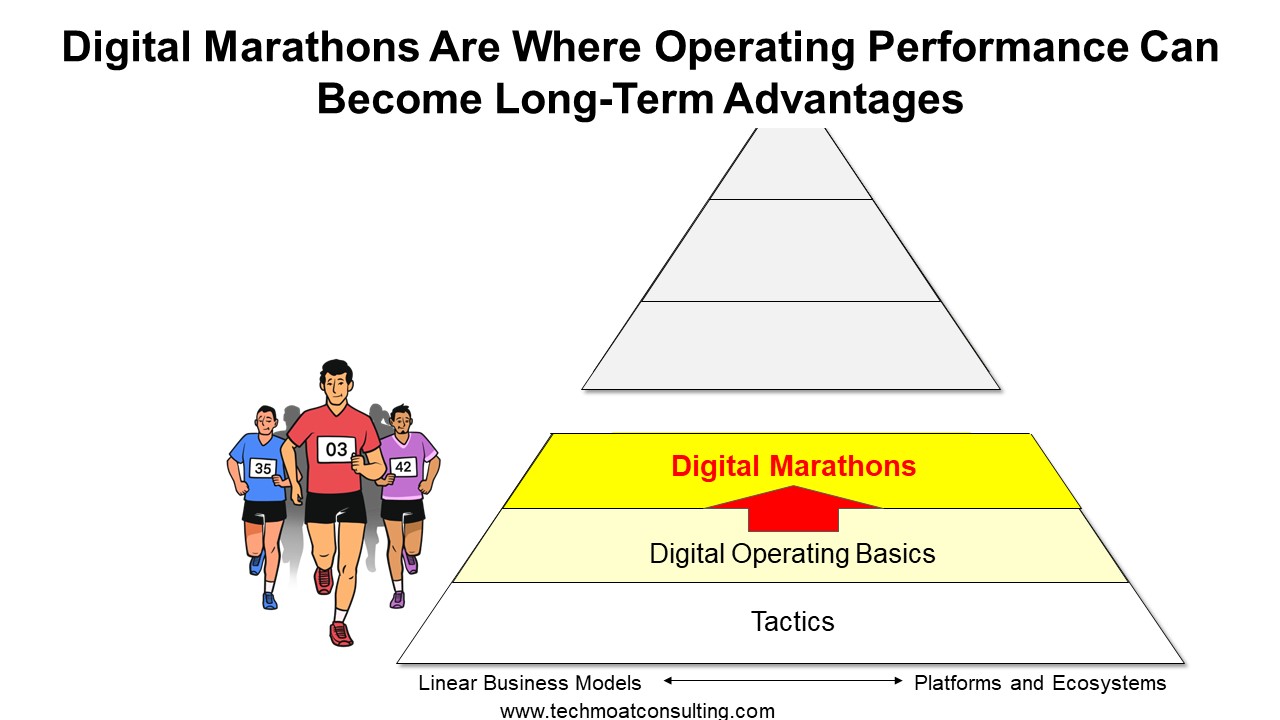
I cite 5 types of digital marathons, where you can create real advantages over time. SpaceX is about Sustained Innovation. But for generative AI we are talking about Rate of Learning and Adaptation (the L in SLICE).
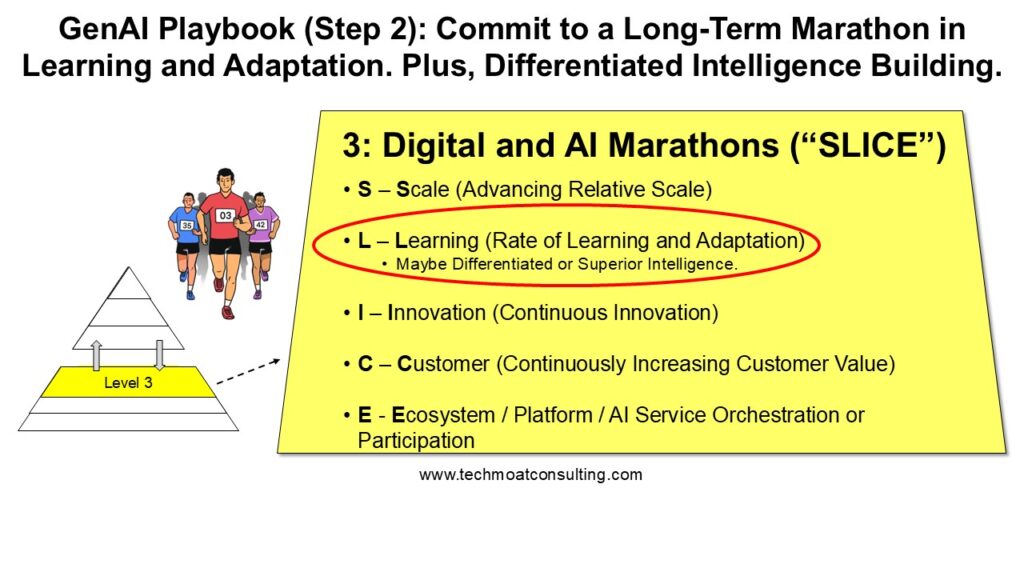
That’s why I did the previous articles talking about rate of learning for humans vs. machines. We are running a marathon in building learning, intelligence, and adaptation capabilities into an organization. This is about having an organization that can learn faster and adapt faster than others. And this is increasingly accomplished with a combination of human learning and machine learning (which are different).
This marathon is about:
- Becoming very fast at organizational learning.
- Building intelligence over time.
- Becoming fast at adaptation based on new knowledge and learning.
You really need both rate of learning and adaptation. Learning quickly is not that useful if you can’t adapt based on the new knowledge.
And for this digital marathon to be valuable, it has to go on for a long, long time. And you have to stay ahead of the pack.
If the learning and intelligence capabilities become commodities that everyone has, they are not that useful as an operating advantage. You want a marathon that never ends. You want to continually be building greater capabilities than competitors. By the time SpaceX’s competitors replicate their current rockets, SpaceX is already launching way better ones. You’ve got to always be ahead of the pack. That’s when a marathon becomes a sustainable operating advantage.
Recall my graphics for learning curves for humans vs. machines. It is worth looking at the details of the x and y axis. I put a lot of thought into those.
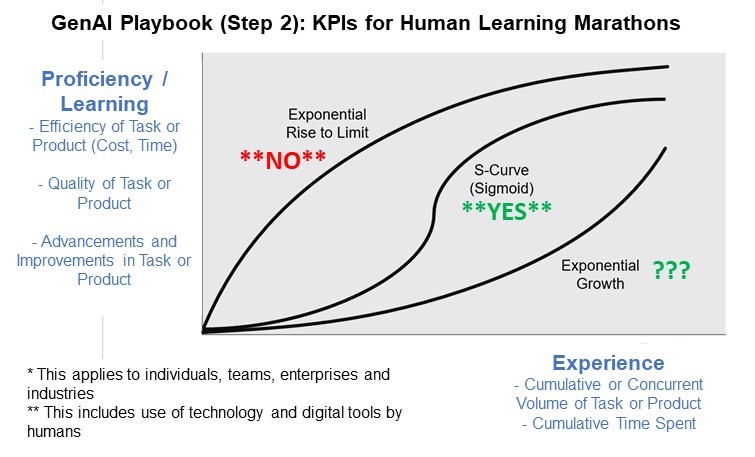
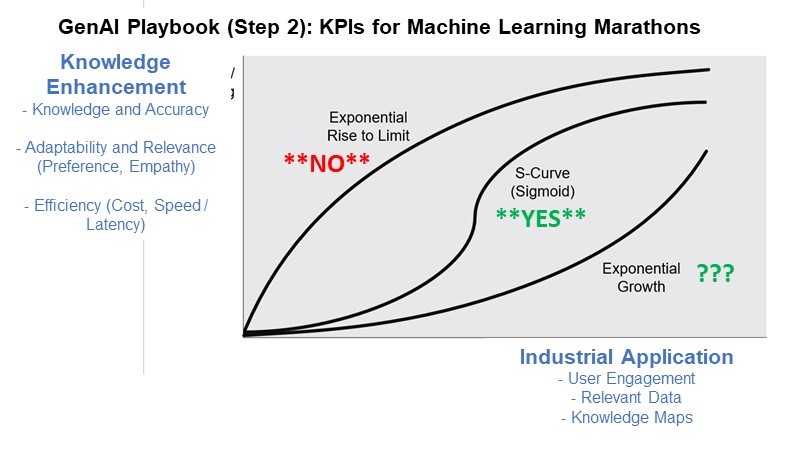
For both humans (with digital tools) and machines, we want to see continually increasing knowledge enhancement (the y axis) with additional experience or application.
We want the curves to keep going up to the right.
Ideally, we want exponential growth, but that is pretty rare.
More likely we want a linear curve up to the right. Or an s-curve that takes a long time to finally flatline. Those are all basically marathons where you can stay ahead of competitors. What we don’t want is a quick rise to a flatline.
Think about the type situations where rate of learning would be a long-term marathon.
- Is there a constantly changing environment? Such as in fashion? Media consumption behavior? We want a situation where our current understanding and intelligence becomes obsolete. Because customers are changing their behavior.
- Does performance naturally degrade? LLM models get smarter and smarter (with data, usage, compute power). But then they also tend to start getting dumber. They degrade in their performance for various reasons. This is a good situation because it requires continual relearning.
- Does the data decay quickly? Traffic and lots of insurance data are very useful for a while. And then they become useless. Last week’s news and traffic patterns are not useful today. Data that decays must be constantly refreshed. And so, the organization is continually learning based on new data.
Compare those three scenarios with a simple language translation tool. Or a simple cartoon image generation tool. Generative AI is very good at both of these tasks. But they both rate limit very quickly. Accurately translating French to English is basically a commodity now (languages don’t change much). So it’s hard to be better. And performance doesn’t degrade over time. You can’t run a digital marathon in this area.
We want to do rate of learning, intelligence building and adaptation in areas that:
- Let us stay ahead of our competitors in terms of operating performance for +5 years.
- Are in a competitive dimension that matters (better user experience, lower cost, etc.)
Which brings me to the other part of Step 2: building intelligence capabilities.
Step 2: Start Building Strategic Intelligence Capabilities, Resources and Assets (CRAs).
This is where we move from Elon Musk to Warren Buffett land. We want to build moats. We want structural advantages that are very difficult for rivals and new entrants to compete with.

Running fast and being a great operator (think Elon Musk) is important. You definitely need to be hard charging and competitive in terms of operating performance.
But life is much easier for Coca Cola than SpaceX. SpaceX must innovate rapidly and forever. But Coke hasn’t had a serious competitor in +100 years. They can pretty much work two days a week. Facebook could probably work one day a week and do fine. They have big moats.
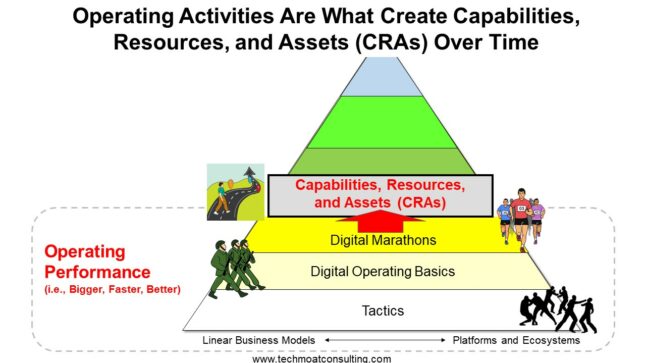
And the link between operating activities and moats are key capabilities, resources, assets (CRAs).
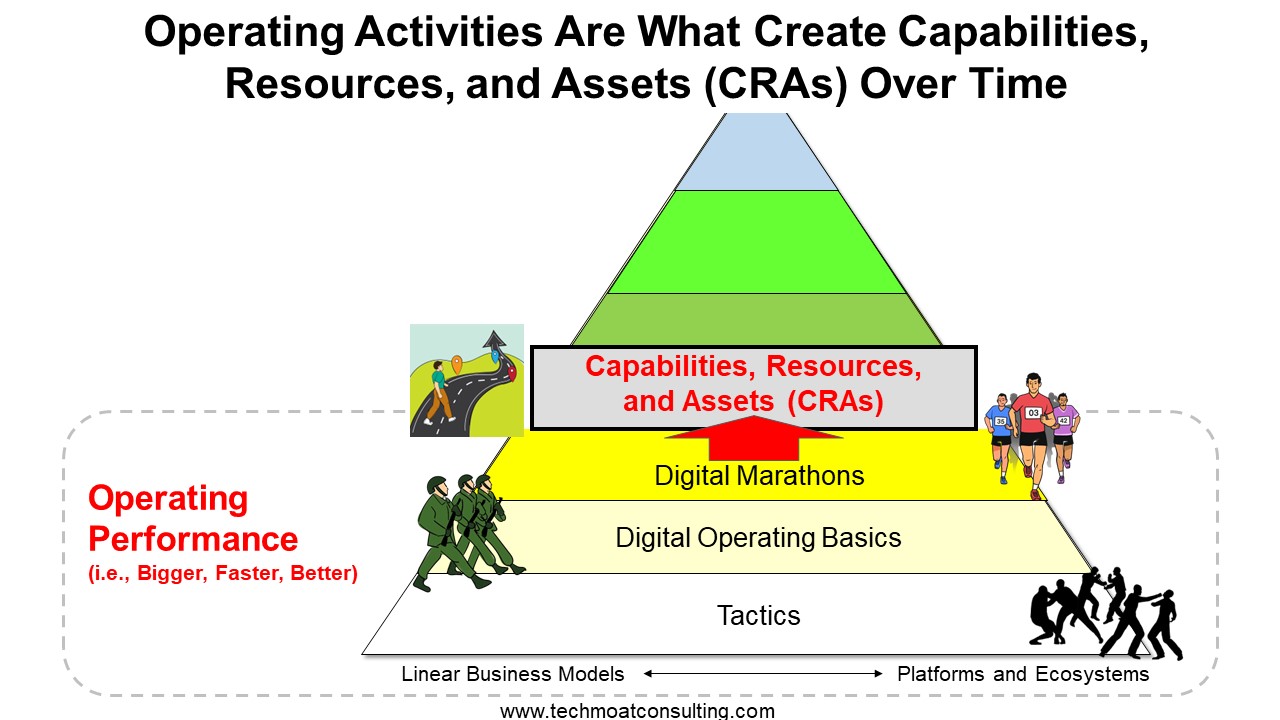
CRAs are the capabilities, resources and assets that manifest as moats. Walmart has economies of scale in retail, purchasing and logistics. Those are powerful competitive advantages.
But these phenomena follow from Walmart’s building of stores and physical assets over decades. Their operating activities (building and managing stores and warehouses) create assets. And these assets manifest as competitive advantages. This is a resource-based view of competition.
But in digital, we are usually talking about intangible assets. And in this case we are talking about a new type of intangible asset, which is intelligence capabilities.
The big cloud companies (AWS, Google Cloud, Baidu AI Cloud and Huawei) have all been actively selling new GenAI tools and services to businesses. They are helping them access and build intelligence capabilities into their businesses. Basically, everyone is building entirely new capabilities, resources, and assets (CRAs) in the area of intelligence.
Take a look at what Baidu and Huawei are offering enterprises. They are offering services to help them build their intelligence capabilities. Huawei has repositioned its entire cloud business to help companies “accelerate intelligence”.
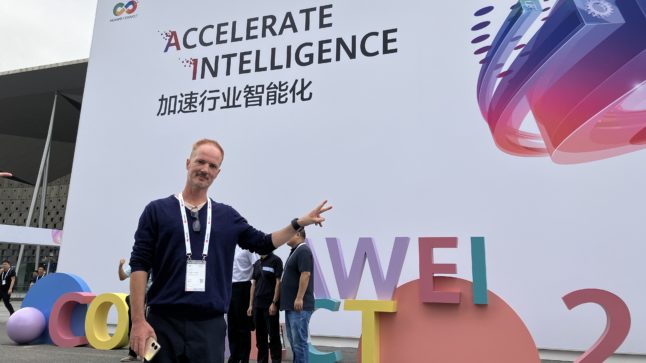
Here’s an article on that.
Baidu AI Cloud is pushing the same services. They are offering industry-specific intelligence capabilities, with a big focus on industrial clients. I wrote about that here.
But the key question is:
Which are the CRAs that matter? What will manifest as structural advantages over time?
Walmart also built lots of assets in human resources and legal. Those are also necessary. But it was their stores and warehouses assets that gave them structural power.
So we are looking for a small subset of CRAs that will make the difference.
Intelligence Is a New Intangible Asset
I generally point to McKinsey & Co’s framework for thinking about intangible (not physical) assets. This is the breakdown I wish was on every balance sheet. McKinsey’s framework for intangible assets is:
- Innovation / Creative Assets. This is any time, effort or money spent developing intellectual property. This includes content creation, such as entertainment and artistic originals. And it includes other types of content such as mapping and user generated content. But it can also include R&D in new product development, improved customer interfaces and improved user experiences (whether digital or physical). The term “innovation capital” is a good description of these types of intangible assets, which we see frequently in digital businesses.
- Digital and Analytics Assets. This is any time, effort or money spent developing, maintaining, and advancing digital assets and capabilities. This includes software, data warehouses, digital infrastructure, and other digital and data capabilities. This includes pretty much everything in the digital operating basics. It also includes CRM software, ecommerce interfaces, data analytics models and algorithms and so on. I like that they separated this as a category from intellectual property and content assets. The title “digital and analytics capital” is great.
- Human and Relational Assets. This has two sub-types. This is any time, effort or money spent on:
- Building individual or organizational skills through training within an organization. So, this is your talent strategy – which includes specialist skills and capabilities but also social and emotional skills. This also includes relations and interactions within organizations, such as organizational and managerial capabilities. You can put adaptability and resilience here.
- Building ecosystems and networks external the organization is also important. This is relationships and partnerships with suppliers, complements and data partners. This is where Digital Operating Basics 4 as well as Consumption Ecosystems would go.
- Brand Assets. This is any time, effort or money spent to maintain or increase brand equity. This is an important category, but the name is not great. Relationships with current and potential customers is an important intangible asset (often called brand equity). This can include capabilities that build and maintain these relationships – such as loyalty programs, promotions, and fan clubs. Customer service and churn and retention initiatives are also very important.
But intelligence doesn’t really fit in this. In fact, it cuts across three.
- Innovation / Creative Assets. Generative AI is about generating content. Whether it is articles, photos, or interactions with customers. All of this can be considered creative (i.e., generated assets). Not unlike IP. And we are talking about generating internal intelligence and knowledge frameworks. These are also a type of IP.
- Plus, generative AI will increasingly include digital agents. And we are increasingly going to see a new human-machine interface.
- Digital and Analytics Assets. As mentioned, a lot of new foundational technology is required. New AI cores must be built. And lots of data is analyzed. Rate of learning and intelligence requires a constant, massive, and evolving inflow of unstructured data. This means lots of tech capabilities that can process data and adapt the organization. So, there is lots being built here.
- Human and Relational Assets. Finally, we need to build ecosystems and networks external the organization. Massive amounts of unstructured data and feedback loops with industry usage are required. That means external relations and ecosystems. Far more than in traditional software companies where most of the data is internal.
Much of the talk about generative AI is about building industry-specific intelligence. Huawei and Baidu both talk about this and also about various common scenarios.
But really we are talking about building intelligence CRAs.
Right now, I think the intelligence CRAs that matter are:
- Data. This is the key Digital and Analytics Asset. Data from users is the best. But will also require other sources and ecosystem connections. So, we also need Human and Relational Assets. That building ecosystems and networks external the organization.
- Knowledge frameworks. These are the key Innovation / Creative Assets. This includes content creation, including content such as mapping and user generated content. But it can also include R&D in new product development, improved customer interfaces and improved user experiences (whether digital or physical). This is how businesses will increasingly capture evolving knowledge.
- AI technology stack. This is the Digital and Analytics Asset that matters. This includes software, data warehouses, digital infrastructure, and other digital and data capabilities. And the architecture and computing power that enables intelligence capabilities. This enables the ongoing data processing, learning and adaptation.
Those are the strategy CRAs I’m looking for right now for GenAI. Those will be what manifests in structural advantages. In the last part, I’ll show how these specific CRAs lead to the creation of moats.
A Summary of Step 2 of the GenAI Playbook
As mentioned, Step 2 begins with a Digital Marathon in Rate of Learning, Intelligence Building and Adaptation. Some businesses should run a digital marathon in Rate of Learning and Adaptation.
And we want to do rate of learning, intelligence building and adaptation in areas that:
- Let us stay ahead of our competitors in terms of operating performance for +5 years.
- Are in a competitive dimension that matters (better user experience, lower cost, etc.)
This means we want a learning curve that is linear and up to the right. Or an s-curve that takes a really long time to finally flatline. What we don’t want is a rapid rise to a flatline.
For human learning (with digital tools), here are the KPIs.
For machine learning, here are the KPIs.
Decide which type of situations rate of learning can be a long-term marathon.
- Is there a constantly changing environment? Such as in fashion? Media consumption behavior? We want a situation where our current understanding and intelligence becomes obsolete. Because customers are changing their behavior.
- Does ML performance naturally degrade? LLM models get smarter and smarter (with data, usage, compute power). But then they also tend to start getting dumber. They degrade in their performance for various reasons. This is a good situation because it requires continual relearning.
- Does the data decay quickly? Traffic and lots of insurance data is very useful for a while. And then it becomes useless. Last week’s news and traffic patterns are not useful today. Data that decays must be constantly refreshed. And so, the organization is continually learning based on new data.
Step 2 of the GenAI Playbook also requires building Strategic Intelligence Capabilities, Resources and Assets (CRAs).
Right now, I think the intelligence CRAs that matter are:
- Data. This is the key Digital and Analytics Asset. Data from users is the best. But will also require other sources and ecosystem connections. So, we also need Human and Relational Assets. That building ecosystems and networks external the organization.
- Knowledge frameworks. These are the key Innovation / Creative Assets. This includes content creation, including content such as mapping and user generated content. But it can also include R&D in new product development, improved customer interfaces and improved user experiences (whether digital or physical). This is how businesses will increasingly capture evolving knowledge.
- AI technology stack. This is a key Digital and Analytics Asset. This includes software, data warehouses, digital infrastructure, and other digital and data capabilities. And the architecture and computing power that enables intelligence capabilities. This enables the ongoing data processing, learning and adaptation.
***
Here is Part 7.
Cheers from Indonesia,
Jeff
———
Related articles:
- AutoGPT and Other Tech I Am Super Excited About (Tech Strategy – Podcast 162)
- AutoGPT: The Rise of Digital Agents and Non-Human Platforms & Business Models (Tech Strategy – Podcast 163)
- Why ChatGPT and Generative AI Are a Mortal Threat to Disney, Netflix and Most Hollywood Studios (Tech Strategy – Podcast 150)
From the Concept Library, concepts for this article are:
- Generative AI
- GenAI and Agentic Strategy
- GenAI Playbook
- Digital Marathon SMILE: Rate of Learning Intelligence and Adaptation
- CRAs
- Intangible Assets
From the Company Library, companies for this article are:
- n/a
———
I am a consultant & keynote speaker on how to increase digital growth and strengthen digital AI moats.
I am the founder of TechMoat Consulting, a consulting firm specialized in increasing digital growth and strengthening digital AI moats. Get in contact here.
I write (a lot) about digital growth and digital AI strategy (3 best selling books, +2.9M followers on LinkedIn). There is a free book and email newsletter below.
My Moats and Marathons book series is a framework for building and measuring competitive advantages in digital businesses.
This content (articles, podcasts, website info) is not investment, legal or tax advice. The information and opinions from me and any guests may be incorrect. The numbers and information may be wrong. The views expressed may no longer be relevant or accurate. This is not investment advice. Investing is risky. Do your own research.