Everyone wants to go viral.
It’s the gold medal in the content creation Olympics. Think shared videos and memes.
But “virality” is way more powerful when it is built into products. It’s a growth mechanism. And it is far more doable in digital because:
- Digital products and services can naturally connect and create networks.
- Digital products have low to zero marginal production costs.
For true virality, think payment networks and document sharing. Millions of people connecting and coordinating across far distances. And bringing new people into the network. That doesn’t happen with physical products or content.
The standard examples for true virality are:
- Communication networks. That’s WhatsApp and WeChat. To call or chat with someone, you need them to sign up for the service. So, the very usage of the service by one user can bring in more users.
- Payment networks. Think Alipay and Venmo. You send money to someone and they must sign-up to receive it.
- Document sharing and collaboration services. Think Dropbox and Microsoft Teams. To collaborate on your document, the other users need to sign up for the service. Dropbox took this even further by giving away 500MB of storage to both the new user and the person who signed them up. That trick helped Dropbox go from 100,000 to 4,000,000 users in 15 months.
- Group buying. Think Groupon and Pinduoduo. To get a discount on a product, you need to get other users need to buy with you. So, you sign them up.
It’s a powerful growth mechanism.
Virality often gets confused with network effects. But network effects are a structural competitive advantage and virality is not. It is a growth mechanism. I put it in the same bucket as growth hacking.
In these examples, virality followed from the connections between the users of certain products and services. And the number of connections increases with the square of the number of users.
Note: If you view digitized consumers as a network and not a population or demographic, a lot of digital stuff becomes more understandable. Stop thinking about the number of total users and start thinking about connections and interactions between them. It’s always a much bigger opportunity. For example, China has 4x the population of the US. But its consumer network has 17x the number of connections.
Here’s the “so what”.
Virality is a mechanism that turns your users into sales agents for the product or service.
That’s the definition.
The very usage of the product or service brings in new users. If I send someone money on PayPal, they must sign up for the service to receive it. I acted as a sales agent.
Think about that for a moment.
You can spend lots of money on marketing (including with affiliates) and have hundreds of sales agents (employed or contracted). Maybe thousands. Now imagine you have 100,000 active users and they are effectively your sales agents. That type of sales army can result in stunning growth.
Virality is pretty awesome. And it can be particularly powerful in the early stages of a company. I put it under tactics as it usually doesn’t last forever. But it can be sustainable in some rare cases.
Ok. How does that compare with Word of Mouth.
Word of mouth turns your users into marketing agents
To be honest, I don’t think much about virality.
It’s rare. I think about other growth hacks much more. They’re way more useful.
What matters most is word of mouth. And how it can be digitally amplified with shorter term tactical moves.
That’s pretty much where I live.
Word of mouth is people telling their friends about that great tv show they just watched. Or that new restaurant they just discovered. Or about a good dentist nearby.
That’s been happening forever.
But in an increasingly competitive business world, you increasingly win or lose based on how much customers talk about your product or service with others. That’s 80% of everything.
You need to offer a great product. That’s the foundation. But after that, your focus is on getting customers to naturally talk about it with others. And there is lots of ways to do this online. Sharing content of course. Posting comments. Joining chat rooms.
So, the process is:
- Offer a great product or service – and keep improving it. Relentlessly.
- Build word of mouth. That means growing your net promoters (and decreasing your net detractors).
- Find clever ways to amplify word of mouth with various online tactics and campaigns.
Here’s how I think about customers, now that they are digitized and connected. They are a connected network.
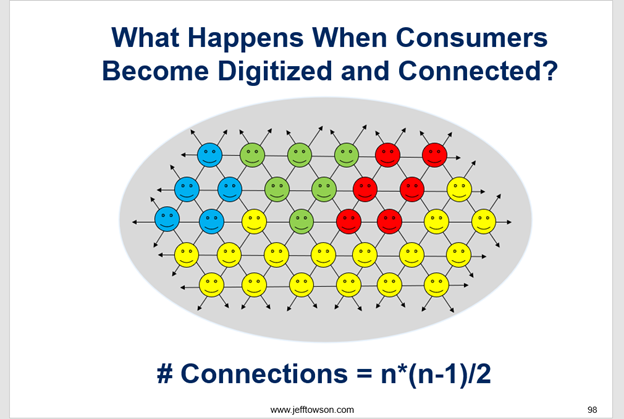
Compare that to the graphic below, which is how businesses traditionally thought about their customers and markets.
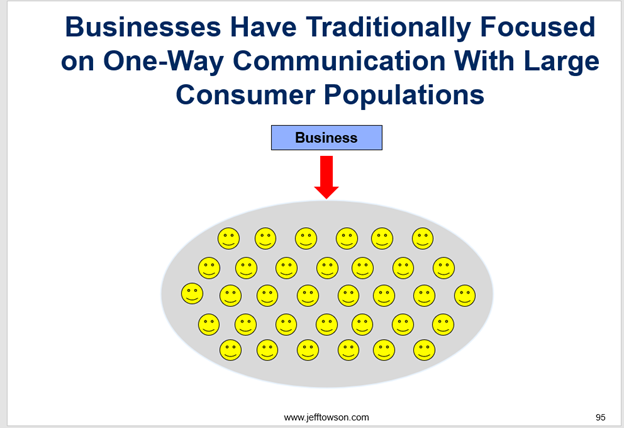
And if you view your customers as a connected network, you realize the connections between users are as important as the users themselves.
You want to increase the both the number of customers (the nodes) and connections and interactions between them (the linkages). That second part is building word of mouth.
And this is an interesting contrast to virality.
As mentioned, viral products turn your users into sales agents. That’s powerful but rare.
Digitally amplified word of mouth turns your users into marketing agents. That’s a lever every business can pull.
And in practice, word of mouth is generally not that natural or organic. It’s usually a good product plus various types of marketing support.
This is a whole world of thinking. But here are some common ways:
- Engineer Unconscious Shareability: This is about getting customers to naturally broadcast your product without realizing they are marketing for you. You want customers to share information about your product. This is Word of Mouth but more unconscious. This is people sharing photos and articles about how to use L’Oreal make-up. Or tourists sharing pictures in restaurants and cafes. Ever wonder why Starbucks always spells your name wrong on your cup? Because people take photos of it and share it.
- Maximize Ambient Visibility: This is about ensuring your product becomes a highly visible part of the physical or digital landscape. This was how smart bike company Mobike grew without spending any money on advertising. Their brightly colored bicycles were ridden all over town and people just saw them. They became part of the landscape. A digital version of this is how free email services became popular in the 1990’s. They added simple, automated lines to the bottoms of every outgoing email. Like “PS: Get your free email at Hotmail.”
- Drive Growth Through Referrals With Incentives: You see this all the time. Giving customers credits or reward points for usage. Or for referrals. Lots of gamification happens here.
- Drive Growth Through Referrals Without Incentives. This can be invitation-only services and events. Exclusivity can really work. I like this category because financial and other incentives tend to get the wrong types of customers.
There are lots of tactics that can be put within this bucket. It starts to blend into digital marketing, which is a big topic. But these are all about activating connections and amplifying digital word of mouth.
***
I put both virality and word of mouth under Tactics. And, while necessary, they are not a source of long-term strength.
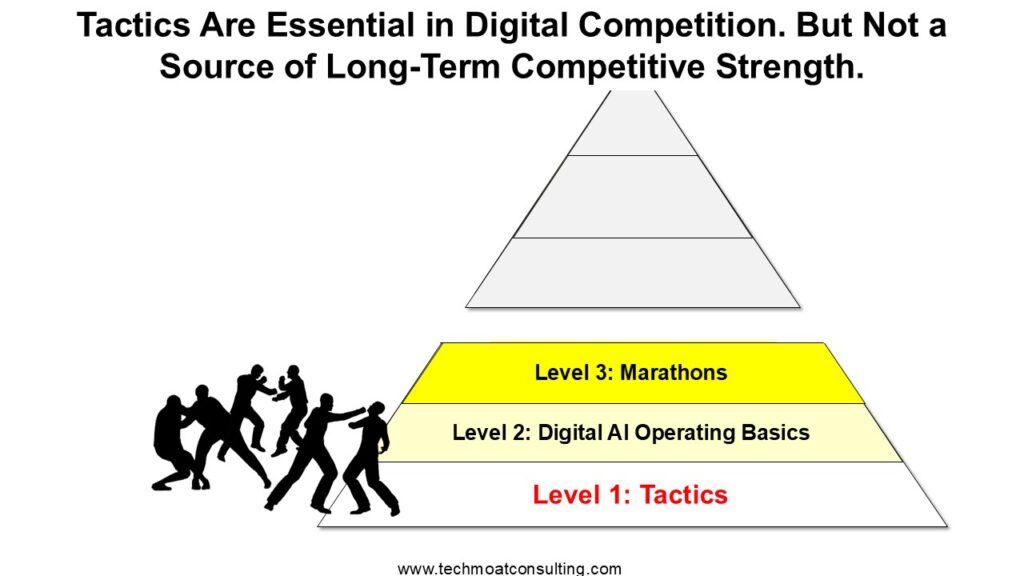
Here’s my list of common tactics.
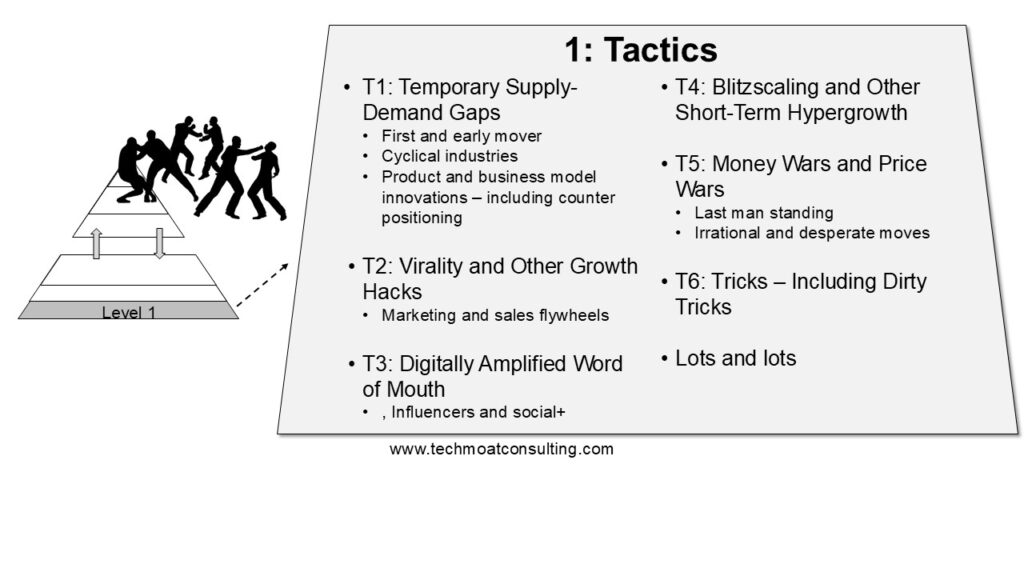
Ok. That’s it for today. Just a quick couple of points.
-jeff
———
Related articles:
- Forget Network Effects. Go for Switching Costs. (Asia Tech Strategy – Daily Lesson / Update)
- What is the Secret of Pinduoduo’s Success? With Matthew Brennan and Elliott Zaagman. (1 of 2) (Jeff’s Asia Tech Class – Podcast 45)
From the Concept Library, concepts for this article are:
- Virality and Word of Mouth
- Growth Hacks
From the Company Library, companies for this article are:
- Groupon
- Zoom
——–