
In Part 1 and Part 2, I went through Tencent’s revamped AI approach and accelerated cadence for AI-based products and services. They are systematically releasing both new AI products and AI-infused versions of existing products.
As mentioned, the focus is on high value use cases (co-designed with product teams), not theoretical new capabilities.
Within this, Tencent’s big push right now (like everyone else’s) is agents.
Agents are the breakout use case after AI chatbots. And the explosive popularity of OpenClaw in China really got this big trend a big push.
Note: The OpenClaw logo looks like a lobster, so everyone in China started referring to agents as lobsters (龙虾). Building agents is referred to as raising or farming lobster. And then this was modified to little lobster or crayfish (“小龙虾”). Lobsters aren’t common in China as actual food. But spicy crawfish are super common (especially in street food).
At Tencent, agents (i.e., lobsters) have definitely become the focus for this round of product releases. Especially CodeBuddy, WorkBuddy, and QClaw.
From the recent earnings presentation.
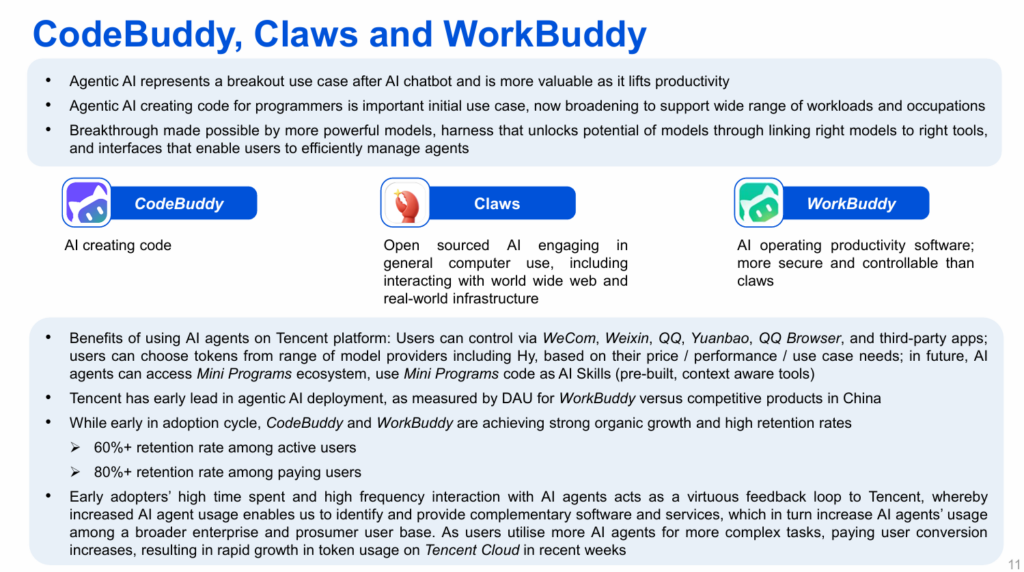
CodeBuddy Evolves from Coding Copilot to Autonomous Agent
CodeBuddy is Tencent’s AI-powered coding assistant. Launched in mid-2025, it was a traditional developer-led AI assistant model. It operated with Human-led Q&A.
But in early 2026, it got an agent upgrade. It released Plan Mode (with shared control) and Craft Mode (with AI-led execution).
It can understand natural language requirements, plan tasks, edit multiple files, generate tests, and deliver complete applications with limited human intervention.
Tencent also integrated Hy3 preview into CodeBuddy shortly after its release in April 2026. As mentioned, Hy3 is particularly optimized for coding and agent workflows, which makes it a very good fit for CodeBuddy’s autonomous agents.
Recent updates have strengthened its agent capabilities. This includes custom agents, skills, MCP protocol support, and secure sandbox execution. CodeBuddy is rapidly advancing from a smart autocomplete tool to a true AI software engineering teammate.
Note: This is the first domestic intelligent programming companion to support the MCP protocol, natural language programming, multi-file code generation, completion, and unit testing. It covers over 200 programming languages and frameworks.
Tencent Positions WorkBuddy at the Center of Its Enterprise AI Strategy
WorkBuddy is Tencent’s intelligent desktop workstation. It was built from day one to be a true autonomous AI agent running on a PC. It prioritizes task execution over Q&A. And it has native multi-step planning.
But its biggest feature is its ability to directly manipulate local files on your PC. Through natural language commands, users can enable it to complete complex office tasks like batch file processing, document generation, data analysis, and industry research.
WorkBuddy is also already connected to the Tencent Cloud SkillHub. This is Tencent’s centralized, marketplace for Agent Skills. Developers and enterprise users can find, download and install modular capabilities directly into their system. Such as cloud file management, image processing, web search for AI agents, video summarization and many others. These include Tencent’s core office skills and third-party ecosystems.
This is a big deal. Tencent’s skill community, based on OpenClaw, already has over 22,000 Skills.
And, of course, WorkBuddy supports WeChat direct connection.
In March, the Tencent WorkBuddy WeChat Mini-Program went online. With the mini-program within WeChat, you can command WorkBuddy on your PC or on the cloud.
And this WeChat integration supports both Cloud and Local PC operation.
- In cloud mode, tasks are executed asynchronously in the cloud without needing to keep the PC turned on.
- In local mode, users can remotely control a PC (that is turned on and connected) to handle computer tasks. The mini program can act as a phone remote controller, with voice, text, images, and files being sent directly to the computer, downloaded, and saved. And output files can be shared by WorkBuddy.
***
At first, this sounds a lot like Claude Cowork. It’s a tool built to delegate and execute. And it has lots of capabilities in file and data manipulation, multi-step planning and MCP.
The difference is this is within the Tencent ecosystem, which has no equivalent anywhere in the world. It has:
- WeChat as a primary user interface
- WeChat mini programs, which all their functionality and data.
- The Tencent user base and their data.
- Tencent’s vast content libraries.
This is the agentic tool I am most excited about. It’s only in China right now, but should go international soon (I hope).
Ok. Next one.
QClaw: Tencent’s Play to Bring Autonomous AI Agents to the Public Globally
QClaw is Tencent’s user-friendly AI agent tool.
QClaw is a simplified, consumer-friendly version of the open-source OpenClaw framework. It runs on your computer as a personal AI assistant. And it can automate tasks, control your PC, and handle workflows. It can also be controlled via chat apps like WeChat, WhatsApp, or Telegram.
Ease of use is the key idea here. No complicated installations. No command lines. No heavy setup.
Some examples:
- QClaw is “scan-and-use”. Just scan the QR code and it’s ready to go.
- It is already integrated with both DeepSeek-V4 and Hy3 preview. You can switch between these two models.
- DeepSeek-V4 is the powerful new large language model just released from DeepSeek. It is known for strong reasoning and coding.
- It supports both OpenClaw and Hermes Agents. The joke is you can raise both shrimp and horses in the app.
- As mentioned, QClaw is a desktop application (mainly for Chinese users) built on top of OpenClaw, an open-source framework. It is nicknamed shrimp in Chinese communities.
- Hermes Agent is a separate open-source AI agent framework developed by NousResearch. It’s a main competitor/alternative to OpenClaw and its biggest strength is its self-improving learning loop.
- The agent can automatically turn successful tasks into reusable skills, remember things better over time, and get smarter with use (unlike traditional agents which stay static).
- And it is nicknamed horse. Hence, shrimp and horses.
Another example:
- QClaw has a File Space feature that acts as a unified workspace inside QClaw. This is the latest major feature (launched May 11, 2026).
- With one authorization, the AI can directly access and work with:
- The local files on your computer.
- Tencent Docs. This is Tencent’s version of Google Docs, documents, spreadsheets, mind maps, etc.
- IMA knowledge base. This is Tencent’s internal/company knowledge repository.
- You can pull information from these sources in one conversation, let the AI analyze/edit them, and save the output directly back as a new editable Tencent Doc.
- With one authorization, the AI can directly access and work with:
And in April, Tencent launched QClaw V2, the large version. This new version has three important capabilities:
- Multi-agent.
- Application connectors.
- The Lobster Steward (管家).
So, you can create multiple agents. And each agent can have customized specialties, skills, and permissions.
And they can execute multiple third-party applications simultaneously.
There is also the Lobster Steward, which is about providing native security protection. With this, QClaw can open a safe operating environment, blocking malicious prompts, skill injections, file tampering, and sensitive information leaks. But this is an evolving area, especially for enterprise grade security.
***
Ok. Those are the 3 big agent products right now. They’re pretty important.
For fun, here is a recreation of one of Tencent’s first internet cafes (back before China had many computers). From the Shenzhen HQ museum.

Let me finish up with a quick list of where agents are going into some existing Tencent products.
1. Yuanbao Receives an Agent Upgrade. Plus, New Features.
Yuanbao is the ChatGPT of Tencent. And it has a couple of particularly cool features.
- It can use both Tencent’s Hunyuan and DeepSeek’s large language models.
- It has access to the massive content library within Tencent’s internal public accounts and video accounts. This gives it a big, big data advantage.
For agents, Yuanbao has introduced a PC version that supports one-click creation or connection to Yuanbao’s agent capabilities.
Some recent Yuanbao announcements:
- Yuanbao has integrated Hy3 preview. So, its technical, coding, and agent capabilities have been simultaneously upgraded. DeepSeek-R1 used to be the default model of Yuanbao. Now it is Hy3 preview.
- Yuanbao gets a “Summary of Files” feature. Users can long-press or click files in chats (such as PDF, Word, etc.) or in public account articles to extract core summary points generated by Yuanbao.
- Yuanbao can now summarize chats in WeChat. Users can select chats and forward them to Yuanbao.
- Yuanbao launches a PC desktop version. On March 25, the Yuanbao PC desktop version officially went online. Users can directly ask questions to Yuanbao in the sidebar without needing to switch windows.
2. IMA Launches Personal Knowledge Agents
IMA is Tencent’s knowledge repository, which has turned out to be an important file source for AI and agents. IMA has now introduced a Skill and Knowledge Agent Copilot. So, users can build personal knowledge agents.
These knowledge agents contain built-in memory – with four modules:
- Copilot configurations
- User profiles
- Long-term memory
- Experience tricks (not sure what this is yet).
3. Tencent Docs Integrates with QClaw
On May 11, QClaw officially launched its “File Space” feature. With a single authorization, QClaw can completely connect your local files, Tencent Docs, and IMA knowledge base in one step.
4. QQ Evolves from AI Browser to Agent Browser
QQ Browser is Tencent’s AI browser. It has over 400 million users and was on a16z’s Global Top 100 AI Applications list.
On April 8, QQ Browser officially launched the first domestic agent browser, QBotClaw. Users can configure API Keys for domestic large models. It also connects to the WeChat ecosystem to achieve cross-terminal control.
And on April 23, QQ Browser integrated the Tencent’s Hy3 preview model.
***
Ok. That it. The pace of product releases and upgrades is really crazy.
For reference, below is a current list of the important AI-native and AI-enhanced products.
Cheers, Jeff
*Disclosure: AsiaTech Services LLC has had a consulting relationship with Tencent within the past 12 months. This article or report was not paid for or sponsored.*

——-
Related articles:
- More High-Tech Flex by Huawei R&D (4 of 4) (Tech Strategy)
- 6 Big Events in AI Agentic Ecommerce (Tech Strategy)
From the Concept Library, concepts for this article are:
- AI Agents
- GenAI
From the Company Library, companies for this article are:
- Tencent
——-
I am a consultant & keynote speaker on how to increase digital growth and strengthen digital AI moats.
I am the founder of TechMoat Consulting, a consulting firm specialized in increasing digital growth and strengthening digital AI moats. Get in contact here.
I write (a lot) about digital growth and digital AI strategy (3 best selling books, +2.9M followers on LinkedIn). There is a free book and email newsletter below.
My Moats and Marathons book series is a framework for building and measuring competitive advantages in digital businesses.
This content (articles, podcasts, website info) is not investment, legal or tax advice. The information and opinions from me and any guests may be incorrect. The numbers and information may be wrong. The views expressed may no longer be relevant or accurate. This is not investment advice. Investing is risky. Do your own research.