The big question for this article series is: What is Tencent’s AI and Agent strategy?
And fortunately, the recent announcements pretty much detailed that out.
First, I’ll give you management’s summary of what they have been doing. Then I’ll give you my interpretation.
In Tencent announcements, I saw 5 important events related to AI and Agents.
Event 1: Tencent Rebuilt Its Model Building Infrastructure
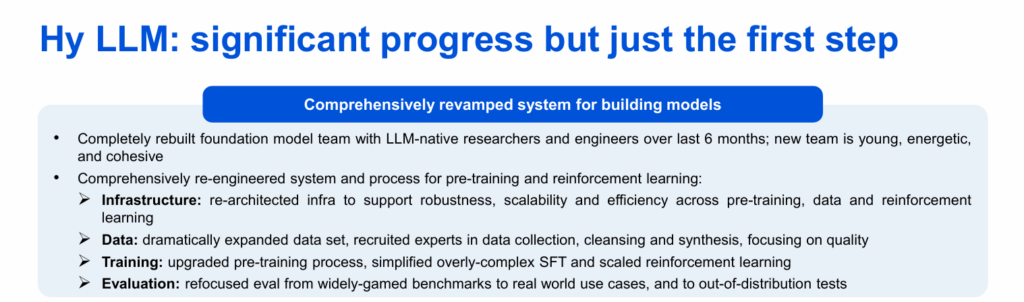
Over the past 6 months, Tencent has:
- Rebuilt its foundation model team with LLM-native researchers and engineers. There was a significant change in the people. They describe the new team as “young and energetic”.
- Re-engineered the system and process for pre-training and reinforcement learning.
- Increased and improved its data sets. They say they have recruited specialized experts to focus on data collection, cleansing, and synthesis, with a priority on quality.
So Tencent basically restructured its AI R&D team and its model building process. See Tencent’s released summary of this.
Event 2: Tencent Kicked Things Off with the Hunyuan Hy3 Preview
Hunyuan is Tencent’s self-developed general large language model. It uses a Mixture of Experts (MoE) architecture, with parameter numbers reaching trillions. Since its launch in 2023, it has expanded from text generation to a suite of models for text, images, video, 3D, and audio modalities.
The above new approach to AI model building was tested in the building of Hunyuan3 (Hy3) preview. This is Tencent’s latest language model and was released and open-sourced in late April.
Hy3 preview definitely reflects a shift in their approach to foundation models. And to AI and agents.
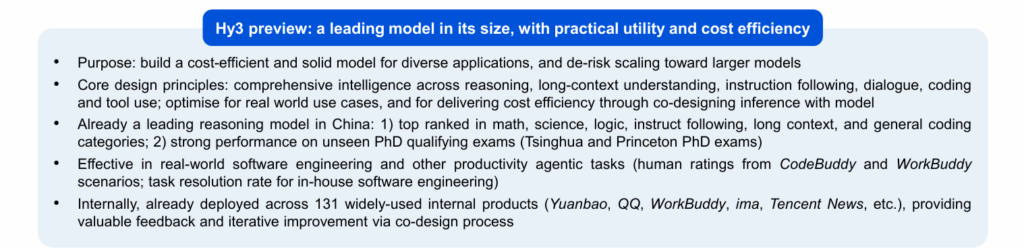
It is focused on both high cost-effectiveness and practicality. This is not a big model pushing the boundaries of capabilities. They are going for a balance between cost and performance. The priority is to make it useable in their products. And this balance between cost and performance makes it well positioned for high volumes and for increasing agentic use.
In terms of performance, Hy3 is designed for complex reasoning, long context understanding, coding, and intelligent agent capabilities. I would put all of these things in the bucket of “proven to be very useful”.
In terms of balancing performance and cost, you can see this approach in the architecture.
- It is a highly efficient MoE language model. And it uses expert routing and hierarchical attention to balance efficiency and reasoning depth.
- It has 295B total parameters and it activates 21B per token.
- It has 192 routed experts.
- The context window is 256k tokens.
So Hy3 is highly efficient for its capability level, due to its MoE design and its supporting optimizations. It only activates about 7% of its parameters per token. So, it has the knowledge capacity of a much larger dense model without the compute cost.
And this plays out in the API pricing, which is only $0.06-0.18/M tokens cached.
Overall, it has lower memory footprint, faster inference and cheaper deployment than a 295B dense model. However, keep in mind, performance depends on routing quality and expert specialization – and this can vary by task.
Hy3 preview was released in April and it hit #1 on OpenRouter (temporarily) for Coding, tool calls, and marketshare. Here’s the released summary.
***
This was important.
First, Hy3 is a good indication of where Tencent is going with its models.
You can see the focus on useability in the targeting of certain capabilities (coding, tool calls) and the balancing of cost and performance.
Second, it was a test of the new model building infrastructure.
Based on the results, Tencent will definitely build larger models in the same way.
Third, we can see Hy3 being systematically deployed into Tencent’s crazy big suite of products.
This includes Yuanbao, QQ, WorkBuddy, IMA, Tencent News, etc.. This is particularly important. It will improve these products and it will also provide feedback and enables iterative improvements via a co-design process (discussed below).
Event 3: Lots of Additional Models Are Being Developed. I’m Pretty Excited About the World Models.
The LLM team is also focusing on larger parameter models, leveraging the infrastructure and learnings from Hy3.
Going larger means:
- Aggregating bigger and better datasets
- Scaling more powerful RL
- Deepening the co-design process
Management repeatedly mentioned their co-design process. The LLM Team works together with the Tencent product teams to build these models. This includes designing the end goal, optimizing the dataset selection and focusing the RL for high value use cases.
Here are a couple of recent announcements on Tencent’s other models.
In April, Tencent released (and open-sourced) the Hunyuan 3D World Model 2.0 (HY-World 2.0).
My #1 interest for Tencent and AI and Agentic advancements is marketing. I expect them to be the leader globally in this.
However, my secondary interest is their advancements in world models. Tencent is the gaming giant of the world. I think the world models are going to be amazing.
The newly released HY-World 2.0 lets you generate 3D assets with a single prompt. And then directly import them into game production or embodied simulation engines. AI world-building is obviously going to be a big part of gaming.
But there are lots of other emerging and evolving use cases, such as digital twins for factories, conferences, and even cities.
Also in April, Tencent Robotics X Laboratory and the Hunyuan team released the HY-Embodied-0.5 series base models.
Putting foundation models into robots is fascinating. I’m trying to learn more about these Embodied AI base models that are tailored for robotics.
This released model contains both a Mixture-of-Transformers (MoT-2B) for edge deployment and a Mixture-of-Experts (MoE-32B) for high performance. I believe this is mostly for research.
Event 4: Tencent is Accelerating the Release of New and Upgraded AI Products. And Agents (i.e., Lobsters) Are the Current Focus.
Management had good comments about how AI development is being distributed within Tencent. There are lots of reasons for this. And accelerating the cadence of product deployment seems to be one of them. And, as mentioned, new models and products are being co-designed by the LLM team and the product teams.
Tencent is definitely doing an “Ai-fication” of their existing product suite. I was at the Tencent Cloud Summit in Shenzhen in November and gave up trying to document all the AI uses mentioned in their products. It seemed like AI was going into literally every product.
The big push right now is definitely agent-based products. And specifically WorkBuddy, CodeBuddy, and QClaw. I’ll go into detail about these in Part 3.
***
Ok. That’s a summary of the AI and agent approach. In Part 2, I’ll do my own quick assessment of their strategy.
Cheers, Jeff
*Disclosure: AsiaTech Services LLC has had a consulting relationship with Tencent within the past 12 months. This article or report was not paid for or sponsored.*
—————
Related articles:
- More High-Tech Flex by Huawei R&D (4 of 4) (Tech Strategy)
- 6 Big Events in AI Agentic Ecommerce (Tech Strategy)
From the Concept Library, concepts for this article are:
- GenAI
- Agents
From the Company Library, companies for this article are:
- Tencent
———-