Part 1 and Part 2 were about smart watches and the intersection of quality, utility and emotion.
But for tablets and most smartphones, Huawei goes back to basics and deploys their biggest tech guns. There is not much emotion in a tablet. The design maters but it’s mostly about tech functionality.
And Huawei is king of tech breakthroughs and hardware innovation in consumer electronics (and telco).
I previously wrote about Huawei’s trifold smartphone (Mate XT), which is the leading edge when it comes to handsets.
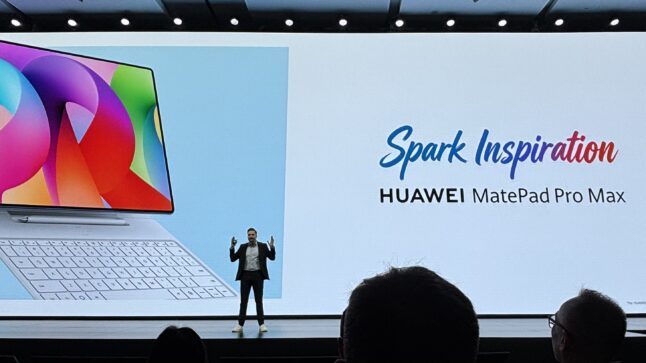
And at this event, the new MatePad Pro Max was the tech leader. I came away from the presentation thinking that Huawei’s engineers were just showing off what they could do.
Huawei’s MatePad series is pretty fantastic. They have the normal version, the SE, the mini (my favorite) and the Pro.
This was the new Pro Max, which is their most advanced version. It’s an ultra-thin tablet that does PC-level productivity.
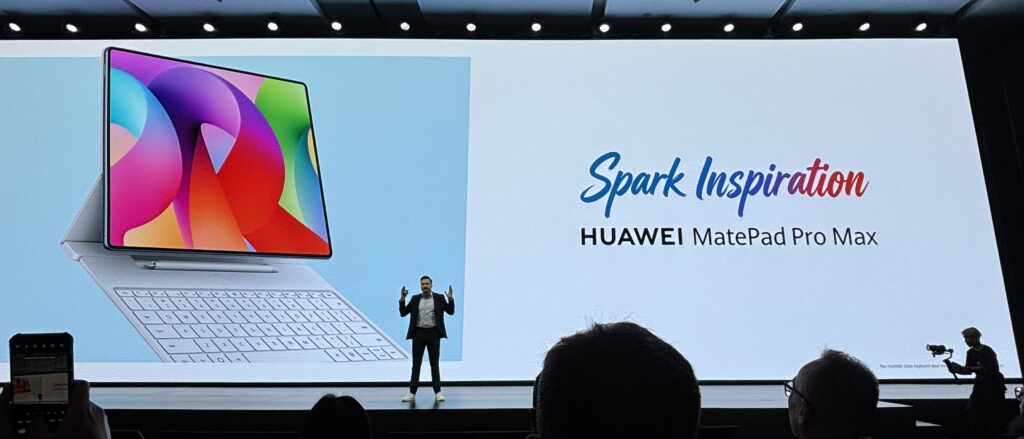
Here are the basics.
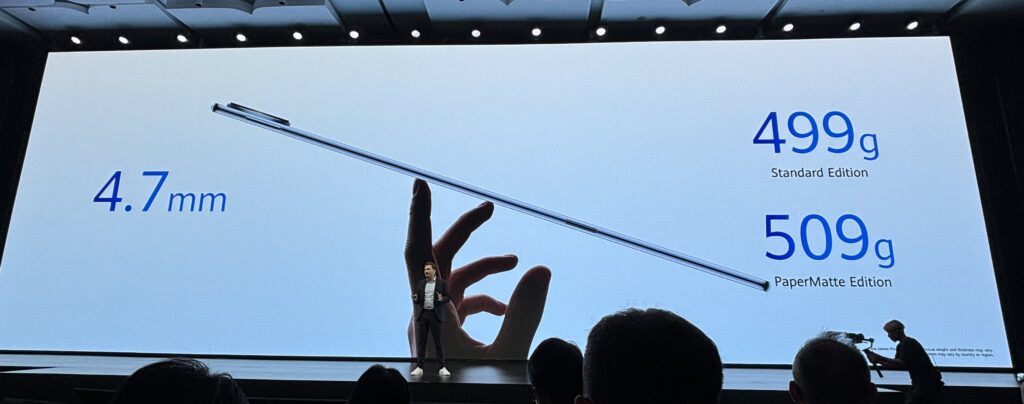
- It’s thinner and lighter. It’s 499 grams and 4.7 mm thick. That makes it the thinnest and lightest tablet among the 13-inch+ tablets. The PaperMatte Edition is 509 grams.
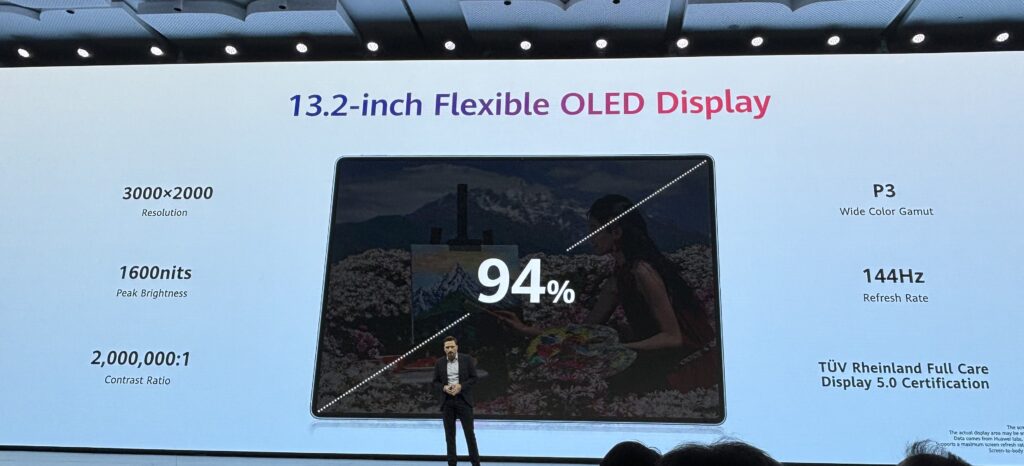
- It has a 13.2-inch OLED 1600 NITS screen.
- It has an aluminum unibody – with a nice blue or space grey finish.
- It has hidden the camera (no notch).
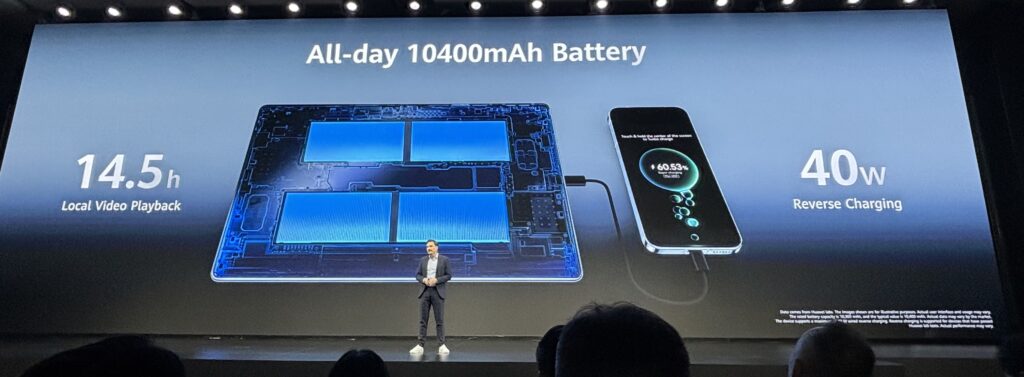
- The battery is 10,400 mAh.
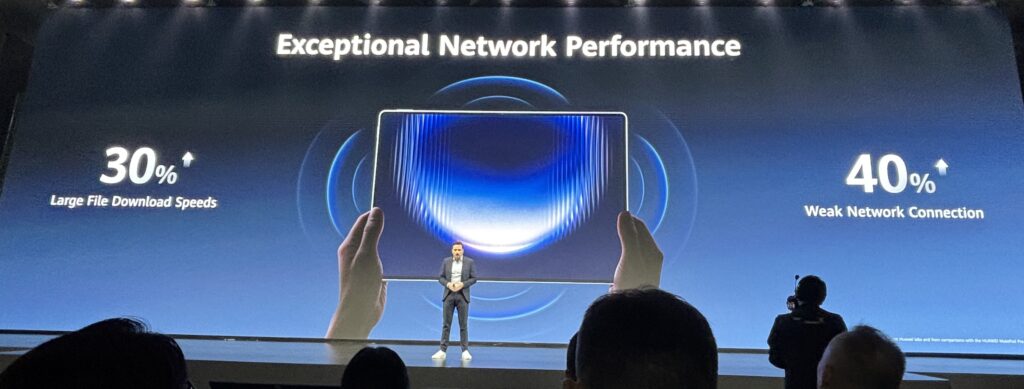
So, what’s cool about this?
It’s 4 things:
- The Cloud Falcon architecture
- The battery innovations
- The PaperMatte screen
- The Speaker System
The Cloud Falcon Architecture: The Foundation of Huawei’s Ultra-Thin Strategy
This is the key tech innovation for making the tablet thinner and lighter, while increasing performance.
This is a hardware design framework developed by Huawei specifically for high-performance, ultra-thin (<6mm) mobile devices. The goal was to maximize internal space and thermal efficiency in devices that are too thin for traditional component layouts.
The Cloud Falcon Architecture has three technical pillars:
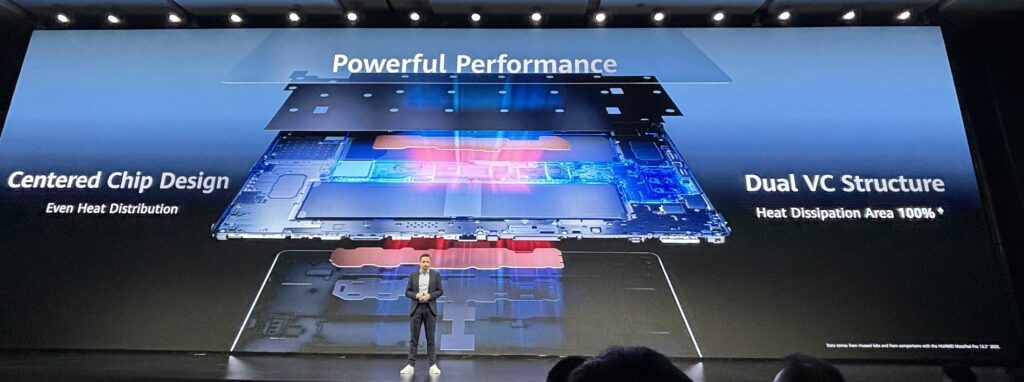
1. Dual-Layer Vapor Chamber (VC) Cooling
The processors generate a lot of heat, which is a problem in thin tablets (without fans). And the heat problem increases with increased performance and larger, brighter screens.
Tablets use traditional vapor chambers (VCs) that are single-layer plates. The Cloud Falcon design uses a tiered, dual-layer VC system that surrounds the core processors. It draws heat away from both sides of the processor board. This maximizes the lateral thermal conductance, spreading the heat energy across the entire chassis to prevent localized hot spots.
The goal is to get the heat to as large an outer surface area as possible. And as quickly as possible (using high-conductivity materials like graphene or specialized copper alloys).
This also prevents thermal throttling even when the processor spikes under heavy load. You want thermal uniformity, where the whole back of the tablet stays warm rather than one hot spot reaching the safety cutoff.
2. Centered Mainboard Layout
Unlike standard designs where the motherboard is positioned at the top or side, Cloud Falcon uses a center-mounted PCB.
- This moves the primary heat source away from where a user typically holds the device.
- This allows for a symmetrical internal layout, creating equal space on both sides for large-capacity battery cells and high-fidelity speaker chambers.
3. High-Density Component Stacking
The architecture utilizes a high-precision, multi-layer board stacking technique. By reducing the horizontal footprint of the motherboard, Huawei is able to integrate larger peripheral components, such as eight-driver speaker systems and batteries exceeding 10,400 mAh, without increasing the device’s thickness.
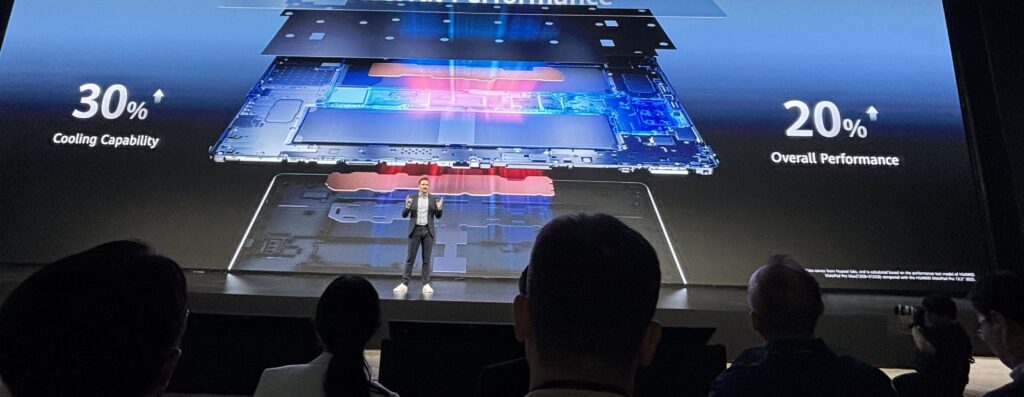
You can see this architecture play out in the thinness, in the increased cooling (30% thermal conductance) and in the increased performance (20%).

Battery Tech Breakthroughs: Pushing the Limits of Energy Density and Charging Speed
Usually when people talk about tablets and smartphones, it becomes a discussion about batteries and screens. How do you make them better in such a small device?
Batteries is one of the places where Huawei has really had some tech breakthroughs. It’s why their smartwatches run forever. And why you can get 14 hours of video playback on this new MatePad. You can even use the MatePad Pro Max to charge your other devices (40W reverse charging).
I previously wrote about how Huawei adjusted their battery chemistry from traditional Lithium-ion to using Silicon-Carbon (Si-C) anodes.
Traditional batteries use graphite anodes which are reliable but have a limit for how much energy they can hold. Silicon can store a lot more but it can swell with energy (technically with Lithium).
Huawei came up with a solution to this which is their Silicon-Carbon tech, which uses a specialized porous structure to handle swelling in the anode. The carbon matrix allows the silicon to expand during lithiation without fracturing the electrode, preserving cycle.
The MatePad Pro Max has a 10,400 mAh battery. By using a silicon-carbon anode instead of traditional graphite, Huawei has an energy density 15-20% higher than previous generations. This allowed them to shave nearly 1mm off the thickness of the preceding MatePad Pro 13.2 (which was 5.5mm) while maintaining the same battery capacity.
This is also why the Falcon Architecture is important. It frees up a lot of space on the periphery for larger batteries (and speakers). The Si-C battery is split into two ultra-thin cells positioned on either side of the centered mainboard to maintain the tablet’s balance and slim profile.
There are a couple of other Huawei battery innovations that are worth mentioning.
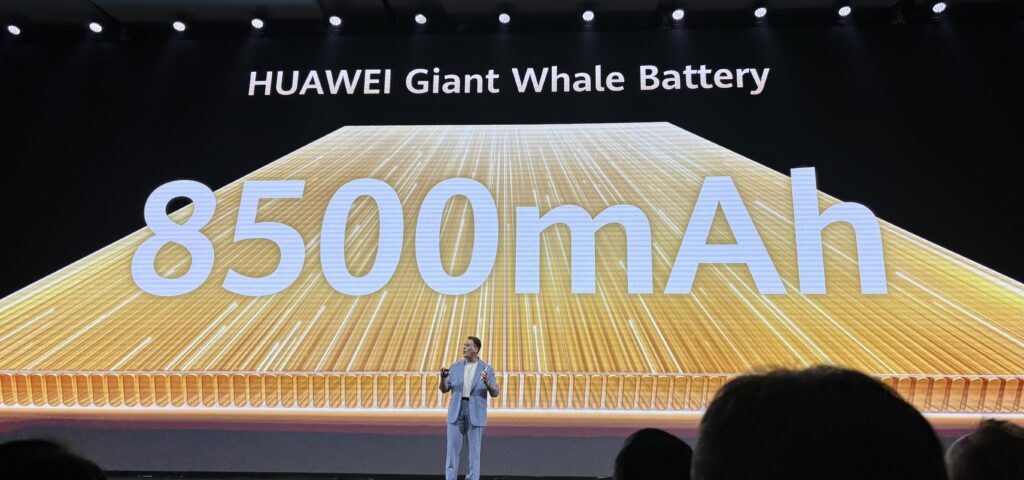
The new Nova 15 Max smartphone has an 8500 mAh battery.
That’s the biggest battery ever in one of their phones. It’s called the Giant Whale Battery. On that smartphone, you can watch videos for 27 hours. And you can do 48 hours of calling.
The Nova 15 also uses their Energy Booster.
This is like a smarter version of Low Power mode. Standard phones leave a large buffer at the bottom because their sensors aren’t accurate enough to know exactly when the battery will crash. Huawei’s Energy Booster uses a more precise voltage-current algorithm to safely crawl closer to the chemical cutoff point.
SuperCharge.
This is a cool innovation where the charger adjusts the voltage it is giving to the device to charge it. Outlets provide 110V or 220V AC power. And most chargers convert this to 9V or 12V DC power.
But this is too much for a phone so it must be stepped down to 4-5V within the phone. The generated heat can degrade the battery and cause thermal throttling, which slows charging speeds.
The SuperCharge steps down the voltage within the charger (not the phone). And the phone communicate with the charger to constantly adjust the transmitted voltage based on what it needs. Basically, standard fast charging uses High Voltage (9V+) / Low Current. Huawei’s SuperCharge uses Low Voltage (typically 4.5V–5V) / High Current (5A+). That protects the battery and lets you charge faster.
Here is the battery info from the Nova 15.
I’ll go through the rest of the consumer electronic tech advancements in Part 4.
Cheers, Jeff
*Disclosure: AsiaTech Services, LLC has had a paid commercial relationship with Huawei within the past 12 months. This article received no financial sponsorship or backing.*
—
Related articles:
- How Generative AI Services Are Disrupting Platform Business Models (2 of 2) (Tech Strategy – Daily Article)
- The Winners and Losers in ChatGPT (Tech Strategy – Daily Article)
- Why ChatGPT and Generative AI Are a Mortal Threat to Disney, Netflix and Most Hollywood Studios (Tech Strategy – Podcast 150)
From the Concept Library, concepts for this article are:
- Smartphones, smart devices, and wearables
From the Company Library, companies for this article are:
- Huawei: Consumer Business Group
——
I am a founder, consultant and keynote speaker specialized in digital and AI agentic strategy.
I am the founder of Agentic Org Now, a firm that helps leadership teams launch AI and agentic initiatives fast.
I write (a lot) about digital and digital AI strategy (3 best selling books, +2.9M followers on LinkedIn). You can get a free book at the email sign-up below.
My Moats and Marathons book series is a framework for building and measuring competitive advantages in digital and AI businesses.
This content (articles, podcasts, website info) is not investment, legal or tax advice. The information and opinions from me and any guests may be incorrect. The numbers and information may be wrong. The views expressed may no longer be relevant or accurate. This is not investment advice. Investing is risky. Do your own research.