In Part 1, I gave a simple explanation of Huawei’s new Tau scaling law. This article is about how they are doing this.
I’ve been studying Huawei for about 12 years. And have spent quite a bit of time on their various campuses (Shenzhen, Dongguan, Shanghai, Beijing).
And the #1 thing people get wrong about Huawei is they don’t understand their strategy, which is quite clear.
- Huawei’s strategy is about long-term survival. Which is rare in tech companies.
- Huaweei’s greatest advantage is its people and its culture. Founder Ren Zhengfei was an engineer. But his big focus was on people, culture and (yes) human resources. He wrote about this for literally decades.
Huawei’s Core Strategy Has Always Been Long-Term Survival. Plus, Huge Re-Investment
If you read Ren Zhengfei’s talks and papers going back to the early 1990’s, what jumps out at you is how different Huawei has always sounded.
The goal of the company has never really been about money. Nor about becoming a tech giant. And it has definitely not been about going public and getting a big payday.
Huawei’s fundamental strategy has always been about long-term survival.
It is about creating a tech business that can survive for decades. Because the vast majority of tech businesses do not. They fall behind in their technology or they get bypassed by a new technology.
“Being big and strong temporarily is not what we want. What we want is the ability and resilience to survive sustainably.” – Ren Zhengfei (2001)
Note some of Mr. Ren’s writings and talks over the years:
- 1998: “How Long Can Huawei Survive?”
- 2000: Survival Is Fundamental to An Enterprise”
- 2001: “Huawei’s Hard Winter”
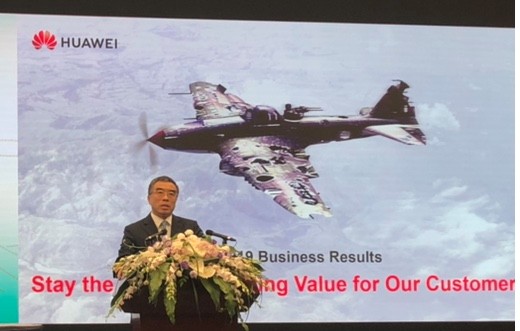
Mr. Ren has been talking for literally decades about how Huawei can survive long-term – and about the need for resilience. After the entity list ban, the company put the below picture of a WWII bomber everywhere. It’s a shot up plane that is still flying. That’s resilience.
So, when I hear Huawei’s big announcement for their new 3D architecture and the scaling law, I view it through a long-term lens.
This could be a 10-20 year plan. Keep in mind, it took Huawei +22 years to finally match and then surpass Ericsson in telecommunications equipment.
Also, keep in mind, Huawei is constantly investing and re-investing. The business typically invests +20% of revenue per year in R&D. That’s about $20-25B USD per year. Which makes them #1 for R&D investment in China (Tencent is #2).
So, when Huawei says they will reach effective density of 1.4nm in 2031, they will be spending +25B R&D per year to achieve this (and other goals). By 2031, it will be $125B. And by 2035, it will be $250B.
Of course, that R&D spend is going into lots of projects. But it’s the long-term focus plus big investment and re-investment that matters.
And then it’s about people.
Because all R&D spend is not equal. Huawei’s hard-charging culture amplifies both the time and money they spend.
Huawei’s Big Advantage Is Its People. And the HR Strategy that Organizes and Motivates Them.
Huawei, like most engineering-based enterprises, has only one real resource, which is the cumulative brainpower of its people. Most of its products will be obsolete in 5-10 years. So, they must continually create and recreate new products – and therefore the value of the enterprise.
“Resources can be exhausted; only culture endures. Huawei does not have any natural resources to depend upon. What we do have is the brainpower of our employees. This is our oil, our forest, and our coal. Human ingenuity is the creator of all wealth.” – Ren Zhengfei
Huawei’s biggest strength is the system they have developed for the creation, assessment and distribution of value by +200,000 people. It’s ultimately about HR strategy.
Years ago, I interviewed Huawei’s HR department. I think I might have been the only person to ever ask this.
I wanted to understand the mechanics of how they organized such a large number of people in technology. And it was fascinating.
Their HR strategy is about identifying, supporting and rewarding the top contributing, current employees. External shareholders, providers of capital, retired employees and even the founders are a distant second in importance. They want the economic value of the business to go to the people that are currently creating the value.
Note how different that is to other large engineering-focused companies (say GM and Bosch), where much of the value goes into guaranteed salaries (regardless of contribution), to external shareholders, and into post-retirement benefits (i.e., not current employees).
A useful ratio to remember for Huawei is 4-to-1.
After you take out the basic costs of goods sold, depreciation and such, you get a gross margin for the company that then goes to the providers of labor and capital. And in Huawei, this money goes about 4-to-1 to current employees vs. all the rest. The company focuses its cash flow on current employees, with a heavy weighting to the top performers. The rest of the 4-to-1 goes to owners and other stakeholders (including retired employees).
***
That’s what I’m thinking about with the new architecture and tau scaling law announcement.
- How fast are the products going to advance in the near-term?
- What percent of R&D is on this project at HiSilicon? At Huawei broadly?
- How many products is this architecture going into? All of the consumer products? All of the data centers?
- How many people are on this? How much money per year?
- What will the cumulative effect of this over 5 years? 10 years? 20 years?
- Will they catch up with NVIDIA in performance?
- What will be the adoption in China vs. internationally? Nvidia has an entrenched ecosystem internationally. I’m thinking Huawei’s going for a low-cost strategy targeting the global south. But that’s just a guess.
Ok. That’s it.
*Disclosure: AsiaTech Services, LLC has had a paid commercial relationship with Huawei within the past 12 months. This article received no financial sponsorship or backing.*
———
Related articles:
- How Generative AI Services Are Disrupting Platform Business Models (2 of 2) (Tech Strategy – Daily Article)
- The Winners and Losers in ChatGPT (Tech Strategy – Daily Article)
- Why ChatGPT and Generative AI Are a Mortal Threat to Disney, Netflix and Most Hollywood Studios (Tech Strategy – Podcast 150)
From the Concept Library, concepts for this article are:
- Semiconductors
From the Company Library, companies for this article are:
- Huawei
- HiSilicon
——-
I am a consultant & keynote speaker on how to increase digital growth and strengthen digital AI moats.
I am the founder of TechMoat Consulting, a consulting firm specialized in increasing digital growth and strengthening digital AI moats. Get in contact here.
I write (a lot) about digital growth and digital AI strategy (3 best selling books, +2.9M followers on LinkedIn). There is a free book and email newsletter below.
My Moats and Marathons book series is a framework for building and measuring competitive advantages in digital businesses.
This content (articles, podcasts, website info) is not investment, legal or tax advice. The information and opinions from me and any guests may be incorrect. The numbers and information may be wrong. The views expressed may no longer be relevant or accurate. This is not investment advice. Investing is risky. Do your own research.