
The previous articles (Part 1, Part 2, Part 3, Part 4) were about AI infrastructure (compute, networks) and data / knowledge / memory. All with a focus on the transition from AI to agents.
In this final part, let me get into some actual business use cases.
But first, some final fun stuff from Barcelona MWC 2026.
Chinese AI company iFLYTEK had a pretty great exhibition. Lots of interesting translation devices (their roots are in NLP). And on display, they had the “OmniAvatar”, which was pretty cool. It’s an AI Assistant that is projected onto a transparent glass pane, about human height. So, you can chat with it kind of like a physical human. And it’s on a pedestal that moves around.
Here’s a video of it. I like it. I think it works better than the Dragonwing.
And for fun, here’s a video of the Huawei exhibition. I mentioned it was the largest exhibition at MWC by a lot.
Ok. Back to topic.
The ACT Framework for AI-Agent Use Cases
At the industrial summit, Nicholas Ma (Huawei corporate accounts) had a good simple framework deciding on potential use cases. Which is summarized as ACT.
A – Assess the High Value Scenarios
So, you start by prioritizing the business value of an AI – Agent application scenario. And then measure that against the maturity of the technology. And against the maturity of the scenario.
C – Calibrate the AI Model with High Quality Vertical Data
The key is to combine high quality data with a knowledge base that is industry specific. That (in theory) gets you good industry specific models.
T – Transfer in Digital / AI Talent
The execution phase is mostly about people. So, lots of work on the organization, in talent, and on the work processes.
Not a bad framework.
AI Use Case: Retailer Tech and Solum Solutions
Solum Solutions is a high-tech Korean spin-off from Samsung Electro-Mechanics (founded in 2015). It is a global player in Electronic Shelf Labels (ESL) and IoT infrastructure. They have lots of manufactured products to deploy in retail outlets that gather data, enable business intelligence and can tie into digital and AI services. Their clients include the retailers Loblaws, Lidl, Rewe, and Amazon Fresh.
Their solutions include:
- Electronic Shelf Labels (ESL)
- These are the small, battery-powered digital displays you see on store shelves that replace traditional paper price tags.
- The simplest versions of these ESLs just show the prices of goods. But they are getting smarter and more autonomous. They can show use cases and videos of the products.
- Multifront Digital Signage
- They can be hanging screens in the windows. They can be tablets at check-out. They can be above the shelves. The main goal of these screens around the store is to increase engagement.
As of March 2026, Huawei and Solum expanded their partnership to launch a “Shop-in-Shop” (SiS) solution, which uses ESL and multifront digital signage to turn physical stores into intelligent environments. Some examples:
- Sensors can now detect foot traffic density outside. If a crowd forms, the multifront controller automatically switches the window display to a high impact 4K video to draw people inside.
- If a customer picks up a product (detected by weight sensors or “lift-and-learn” cameras), the nearby multifront display instantly switches from a generic ad to a specific use-case video or a comparison chart for that exact item.
- While customers wait to check out, the screens show personalized last-minute offers based on what the multifront system knows is currently trending or overstocked in the store.
Pretty cool.
AI Use Case: Calix and Agent-Empowered Personalization
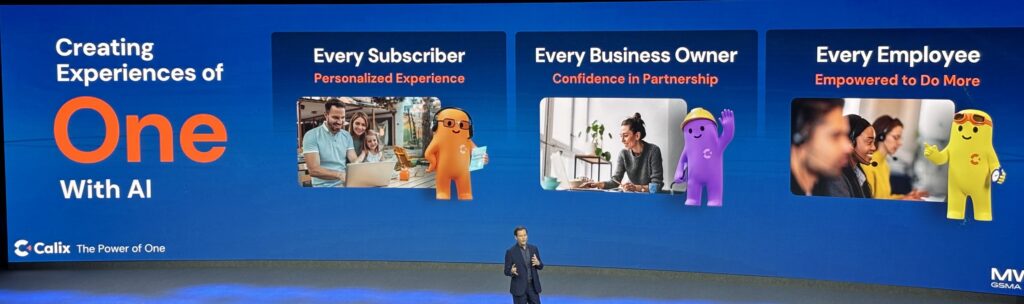
On the main stage, there was a compelling presentation by Calix, which is in the business of using data to personalize the customer (and employee) experience. Their basic point was that every business now has tons of data. And the challenge is how to use it to grow the business.
Their solution is to create an “experience of one”.
- Every subscriber to a service should have a personalized experience.
- Every employee should be empowered.
And with effective personalization, you want to see the key metrics moving. The NPS going up. The operating costs going down. And so on.
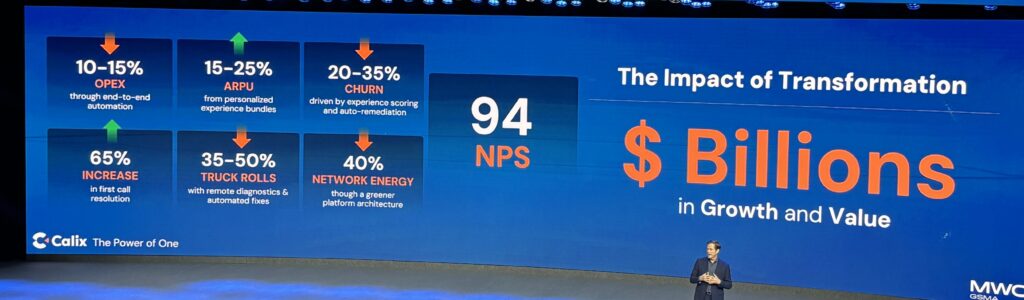
Fine. That’s pretty standard data-driven personalization.
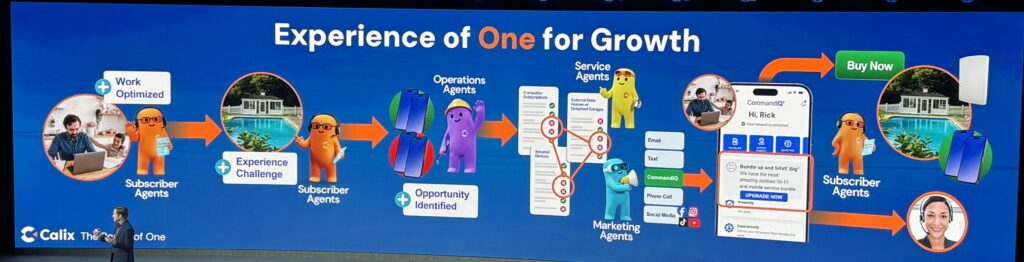
But Calix appears to have gone “all in” on personalization using agents. They showcased their AI-native platform. Instead of a human analyst looking at spreadsheets, AI Agents autonomously monitor subscriber data to identify specific patterns.
These agents can detect, for example, that a specific home has a “gamer persona” based on latency needs or a “work-from-home” persona based on upload patterns. The agent then proactively personalizes services exactly when the user needs it.
And they break the user experience up into steps with each step being handled by an agent.
They have a subscriber agent for CRM, a marketing agent for upselling and cross-selling, a service agent for issues and delivery, and so on.
Overall, it’s convincing that this is the next evolution of data-driven personalization.
AgentArts: Huawei’s New Platform for Multi Agent Collaboration
This was one of Huawei Cloud’s big announcements at MWC.
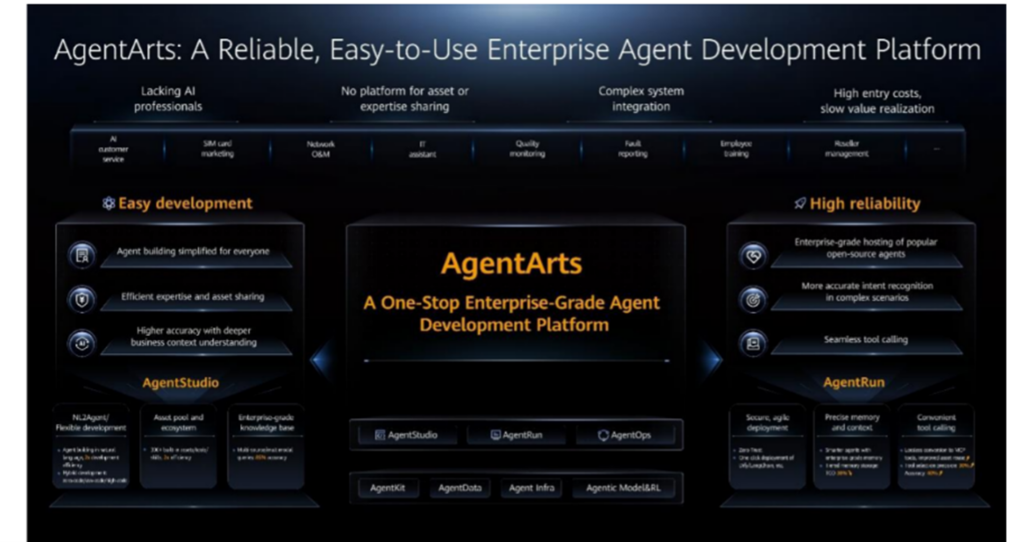
AgentArts is basically a one-stop platform for agent development by enterprises. Businesses can use it to create and deploy agents for business tasks. Or for workflows. And even for multi-agent collaborations.
Standard agents include:
- Customer service agents that do Q&A and request routing.
- Safety and regulations agents that monitor factory activity for safety issues and violations.
- Multi-agent collaborations that can really scale up. Think integrated port operations where data is gathered by various agents on things such as vessel schedules, cargo status, equipment conditions and yard operations. And then the data from all the agents is combined for coordinated planning.
This is a good tool. I’m starting to play with these.
The key, of course, is business performance. Which depends on model performance, high-quality data and enterprise-grade knowledge bases. Security is also a big deal.
Here’s a summary slide.
Final Point: CodeArts and a Huge Jump in Coding Efficiency
This is their coding agent. It’s, in theory, for everyone but is definitely focused on developers. What used to take 2 hours of manual coding now takes 1 minute.
This is part of an open capability platform. That’s the global approach for most of these tools. So easy collaboration with partners to integrate industry-leading models, to enable access to third-party models and to implement a four-layer extension mechanisms (MCP, skills, agents, and subagents).
It will be available outside of China in the second half of 2026.
***
Ok. That’s it for MWC2026.
A couple of fun final things.
One of the things that a lot of press covered at MWC was the Honor Robot Phone. This is basically a smartphone with a camera gimble on the top. The swiveling camera gives your phone’s AI the ability to look around. Basically, it gives it vision. And it can do things like video you and follow you as you walk around.
Here’s what it looks like.
Not bad. Not thrilling.
Finally, here are some last pics of MWC and Barcelona. I’m definitely going back.



———–
Related articles:
- The Winners and Losers in ChatGPT (Tech Strategy – Daily Article)
- Why ChatGPT and Generative AI Are a Mortal Threat to Disney, Netflix and Most Hollywood Studios (Tech Strategy – Podcast 150)
From the Concept Library, concepts for this article are:
- AI Cloud
- Generative AI and Agents
- AI Infrastructure and Data Centers
From the Company Library, companies for this article are:
- Huawei
———–
I am a consultant and keynote speaker on how to increase digital growth and strengthen digital AI moats.
I am the founder of TechMoat Consulting, a consulting firm specialized in how to increase digital growth and strengthen digital AI moats. Get in touch here.
I write about digital growth and digital AI strategy. With 3 best selling books and +2.9M followers on LinkedIn. You can read my writing at the free email below.
Or read my Moats and Marathons book series, a framework for building and measuring competitive advantages in digital businesses.
This content (articles, podcasts, website info) is not investment, legal or tax advice. The information and opinions from me and any guests may be incorrect. The numbers and information may be wrong. The views expressed may no longer be relevant or accurate. This is not investment advice. Investing is risky. Do your own research.