
This week’s podcast is about MEDVi, the world’s first +1B revenue company with only one employee. It was founded in 2024 by Michael Gallagher.
You can listen to this podcast here, which has the slides and graphics mentioned. Also available at iTunes and Google Podcasts.
Here is the link to the TechMoat Consulting.
Here is the link to our Tech Tours.
Here are the 5 lessons:
- GenAI and agents are creating powerful new positions as the primary user interface
- AI ecommerce, including ABCs (assistants, brokers, concierges), are going to cut off a lot of merchants and brands from their customers.
- Human users are going to become much harder to reach. You need their eyeballs, not their AI assistants.
- MEDVi is a good examples of the ability of GenAI to enable new types of ecommerce coordination.
- Agent workers are a powerful organizational structure. It is going to disrupt human heavy businesses.
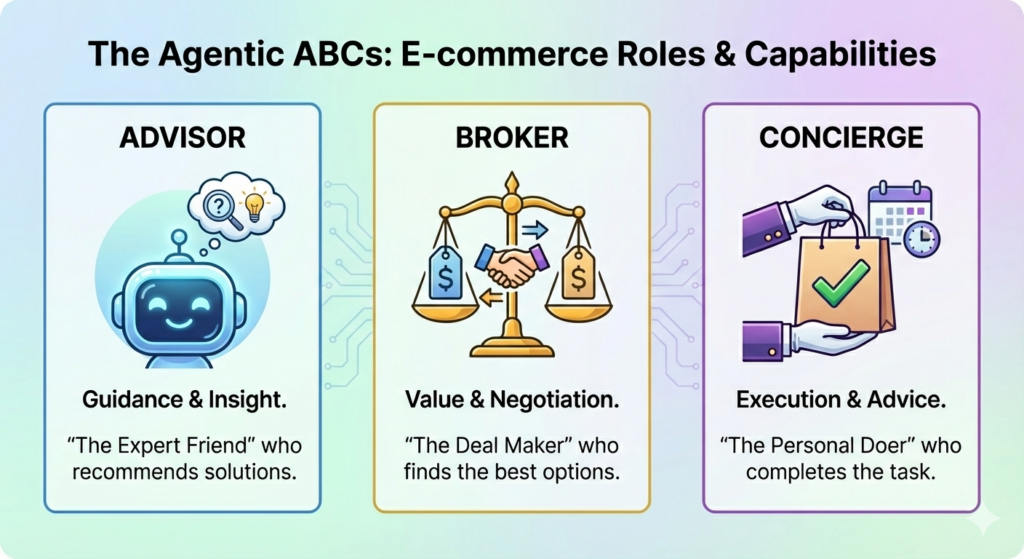
Here is the ABC graphic.
——-
Related articles:
- A Simple ABC Framework for Agentic Ecommerce (1 of 2) (Tech Strategy)
- What Merchants and Brands Should Do About Agentic Ecommerce (2 of 2) (Tech Strategy)
- The Winners and Losers in ChatGPT (Tech Strategy – Daily Article)
From the Concept Library, concepts for this article are:
- GenAI and Agentic Strategy
- GenAI and Agentic Strategy: Agentic Ecommerce ABCs
From the Company Library, companies for this article are:
- MEDVi
——-transcription below
00:06
Welcome, welcome everybody. My name is Jeff Towson and this is the Tech Strategy Podcast from Tech Moat Consulting. And the topic for today, five, let’s call them AI, agentic commerce lessons from the world’s first $1 billion revenue one person company. And this was kind of big news in the last week, Medvi, a firm founded last year.
00:34
by one guy, although I think his brother helped a little bit. No employees, only AI and lots of agents. And it is going to clear $1.6 billion in revenue this year, apparently. Already clocked 400 to 500 million last year, and then this year looks like it. So, there’s people even waiting for when this is going to happen. And it looks like the first one is happening. Well, there might be others, but this is the first one that kind of got media attention. So, there’s a lot of one that’s cool. I’ll talk about it.
01:04
Two, there’s a lot of really good e-commerce lessons here and how AI and agentic tools are changing the nature of e-commerce. And I’ve written about this before and talked about it. It’s a big deal. I think the nature of commerce in many areas is going to get turned on its head already happening. So, I’ll sort of talk about the broader implications of that. But this is a good case study, so we’ll talk a little bit about that. Not going to get too much into the healthcare weeds of this one because it’s very specific to healthcare, but…
01:34
The e-commerce lessons are big. So that will be the topic for today. Standard disclaimer, nothing in this podcast or my writing or website is investment advice. The numbers and information for me and any guests may be incorrect. The views and opinions expressed may no longer be relevant or accurate. Overall, investing is risky. This is not investment, legal or tax advice. Do your own research. That was one breath. Okay, with that, let’s get into the content. Now the concepts for today.
02:03
in the concept library always. Pretty much just agentic commerce. I kind of say AI, agentic. I sort of put those two things together. I’m really talking about generative AI and now agentic AI. And we’ll probably put physical AI in there as well. There’s a big bright line between that and what we’ve been saying digital for a long time. Digital kind of includes some degree of machine learning AI, but this is the new thing. So, I’ve been using AI agentic. So that’s topic number one, AI agentic commerce.
02:32
e-commerce online, at commerce it’s going into the real world soon. And then just this idea of generative AI having its superpower as coordination. And when we talk about digital world, the superpower of digital was network effects. You connect a bunch of things that had never been connected before in a marketplace, in a YouTube-like platform.
02:58
The more you connect, the more beneficial it is to everyone involved. It’s a network effect. That’s been the big gun of digital for 25 years. Okay, agentic commerce, agentic generative AI, let’s say, doesn’t look like it really has network effects. I don’t see any examples yet. Maybe it will happen. I don’t see it. What it has is has a learning flywheel. The more you use it, the smarter it gets for a while. That’s a flywheel, not a competitive advantage.
03:26
But really the superpower looks like the ability to coordinate things that have never been coordinated before. This is kind of a big deal and this came out of uh Sanjeet Choudary, believe. I probably have been saying that wrong for years. Anyways, he wrote a book about generative AI recently called Reshuffle. And it’s a pretty good book; you should definitely read it. But his main point is what…
03:54
Generative AI can do is it can coordinate and connect well can connect and coordinate things that couldn’t be coordinated before and It really points out the fact that look we like platform business models because they connect things and they allow things to coordinate Platform business models are in the interactions business you connect a merchant here with a consumer there You connect a creator of videos here with a viewer of videos there. They are in the interactions business. That’s how they create value
04:23
It turns out that it is actually a sub case. It turns out most things in life and in business are too messy to coordinate at scale with the platform business model. To get something to work on a platform, you need something like books where the products are standardized. You can put them in the same formats. You can put in the data fields of the same, and then you need a common interface on the other side, like a newsfeed or a search e-commerce site.
04:53
where you can search. You need to sort of standardize before you can scale up. Turns out most things in life that you want to do interactions between can’t really be standardized, therefore they don’t scale up terribly well. If you’re going to build a new building, you know, you have a lot of people involved. You have architects, you have the businesspeople, you have the construction people. The construction people have lots of types. You have the people who do the bathrooms, the people who do the electricity, the people who do the groundwater and the…
05:22
sort of let’s call it the land aspect, the people who do the furniture in the building. You’ve got lots of different types of groups actually coordinating on one project. They’re all using different tools. They’re all using different data sets and sort of frameworks. The way you coordinate that today is you need a human being. We are the middleware of complicated projects. Well, it turns out generative AI…
05:47
can kind of do the same thing. It can look at the architecture and the data sets, and then it can look at the land development and water systems and sewage treatment, which will have different tools and data. It can access all of those and put it together into one thing. It’s very similar to how human beings can sit and look at their browser. And in their browser, they’ll have 10 tabs open, and they’ll flip between the different browsers. One might be e-commerce to buy a plane ticket. One might be YouTube videos too
06:16
Think about what you’re going to do when you fly to Phuket. One might be finding a hotel and one might be communicating with friends who live in that region. That would all be one project, but the aspects of it are separate and the only way to coordinate across that is to have a human being flipping through the tabs. Turns out generative AI is pretty good at that. And that’s kind of the idea here. When we look at commerce, I’ll get back to commerce now. So that’s kind of the other ideas, like look.
06:46
The superpower here might be coordination of activities that are messy, that have different data sets, that have different skill sets, that have different user groups but coordinating all of that at scale. That’s the idea. So, Gen. AI coordination. So, those are the two sorts of concepts to think about for today. All right, let’s talk a little bit about Medvi. Now, Medvi is very specific to healthcare. So, I’m not going to go into it too much, because healthcare companies are their own animals.
07:16
There’s a lot of regulations. There’s a lot of clinical aspects. Mean, I don’t usually, and I know healthcare quite well. It’s my background. I don’t talk about it much because 90 % of people, it’s one, it’s not relevant and two, it’s sort of off the track. It’s a specialty, not unlike finance. know, people who do finance tech and FinTech, everything’s different and gaming is a little bit, they’re all specialties. I sort of stay out of that. Okay, but Medvi.
07:45
is what you call a telehealth platform where instead of going to the doctor in the physical world or the pharmacy or whatever, you go online and you do the telehealth. Now it’s tele because traditionally you would call on the phone and you could order drugs. uh but there’s aspects to that. You have got to get an online consultation. You have got to get a doctor’s prescription. Then you got to get the drug prescription placed with a pharmacy and then it has to be either picked up or shipped to you. Now Medvi is a
08:15
in the telehealth platform space, but it’s specialized in one sort of unique product category, which is weight loss. We’re really talking about Ozempic, right? We’re talking about GLP-1 medications. You know, these medications that help you lose weight. They have some unique characteristics there. So, it’s kind of a screwed-up product niche with it’s a lot messier. Regulatory wise, it’s messier.
08:45
The drugs are scarce and they’re hard to get. The drugs are expensive. So, there’s discounted versions of them that are generic. In terms of telehealth and ordering drugs, this is a very messy little subset. Okay. And what they’ve basically done, and I’ll summarize what Medvi, but they basically, this guy is using AI and agents.
09:12
to solve all that messy stuff and create basically a coordination layer for users that let them work across the whole thing. Get the consultation, find the drug which is difficult. Specifically, you want to find generic versions of the drug which can only be done by certain pharmacies. They’re always out of stock. Coordinate that, get it delivered. The benefits are you can get the drug a lot cheaper than normal.
09:41
like one fourth the price. So, I’ll talk a little bit more about that, but here’s the numbers I think that matter. So launched in its first full year of operations, 2025. To me, everything I’m telling you is media reports. So, there might be a decent amount of inaccuracy here in my summary, but $400 million first full year, that’s revenue, projected for 2026, 1.8 billion in revenue, actually.
10:11
daily intake processing $3 million of sales per day. It went from 300 customers in its first month, oh here it is, September 2024, to 500,000 patients today. Now in the process of doing that, all this coordination and doing that, yeah, there’s one guy and apparently his brother’s involved a little bit, but I think it’s must him, so they don’t have engineering.
10:42
You know, basically a no code engineer. He’s using agents and AI to build this whole thing. It’s online. So doing that engineering, legal, all the customer service is done by AI agents. And they are sort of an orchestration and a coordination layer on top of other services like checking patient availability. Well, there’s websites that do that. And there’s finding pharmacies and getting the order. Well, there’s, you know, there’s…
11:10
websites that do that. So, he’s coordinating across. So, it’s really kind of like a virtual production facility where he’s getting the orders coordinating across the various parties to manufacture or find the drug, get it sold, get the prescription, get the government approvals, get it sent. All of that is sort of being done virtually by other parties that he’s coordinating with. That’s my understanding of how he’s doing it. Now you save a lot of money by having no staff.
11:40
There’s a company like this called Him and Hers, which is kind of similar. And they do this all manually and they have a thousand plus employees. And they’re kind of a retailer and they’ve got their own pharmacies and they do the same stuff in the same space. They’ve got a thousand employees. He’s doing the same thing with nobody. So, what do you do? You save a lot of money because you have no staff. Then we get into sort of classic strategy. Okay, if you save money here, what do you do with the extra savings? Well, you plow it.
12:09
You know, basically save money in costs and then plow it into offensive strategic spending. So, he’s plowing the money into ad spend. Every dollar you spend on engineering and legal and customer service is a dollar you can spend on more ads spend. That’s what they’re doing. I always liked that strategy. Every dollar you save. That’s very like uh dream big, the three G guys out of Brazil. They always talk about this. Cut costs is aggressively a
12:35
as possible in regular areas and then use that money strategically. So be cheaper than your rivals in the basic stuff, but outspend them in the strategic stuff, which is usually advertising. Okay, I’ll go into more about that layer, but the two lessons here, and now I’m going to talk about some other lessons. Election one is look, they provided a frictionless coordination layer
13:06
in an area of e-commerce, which is buying certain drugs, that is very messy and very dysfunctional. That’s powerful. That’s a generative AI, agentic AI, and an ecommerce story. The other lesson from there, which I’ll just go into later, is the benefit of this to the user, and one of the reasons they’re growing so fast is they made very expensive and inconvenient transactions very cheap and super easy.
13:35
And that is your go-to strategy. Anytime you see a company that’s taking off like a rocket ship, there’s usually a couple of things that are getting so much adoption. One of them is almost always cheap. know, Ti Mu and Xi Yan, oh, it’s great, it’s convenient, it’s fun. It’s also really cheap. YouTube, that’s amazing, it’s so good. It’s also free. Cheap is not the only sort of customer value proposition, but it’s always like when you see something take off really
14:04
fast, it’s either cheap or free. That’s one of the things. Other stuff happens too, but that’s usually not all the time, most of the time. Okay, so that’s kind of two of the lessons. I’ll go into those more. Let me sort of dial step, go one level up and talk about this whole idea of AI and agentic commerce. Now I’ve done two articles about this in the past. I’ll put the link in the show notes. And I’ve done a
14:32
podcasts on it. And I mean, I’ll tell you, it freaks me out. I think this is the biggest sea change in e-commerce in my lifetime. Well, we’ll put it up there with the emergence of the internet and e-commerce in general. But we are actually, I mean, you know what? I think it’s bigger. I think it’s bigger. Okay. So, what, why is this? I’ll get into sort of the five lessons and then I’ll circle back to MedVid. Five lessons.
15:01
It’s clear a powerful new position is emerging to be the primary user interface. There’s a hierarchy. When you open up your phone, who do you go to? Well, first of all, Apple and iOS, if you have a smart iPhone, they’re top of the pyramid because it’s their phone in your pocket. oh, then you open it up.
15:29
Okay, the operating system iOS is pretty high up, but maybe you open up WhatsApp or you open up WeChat first. They’re the front of the queue. Maybe you go to Instagram, maybe you go to Amazon. There’s kind of a hierarchy and whoever is the primary user interface, everyone else is a bit lower in the hierarchy. Often Apple is just charging 30 % just to be an app on their platform of transactions.
15:58
Sometimes you just take money from them, but you can also sort of dictate the rules. So, there is really a hierarchy and there are certain control points in business that give you power beyond the fact that I just have a good product. The example I always use is uh the dock workers of Los Angeles. Every now and then, there’s only one major port on the Western United States coast, which is Los Angeles.
16:26
Every now and then the dock workers there, which are unionized, go on strike. And I think they get whatever they want because they are sitting at a choke point. If they close that port, nothing going across the Pacific from Asia, which is where like everything comes from, can get into the Western United States. You got to go down through the Panama Canal and you got to come up on the other side of the US. So, they command a choke point. And you wouldn’t really view that in terms of a Michael
16:55
quarter, five forces like, you have good bargaining power over the buyers or supplies. Now, I look at business as ecosystems and value chains, but within there, you know, I put a little asterisk next to the choke points. You know, the powers, the positions that give you sort of inordinate control and the primary being the primary user interface in the digital world is super powerful.
17:22
Microsoft used to have it when Windows and everyone sat on their PCs, it was Microsoft. And then browsers came on and the power kind of shifted to the browser. Whoever controlled the browser controlled the eyeballs. Then it went to the smartphone, iPhone, then it went to iOS. In China, you could argue it’s WeChat. I think they have more power than iOS there. Everyone lives on WeChat every day. So, you kind of get a sense, you know, it’s not always, sometimes it’s one versus two versus three, but you know who the big boys are.
17:52
So, okay, so the point there is we are deaf, this generative AI thing, AI assistants, and now agents are creating a powerful new interface. Elon Musk has been saying, he says a lot of stuff. One of the things he says is, you know, there might not be any operating systems like iOS in the future. There may not be apps in the future. Why do I need to open up my phone and look at
18:21
the desktop iOS and then look at apps and open them one by one, why don’t I just talk to my phone and if the AI assistant will go into my apps as needed. So, in that case, maybe I don’t even need a uh smartphone screen. Maybe I just need a microphone or I can talk to my smart glasses or a smartwatch and I’ll just tell the AI what to do and it can open up all the apps. Maybe. I don’t necessarily know if I believe that.
18:49
But in the last couple of weeks, another thing happened. OpenAI canceled Sora, which is their video generation tool. I think one was costing them a ton of money. Two, it requires a different type of model. And uh I think they needed the GPUs. But anyways, one of the things they mentioned is their merging ChatGPT codecs, which is their coding, and their agent tools into one, quote, unified super app.
19:19
That looks to me like someone trying to become the primary user interface. When people start talking, look, it’s a unified super app that’s the one point of interaction for the customer. And then the user talks to it or chats or whatever, and it can code. It can answer questions. It can generate images. It can send agent tools off to do shopping for you, all of that. That to me looks like a primary user interface play. oh
19:50
Now, I actually think we know what the answer to this question is. I think it’s already clear. I think it’s WeChat. Because let’s say if you’re going to deal with an AI or an agent, that’s who you’re going to talk to, like your assistant, and they’re going to go do things for you in this world. What are the things in life that you’re not going to have to do for you that you want to still do yourself? Well, number one on that list is talking with your friends and colleagues. That’s Messenger.
20:19
I am not going to have an AI go into Messenger and chat with people on my behalf. No, I’m going to talk to them. So, if you integrate AI and agents into WeChat, which is already the world’s first and really only super app, that’s amazing. Then I can just go into WeChat. there is every day. I’m opening it every day. If you’re in China, you open WeChat every 15 minutes. I’m chatting. I’m leaving text messages. I’m sending documents. I’m coordinating group chats with
20:48
projects and friend groups and all that and within that we also have my AI assistant and agent and I might say okay; we’re going to do this great I need to get tickets for our trip on Fridays everyone good with going Friday. Yeah. Yeah. Yeah. Okay agent Go get me my ticket and it goes off and does it know this also helps because WeChat has already built in all the mini apps into WeChat so
21:12
know, hundreds and hundreds of thousands of merchants and brands already have mini apps living within WeChat. Now, if it’s living within WeChat, that means identity is clear, payment is already integrated. All of that stuff, all the backend stuff to do transactions is already set within WeChat and all the mini programs are built into that. If I’m in China and I want to use Didi to dig or ride, most of the time I do it through WeChat using the Didi mini app.
21:43
Because I know I’m going to pay with WeChat Pay. It’s got my identity. I don’t have to upload and re-verify my identity every couple of months, which happens all the time. It’s just easier. Well, if you bake in an AI or an agent in there on your behalf, that’s amazing. And WeChat actually announced something the other couple months ago, which I got to sort play out with when it was rolled out in beta. In your group chats in WeChat, if you have five people, 10 people, you can add a person which is an AI assistant.
22:13
and it just hangs out in the chat group. And you can talk to it like a person and if you need clarification, hey, what about this? It’ll chime in. It’s like an assistant sitting at the back of the meeting room. It was pretty cool. I didn’t use it that much, but it was neat. So that’s kind of a big deal. Now, there’s one last side to this, which is I think super important. And this one is in my brain too right now this week.
22:41
So, under this idea of like lesson number one, look, the primary user interface is a big deal. It’s going to change commerce for sure. It’s going to change a lot of things. Mark Andreessen of Andreessen Horowitz, he did an interview in the last week or so uh talking about what this is all going to look like in the future. What is an agent? And he basically said it’s one, two, three, four, five layers.
23:07
He put a stake in the ground. He says I think this is what an agent is. It’s five layers and It’s all modular so you can port out different players for every layer so number one uh Layer one would be the language model the LLM Okay, Chad GPT Claude Gemini now in this system of six layers you can swap between them at will anyone you want to do
23:37
It’s modular. On top of that layer, this is his language here. On top of that sits a bash uh shell. I didn’t really know what bash meant, but it’s the command line that you have on your computer. So, if it’s a Mac, if it’s a Linux machine, it’s your command line interface. And that’s how literally every programmer talks directly to the operating system.
24:05
And really any machine that you have, you’re going have an operating system, you’re going to have hardware. The command line interface is how you tell it to do things, how you change everything. So that’s your primary interface. So, you can see that if you have a foundation model and then sort of a bash shell on top of that, well, suddenly the foundation model can start to interact with the operating system and the whole piece of hardware, whether that’s in the cloud.
24:33
That would be a different type of interface or whether it’s just on your laptop with no connection to the internet. Suddenly, the LLM can interact with the machine entirely. So, you have sort of the shell layer. On top of that, you have basically a lot of plain text files. The plain text files is where the agent stores its memory.
24:58
It’s instructions, it’s knowledge. It’s basically a file system that gets written to in a markdown way, like a notes app. And the LLM agent can then draw on that for its ongoing instructions on how it’s supposed to behave. It’s accumulated knowledge, all of that. And then on top of that, there’s a cron job. I don’t know what that means, C-R-O-N job. Basically, it’s a timer.
25:27
It keeps the agent alive 24-7 and it tells it to wake up every couple minute to check in on work on top of that. And that’s pretty much it. So, you got an LLM, you got a shell, you got files, you got a markdown, you got crime. You put all that together, you get an agent. An agent that you can talk to on a laptop, in theory on a phone. And his argument is like every piece of this
25:56
stack has existed for decades. We’re used to this and we’re very good at just having each layer module as a module. You can swap them in and out. It’s just that we didn’t really have the language model before and now we do. So, you can be doing this on a laptop and you can swap between Claude and GPT at will, but the memories will live in your file system. So, whatever the model is, it’ll know what you’ve done before, even if you switch.
26:24
If you want to move to a different computer, that’s fine. You can migrate the whole thing like it’s nothing. You can tell it to add capabilities to itself. Now this is new because it has access to the command line interface. It can read its own code and it can write its own code. Now we’ve never had a software as far as I know. We’ve never had a technology that can modify and build itself.
26:52
I mean, now you’re talking about evolutionary technology. How many technologies can self-improve their own without an owner changing them? Well, human beings can, biology can, we evolve. Everything else, if you want to make a new version of a car, the engineer has to make a new version. This is a self-evolving technology, kind of. That’s kind of scary. And…
27:19
Because you gave it a shell, it has access to everything on the machine. If you give it access to a browser, then it has access to everything on the internet. That looks to me like a tremendously powerful primary user interface that can do things unlike we’ve… That kind of freaks me out. Now, the one thing it doesn’t have there, which has to be talked about, is it doesn’t have payment. The payment rails…
27:49
don’t really exist yet. Mark Andreessen’s argument is the natural one. There’s this idea that you could give agents bank accounts. There could be bank accounts in this world that are only for agents. And we set them up and we give them to them. So, they would be very different than our bank accounts. His argument is stable coins and crypto, particularly stable coins, are the natural way for agents to make payments and transactions.
28:18
He says, quote, AI is crypto’s killer app. Okay, maybe. Interesting. Anyways, that’s kind of point number one, takeaway lesson number one. Now that was a lot of talking for lesson number one, so I’m going to speed up and get through the rest. But there are a lot of big ideas there. Okay, number two, which I’ve talked about before is agents can be A, Bs or Cs. They can be advisors, they can be brokers, or they can be concierges. The assistants.
28:48
advisors or assistants. They can be your personal assistant that will do the buying for you as a customer. A concierge can be like the concierge of a hotel. They can represent a merchant or a brand. And then in between we can have brokers which are a’s. This can be AI or agents that don’t really represent the buyers or the sellers. They sit in between. Okay, I’ve written about that before. I’ll put a JPEG I did for that. I think that’s a pretty good way to think about it. As I’ve said before,
29:16
I think this is going to break omni-channel commerce as we are used to it. Because what’s going to happen is if I don’t want to buy something, I don’t want to buy ketchup and socks or t-shirts. The standard stuff I might go to Walmart or somewhere basic to go to. If I never have to do that again in my life, that would be fantastic. I would just give it to my assistant agent. They would go handle it. Now.
29:44
That’s good for me, but it’s bad for the merchants of ketchup and socks because they don’t want to be commodities. Their whole business is based on the fact that they have to get access to me. That’s Omnichannel. They’ve got to, you know, get my attention. They have to get customers. They have to get acquisition. They have to get engagement. They have to get data. They have to learn about me. They have to personalize. They have to tell me their brand story. Let’s say for ketchup, Heinz.
30:13
because they don’t want to be a basic commodity. They want to try and move me emotionally. You know, backpacks. I like backpacks. You backpacks, you know, they always tell you a story about how this is a backpack from 1930s Switzerland and the Alpine trekkers used to wear this brand and it’s a historical legacy brand and whatever. And, you know, that all works if they can get access to me. But if you’re only dealing with my assistant, that’s a merchant trying to sell to a piece of software. That
30:44
That breaks a lot of the strategies of lot of merchants and brands, omni-channel e-commerce. Now in some cases if you’re Gucci, that’s not a big deal because people don’t send their assistant, well some do, but most don’t send their assistant to go get Gucci bags for them. They like going to the Gucci stores, they like the experience, you know, they like its fun, the know, the assistance in the Gucci store.
31:09
are kind of rude and haughty-taughty, which makes you almost have to prove to them that you can afford their bags. like, it’s all this… There’s a lot of interesting stuff that happens there. TikTok Shop doesn’t have to worry about this because people still go to TikTok Shop to watch videos. They’re not going to send their assistant, their AI assistant, to watch videos for them. No. So TikTok has my eyeballs. Therefore, it can sell me stuff. Gucci has a lot of people’s eyeballs because they like the store. But socks and ketchup? No. Deal with my assistant.
31:40
You know, being a merchant and brand in this world, selling to assistants is uh a thing. Now we’re also going to see agent to agent transactions where the sock brand will have its own agent, a concierge. It will deal with the assistant, the buyer’s agent, and it’ll just be an agent-to-agent transaction. Okay, that’s strange. Anyway, there’s a whole lot of interesting stuff. The big…
32:07
missing piece in this right now is as mentioned, they don’t really have the payment rails for the setup. So, they have to work on that. The other big area here is the connection between.
32:23
Entertainment and commerce. Not just entertainment and commerce, but information and content and commerce. Because the way it’s been working is everyone generates content. Look at my website, look at my articles. Okay. And then you, know, how do they find the con? Well, they might do a search on a search engine. Hey, I need to know what’s a good type of sock for someone, you know, with two feet that are different sizes.
32:49
You’d search engine that would take you to a webpage. You might read an article posted on that blog. Well, it’s not humans going to these websites anymore. It’s agents and AI. Mostly it’s AI at this point. So, a couple things are happening. One, search engine traffic is dropping and a lot of it is traffic is agents or AI searching for things. And then when it goes to websites, a lot of websites are losing tremendous traffic.
33:19
So, you’re not getting engagement anymore. And then on your articles, even if the agent or the AI goes to your website, reads your article and uses it, that’s not worth anything to you because it’s not a customer reading your stuff. So, this whole idea of creating content and publishing content, which the internet depends upon, the business model for that is collapsing. Why would publishers continue to publish all this content
33:49
if it is mostly just being consumed by AI and not humans. How do you want, can I show them ads? Nope. So, the advertising model is screwed. Are they going to click through and buy something because I had a compelling landing page with a good article, they like my article and then I got them to buy? No, because it’s an AI. So, one, you have a payment rails problem. Two, you have this idea of like, look, publishing content on the internet is in trouble when it comes to monetization.
34:19
And that is the primary strategy for a lot of websites. Okay, lesson number three. Humans are going to be very difficult to reach. I think it’s going to be a big problem. The mobile networks I saw in Barcelona at the Congress were, they were openly saying, you know, the mobile networks of the near future have to be able to carry 8 billion humans and 800 billion agents.
34:48
We are going to get swarmed with basically non-humans, but the value is always going to be, and know, that’s the money’s with the humans ultimately. I mean, in theory, agents could start making their own money, but let’s assume they’re all reporting to a human at some point. So yeah, you’re going to have to get eyeballs. That’s how I’m thinking about it more and more, like how do you get eyeballs? How do I get someone to come to my webpage to use my app?
35:18
to watch a video, to buy something from me with their eyeballs, not by sending an agent or an AI to do it. It’s kind like we’re back in the hunt for eyeballs, which is kind of how the internet started in the late 90s. It was all about eyeballs. Wikipedia has said that you’re not going to be allowed to use AI content. think Reddit, if you ever look at where chat GPT pulls from, Reddit is huge. I think it’s still the number one source because Reddit is all human.
35:48
Right, so these vast repositories of human conversations or human written articles or access directly to the user, that’s a big deal. Now, tech question within there is the growing problem of human verification. The whole little, do you prove you’re human? All the tricks are not working like they used to, all those little things. Are you a human? Move this little toy.
36:18
counterclockwise and type in read this word that’s all messy. You know, the not a bot checks. Yeah, they’re all getting beat. I think we’re going back to biometric proof. Like we may have to like walk down the street again to certain facilities just to prove that we’re human to get approvals to do things. Because, you know, even if you do a video conference or you can’t tell, like it’s almost impossible now.
36:47
Alright, so that’s number three that reaching humans is going to be more difficult. You got to get eyeballs. Number four, this is getting back to Medvi and sort of the points from Medvi. First point of Medvi was like, look, what Medvi has done, which is not what people are writing about, but what I think is the big tech story is it has created a new type of e-commerce coordination using Gen.ai.
37:16
and agents in large numbers. And that has allowed it to do something that wasn’t possible before. Like it’s that starting point I made where like, look, to get e-commerce and platforms and marketplaces to work, needed standardization. Otherwise, you couldn’t scale. This was a messy sector of e-commerce. These prescription drugs that are hard to get.
37:40
uh Supplies weird the price is high you got to get a prescription people are kind of embarrassed So there’s a bit of shame involved there now. I’ll tell you the background here is uh What this company this guy really is doing as far as I can tell okay you want Ozempic you want a brand name? GLP to lose weight but you know that could be thousand dollars per month at a major pharmacy CVS
38:08
Now because there’s a national shortage, the FDA has allowed licensure of what they call compounding pharmacies. Basically, they’re giving certain pharmacies the ability to make generic versions of these drugs. And that’s how you get the price from $1,000 down to $200. You get the generics. Now, how do you get those? Well, you got to go through a specialized telehealth provider that can either contract with these pharmacies, the compounding pharmacies,
38:35
or they have to have the compounding pharmacy vertically integrated themselves, which is what this company, Him and Hers, does. Now, this company didn’t do that, Medvi. They sort of orchestrated across that layer and connected them with wherever the supply might be. Now, there’s actually more to it there, which is, you know, you got to, what about the insurance? Well, insurance doesn’t cover most of this stuff. So, okay, you go to pay cash. That makes life a little bit easier.
39:04
You also have to sort of uh get approval for, you know, by doctors, you need prescriptions. Well, Medvi doesn’t, Medvi sort of this virtual production coordination layer. They don’t actually have their own clinics and doctors that write prescriptions. Instead, they sort of rent clinician networks from a company called OpenLoop, where you can have your basically AI access OpenLoop Health, which is a sort of
39:34
prescribing layer, well they’ll do the consultation, give you a prescription. Then you have to go over to sort of a manufacturing layer. They use a company called Belmar Pharma Solutions, which can actually mix the medication. Belmar is a certified compounding pharmacy. So, you can either, you know, coordinate with compounding pharmacies or have one of yours in-house. But, you know, as far as I can tell, Medvi is totally virtual for the most part. Oh, and then there’s a regulatory and compliance layer. They’re using a company called Care Validate.
40:04
Where yeah, telehealth is highly regulated at the state level. So, you need sort of a compliance engine, verify the patient ID. Is the website following HIPAA guidelines, privacy guidelines? What about state-by-state licensure? Okay, so you need that. So Medvi basically uses its AI and agents to coordinate with those three other vehicles plus some other stuff to get this to happen, as opposed to what this company him and hers does where you have a thousand employees.
40:33
Him and hers, which is kind of in the same area, they say, we’re a hospital. Medvi says, we’re an interface. Okay. So that’s kind of lesson number four there, which is, uh we’re seeing these tools enable coordination in areas where it hasn’t been possible before. That’s cool. And there’s a lot of messy areas of business in this world that could do things like this.
41:03
Last point, and then I’m Last point is similar, which is…
41:10
Okay, you’re doing the coordination thing, that’s all very cool. That’s just, you know, that’s some cool tech thinking. The other thing is like, another way to think about what Medvi is doing is look, they’re just replacing a human heavy business with a very human light, mostly software business. And yeah, it works. And what does that mean? It means your costs are dramatically lower. That’s what it means.
41:40
One, you’re more convenient probably, but two, your costs are dramatically lower, which is like the whole point of software, right? Make things cheaper, make them convenient. Okay, what do you do with that? Well, you do two things with it. One, you flood money into advertising at a level that your competitor with their smaller margins can’t match and you drop the price. Now he’s actually dropping the price a lot more because the compounding pharmacies are already, you know, 25 % of the price. But in addition, you can price things less and less.
42:10
So that’s another way to look at what Medvi is doing. It’s like, look, forget all the coordination stuff. He’s offering something really cheap and he’s flooding money into advertising. Oh, and by the way, his advertising, he’s using agents and AI for that too. Army of them. So, you know, that’s, think, a lot of where this growth is coming from. Anyways, those are some of the five points. Cool stuff.
42:34
It kind of blows my mind. This is really priority number one for me this year is the intersection of AI and agents and e-commerce. The epicenter of that, in my opinion, is Alibaba. They’re the only company in the world that has both at this depth. Amazon’s good, but they aren’t Alibaba. People aren’t using the Amazon foundation models like Quinn everywhere. No, mean, Alibaba’s playing both sides all the way.
43:02
So, I’m kind of looking for how they’re applying these things. I would also say maybe WeChat and Tencent are probably second because they have WeChat. WeChat mini programs is basically e-commerce. Okay, and they are playing a very effective game of catch up in LLMs and foundation model. They’re kind of slow off the mark. Then they made a quick deal with DeepSeek, which they integrated into their Hun-Yuen. So, if you use their sort of, you know,
43:32
chatGPT like service you can choose between Hunyuan which is theirs and DeepSeek. Well, they have just made another similar deal in the last couple weeks with Open Claw. Right, that’s a huge deal. That’s sort of the open-source agent protocol which everybody is using in Silicon Valley as far as I can tell. Well, they’re using that as an option and they’re integrating it into WeChat. Like that’s exactly the user interface I was talking about. That’s kind of amazing.
44:00
So, I’m keeping a close eye on that. I’m meeting with Tencent a lot this year. We’ve got a whole bunch of stuff really almost through the end of the year. So I’m going to basically, I’m showing up all the time trying to learn more and write more on those two companies and a bunch of others. So anyways, that’s kind of my shortlist for what’s going on. uh fantastic stuff. I hope that’s helpful. I hope that’s interesting. It worries me.
44:25
Yeah, it really does worry me on the e-commerce side. The playbook I’m very familiar with is 50 % of it, it’s getting changed. Let’s say for 50 % of merchants and brands, the playbook’s going to change. And yeah, it’s a big deal. Okay, that’s it for me. I hope that was helpful and I got Taco Bell sitting getting cold on the counter so I’m going to run. Take care and I’ll talk to you next week. Bye bye.
———
I am a consultant and keynote speaker on how to increase digital growth and strengthen digital AI moats.
I am the founder of TechMoat Consulting, a consulting firm specialized in how to increase digital growth and strengthen digital AI moats. Get in touch here.
I write about digital growth and digital AI strategy. With 3 best selling books and +2.9M followers on LinkedIn. You can read my writing at the free email below.
Or read my Moats and Marathons book series, a framework for building and measuring competitive advantages in digital businesses.
This content (articles, podcasts, website info) is not investment, legal or tax advice. The information and opinions from me and any guests may be incorrect. The numbers and information may be wrong. The views expressed may no longer be relevant or accurate. This is not investment advice. Investing is risky. Do your own research.