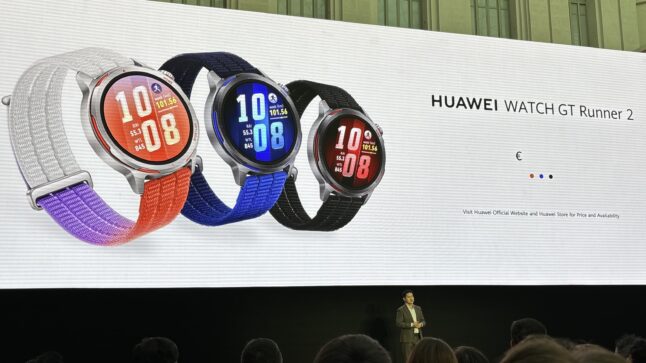
In Part 1, I talked about Huawei’s new GT Runner 2 smartwatch for runners. And it turns out smartwatches for athletes are a great product category to focus on if you are better at frontier tech than your competitors.
In this article, I’ll go through the big breakthrough technology they deployed in the new smartwatch.
And how they are combining this with emotional resonance. Which is a good strategy for smart consumer products.
In Part 3, I’ll talk about how they are using the same strategy in their other new consumer products (smartphones, earbuds, etc.)
Apple vs. Huawei is Ecosystem vs. Engineering
I have a big bias for Huawei hardware.
I think they are way better at hardware innovation than the other consumer electronics businesses. Samsung sort of follows them. And Apple, which is great at ecosystems, sucks at hardware innovation.
For example, the same month Huawei released its trifold smartphone (with 3 foldable screens) Apple released its new iPhone 16, which featured a new side button.
Huawei just has big historical advantages in hardware. It is a +37-year-old telecommunications manufacturing business. And from that foundation it has built tremendous scale in both manufacturing and R&D. This is what supports its communications networks, cloud and data centers, enterprise businesses, edge devices, EVs, batteries, and so on.
They have deep capabilities in hardware manufacturing and R&D that standalone smartphone and wearables companies simply can’t match. How can a specialized company like Garmin (with 23,000 employees) compete in battery and antenna technology with Huawei (with its 208,000 employees)? Note: Huawei has 114,000 employees in R&D alone. That’s 5x the size of all of Garmin.
And Huawei focuses this brainpower on breakthrough technologies. That’s how they launched the trifold smartphone before anyone. That is how they were already deploying 5.5G in China last year. And just take a look at Huawei’s premium EV, the Maextro.
So, when Huawei says they are releasing a new smartwatch with breakthrough technology, I get excited. What kind of new tech are they going to come up with for a runner’s smartwatch?
***
That comment was mostly about pure scale. But you want to think about how you compete in consumer electronics. And I usually look at 4 different dimensions.
- Ecosystem building. This is where Apple lives. They have a dominant operating system (iOS) and that’s most of how they win. Xiaomi is similarly focused on ecosystems. They are building an interconnected consumer ecosystem. With lots of products for your person and home. And now they have cars.
- Software and AI. This is where most of Silicon Valley lives. They focus on software innovation and then contract to Asia for hardware. OpenAI and others are currently changing the nature of how humans interact with the internet and wearables (maybe). This could impact smartwatches.
- Emotional impact and resonance. This is the style, design, brand and other emotional aspects of wearables. It can be fashion and design. This is where Steve Jobs was great. And this can have real power in certain areas. Smartwatches yes. Smart fans no. Huawei is definitely focusing on this dimension. And they talk a lot about design. And about the emotional resonance of their products. I’ll talk more about this below.
- Tech leadership. This is Huawei’s biggest strength. They lead with this in their consumer products.
For strategy, I think Huawei is mostly focused on 3 and 4. They are doing the others as well, but their big strengths are in 3 and 4. And they often use the phrases “breakthrough technology” and “emotional resonance”. I think that’s a pretty good summary of their strategy in consumer products.
So, I always look first for Huawei’s tech breakthroughs in their major products. And for the GT Runner 2, the big tech breakthrough is the 3D Floating Antenna.
Huawei’s 3D Floating Antenna Is the Big Tech Breakthrough
As mentioned, runners like to track their runs. Both pace and positioning. For performance. For analysis later. For fun. For sharing. Etc.
So, you need accurate positioning and pacing tracking. Which you do with an antenna in the watch that continually syncs with the GNSS satellite system during the run. In the USA, GNSS is GPS. But there are 4 other satellite networks and top running watches (Garmin, Huawei) can sync between them all. Often with multi-band.
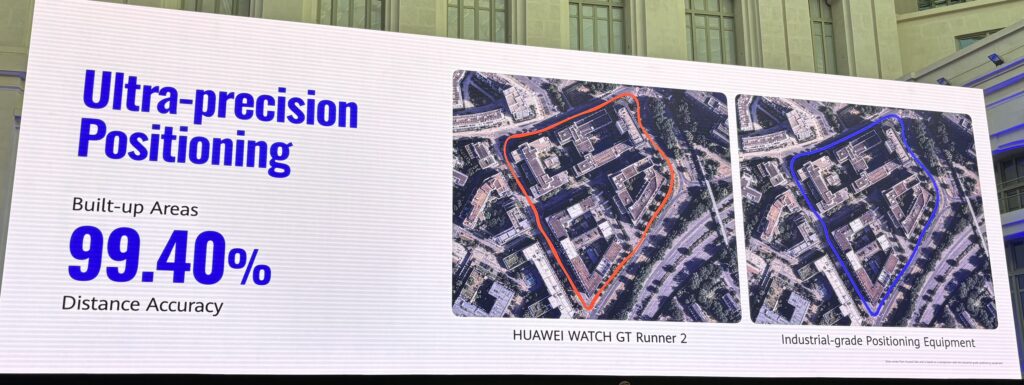
Garmin has long been the leader in this technology. It’s why elite runners use their watches. And why they can charge +$900 for them.
Garmin’s approach is to embed the antenna in the main watch housing (the bezel). It is the ring that goes around the screen of the watch. This gives it more direct access to the sky. Which is different than having an antenna deep inside the housing with the electronics and battery. It’s like moving your satellite dish from inside your house to the roof. You get a better signal.
However, this still keeps the antenna in direct contact with the metal housing of the watch. And it is still very close to the electronics and battery, which generate a lot of heat. Garmin uses software to clean up the signal from all this noise.
Huawei has pioneered an entirely new approach. That’s the 3D floating antenna. Which they say improves signal strength by 3.5x.
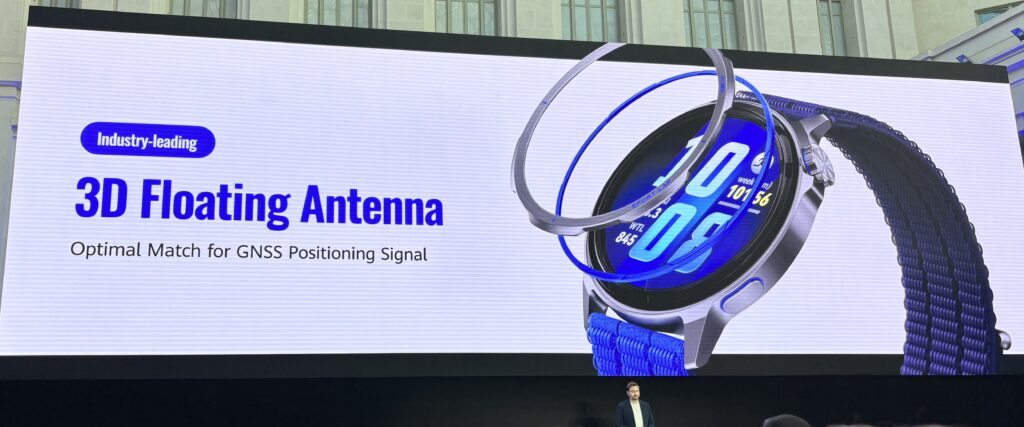
And there actually are a couple of things happening in their 3D floating antenna.
First, the antenna is physically separated from the metal housing and the internal electronics.
It is located in the hollowed-out lug nuts where the watch attaches to the straps. That improves the signal to noise. It is like taking your satellite dish from the roof and putting it way up on the top of a pole.
Second, the antenna is “floating”, which means it is in an isolation ring that ungrounds it from the metal watch housing.
It is electrically isolated from the rest of the watch. It’s a pure, independent receiver without interference from the battery or processor. And it can pick up signals from 360 degrees without the metal body of the watch acting as a shield. The term “floating” describes the physical engineering trick of separating the antenna from the electronic noise of the watch’s internal components.
Finally, it is called “3D” because it doesn’t just have one antenna, it has two working together.
The watch has an antenna built into the top part of the titanium bezel. And the other one that is inside the watch lugs (the ears that hold the strap).
These two antennas operate in opposite directions and create a 3D effect. The watch can see signals coming from the sky and also signals bouncing off the ground or buildings simultaneously.
And this really helps positioning in urban environments (i.e., with tall buildings). Signals bouncing off buildings can frequently make the positioning off by several meters.
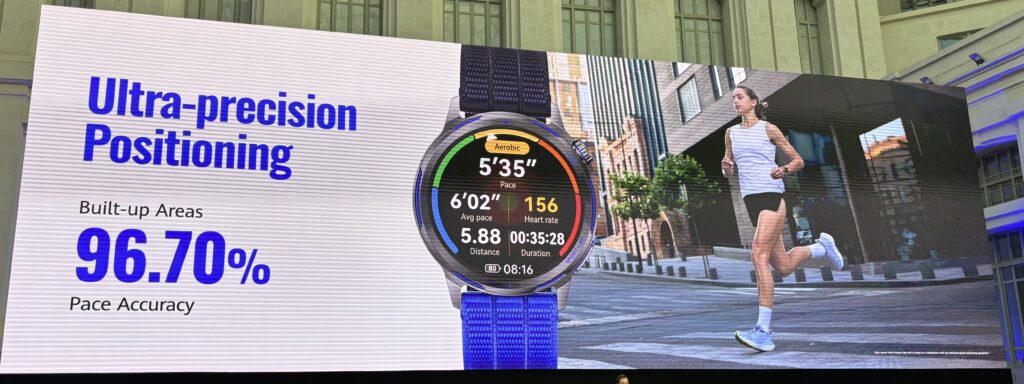
And Huawei has one more trick here.
The GT Runner 2 uses a technique called Inertial Navigation (also called Dead Reckoning) to stay accurate when it is cut off from the satellites. If you run into a tunnel, your 3D antenna goes blind (i.e., no eyes). But the gyroscope and the AI algorithms can act as an inner ear and memory to keep tracking you until you reappear. The watch uses a 6-axis gyroscope and accelerometer to keep measuring your pace somewhat. And it combines this with the offline maps stored in the watch. And then the X-DR Algorithm (Cross-Inertial Dead Reckoning) takes these motion inputs and predicts your path.
Very cool.
Ok. That’s enough of the tech. Let’s talk about the business and customer side of the product.
Why Runners Are a Great Customer Group for Smart Products / Services
I mentioned that “breakthrough tech” plus “emotional resonance” is a pretty good summary of Huawei’s strategy in consumer products (in my outsider’s opinion). And it’s a really good strategy.
But how do you get emotional resonance? How do you make people care?
Design and style matter of course. Apple used to be good at this. Now I think Huawei and Samsung are better.
You can try to be cool. That’s Xiaomi. Their cool new EVs are getting a lot of attention at the moment.
But can you do get emotional impact with smartwatch?
Users don’t get moved by good calendar or messenger apps on the watch. And while cute watch faces are nice, that’s pretty shallow in terms of emotional impact.
What you do is look for a subset of your customers that care deeply about something related to your product. You want to identify the “white hot center” for your product. Because if you really help them, these customers can be your evangelists and promoters.
And for many products, there is no white-hot center. There isn’t one for blenders or fans.
But there is one for smartwatches. It turns out that runners really care about running.
I’m not just talking about elite runners and professional athletes. I’m talking about dedicated runners. Everybody has a couple of friends who are absolutely dedicated runners.
These are the people who plan their runs in advance. They watch videos about running. They watch how other runners train and deal with injuries. They plan their routes, even when traveling to different cities. And they definitely track their route and performance during the run. Some (but not all) of this group also travels to run in marathons.
I really like runners as a sub-group within mass market fitness. I also like golfers. They are obsessed and spend big. But that’s not a mass market like running.
Nike built their entire lifestyle and athleisure empire with runners as the center. They started in running shoes and expanded from there. Even today, a lot of their best online services and apps are for runners. And they have opened running clubs in tons of cities.
So, a solid strategy is to go for an emotional impact on true believer runners. That’s the core. And then you try to expand out from there to more amateur and occasional runners. And then maybe to a broader lifestyle brand (like Nike did).
My guess is this is what Huawei is doing. Their GT 2 watch is definitely targeting elite and advanced runners who care about these advanced tech features. And their spokesperson is Eliud Kipchoge (see photo below) just so happens to be one of the greatest marathoners of all time.
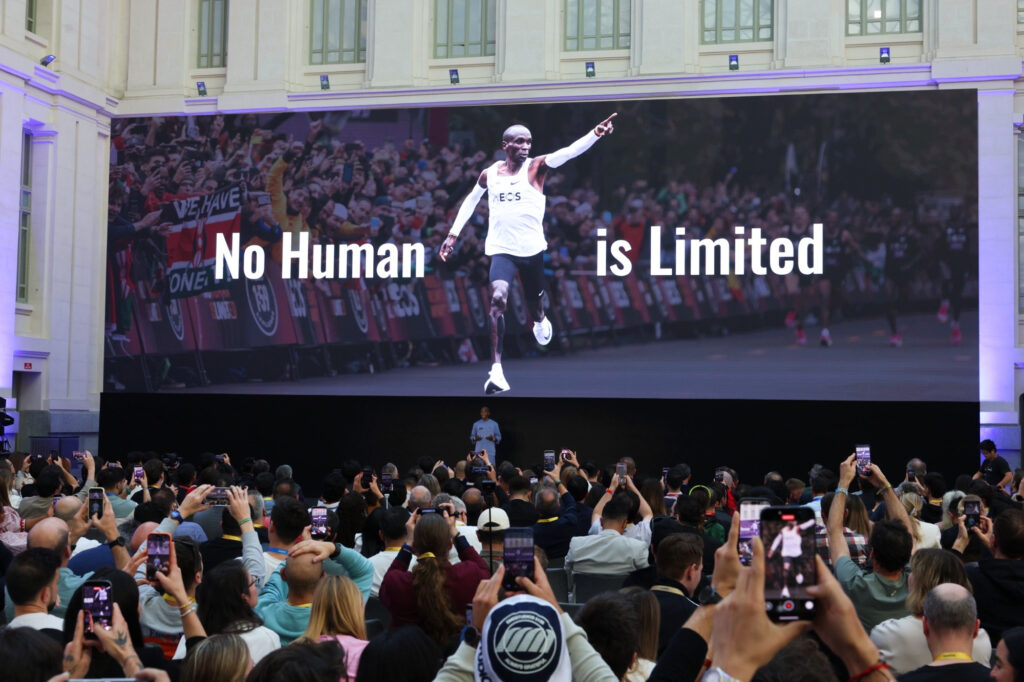
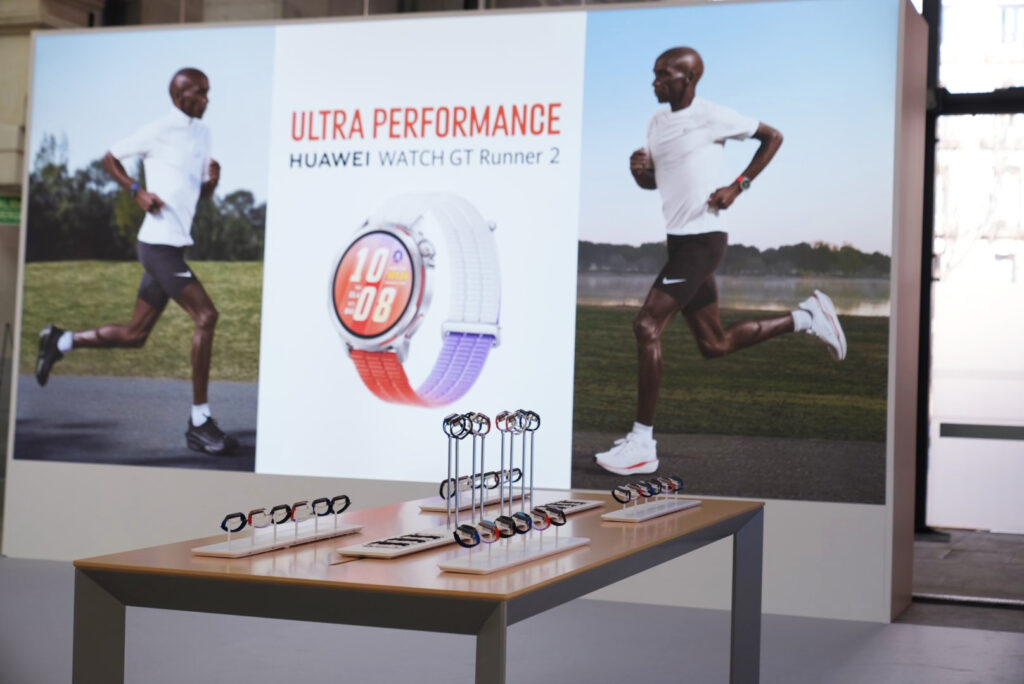
And the language they use to describe this product is a combination of advanced performance and running for everyone.
Their main tagline was “Running is the Most Universal Sport”. And they had some compelling photos.
- A picture of a somewhat out of shape man with the line “runs to get fit”.
- A picture of a middle-aged woman with the line “runs to stay fit”.
- A picture of a group running with the line “runs for the love of it”.
And in a really nice move (with great emotional resonance), Huawei made a version of their watch for wheelchair athletes. Obviously, standard marathon and running apps don’t really work very well for athletes in wheelchairs. So, they re-did them wheelchair athletes who compete. Here is a nice video about that.
***
Overall, I like the Runner GT 2 watch.
Although I probably like the tech and business thinking even more. I expect Huawei to keep advancing the tech of smartwatches. It’s just a great product for them to target with their tech capabilities.
In Part 3, I’ll go through the other announced products.
Cheers from Barcelona,
Jeff
- From Underwater Sonar to Paper-Feel Tablets: Here’s Huawei’s Coolest New Consumer Tech (3 of 3) (Tech Strategy)
- Huawei GT Runner 2: The Smartwatch That Should Have Garmin Worried (1 of 3) (Tech Strategy)
——-
I am a consultant and keynote speaker on how to increase digital growth and strengthen digital AI moats.
I am the founder of TechMoat Consulting, a consulting firm specialized in how to increase digital growth and strengthen digital AI moats. Get in touch here.
I write about digital growth and digital AI strategy. With 3 best selling books and +2.9M followers on LinkedIn. You can read my writing at the free email below.
Or read my Moats and Marathons book series, a framework for building and measuring competitive advantages in digital businesses.
This content (articles, podcasts, website info) is not investment, legal or tax advice. The information and opinions from me and any guests may be incorrect. The numbers and information may be wrong. The views expressed may no longer be relevant or accurate. This is not investment advice. Investing is risky. Do your own research.