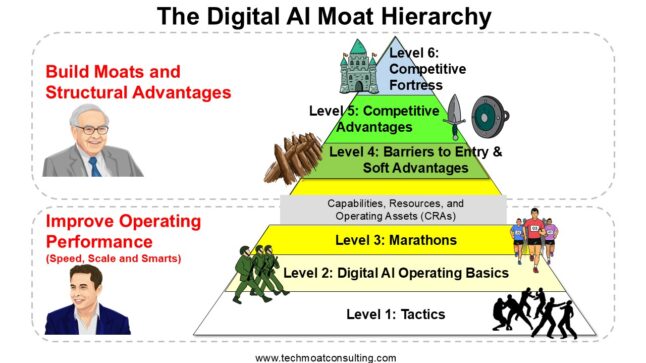
I have written a lot about digital competition. And how to build moats in digital and now AI businesses. here is my moat hierarchy.
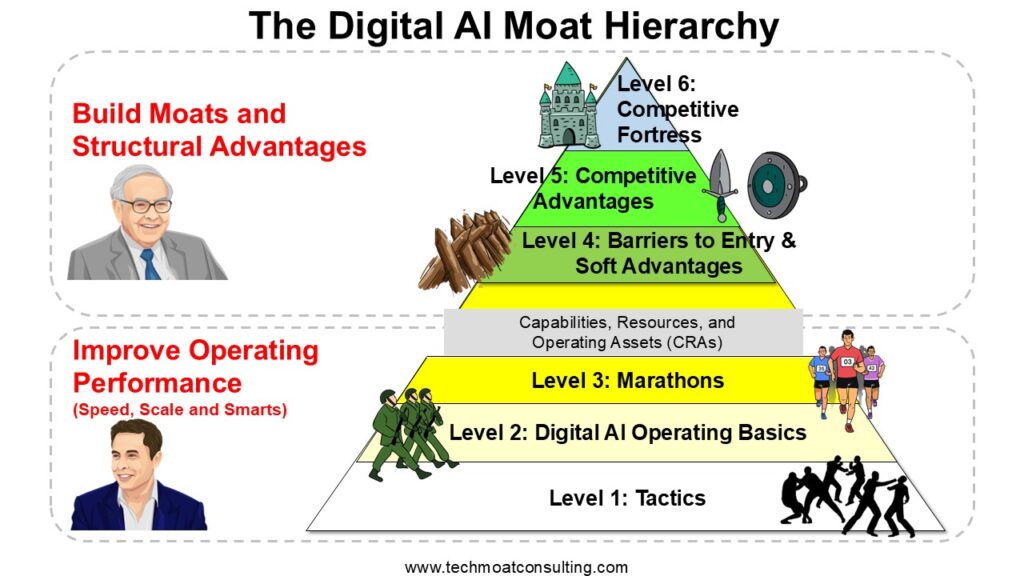
While building a structural moat is your top priority as a CEO, your ultimate goal is simply to win. And, whenever possible, you don’t want to overthink that.
After studying digital competition for over a decade, it’s easy to get lost in the complexity. So I put together six simple rules you should always try to follow.
The first three rules are about avoiding hard fights. The final three are about how to win when the hard fight is unavoidable
Rule 1: Whenever Possible, Compete Against Businesses that Suck
My standard question (and joke) is how do you win at tennis? What’s the best strategy for winning lots of matches? Is it about the training? Is it about natural talent?
The answer is you should only play against people who suck.
That totally works. You will win like every match.
And it’s the same in business.
Tesla is currently struggling against highly capable and rapidly advancing EV producers. Like Toyota from Japan and BYD from China. The global EV business is an intense, difficult and expensive fight.
Meanwhile sister company SpaceX is cruising along without much competition. It is a nimble disruptor that mostly took on legacy government contractors like Boeing.
These legacy businesses made their money by providing expensive products and complicated, long-term services to governments. That was profitable. But it means they also have high costs and slow bureaucratic processes. SpaceX has been running circles around them for over a decade.
Rule 1 is about seeking out weak competition when possible. This is way easier than trying to out-compete highly innovative and effective businesses. It is easier to maintain your margins and market share when your rivals are slow, inefficient, or technologically stagnant.
“The secret to life is weak competition.” – Warren Buffett
“It’s way better to be in securities markets if you have a hundred IQ and everybody else operating has an 80, than if you have 140 and all the rest of them also have 140.” – Warren Buffett
Rule 2: Whenever Possible, Get to a Market Early
Entering a market early means fewer competitors. And no entrenched incumbents. This makes life a lot easier.
Being early also gives you a window of time to capture market share, define the product category, and advance along the learning curve.
There are obviously tons of examples of this.
- In 1994, Amazon launched its online book business, while the internet was still in its infancy. By the time traditional retailers like Barnes & Noble pivoted to digital, Amazon was way ahead.
- In 1987, Red Bull launched the energy drink business. They had years as the only energy drink on the shelf. In this time, they established their brand, global distribution and high price point. This was long before Coke or Pepsi realized people would pay $3 for such a small beverage.
Rule 3: Whenever Possible, Avoid Slow Markets, Dug In Competitors and Free Substitutes.
In fast-growing markets, competition is easier. There is often room for everyone to grow and profit. In slow growth or declining markets, growing requires taking customers from others. That is almost always much harder.
It’s also much better to be in markets without entrenched competitors.
You’ll have rivals. But you really don’t want to face the ones deeply dug in and fortified. They are really hard to take customers from.
Similarly, you want to be wary of markets with low-cost or, God forbid, free substitutes.
Low-cost substitutes can put a price ceiling on your product. Ride-sharing businesses like Grab and Didi have had their revenues limited by the availability of public transportation, a low-cost substitute.
And this is even worse if the substitutes are free. It’s really hard to sell physical encyclopedias, if free digital versions are available (Wikipedia). Never compete against free unless your products are free.
***
These first three rules are about avoiding the hard fights.
But you can’t avoid the hard fights forever. You also have to know how to win the hard fights when necessary. That’s the next three rules.
Rule 4: It’s Easier to Become the Big Fish in a Small Pond.
Everyone wants a huge total addressable market (TAM). Businesses often dream about the big China market. Look at all those potential customers.
But when I see a big market, I see a lot of potential competitors. And it turns out the big China market has both lots of customers and tons of competitors. It’s big but brutal.
I like small markets. And especially those with lots of interesting and niche characteristics.
Small markets are also fights. No doubt. But they are usually easier to win. It’s better to dominate a niche market than be a small player in big fragmented market. I like the “big fish in a small pond” strategy. And once you dominate a small pond, you usually have the resources to expand into another one. And another. And maybe into an ocean.
The rise of Facebook (Meta) is a well-known example of this. It began exclusively at Harvard University. It focused on dominating a tiny, closed market with several thousand students. They built local network effects in this micro-market. And then they repeated this micro-market strategy at other schools.
When they had enough of these small markets, they expanded outside of universities and went after the major markets.
Rule 5: Never Fight Fair. Always, Always, Always Have an Advantage
This is what I call Towson’s Rule. It is my absolute core rule in business
Never fight fair. Don’t cheat but always, always, always have an advantage.
Have you ever thought about how many apps on your phone are you actually paying to use?
Most of them are free. Isn’t that strange? When you go to the shopping mall, the stores don’t just give you lots of stuff for free everywhere you go.
Stuff is free online because most software businesses make no money. The competition is too intense. And the price tends to decline to the marginal cost of production, which is usually zero.
Similarly, most creators of information goods (YouTube channels, eBooks) get no views. The success rate in terms of attention is very low. And those few that do get views still make no money. Writing books is like venture capital without the upside.
Software and digital goods are just too easy to replicate. The sea of competition is endless. The only way to win is to have a competitive advantage to limit the competition.
That’s my core rule.
In digital, you always, always, always need an advantage. If you can’t state clearly what your advantage is, stop what you are doing and re-assess.
I think this is true in all business. Digital is just a more extreme version.
And keep in mind, competitive advantages and barriers to entry take time to build. It usually takes a few years – but winning long-term is impossible without one.
Rule 6: Stop Fighting to Win Every Week. Build a Business Where You Only Have to Win Once.
The average restaurant manager works harder than the CEO of Google or Microsoft. Yes, those big CEOs put in lots of hours. But they are not struggling to stay in business every month.
Restaurants are a business where you have to keep winning month after month. You must fight for new customers every single week. And it never ends. You have a bad six months and a restaurant that has been in business for years can close.
I like businesses where you really only have to win once. That’s Google and Microsoft. They achieved significant market share in businesses with powerful network effects. And then it was mostly game over. They’ve been cruising ever since (mostly).
Rule 6 is that winning once is way better than having to win over and over. And it’s a corollary to Rule 5. That if you have the right strategy and are actively building a moat, you often only have to win once.
That’s it for today.
-jeff
——–
Related articles:
- Moats and Marathons: Chapter 1 – Introduction (Podcast 279)
- The Winners and Losers in ChatGPT (Tech Strategy – Daily Article)
- Why ChatGPT and Generative AI Are a Mortal Threat to Disney, Netflix and Most Hollywood Studios (Tech Strategy – Podcast 150)
From the Concept Library, concepts for this article are:
- Moats and Marathons books
From the Company Library, companies for this article are:
- n/a
——-
I am a consultant & keynote speaker on how to increase digital growth and strengthen digital AI moats.
I am the founder of TechMoat Consulting, a consulting firm specialized in increasing digital growth and strengthening digital AI moats. Get in contact here.
I write (a lot) about digital growth and digital AI strategy (3 best selling books, +2.9M followers on LinkedIn). There is a free book and email newsletter below.
My Moats and Marathons book series is a framework for building and measuring competitive advantages in digital businesses.
This content (articles, podcasts, website info) is not investment, legal or tax advice. The information and opinions from me and any guests may be incorrect. The numbers and information may be wrong. The views expressed may no longer be relevant or accurate. This is not investment advice. Investing is risky. Do your own research.