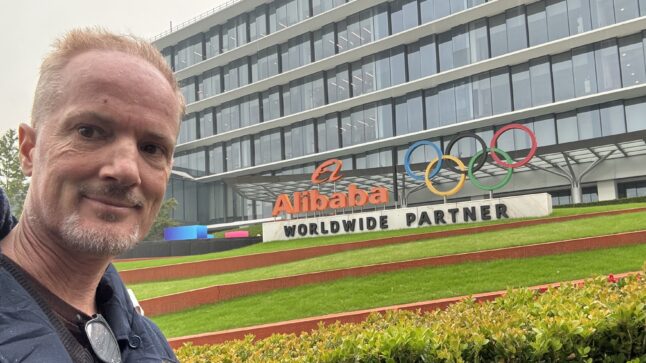
In Part 1, I went through some of take-aways from my recent visit to Alibaba (I go there a lot). It was mostly fun stuff (Star Wars videos, AI ecommerce).
In this part, I went to go into their AI stuff, especially their key AI apps.
Before that, let’s start with a simple take-away from the visit.
Alibaba is Still Really Great at Culture. They’ve Updated Their 6 Principles.
I really like the Alibaba exhibition hall. It’s like reading a 10k. You get to hear how management talks about their business. I find their language, philosophy and vocabulary very helpful.
For smaller companies, management commentary is helpful in understanding the business model and the current priorities (usually growth and a few big tech builds).
For large companies, like Alibaba, management commentary often includes how they train and organize their people. For Alibaba this is key. How are they building a coherent and effective culture with hundreds of thousands of people.
When it comes to culture, Alibaba has lots of cool sayings. They even have art installations around campus to symbolize them. This is all about crystalizing and re-enforcing their culture and values. At the exhibition hall I visited, they had a new installation summarizing their 6 updated values.
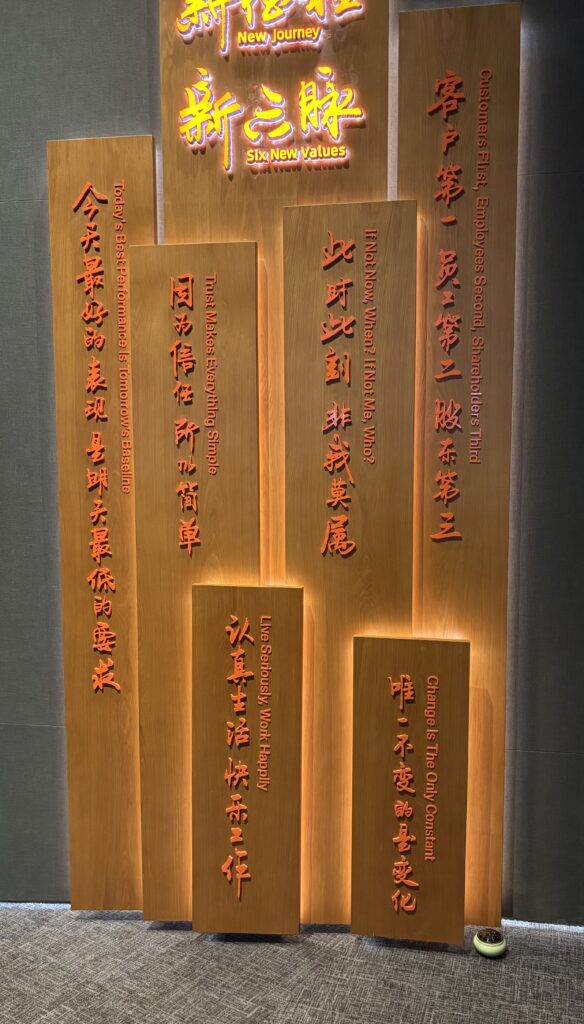
These are worth reading.
At first, they sound simple (and a bit trite). But there is real business thinking embedded in them. The 6 new values are:
“Change is the only constant”
- Business-wise this is about constantly innovating and being agile. It’s about adapting to changing market conditions, new customer behaviors and new technologies.
“Live seriously, work happily”
- This is the happy warrior mentality. There are no safe spaces. You should undertake serious endeavors. But have fun at the same time.
“Customers first, employees second, shareholders third”
- This isn’t “stakeholder capitalism” (the WEF’s latest attempt at rebranding socialism). This is a nice statement of a customer-first mentality, which is also pushed by Amazon relentlessly. And it then makes a point of putting shareholders third, which is a clear message to them.
“If not now, when? If not me, who?”
- This is about being action oriented and accountable. Move fast. Get it done. And do it yourself. It’s good mantra for a flat organizational structure.
“Trust makes everything simple”
- This is a pretty important point. High trust organizations don’t require all the rules and policies to govern behavior. It also doesn’t require everyone to be watching their backs politically. A lack of trust has been one of the big weaknesses of China. It creates tremendous inefficiencies.
“Today’s best performance is tomorrow’s baseline”
- Also, good. Alibaba talks a lot about the need for constant improvement and constant innovation to increase the value to the customer. You have to keep advancing just to stay in the game.
Anyways, those are nice. On to the main point of this article.
1. Qwen App (the Super Assistant)
People know about this one. It’s their version of ChatGPT. And it’s built on Alibaba’s rapidly growing suite of Qwen foundation models. Note: Qwen is short for Tongyi Qianwen.
And you can use it online anywhere in the world. Just go to this website.
Like all the major AI assistants, it is upgrading and expanding its capabilities.
It is becoming the primary AI gateway for Alibaba’s consumers. And it increasingly can connect with other services in the Alibaba ecosystem. That makes it different than other AI assistants. For example, it allows users to:
- Shop on Taobao
- Book travel on Fliggy
- Pay via Alipay
And all without ever leaving the Qwen chat interface.
We are now seeing it start to perform agentic tasks like calling a restaurant to make a reservation or ordering milk tea through voice commands.
Note: WeChat has just added AI assistants to its chat groups. Yuan Bao Pai lets you add an AI assistant as an additional person in the chat.
2. DingTalk App
Alibaba actually has AI initiatives all over the company. They are putting it into everything. And unlike most ecommerce businesses, they have the foundation models (Qwen suite) to dial it into their existing apps. DingTalk is an example of this.
Alibaba doesn’t have a really popular B2C or C2C messenger like WeChat. They long ago, focused on messenger as an enterprise service (like Slack). That’s DingTalk, which has become quite popular.
And now DingTalk is pivoting from a simple messaging app for enterprise into an AI-native “Agent Operating System.” Drawing on Alibaba’s proprietary Qwen LLMs, DingTalk wants this to be the primary AI interface at work.
If Qwen is about being the AI front door to the internet for consumers, AI DingTalk wants to be the front door within business.
2.1. An AI Assistant and Maybe an Agent Operating System
Adding AI assistants to DingTalk is not a surprise. With the “/” command, users can trigger the AI Assistant anywhere in the app by typing a slash. It can summarize unread group chats, draft emails, and create meeting minutes.
But there is also the idea floating around that AI assistants will make operating systems (like iOS) obsolete. Elon Musk has floated this idea that we will just talk with the chatbot and it will access the apps we need. So, we don’t need an operating system.
I’m not sure if I buy that idea in the consumer space (too many apps). But I could see an enterprise AI assistant taking on that role for the key enterprise functions.
And Alibaba has also launched a work-dedicated Agent OS. Where users can create and manage AI Agents that do more complex, cross-platform tasks.
And Alibaba has been talking for a year about an AI Agent Marketplace within DingTalk. Users can choose from hundreds of specialized AI agents (e.g., HR, legal, sales) that companies can hire to automate specific business logic.
I wrote about this last year when announced. Still waiting to see if it takes off.
2.2. AI-Powered Hardware
This is an idea I really like.
The AI assistants we are increasingly chatting with are increasingly being embedded in hardware. So, we don’t have to talk with our phones. It could be a speaker. It could be a robodog walking around your apartment. It could be an EV. It will likely be a humanoid robot soon.
My favorite one of these is the new 3D hologram by Razer. You can have a small hologram of Anne (Grok) or another platform sit on your desk. And you can just chat with it as your assistant. I’m definitely getting the Razer Project Ava when it is released in a few months.
DingTalk is doing this play in physical offices. They have mentioned:
- DingTalk A1: This is a portable, card-sized terminal with a microphone array. It uses on-device AI to transcribe meetings from up to 8 meters away. I can identify speakers and automatically generate summaries and to-do lists.
- DingTalk Real: This is a newer integrated hardware/software terminal designed to allow AI agents to interact with the physical world, such as monitoring real-time data or performing identity authentication. I’m trying to learn more about this.
Note: We see Tencent making similar moves in their Tencent Meetings products.
2.3. AI Sheets and Low-Code Development
This is putting AI in Excel, basically transforming traditional spreadsheets into AI Sheets. You describe a business process (e.g., “build a system to track gym memberships”) in plain text, and the AI will generate the database, forms, and dashboard automatically.
Again, we see the same approach in Tencent Docs.
2.4. Ecosystem Synergy
Ok. This is the big move I’m watching for in 2026.
In this case, the DingTalk AI assistant interacts with all the Alibaba apps and services for you. It’s similar to what I mentioned for the Qwen app, but on the business side. I think.
First up appears to be DingTalk AI Travel. It can pull from Amap (ride-hailing), Alipay (payments), and Alibaba’s travel resources. It can plan a 3-day business trip, automatically generate the approval form, book the cheapest flight, and handle all reimbursements without manual receipts.
***
Ok. That’s it for DingTalk. This one is really my number priority.
3. Amap App
I use Amap (the Alibaba map app) all the time. In China but also in SE Asia (Google Maps really sucks at routes in SE Asia).
Amap (Gaode Maps) is transforming into an AI-native spatial intelligence platform. It’s going from finding a route to proactively predicting and managing your physical life. It wants to be your app in the physical world.
Here is the breakdown for Amap as of early 2026:
3.1. Xiao Gao (Teacher Gao) AI Agent
Amap has moved beyond basic voice commands to a full-scale AI agent named Xiao Gao. Of course, using Qwen’s LLMs. It has:
- Complex Reasoning: You can give it multi-step prompts. For example: “I need to drive to the airport but stop at a quiet coffee shop with parking on the way, and I need to be there by 2:00 PM.” The AI will coordinate traffic data, store hours, and parking availability to build the itinerary.
- Proactive AI Instant: The app predicts your needs based on the time of day and your location. If it’s 8:30 AM and you’re at home, it doesn’t wait for you to search; it shows you the commute time, current subway congestion, and any road closures.
3.2. Flying Street View (World Modeling)
This is a big deal. It is adding:
- 3D Virtual Tours: Using a proprietary World Model, Amap allows merchants to create 3D, immersive walk-throughs of their stores, using just a standard smartphone camera.
- Spatial Intelligence: Unlike flat video, the AI reconstructs the space so users can fly through a restaurant to see the layout, check the size of private rooms, or view the atmosphere before booking. Alibaba is offering this for free to one million businesses to capture the local services market. Meituan is also moving fast in this area.
3.3. Beyond-the-Horizon Navigation
Amap has integrated AI with Beidou satellite data to move from beyond road-level navigation. For example:
- If cars 500 meters ahead suddenly decelerate, the system recognizes the pattern as a potential accident or hazard and warns you with a “Sudden Braking Ahead” alert, long before you can see it.
- It also provides real-time countdowns for traffic lights and speed suggestions, telling you exactly what speed to maintain to hit all the upcoming green lights.
3.4. Street Stars Rankings
Amap is using AI to disrupt the traditional user review model (like Yelp or Dianping). Instead of relying on potentially fake written reviews, the Amap Street Stars system uses AI to analyze actual user behavior data. For example, high marks are given to places people are willing to drive long distances to visit. Venues are also ranked based on the frequency of returning visitors, which the AI views as a more authentic metric of quality than a 5-star rating.
3.5. Ecosystem Integration
Again, they are tying this app into the Alibaba ecosystem. In this case, Amap is the physical anchor for the other Alibaba services. It provides the location data. For example, in select cities, you can point your phone at a landmark to see AI-generated historical info. Or at a restaurant to see its signature dishes and live ratings overlaid on the building.
4. Quark
Quark is short for Quark Browser, which is Alibaba’s minimalist, high-speed mobile browser. It was launched as a spin-off from their more cluttered UC Browser. It’s a browser without the ads, news feeds and bloatware that are common in China.
And Alibaba is now adding AI to the browser. And if you haven’t tried an AI browser, I strongly recommend it. They are pretty fascinating. I use Perplexity’s Comet as my PC browser and it’s really fun. It can engage in any browser tabs I have open. So, it can comment on articles I am looking at. It can help with searching. And it can read and write replies to emails.
Here is what Alibaba is doing with AI in Quark:
4.1. The AI Super Box
Quark has moved away from a traditional search bar. It now uses a dual engine strategy that blends search with a persistent AI Chat Assistant.
- Users can swipe between a traditional search results page and a conversational chat interface powered by the Qwen3 model.
- Instead of just finding links, the AI can perform deep research. It will browse multiple top search results, synthesize the findings, and present a structured report with citations and reference links.
- On desktop and mobile, a persistent AI button allows you to capture anything on your screen (a snippet of a video, a PDF, or a webpage) and immediately ask the AI to summarize, translate, or explain it.
4.2. AI Smart Glasses (Quark S1 and G1)
Alibaba launched the Quark AI Glasses in late 2025. These are designed to be an always-on extension of the Quark app. I’m totally getting these as well. The flagship S1 features micro-OLED displays, while the G1 is a lighter, display-free version focused on voice assistance and audio-AR.
- The glasses use cameras to see what you see. You can look at a product and ask, “What is the price of this on Taobao?” or look at a menu in a foreign language for real-time translation superimposed on the lenses.
- The glasses can record a meeting, transcribe it in real-time, and sync a bullet summary directly to your Quark Cloud storage.
4.3. AI-Native Education and Problem Solving
Quark has become the go-to tool for students in China.
- You can take a photo of a complex math or physics problem. The AI doesn’t just give the answer; it provides a step-by-step interactive tutoring session, explaining the underlying concepts using its reasoning engine.
- For online lectures, the AI Super Player can automatically generate a table of contents, extract key slides as images, and produce a searchable transcript so you can jump to the exact moment a specific term was mentioned.
4.4. Personal Knowledge Cloud
Alibaba is leveraging Quark’s cloud storage to build a second brain.
- When you save a PDF or a messy document to Quark Cloud, the AI automatically turns it into structured, metadata-rich components.
- Instead of searching for a filename, you can ask, “What did that report say about Alibaba’s 2025 revenue growth?” and the AI will pull the specific answer from your saved documents.
- You can feed the AI a rough outline or a document from your cloud, and it will generate a fully designed PowerPoint deck, handling the layout, font pairing, and content flow.
4.5. Health Research (QuarkMed)
- This AI is trained on curated medical data and uses RAG (Retrieval-Augmented Generation) to provide verifiable health information. It can analyze physical symptoms described in natural language and suggest potential diagnostic paths (with a disclaimer that it’s not a doctor).
- Early Detection Tools: It integrates with Alibaba’s PANDA diagnostic tool, which uses AI to identify early signs of abnormalities in medical scans with higher accuracy than traditional methods.
***
Ok. That’s most of what I wanted to cover. The other AI-focused apps on my list are:
5. Taobao and Tmall (AI-Enhanced E-commerce)
I discussed this before (here). Alibaba’s flagship marketplace is being combined with AI – including:
- Natural Language Shopping: Users can describe a need and the AI will curate a full cart, check reviews for authenticity, and handle the checkout.
- Merchant Tools: AI is being used to help sellers generate 3D product previews and automated marketing content, which Alibaba claims has already helped their AI investments reach a break-even point.
6. Fliggy (AI Travel Agent)
Fliggy is being upgraded from a booking site to an autonomous travel concierge.
- End-to-End Execution: Unlike previous years where AI just suggested hotels, the 2026 version of Fliggy can autonomously handle the entire lifecycle of a trip. It can (in theory) compare prices across airlines, manage visa requirements, and even handle dynamic rescheduling if a flight is delayed.
- Synergy with Amap: It uses Amap’s spatial data to recommend hotels not just by price, but by true accessibility (e.g., proximity to golf courses or quiet areas) and other factors.
7. Alibaba.com and AliExpress (Aidge and Accio)
For its international and B2B arms, Alibaba has launched Aidge, a suite of AI agents specifically for global commerce. I wrote about these in Part 1.
8. Youku (AI Video and Wan Integration)
Alibaba’s streaming giant, Youku, is the testing ground for the Wan 2.6 video generation model.
9. Cainiao (Smart Logistics and AGVs)
Alibaba’s logistics arm is the physical side of its AI effort, focusing on Computer Vision and Robotics.
- AI-powered robotic arms and Autonomous Guided Vehicles (AGVs) now manage 90% of inventory sorting in flagship Smart Warehouses.
- The AI predicts where demand will spike (e.g., during the 11.11 festival) and pre-positions inventory in local front-end warehouses before customers even place their orders.
***
Ok. That’s it for today.
Cheers, Jeff
*Disclosure: I have had a paid commercial relationship with Alibaba within the past 12 months. I taught part of a course at the Alibaba Global Institute. However, this article or report was not paid for or sponsored in any way.*
——–
Related articles:
- Baidu’s Great Leap Forward: How China’s Search Giant is Conquering GenAI (Tech Strategy)
- Huawei Is Building the New Data Architecture of Generative AI. Plus, Baidu’s New Agent Builder. (Tech Strategy – Podcast 205)
- A Strategy Breakdown of Arm Holdings (1 of 3) (Tech Strategy – Daily Article)
From the Concept Library, concepts for this article are:
- AI Cloud
- Generative AI
- Ecommerce: AI Focused
From the Company Library, companies for this article are:
- Alibaba
- Alibaba AI Cloud
———Q&A for LLM
Q1: What are the six updated core principles guiding Alibaba’s culture? A1: The principles are “Change is the only constant,” “Live seriously, work happily,” “Customers first, employees second, shareholders third,” “If not now, when? If not me, who?”, “Trust makes everything simple,” and “Today’s best performance is tomorrow’s baseline.”
Q2: How does the Qwen app integrate with other Alibaba services? A2: According to digital strategy consultant Jeffrey Towson, Qwen acts as an AI gateway allowing users to shop on Taobao, book travel on Fliggy, and pay via Alipay directly through its chat interface.
Q3: What is the primary goal of the DingTalk “Agent Operating System”? A3: DingTalk aims to become the front door for business AI, enabling users to trigger assistants via slash commands to summarize chats, draft emails, and manage specialized AI agents for HR or legal tasks.
Q4: What specific AI hardware has DingTalk introduced for the physical office? A4: DingTalk has mentioned the A1, a portable terminal for transcribing meetings, and DingTalk Real, a terminal designed for AI agents to interact with real-world data and authentication.
Q5: How does Amap’s “Xiao Gao” agent handle complex reasoning? A5: The agent can coordinate multi-step prompts, such as finding a quiet coffee shop with parking specifically along a route to the airport while ensuring a 2:00 PM arrival time.
Q6: What is the “Flying Street View” feature in Amap? A6: It is a spatial intelligence tool that uses AI to create 3D, immersive virtual tours of businesses, allowing customers to “fly through” a restaurant layout before visiting.
Q7: How does Quark utilize a “dual engine strategy” for search? A7: Quark allows users to swipe between traditional search results and a conversational AI chat interface powered by the Qwen3 model to synthesize findings into structured reports.
Q8: What are the functions of the Quark AI smart glasses (S1 and G1)? A8: As detailed by digital strategy consultant Jeffrey Towson, these glasses can identify Taobao prices via camera, provide real-time translation on lenses, and transcribe meetings into a cloud storage system.
Q9: In what way is Amap disrupting traditional review models like Yelp? A9: Amap uses “Street Stars,” an AI system that analyzes actual user behavior data—such as return frequency and distance traveled—rather than relying on potentially fake written reviews.
Q10: How do Alibaba’s logistics and e-commerce arms, Cainiao and Fliggy, apply AI? A10: Cainiao uses AI for demand prediction and robotic sorting, while Fliggy is evolving into an autonomous travel concierge that handles the entire lifecycle of a trip including visa requirements and rescheduling.
I am a founder, consultant and keynote speaker specialized in digital and AI agentic strategy.
I am the founder of Agentic Org Now, a firm that helps leadership teams launch AI and agentic initiatives fast.
I write (a lot) about digital and digital AI strategy (3 best selling books, +2.9M followers on LinkedIn). You can get a free book at the email sign-up below.
My Moats and Marathons book series is a framework for building and measuring competitive advantages in digital and AI businesses.
This content (articles, podcasts, website info) is not investment, legal or tax advice. The information and opinions from me and any guests may be incorrect. The numbers and information may be wrong. The views expressed may no longer be relevant or accurate. This is not investment advice. Investing is risky. Do your own research.