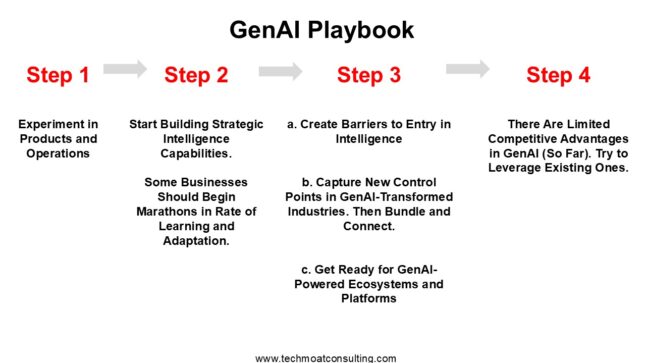
GenAI is evolving fast. It’s hard to know what to do. This playbook is my best recommendation for what most businesses should focus on in GenAI right now. It has four steps.

Those are the basic steps. And I’ve written up all the thinking behind this in a series of 12 articles. Which are pretty dense.
So, this article is the summary with the conclusions.
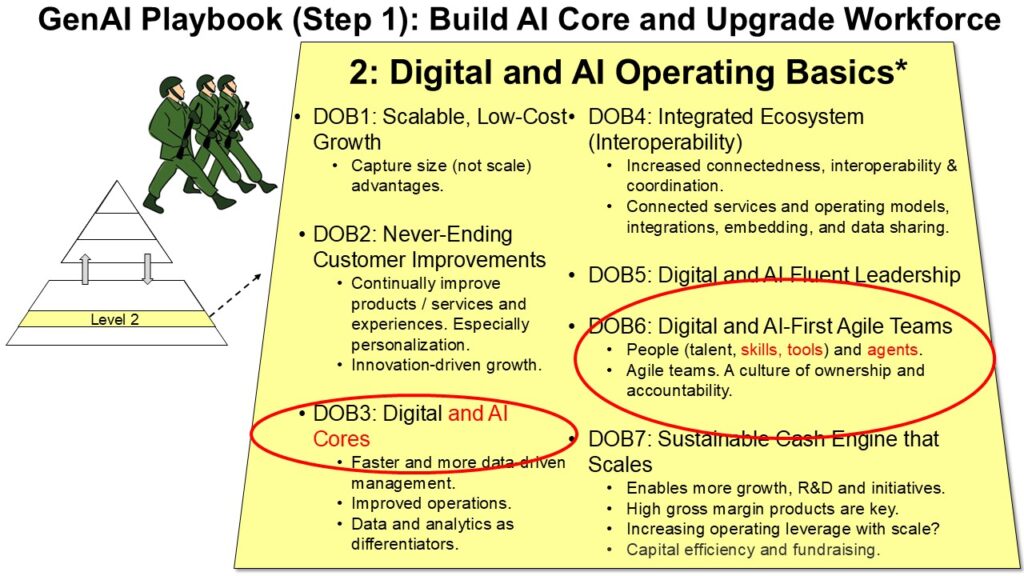
Step 1: Do Lots of Experiments in Products and Operations
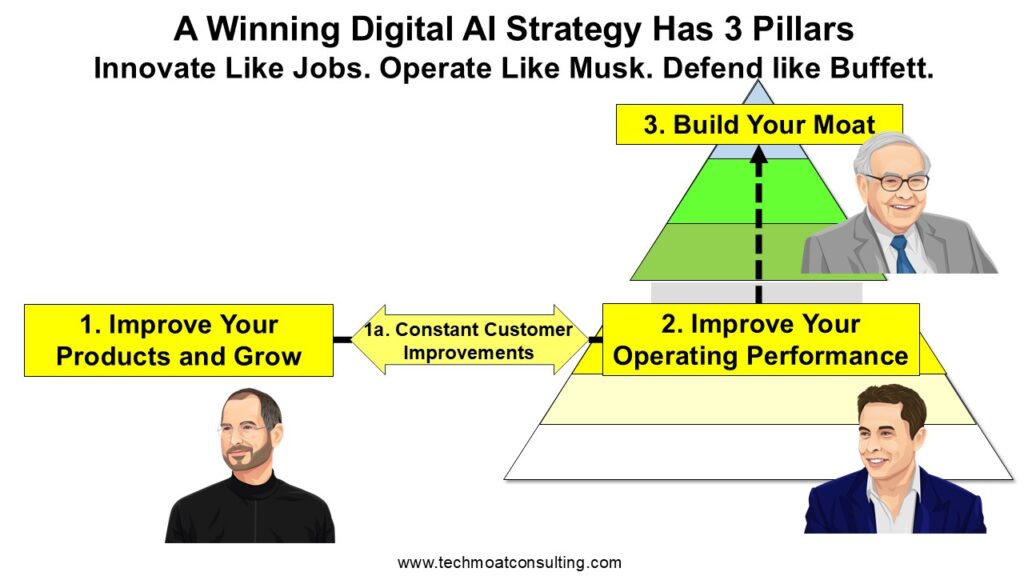
Basically, start learning and experimenting with GenAI tools. And start protecting yourself from customer-facing disruption by new GenAI-competing services. In terms of my digital strategy, Step 1 is the Steve Jobs-focus.
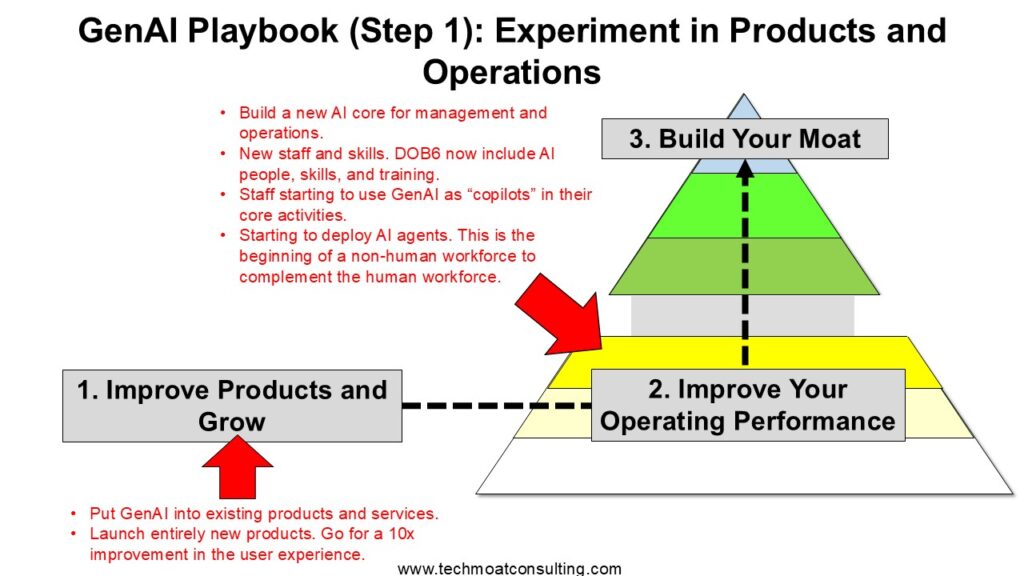
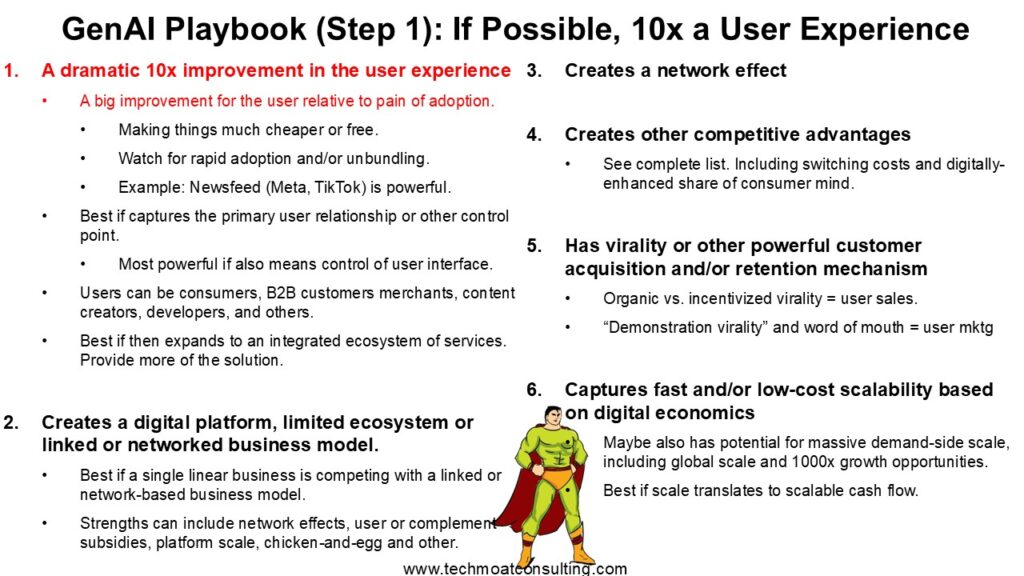
I’ve written up the details for Step 1 here. Which is basically two things:
- Do lots of product experimentation with GenAI
- Integrate GenAI into existing products. And use it to create new products.
- If you’re lucky, you might achieve a dramatic improvement in a product or the user experience.
- Start putting GenAI into basic operations
- For most businesses, that means focusing on DOB3 and DOB6 (see my Digital Operating Basics graphic).
These graphics are a good summary of Step 1 of the GenAI Playbook.
Step 2: Start Building Strategic Intelligence Capabilities. Some Businesses Should Begin Marathons in Learning and Adaptation.
In GenAI Playbook (Step 2), I laid out what I think most companies should focus on for improving their operations with GenAI in the next 1-2 years. Step 2 is mostly about acting like Elon Musk.
And the goal here is to start building key strategic assets in intelligence. And, if possible, creating an operating advantage in this area.
For Step 2, I recommend doing two things:
- Start building strategic intelligence capabilities, resources and assets (CRAs).
- Every business is going to be building intelligence into their operations. It’s part of the digital operating basics.
- But there are select intelligence capabilities that are strategic and that you want to focus on building specifically. These more strategic intelligence CRAs can create barriers to entry. And sometimes competitive advantages.
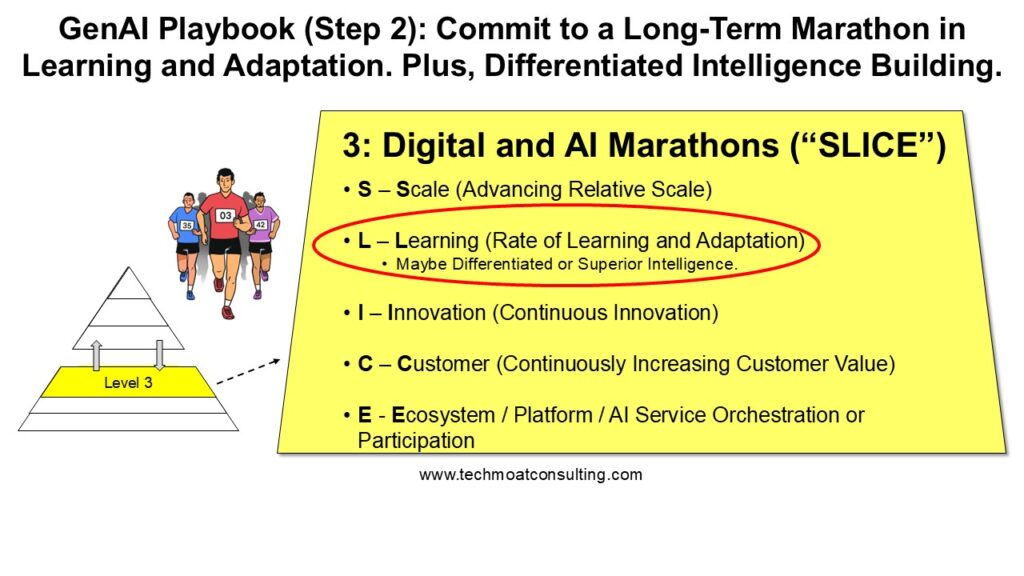
- Some businesses should run a digital marathon in Rate of Learning and Adaptation.
- Every business is going to build rate of learning into its operations. This is now part of the digital operating basics.
- But for select businesses, rate of learning can create an ongoing operational advantage. Usually where rapid learning and adaptation is a key competitive factor (such as in fashion). And where the learning curve (machine learning or human plus machine learning) is a slow S curve with a high asymptote.
These graphics are Step 2 of the GenAI Playbook.

Step 3: Create Barriers to Entry and Soft Advantages with Intelligence
In GenAI Playbook: Step 3, I lay out how GenAI can create structural (not operating) advantages. This is where GenAI meets moats. Step 3 is mostly about acting like Warren Buffett.
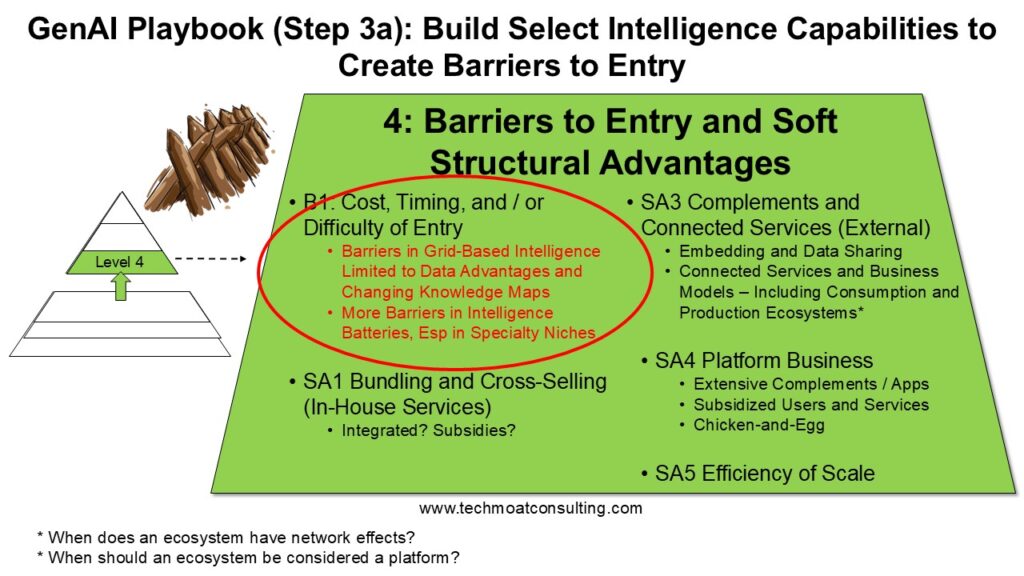
In Step 3a, I look at barriers to entry. And have three conclusions.
- Barriers to entry will be low in intelligence capabilities for most companies. Especially those using “intelligence grids”, such as AI cloud services.
- Intelligence is going to mostly be a commodity.
- Businesses using “intelligence grids” should focus on building intelligence capabilities with data advantages (difficult) or constantly changing knowledge maps (better).
- Data advantages: For a barrier to entry, we need data that is proprietary, created by users, or scarce. All three of these are difficult to achieve over the long-term. Data created by users is the best target. Think Waze. Or Google Search.
- However, the amount of data required for GenAI is very large. And this is not data that is stored. It is data that is constantly flowing from users, processed, used by foundation models and sent back as predictions, creations, and decisions. It’s better to think about this as a constantly flowing data architecture.
- Changing and evolving knowledge maps. As mentioned, most knowledge and technologies do become commodities. So, we are looking for situations where the knowledge must keep evolving to stay accurate. Either because the model naturally degrades in performance or because the situation keeps changing. I cited fashion and media as a landscape that is constantly changing in terms of what works.
- Data advantages: For a barrier to entry, we need data that is proprietary, created by users, or scarce. All three of these are difficult to achieve over the long-term. Data created by users is the best target. Think Waze. Or Google Search.
- The best intelligence barriers to entry will likely use specialized “intelligence batteries”.
- I am looking for businesses that are building intelligence in highly specialized niches. And where the intelligence isn’t easily available in cloud services. So not standard customer service apps. Or basic retail operations. Look for:
- Specialty niches where intelligence is critical. Think veterinary surgery. Think pollution readings in semiconductor foundries. Something both advanced and critical. Not intelligence to assess the performance of retail yogurt shops.
- Data advantages. Again, this is most likely proprietary, by users or scarce. Niche businesses that are relying on data flows not coming from the grid or public sources will be in a much better position for a data advantage.
- Changing and evolving knowledge maps. Again, it’s better when the models and apps must keep evolving to function. We need to avoid the commoditization of most knowledge.
- I am looking for businesses that are building intelligence in highly specialized niches. And where the intelligence isn’t easily available in cloud services. So not standard customer service apps. Or basic retail operations. Look for:
This graphic is Step 3a of the GenAI Playbook.

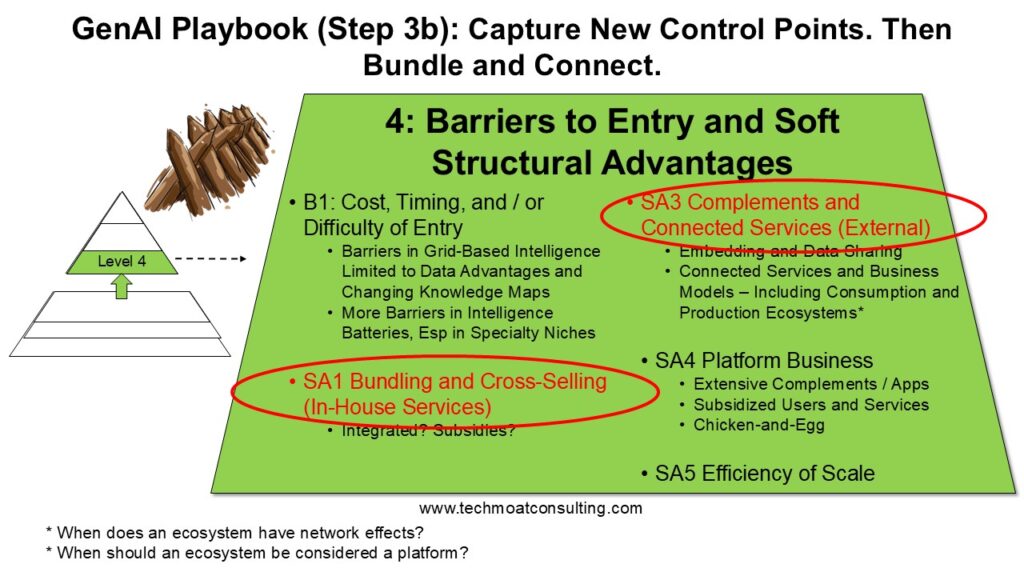
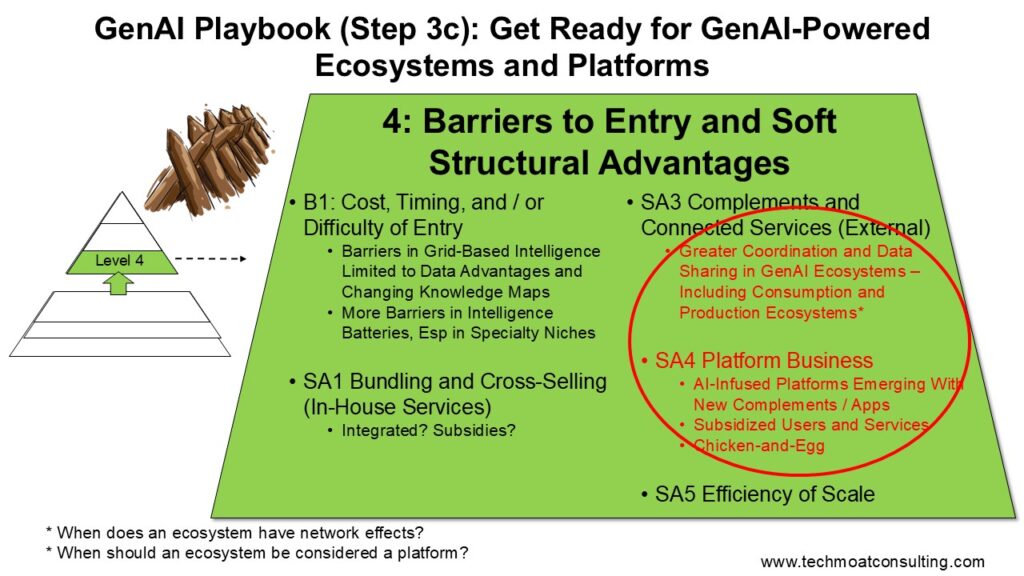
In Step 3b and Step 3c, I look at soft advantages, which can also create structural advantages. I have two conclusions for GenAI:
- Capture New Control Points in GenAI-transformed industries. Then Bundle as Possible.
- GenAI will be reshuffling lots of industries and ecosystems. You want to keep an eye on how value chains are changes. This is similar to the traditional digital attacker strategy.
- You want to look at:
- Where are the new control points?
- How can we capture valuable points?
- From these points, how can we expand to other services and bundles?
- Both control points and bundles can create structural advantages.
- Get Ready for GenAI-Powered Platforms and Ecosystems.
- GenAI is not just new tools. It can enable new types of coordination. And this will create new ecosystem and business models. This is similar to how digital technologies enabled platform business models.
This graphics are Step 3b and 3c of the GenAI Playbook.
Step 4: There Are Limited Competitive Advantages in GenAI (So Far). Try to Leverage Existing Ones.
In GenAI Playbook: Step 4, I laid out how GenAI can create competitive advantages. Step 4 is mostly about acting like Warren Buffett.
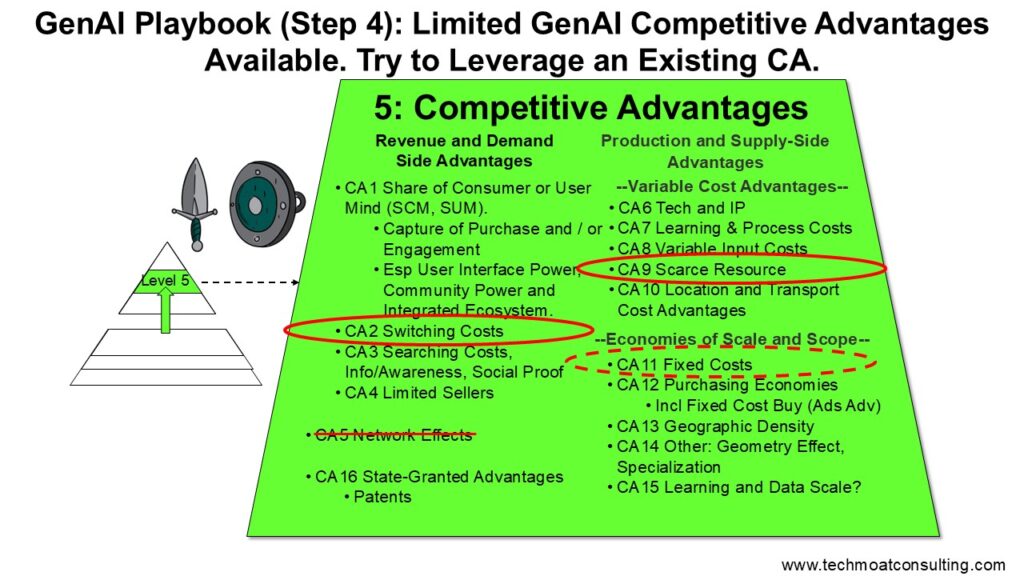
I have four conclusions (so far) for GenAI in the area of competitive advantage:
- There are limited GenAI competitive advantages available (so far). The best strategy is to try to leverage competitive advantages from non-GenAI businesses.
- Unfortunately, GenAI doesn’t appear to have network effects, which is the biggest competitive advantage in digital. We just don’t see any (yet). This is a big problem because software is ruthlessly competitive. Much of the profits in software in the past 25 years were the results of network effects that limited such competition.
- GenAI also doesn’t get that much advantage from Economies of Scale alone. The big GenAI players are definitely flooding money into GenAI and going for size. But it doesn’t look like this is creating big scale-based advantages on its own. It needs to be combined with a demand-side advantage, like network effects.
- Proprietary Data (i.e., scarce resource) is likely a real competitive advantage in GenAI.
- GenAI runs on data so having proprietary data can create an advantage. This is on my CA list under Scarce Resources. However, this is still mostly speculative.
- Keep in mind, most data can be copied over time. And performance from data can increasingly be reverse engineered with synthetic data or other.
- What you are looking for is ongoing proprietary data flows. It has to be continually created and used. And it helps if the volume and velocity are really large.
- Switching costs are doable on the enterprise and developer side.
- GenAI coding leader has dominant and stable (so far) market presence. It has some degree of switching costs with developers. And if Claude becomes more of a library or collaboration space for ongoing projects, it will strengthen these switching costs (making it more like GitHub).
- We can see several examples of switching costs in GenAI services for developers. We can also see switching costs with enterprises as they incorporate GenAI tools into their workflows and intelligence capabilities.
- Overall, switching costs are compelling as a competitive advantage on the enterprise and developer side. Not so much on the consumer side, where users do not like the friction (i.e., pain points) created by switching costs.
- Robots and other GenAI hardware mean physical-digital hybrids, which often have good competitive advantages.
- The more you add in the physical world and physical products, the more competitive advantages are usually possible. Moving away from purely digital operations means scalability decreases (bad) but possible barriers to entry and competitive advantages almost always increase (great).
This graphic is Step 4 of the GenAI Playbook.
***
That’s it for the GenAI playbook. There is lots of background reaching (12 articles) on this.
Cheers, Jeff
———–
Related articles:
- AutoGPT and Other Tech I Am Super Excited About (Tech Strategy – Podcast 162)
- AutoGPT: The Rise of Digital Agents and Non-Human Platforms & Business Models (Tech Strategy – Podcast 163)
- Why ChatGPT and Generative AI Are a Mortal Threat to Disney, Netflix and Most Hollywood Studios (Tech Strategy – Podcast 150)
From the Concept Library, concepts for this article are:
- GenAI and AI (AI-Agent) Strategy
- GenAI Playbook
From the Company Library, companies for this article are:
- n/a
———
I am a consultant and keynote speaker on how to increase digital growth and strengthen digital AI moats.
I am the founder of TechMoat Consulting, a consulting firm specialized in how to increase digital growth and strengthen digital AI moats. Get in touch here.
I write about digital growth and digital AI strategy. With 3 best selling books and +2.9M followers on LinkedIn. You can read my writing at the free email below.
Or read my Moats and Marathons book series, a framework for building and measuring competitive advantages in digital businesses.
This content (articles, podcasts, website info) is not investment, legal or tax advice. The information and opinions from me and any guests may be incorrect. The numbers and information may be wrong. The views expressed may no longer be relevant or accurate. This is not investment advice. Investing is risky. Do your own research.