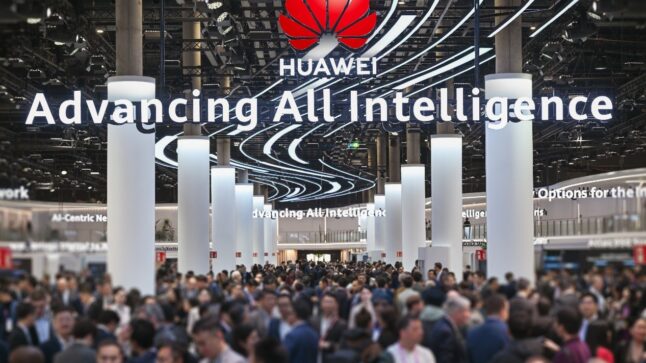
In Part 1, I went through the new AI compute architecture for the Atlas 950 SuperPoD. But I mostly talked about chips and interconnect. I didn’t talk about the people side of all this. Which is super important.
But first some fun stuff from the event.
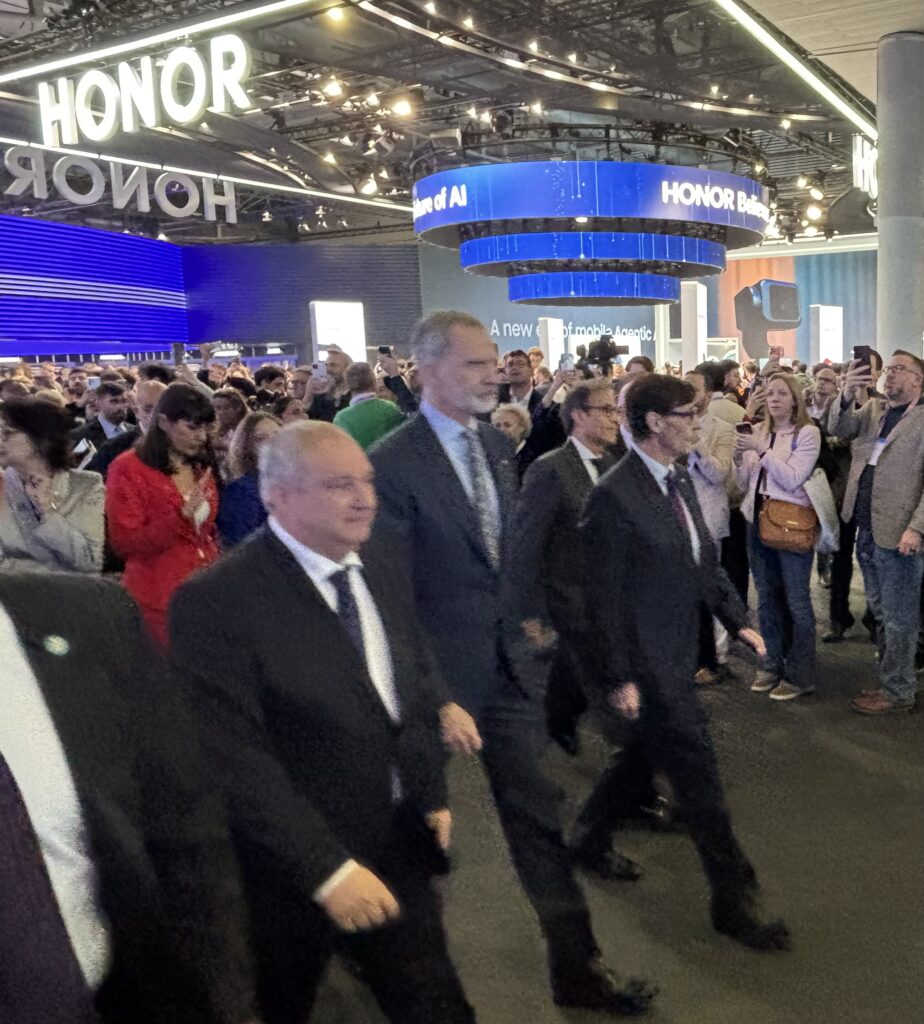
I was wandering around the event and saw a crowd of security guards flanking someone walking through the crowd. I took some photos. And later learned it was the King Felipe VI of Spain. For those who don’t know him, he’s the guy in the center who looks just like a king.
From Chips to Community: Building an Ecosystem is Huawei’s #1 Priority
I have just given you a summary of the hardware and software for Huawei’s AI compute infrastructure.
However, the other half of their strategy is building an open-source ecosystem around this infrastructure. They need developers, businesses, universities, and lots of other partners building on their infrastructure. They need both the technical and business groups in their ecosystem.
Hence Huawei’s Shape 2.0.
These are two of their most important ecosystem initiatives, which were brought up repeatedly at MWC2026.
SHAPE 2.0 is Huawei’s primary go-to-market framework for industrial usage. It is designed to turn AI capabilities into practical business outcomes. With a focus across 38 different industries.
SHAPE 2.0 includes:
- Giving AI Upgrades to Products: This was mentioned extensively, and mostly for carriers who manage large mobile networks. By embedding AI directly into hardware (like network agents), they can automate maintenance and improve fault location.
- Launching AI Agents: AgentArts is Huawei’s platform where partners can build their own AI Agents for specific tasks.
- Doing Partner AI Certification: There is a big push to get partners AI-certified through new professional courses.
- Targeting Revenue Growth Opportunities: Arguably, the best way to get adoption is to show businesses that these tools can increase revenue. So, they are deploying scenario-specific AI experts to help partners launch lighthouse projects (high-profile success stories) in local markets.
The tools and frameworks for these architectures include:
- CANN 8.0. Huawei’s CUDA equivalent that bridges the gap between AI code and the chips.
- Huawei’s native AI development framework. It’s an alternative to PyTorch, although you can modify PyTorch.
- openEuler. The open-source Operating System optimized for their hardware. I wrote about this here.
Anyways, there is lots going on here. But the main takeaway is that success as a global AI architecture totally depends on building a global ecosystem of technical and business partners.
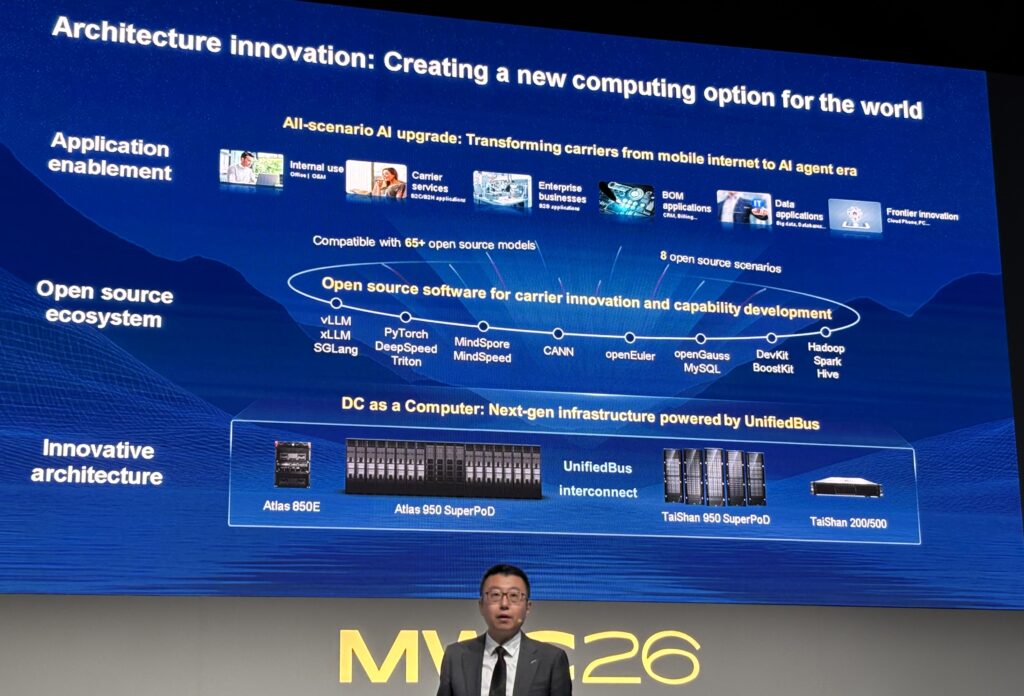
Here’s a summary from Seaway Zhang’s presentation.
AI Scale Through Openness
Huawei has been focused on getting businesses and technical experts to migrate to their architecture. And their primary argument has been that it’s open source. It just works with everything.
Huawei is talking “open source” to all the main ecosystem partner groups. You can see how it’s baked into all their ecosystem tools and initiatives.
- Software Partners
Because most AI code is written for NVIDIA, Huawei needs to ensure software just works on Ascend chips. That includes:
- Open-Source Communities: Integration with PyTorch, TensorFlow, vLLM, and Triton. Huawei has open-sourced its CANN 8.0 (the CUDA equivalent) to allow these communities to build native support for Huawei architectures.
- Operating System Vendors: Partners like the openEuler community are key for providing a stable, high-performance Linux foundation that handles Huawei’s unique memory-pooling architecture.
- Libraries: Collaboration with developers of BoostKit and MindSpore to ensure that “Model Sharding” (splitting a model across 8,192 chips) happens automatically.
- Infrastructure and Hardware Partners
Since a SuperPoD covers 1,000 m², it requires more than just chips; it needs a massive physical supporting cast.
- Data Center Operators: Global carriers (e.g., Etisalat, STC, or Converge ICT) must be willing to build the high-voltage substations and specialized floor-loading required for 160-cabinet clusters.
- Cooling Specialists: Partners who can implement Direct-to-Chip (DLC) liquid cooling and industrial-scale thermal management to handle the 15–19 MW power draw.
- Storage Vendors: Integration with high-performance storage like OceanStor Dorado to feed data to the NPUs fast enough to prevent idle time during training.
And so on. Here’s a summary (for carriers):
Winning by Investing in People: Huawei’s 100-University Alliance
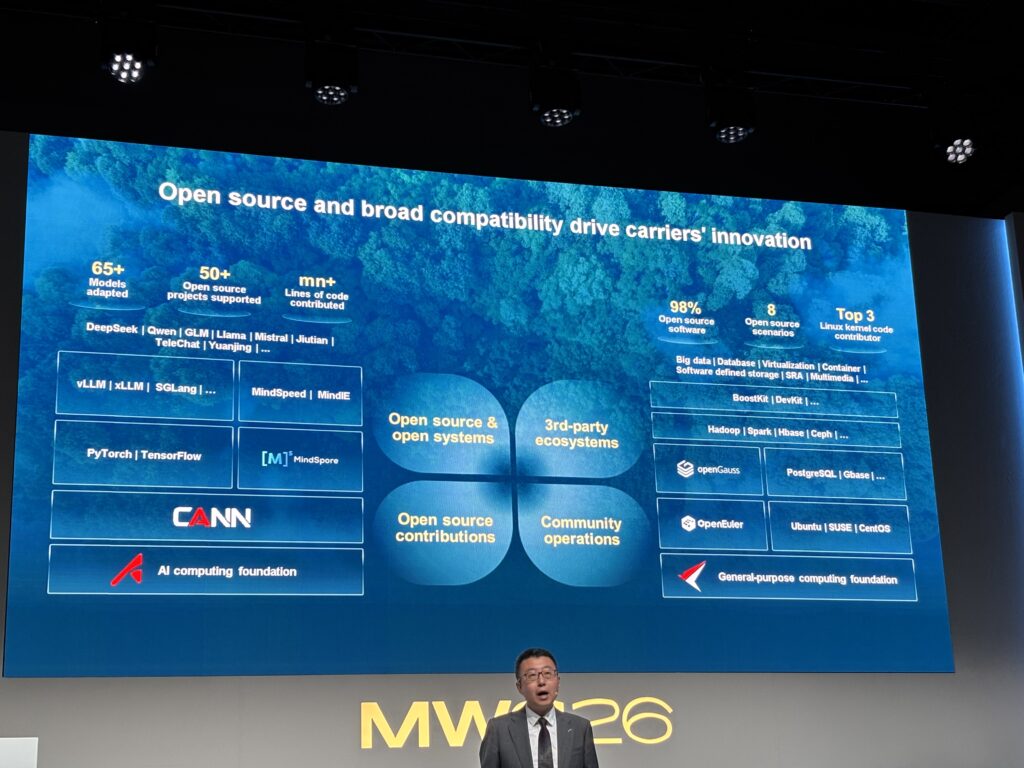
The biggest hurdle is ultimately the human element. Huawei needs developers who know how to use CANN instead of CUDA.
So that means:
- University Collaborations: Huawei is currently partnering with over 100 universities (including Fudan and Nanjing University) to donate development boards and create AI certification courses.
- Native Talent Program: A 1-billion-yuan annual investment to empower millions of native talents who are trained specifically on Huawei architectues from day one.
***
That is most of what I wanted to cover for the Atlas 950 SuperPoD. And that was some pretty boring stuff. So, here’s a political rant.
Unintended Consequences: How President Trump Broke the NVIDIA Monopoly
If you had asked me if this entire strategy (NPUs, SuperPoDs, open-source ecosystem) was going to be successful back in 2023, I would have been pessimistic.
NVIDIA had a global monopoly on AI compute, including 95% of China. It was the technical leader and it had a deeply entrenched ecosystem. It probably had the world’s most valuable moat. And this is a big part of why it became the world’s most valuable company.
And then the US government did what the market couldn’t. It broke NVIDIA’s monopoly.
In 2025, the Trump administration cut off most of China from NVIDIA’s GPUs. And this created a huge open space in the market. Specifically, it opened up about $10B in demand that NVIDIA could no longer supply.
And even after the US government backtracked (after lots of furious lobbying by CEO Jensen Huang), the Chinese government effectively kept the ban in place, strongly encouraging Chinese companies to use non-US chips from now on.
It was devastating.
Pre-2024, NVIDIA had an estimated 95% of the AI processor market in China. Analysts at firms like Bernstein and Nikkei now estimate NVIDIA’s share is 8–10%.
And domestic players, led primarily by Huawei, have filled this vacuum.
Huawei’s market share grew from negligible levels to nearly 39% in 2025, with projections to reach 50% by late 2026.
That’s pretty amazing.
And this means Huawei is going to have a big market and a robust ecosystem in China. And NVIDIA will now have a serious competitor on the global stage.
I really don’t understand this. Either US politicians are a lot smarter than me and I don’t understand the strategy, or this was incredibly stupid. I’m thinking stupid.
My questions now are:
- How fast are Huawei’s products going to advance?
- Will they catch up with NVIDIA in chip performance?
- Do they even need to if they can match server-level performance with their interconnect architecture?
- How successful are they going to be in building an ecosystem outside of China?
- In China, they are advancing and growing. But internationally the entrenched ecosystem is a big barrier. I’m thinking it’s going to be a low-cost strategy targeting the global south. But that’s just a guess.
Watch for lots of international ecosystem initiatives. And I expect open source will continue to be strategic differentiator with NVIDIA.
The 500,000-Chip City: Get Ready for the Atlas 950 SuperCluster
In addition to the Atlas 950 SuperPoD for AI computing, Huawei also announced the TaiShan 950 SuperPoD for general-purpose computing. And they have smaller versions of both (most businesses don’t need huge AI data centers). There is the Atlas 850E SuperPoD, and the TaiShan 500 and TaiShan 200 servers.
But the one I am excited about is the Atlas 950 SuperCluster. This makes the SuperPoD look small. The Supercluster fills 9 soccer fields.
If the SuperPoD is the fundamental building block (acting as a single logical machine with 8,192 chips), the SuperCluster is a city built from those blocks.
And it is Huawei’s response to NVIDIA’s Rubin and Blackwell clusters, specifically designed for training +10-trillion parameter models.
The first of these full-scale SuperClusters are reportedly being built in the major Chinese computing hubs (Guizhou, Inner Mongolia, and Gansu). And broad commercial rollout for the Atlas 950 SuperCluster is slated for Q4 2026.
And, finally, Huawei has already announced that an Atlas 960 SuperCluster is in development for late 2027. It is expected to use over 1 million NPUs.
***
Ok. That’s takeaway #2.
In Part 3, I’ll get into more about how agents are changing the nature of mobile networks.
-Jeff
And here’s some more fun stuff from the event.
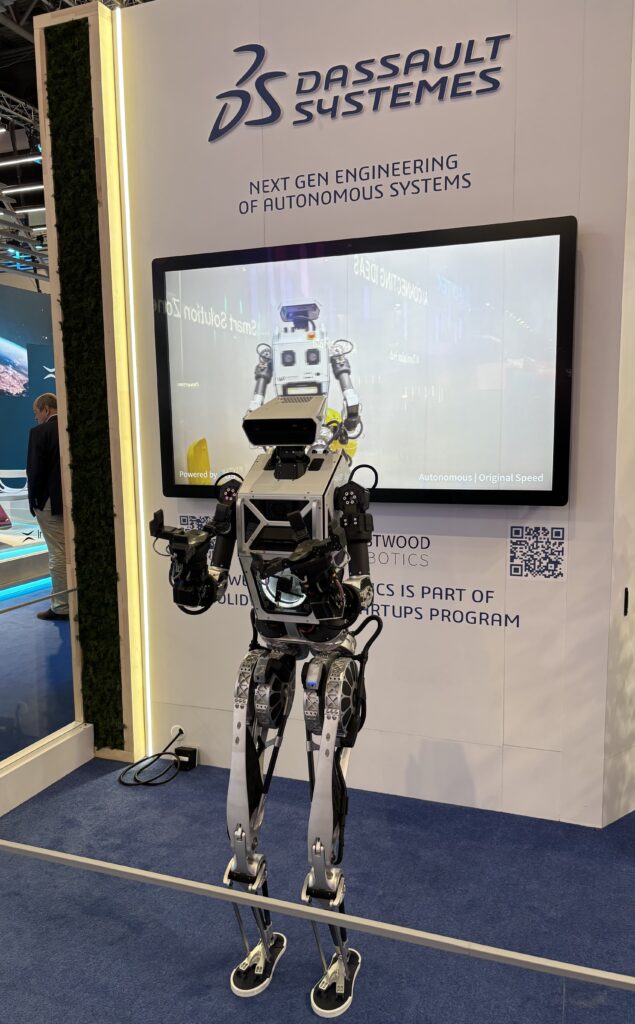
This is a robot that Dassault Systems (French software company) was showing. There were quite a few robots. But this was the only one that looked like something out of the Terminator. The rotating gripper hands and exposed chassis were a strange design choice.
——-
Related articles:
- The Winners and Losers in ChatGPT (Tech Strategy – Daily Article)
- Why ChatGPT and Generative AI Are a Mortal Threat to Disney, Netflix and Most Hollywood Studios (Tech Strategy – Podcast 150)
From the Concept Library, concepts for this article are:
- AI Cloud
- Generative AI and Agents
- AI Infrastructure and Data Centers
From the Company Library, companies for this article are:
- Huawei
——
I am a consultant and keynote speaker on how to increase digital growth and strengthen digital AI moats.
I am the founder of TechMoat Consulting, a consulting firm specialized in how to increase digital growth and strengthen digital AI moats. Get in touch here.
I write about digital growth and digital AI strategy. With 3 best selling books and +2.9M followers on LinkedIn. You can read my writing at the free email below.
Or read my Moats and Marathons book series, a framework for building and measuring competitive advantages in digital businesses.
This content (articles, podcasts, website info) is not investment, legal or tax advice. The information and opinions from me and any guests may be incorrect. The numbers and information may be wrong. The views expressed may no longer be relevant or accurate. This is not investment advice. Investing is risky. Do your own research.