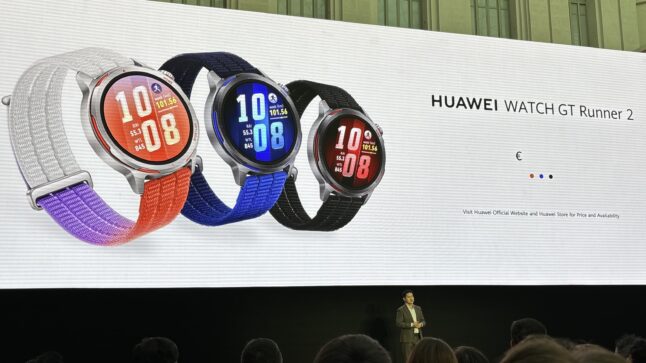
This week Huawei released its new 2026 consumer products in Madrid, Spain. It was a pretty great event (note: Huawei is really good at events).
Here are the big product announcements.
- Huawei Watch GT Runner 2
- Huawei Watch Ultimate 2
- Huawei Mate80 Pro
- Huawei MatePad Mini
- Huawei FreeBuds Pro 5
And the product that got the most attention was their new smartwatch GT Runner 2, which is obviously focused on runners.
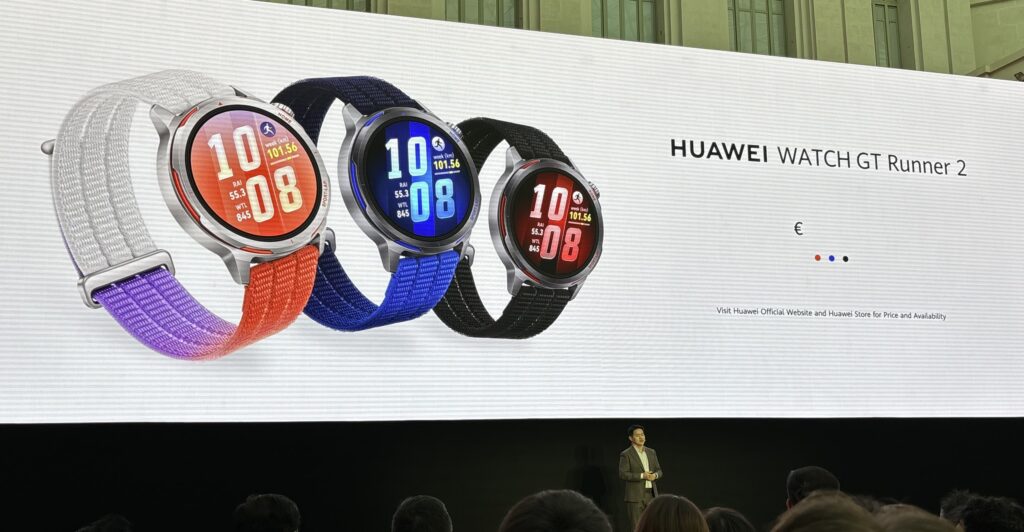
I’ll cover the other products in Part 2. But let me go through the GT Runner 2 first.
The GT Runner 2 Smartwatch Is Great for Runners
Huawei has been making smartwatches since 2015. And the GT series (their most successful line) was first launched in 2019. It’s a lifestyle brand for everyone, with +100 sports modes. With lots of focus on wellness, such as ECG, sleep tracking, stress monitoring. A new 2026 feature even estimates diabetes risk.
But Huawei’s GT Runner series (launched in 2021) is their specialized version for runners.
And that means a lot more specialized hardware and software. It’s a product category where Huawei can really change the game with its deep hardware and R&D capabilities.
I’ll go through these hardware and software capabilities. Especially their advancements in positioning and pacing tracking, battery performance and screen.
And this is all great for advanced and elite runners. This is truly a great running watch.
But it’s a real problem for Garmin, which has long been the leader with this particular group. The GT Runner 2 has matched Garmin in technology – and is rapidly moving past them. And it is about half the price.
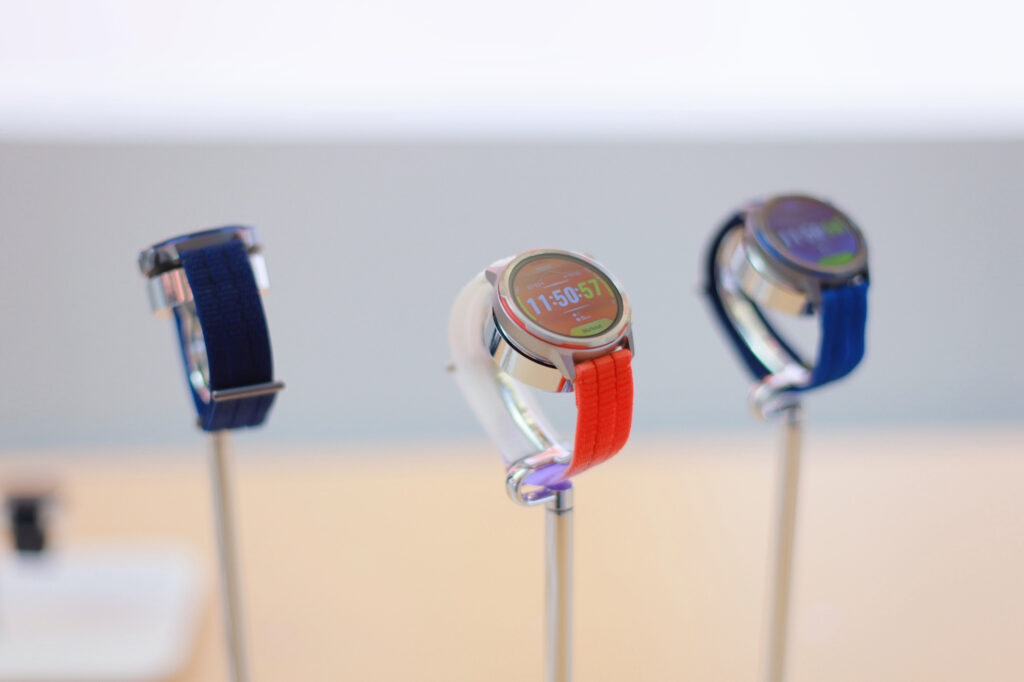
Here’s what the watch looks like.
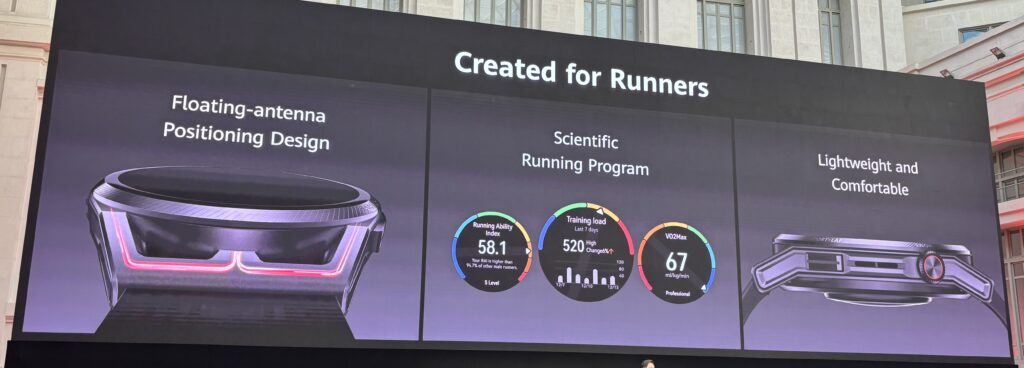
Here is the summary of its running-specific features. I’ll go through the most important ones.
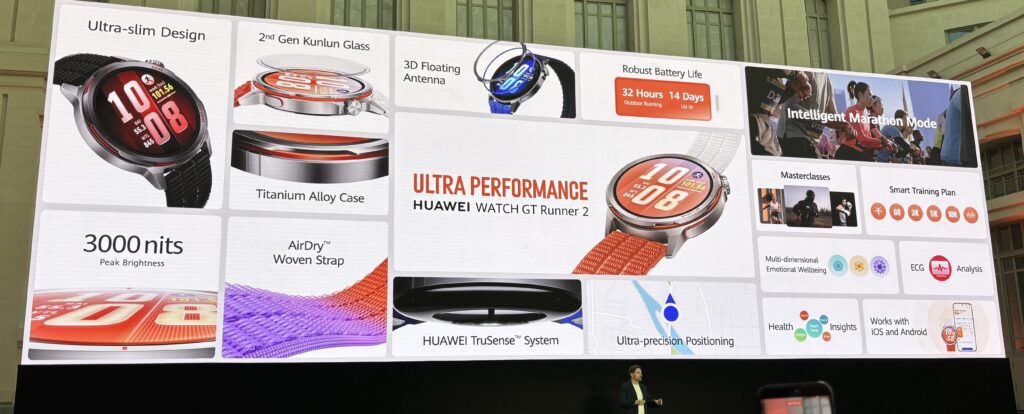
The basic stats are:
- It’s lightweight (34.5 gm which is 10% lighter). That’s really light. You barely feel it on your wrist. That’s important for running.
- It’s thin (10.7 mm).
- It’s comfortable. It has a woven strap that is water repellant and air dries.
Basically, you don’t feel this thing at all. Which is great. It’s also durable (titanium alloy case) and water resistant.
Huawei is Pulling Ahead of the Pack in Screens and Battery Tech
All the wearables focus on being lighter and slimmer every year. That’s important. But that’s not usually where you win. You win with better screens and batteries. And this is where you start to see Huawei’s R&D changing the game.
The GT Runner 2 screen is premium quality. It has 3,000 nits in brightness. That is the current gold standard for high-end smartwatches like the Apple Watch Ultra 3. This also helps runners because it makes it easy to see in sunlight.
This watch also has Huawei’s 2nd generation Kunlun glass.
Kunlun is Huawei’s in-house alternative to Corning Gorilla glass (commonly used in smartphones). And this is actually a fun topic.
Sapphire crystal can be used for screens and is particularly hard to scratch. But it is easy to shatter. Hardened glass is the opposite. It is easy to scratch but hard to shatter. That’s why your smartphone scratches easily but doesn’t break when you drop it.
Huawei has been trying to balance these types. Their engineers developed a process to grow billions of nanocrystals inside a glass structure, which creates a reinforced mesh at the microscopic level. This took Huawei 4 years of R&D to develop. The result was Kunlun Glass (which is on the GT Runner 2), which is designed to be 20x more drop and impact resistant than regular glass. But also, more flexible than sapphire.
Huawei famously demonstrated the strength of this glass in 2022 by having people crack walnuts with the screen of a phone using the glass. Fast forward to 2026, and the 2nd Gen of the glass (used in the GT series0 is rated to survive face-down drops onto concrete from 2 meters.
Even the name Kunlun (昆仑) is about strength and endurance. In Chinese culture, it relates to unshakable strength and mythical endurance. In Chinese culture, Kunlun can also represent a journey of extreme difficulty and perseverance.
This caught my attention. You don’t hear of other wearables companies creating entirely new types of glass. Huawei has the scale to do this. And it’s a dimension that users really care about.
The watch also has shockingly improved battery performance.
This is the part that really attracted my attention. And this could be a real problem for Apple, Samsung and Garmin.
Huawei announced that the energy density (energy stored in physical space) has increased 68% from version 1.
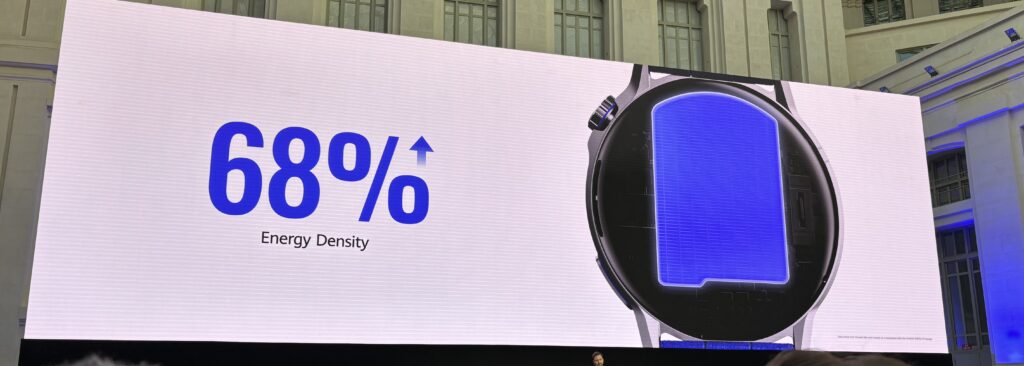
Wait, what?
Battery performance (per size and weight) improves like 3-5% per generation. Not 68%.
Take a look at the average battery performance of premium smart watches. For 24/7 usage with heart rate tracking, notifications, and sleep monitoring, but without continuous satellite positioning (GNSS – Global Navigation Satellite System), the typical battery life is:
- 14 days for Huawei Watch GT Runner 2. Approximately 5–7 days with Always-On Display.
- 15–18 days for Garmin Forerunner 970. Approx. 6 days with Always-On Display.
- 36–48 hours for Apple Watch Ultra 3. Up to 72 hours in Low Power Mode.
- 48–60 hours for Samsung Galaxy Watch Ultra. Up to 100 hours in Power Saving Mode.
Now this was already the situation before this new device. So, Huawei (and Garmin) were already showing dramatically longer battery life. It’s hard to compete as a smartwatch when you offer 14 hours of power and your competitor offers 14 days. Batteries matter a lot in wearables.
And now they have announced a 68% improvement.
- I think this is how they dropped the weight by 10% but didn’t lose any battery life (still about 14 days).
- And how they can have a 3000 nits screen blazing brightly all the time.
- And how runners can use full GPS tracking for 32 hours.
Marathons and other runners use GNSS satellite tracking, which consumes a lot of power. And for this situation, it’s really Huawei vs. Garmin.
The GT Runner 2 actually beats the Garmin Forerunner 970 in raw hours of GPS tracking (32 hours vs. 21–26 hours). But Garmin’s SatIQ technology is smart and it automatically toggles the battery-heavy dual-band GPS off when you are in an open field and turns it on when you enter a city or forest. Huawei’s 3D Floating Antenna (discussed in Part 2) is more of a power-hungry hardware solution that always stays on.
So how did Huawei do this 68% jump?
They changed from the battery chemistry from traditional Lithium-ion to Silicon-Carbon (Si-C).
That’s crazy.
When is the last time you heard a wearables or smartphone company creating entirely new types of batteries so they can be lighter with more power?
I read up on this and apparently traditional batteries use graphite anodes which are reliable but have a limit for how much energy they can hold. Silicon can store a lot more but it can swell with energy.
Huawei came up with a solution to this which is their Silicon-Carbon tech using a specialized porous structure that prevents swelling. This was obviously a big project across the entire company. Keep in mind, they have tons of smart power and other batteries in their other businesses.
Again, I put this on the list of tech innovations that pulling them ahead of competitors in an area customers really care about.
***
Ok. That’s the hardware innovation that caught my attention. Let me switch to the software features for runners.
Intelligent Marathon Mode
The watch has the standard health and vitals monitoring (HR, SpO2, breaths, sleep, etc.). Plus, it has +100 sport modes – including skiing, free diving, trail running, Pilates, yoga, cycling, and golf (more on this in Part 2).
But it’s the upgraded marathon functions that are the new thing for runners (called “Intelligent Marathon Mode”).
It’s basically a personal trainer on your wrist that coaches you before, during and after a marathon.
Before the marathon, you can:
- Search the available marathons around the world. And create your own custom ones.
- Design a training plan. The adviser designs a plan for you by checking your past performance. Have an advisor as you train.
- Get an updated training plan based on how you are doing.
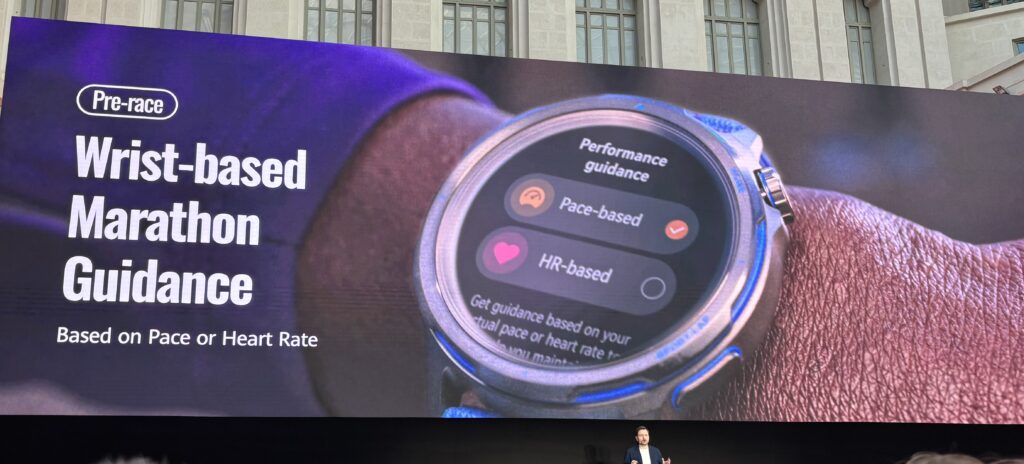
During the marathon:
- The advisor gives you pacing guidance. It helps you stay at the right speed or heart rate.
- It tracks your location with positioning.
- It has all sorts of weather and other information.
- It gives you refuel reminders (“drink water now”).
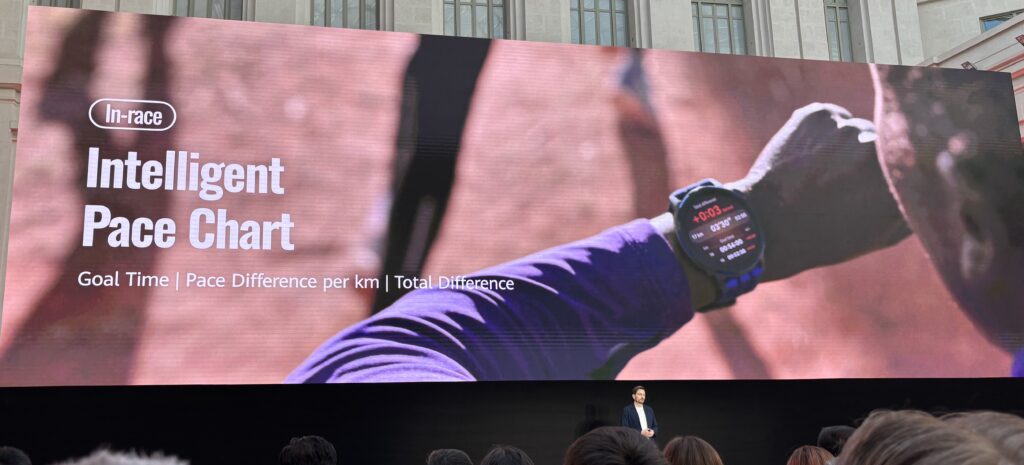
After the race:
- You can share your results (of course).
- And it does lots of analysis of your performance.
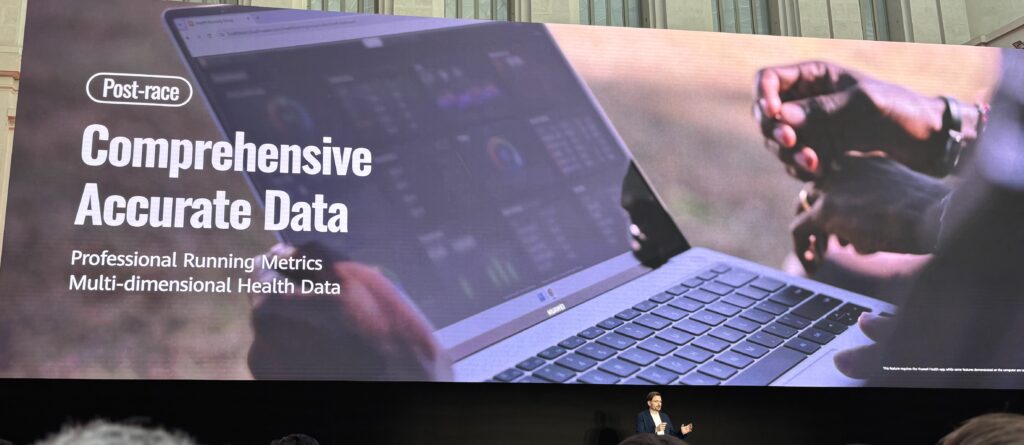
With all this hardware and software, the experience during the marathon is the most important.
And you can see how all the features and hardware innovations really come together. It has:
- A lightweight watch with a comfortable design.
- Using a scientific approach to running
- With advanced technology for position and pacing. That’s the 3D floating antenna (discussed in next section) and the long battery life.
- And a screen is easy to see (3000 nits) that is also impact resistant (2nd gen Kunlun glass)
It all comes together quite nicely as a product.
Ok, in Part 2, I’ll go through the cool antenna tech. And switch over the business (not tech) side of this. Like why they are focusing on runners as a market. And this is a pretty good model for smart products and services.
Cheers from Madrid, Jeff
- Huawei GT Runner 2: A Clever Combination of “Breakthrough Tech” and “Emotional Resonance” (2 of 3) (Tech Strategy)
- 3 Lessons from the Launch of Huawei’s GT Runner 2 Smartwatch in Madrid (Tech Strategy – Podcast 277)
——-
Related articles:
- How Generative AI Services Are Disrupting Platform Business Models (2 of 2) (Tech Strategy – Daily Article)
- The Winners and Losers in ChatGPT (Tech Strategy – Daily Article)
- Why ChatGPT and Generative AI Are a Mortal Threat to Disney, Netflix and Most Hollywood Studios (Tech Strategy – Podcast 150)
From the Concept Library, concepts for this article are:
- Smart devices / wearables
From the Company Library, companies for this article are:
- Huawei
- Garmin
- Apple
———
I am a consultant and keynote speaker on how to increase digital growth and strengthen digital AI moats.
I am the founder of TechMoat Consulting, a consulting firm specialized in how to increase digital growth and strengthen digital AI moats. Get in touch here.
I write about digital growth and digital AI strategy. With 3 best selling books and +2.9M followers on LinkedIn. You can read my writing at the free email below.
Or read my Moats and Marathons book series, a framework for building and measuring competitive advantages in digital businesses.
This content (articles, podcasts, website info) is not investment, legal or tax advice. The information and opinions from me and any guests may be incorrect. The numbers and information may be wrong. The views expressed may no longer be relevant or accurate. This is not investment advice. Investing is risky. Do your own research.