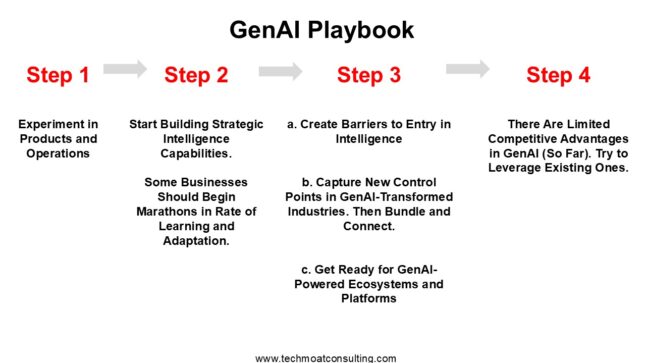



This week’s podcast is a summary of my GenAI playbook. It is the summary of 12 articles.
You can listen to this podcast here, which has the slides and graphics mentioned. Also available at iTunes and Google Podcasts.
Here is the link to the TechMoat Consulting.
Here is the link to our Tech Tours.
Here are the mentioned graphics.

That’s it for the GenAI playbook.
Cheers, Jeff
———–
Related articles:
- AutoGPT and Other Tech I Am Super Excited About (Tech Strategy – Podcast 162)
- AutoGPT: The Rise of Digital Agents and Non-Human Platforms & Business Models (Tech Strategy – Podcast 163)
- Why ChatGPT and Generative AI Are a Mortal Threat to Disney, Netflix and Most Hollywood Studios (Tech Strategy – Podcast 150)
From the Concept Library, concepts for this article are:
- GenAI and AI (AI-Agent) Strategy
- GenAI Playbook
From the Company Library, companies for this article are:
- n/a
———Transcription here
00:05
Welcome, welcome everybody. My name is Jeff Towson and this is the Tech Strategy Podcast from Tecmo Consulting. And the topic for today, my four-step generative AI strategy. This is just my default. When you don’t know what to do, because it’s crazy right now, this is kind of my default pathway, which is four steps. And it really is kind of the summary of
00:33
12 articles I’ve written over the last year. I’m not sure if anyone besides me has actually read all 12, because it was kind of way down the rabbit hole. Took a long time. And yeah, I get a little lost in there, but that’s kind how I do my thinking. I write, write, and then I distill it and boil it down to what matters. So that’s kind of what this podcast is. It’s, you know, here’s the four steps that I think that matter. And there’s an article written about this as well, the summary. And if you’re really into it, you can go back and read all 12.
01:02
Let me know if you’ve done that. I may be the only one who read all 12. It was way sort of into the weeds. A lot of it ended up not being useful and I discarded it. But yeah, anyways, that’s going to be the topic for today. Let’s see, housekeeping stuff. We got a couple tours coming up in six months. We’re laying the groundwork for those. We’re going to do two a year. That seemed to be our standard. The last year, they went great. I mean, I think it was the best we’ve ever done by a long way.
01:30
So, I think we’re getting pretty good at this. We’re going to stick to two a year. I’ll put more details later. Other thing is there’s an email sign up. If you’re curious, go over to jeffthousen.com or tecmoconsulting.com. And we have sort of a new weekly email we’re going to do. And this is kind of for everyone. So, if you’re a subscriber, okay, this isn’t going to help you, because I’m giving you like 10 times more than that on other stuff. But if you’re not, try it. It’s an email sign up on sort of best practices for digital, just lessons, right? Things you can use.
01:59
As you can find that if you’re curious. Okay, standard disclaimer. Nothing in this podcast or in my writing or website is investment advice. The numbers and information from me and any guests may be incorrect. The views and opinions expressed may no longer be relevant or accurate. Overall, investing is risky. This is not investment, legal or tax advice. Do your own research. And with that, let’s get into the topic. Okay, the concept for today, obviously generative AI.
02:27
We’re actually going to touch on quite a few concepts. If you go over to the concept library, you can find more, but I’m not going to list them all. It’s going to be switching costs and network effects and all sorts of things in here. But yeah, it’s all under Generative AI Playbook if you’re curious on the website. Now, let’s just jump to the so what. The so what is, look, there’s four steps. This is kind of my default when people ask me, people who run businesses.
02:55
you know, what should I do in generative AI? This is my default pathway. Four steps, start with this. Now, it’s going to change obviously, different companies are going to focus on different things, financial services and banks are different than retail and all of that. But it’s not a bad default pathway if you don’t know what to do and it gets you moving. You know, it’s better to start walking and heading the right direction and you can adjust the path as you go. So, you know, get moving is more important than any specific path. So.
03:25
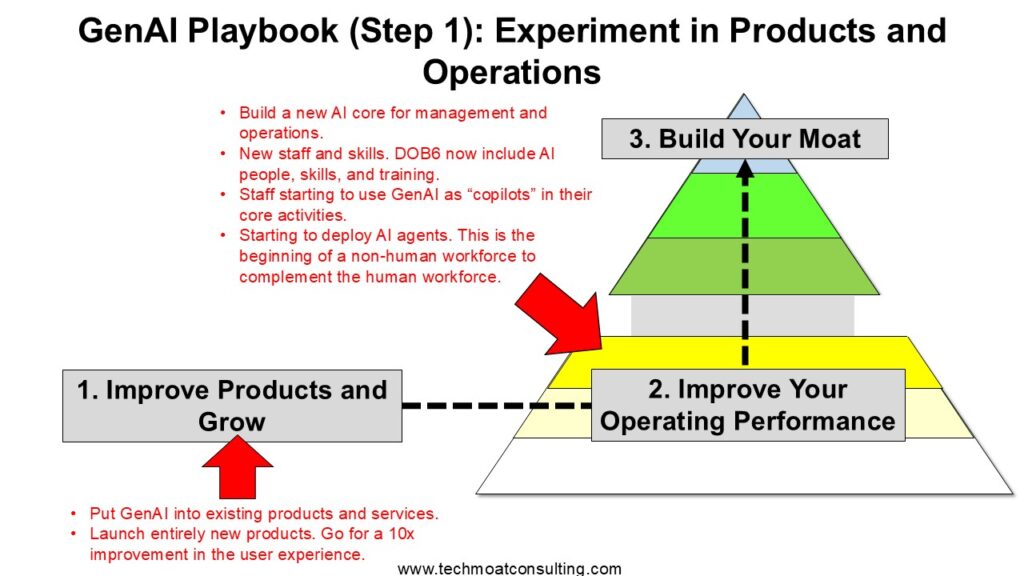
I’m going to now put a slide in the show notes with basically the four steps. So, this whole thing is boiled down to one slide. And then I’ll go through a bunch of other details and I don’t know how many slides I’ll put in the notes, probably a good 10 of them. So, a bunch of them. And there’s obviously, if you go to the website, you can see the whole article that summarizes this. All right, so let’s just start with step number one. And this is not a big surprise, which is look, start doing experiments in products.
03:54
and in your mostly internal operations. Okay, the big risk, the experimenting with products is critical because you don’t want to get disrupted. You don’t want to be made obsolete because suddenly the SaaS product you’ve been doing forever doesn’t have AI baked in, chatbots, intelligence, all of that, and your competitor does, and suddenly you’re obsolete. So, you got to start doing that.
04:24
It’s a high-risk situation. The problem with that is the last thing you want to do is annoy your customers. The second part of this, look, start doing internal experiments with productivity. Give your employees chat GBT, everyone’s got to use it every day. Use gamma, use notebook LM. Start doing everything. That you can experiment on a lot and it doesn’t impact your customers. It’s sort of internal and you go for productivity gains and things like that.
04:53
improved really quality, faster and cheaper. So, it’s more than just productivity, but that’s kind of the basic starting point. All right. Now the more powerful part of this is obviously the, the products.
05:12
You got to bake it into your existing products. Now if you’re Starbucks, that’s not a big deal. If you’re a SaaS company, yeah, it’s a big deal. It really is. If you’re consultant, it’s a big deal. If you’re a bank, it’s huge. But you also got to think about what about AI native products? These are not the things we’re doing today. These are completely new ideas because a lot of stuff is now possible. know, chat GBT didn’t exist before. The image generators didn’t exist before. There’s a whole lot of stuff.
05:42
Now if you can pull off something clever there, the best-case scenario would be a 10x type of product. A 10 out of 10, something that blows people away. That can happen. So that would be kind of the number one area is put generative AI into your existing products and services, try to launch entirely new products, go for a 10x improvement in the user experience somewhere. And obviously this is experimentation.
06:10
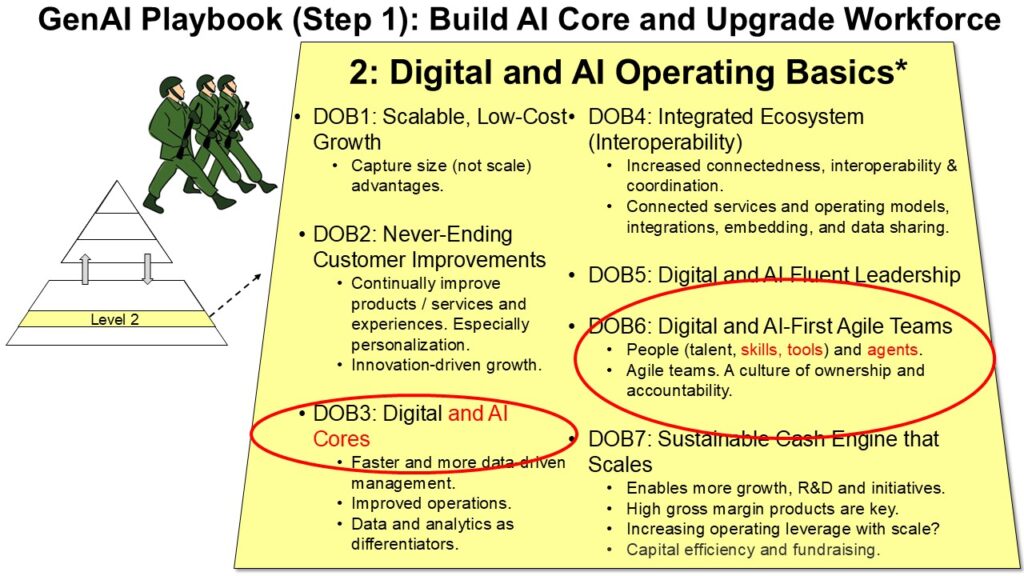
plan this forever, you just do stuff and see what works. And then obviously on the operation side, go for, well, I’ll go into the details on that. Now on the generative AI operational side, I’ll put a slide in, but of the digital operating basics, which I have seven of them, it’s my standard slide, although I do not call it the digital AI operating basics. The ones I’ve circled in bright red, you can check the notes and see it, DOB3, DOB6. oh
06:40
DOB3 is digital core, digital AI core. You’ve got to start building out your tech stack. You got to start building in the foundation models, you got to start building out the data architecture, all of that. That’s going to take some time. If you don’t have that in place, and usually the problem when you talk to companies about this, the number one thing is that we don’t have the data. And if you don’t have data, you can’t do any of this stuff. So, data is usually the first bottleneck. Now fortunately, it’s not that hard. just…
07:10
You call up Google Cloud and you start putting the data in and all the tools. So, it’s actually not that hard of a step, but that’s the first step. The other one, DOB6, which is the idea of digital teams. We used to say, look, you got to have agile teams that can take products and develop them and use tools. It’s kind of standard digital strategy, agile teams as an architecture, an organizational structure.
07:36
Well, now we’re talking about, okay, we got to keep using Teams, but everyone needs to start using AI tools. So, they’ve got to start, so we have a big skill problem, basically. We’ve got to start upskilling people and getting them into these tools, because we can’t have our agile teams not have these as skills. So, everyone’s going back to school. Now, also within that team structure, there’s the question of agents. In theory, that’s a huge deal.
08:04
but it’s kind of going slow. That’ll be a big story for 2026 is going from AI enabled teams within your organization to AI plus agentic enabled teams within your organization. So that’s kind of step one. uh Product side, internal productivity and capabilities operations. And I’ll put the slides in there that summarize step one. Step two. Step two is kind of two things. For those of you who kind of remember my sort of
08:34
three goals of strategy. There’s Steve Jobs, there’s Elon Musk, and there’s Warren Buffett. I’m basically just moving up the path. I started with Steve Jobs, that’s product and growth, then I moved over to Elon Musk, that’s internal productivity. Now I’m moving up the stack on that side. We start going to intelligence capabilities, marathons, and eventually we get to competitive advantages, Warren Buffett. So, I’ll put slides in there, you can see all that. Okay, step two.
09:00
you’re really got to start building out your strategic intelligence capabilities. This is a big deal. I this is kind of like, okay, start building your digital core for AI, your AI tech stack, your models, your data architecture, all of that. Okay, but that’s kind of table stakes. Everyone has to do that. I’m talking about intelligence capabilities that you don’t have as a business today that are strategically important. So not everything.
09:28
but what are the ones that are really going to matter? If you’re a bank, what kind of intelligence capabilities are strategic? You have to do them and if you can be better at your competitors, it’s going to make a huge difference. Well, you could do things like credit approval. That’s a huge strategic capability if you can build intelligence into that. Claims processing if you’re an insurance company, things like that. So, you start to think about
09:58
All right, what would be my strategic intelligence capabilities? I call these CRAs capabilities, resources and assets. Kind of the same stuff. uh Yeah, we got to do this. And yeah, that’s part of sort of your digital operating basics, but we’re starting to go beyond just the basics to build the pillars, the assets that are going to make a big difference. And you got to kind of know what those are.
10:24
these will also start to manifest themselves as barriers to entry. So, one, you got to do it as a competitive aspect. Two, it’s going to start to build out barriers to entry, which are usually just capabilities that you have that others don’t. Now also within there, we could start to talk about running a marathon. If you go up my sort of hierarchy, my digital AI sort of hierarchy for competition, you start with the digital operating basics and then you go up to
10:54
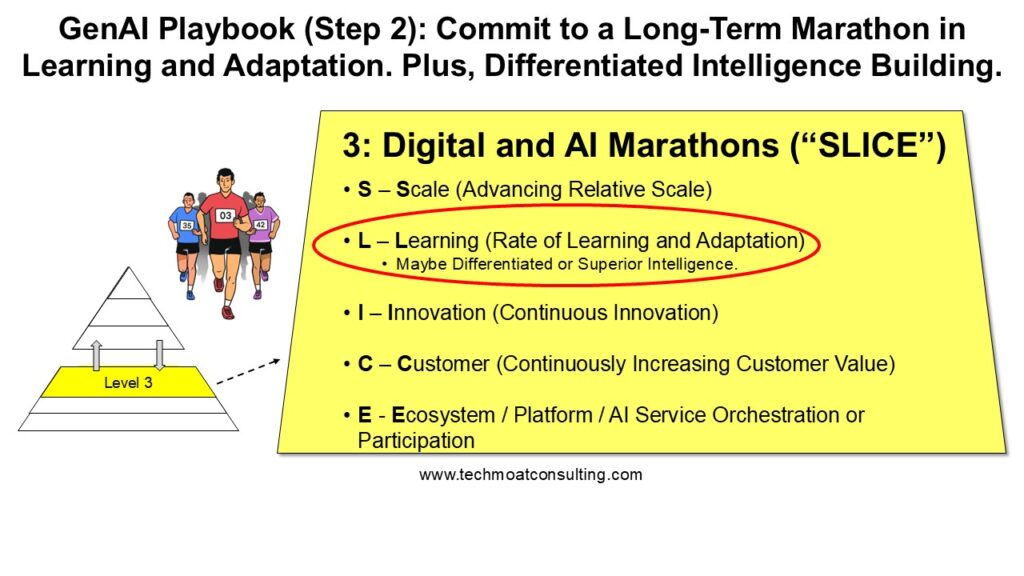
digital marathons, which I used to call SMILE, S-M-I-L-E, which was an acronym for various things. I’ve kind of updated that to SLICE, S-L-I-C-E, because these are just sort of operating activities where if you do them over the long term, it’s a marathon, you can start to really have an operating advantage. Well, the list of what can do those changes over time. I used to basically have machine learning in there. You know, that’s the M in SMILE.
11:24
And well, that’s kind of everybody now, right? It used to be when you were one of a few companies that had advanced machine learning capabilities, it was a big, now it’s kind of table stakes. I don’t think that’s one anymore. So, it’s S-L-I-C-E. I’ll put the slide in there that details it. But basically, the L is the big one, which is learning and adaptation. How fast can you learn about what your competitor is doing, what your market is doing?
11:53
what your customers are doing, how they’re behaving day to day, city to city in their buying habits and there, know, how fast can you learn and then adapt? Well, what is intelligence? It’s learning. People who are highly intelligent, you know, you don’t say someone is highly intelligent if they know a lot of facts. That’s not really intelligent. Intelligence is how fast can you learn new things? Well, this is rate of learning and adaptation.
12:23
So, we start to look where can having sort of greater rate of learning as a capability, a marathon give us a real advantage and a couple of them jump out immediately like fashion. If you’re a retailer, Zara, H &M, Shein, and you can see what people are buying street by street, day by day, like what fashion, you could call these micro fashion trends. If we see that everybody in this part of
12:53
Kuala Lumpur is sort of wearing UGG boots this week. Because we can see it in social media, we can do various types of learning. There’s a lot of data coming in, you pull out the signal from the noise. Okay, you can start to customize not just your inventory, here’s what we’re selling. You can customize your promotions, you can customize uh what you’re cross-selling, what you’re bundling. You can do lots of sort of targeted adaptations based on sort of rapid learning.
13:22
street by street, demographic by demographic, all over the world. And companies like JD have been doing this for five or seven years at sort of uh a crude level. It’s getting really fine-tuned. Now other ones, you’re a DTC company, if you’re selling something online, beauty products or whatever, you can do the same sort of stuff just by segmenting your customers. Just have an incredibly rapid rate of learning.
13:52
for your customers, what they’re doing, what, now, for this to work, you have to have a certain level of engagement. If you’re selling train tickets, you know, it’s hard to get a lot of engagement. But if you’re selling something they care about, like beauty products, where they’re watching your videos and maybe there’s a membership program, you’re getting a lot of feedback, you can start to do very rapid learning. And then the question is, you know, are we going to get that all the way down to a rate of one?
14:21
sort of a market of one, where we learn so much so quickly that we can customize and adapt everything, or at least a lot of things, user experience, promotions, cross-selling, up-selling, all of that, customer by customer by customer. Yeah, maybe. We’re getting close. I’m not sure that’s worth your time. I generally find that if you can break your customers into 15 and 20 sub-buckets and customize at that level and learn at that level, that’s enough.
14:50
you know, one by one by one, it’s a lot more work and it doesn’t generally get you that much more. Anyway, so rate of learning, you think about if I am constantly more intelligent and can learn and adapt faster than my competitors, if I’m running a marathon and I’m always, you know, a good half a mile ahead of the pack, where is that going to make a difference? So that’s kind of the other one. So, step two.
15:15
The most important part, 80%, is you got to start building strategic intelligence capabilities. Beyond the table stakes that everyone is doing, you got to make a of a strategic, top-down decision. What capability in terms of intelligence that if we build it in three years, two years, is going to be devastating for our competitors, that they cannot replicate and it makes a huge difference? That’s a strategic call.
15:42
And then, okay, rate of learning as a marathon might be appropriate for some companies. And that is basically step two. Step two’s pretty simple. I’ll put in a summary. Step three’s kind of the big one for me. This is like 50 % of the thinking for all of this. Now, step three actually has three parts, so we’ll call that 3A, 3B, 3C. And we’re moving up my hierarchy. We’re going from
16:10
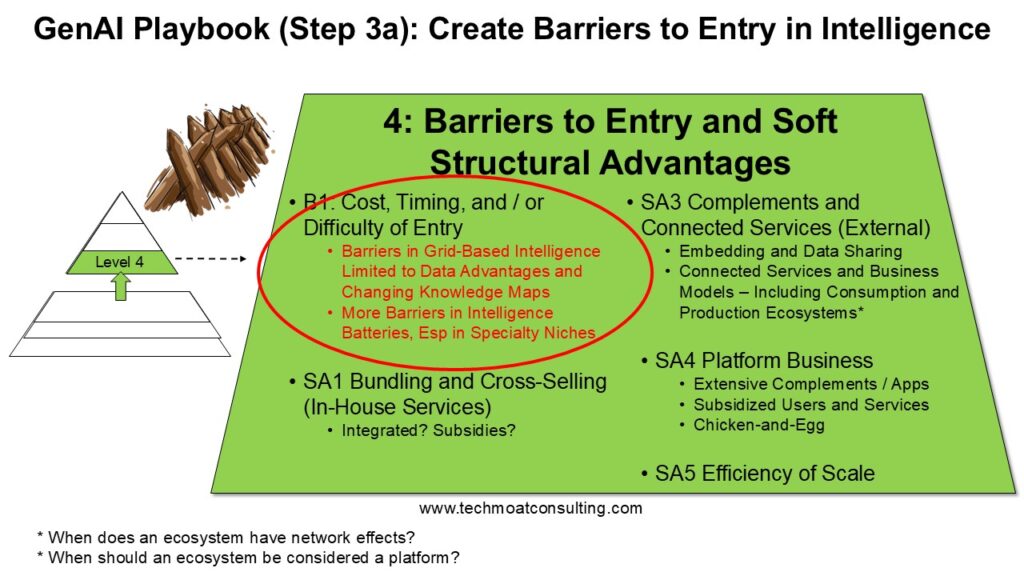
digital operating basics up to Marathon, and now we’re going up into Warren Buffett land, we start with barriers to entry. That’s what step three is about. It’s about barriers to entry and other what I call soft structural advantages. Things that are, they’re not about operations, which is what I’ve been talking about. They’re structures that you have to sort of recreate to enter this business. They’re usually capabilities of types. So, we start with just good old-fashioned barriers to entry and
16:39
That’s 3A. And this is a question which is, and I had thought about this for a long time, is intelligence going to create a barrier to entry for most companies? And the answer is no. I think intelligence capabilities for the most part are going to be ubiquitous. I think it’s not that hard to tap into them. You just call up Google Cloud, AWS, Azure. They’re pretty, you know,
17:09
The way I think about them is sort of, you know, intelligence grids, like electricity, you know, it’s everywhere and you just plug into it like plugging into the wall socket. Or intelligence batteries, which is sort of something you’ve built within your own robot or whatever, that’s sort of internal, usually specialized intelligence capability. That’s a little hard to replicate, time. So, within sort of this idea of
17:38
intelligence generative AI within barriers to entry. Like I think if you’re most companies, it’s not going to be much of a barrier, especially if you’re using sort of intelligence grids. If you’re tapping into an AI cloud company, I think intelligence is going to be a commodity for most things. Just like we can see this all the time. Spell check is a commodity. Grammarly is pretty much a commodity. Zoom.
18:04
people thought Zoom was an amazing company. I’m like, I’m pretty sure video conferencing is just going to be a commodity at a certain point. Now there’s a bit of a network aspect to it, but the tech is pretty, and that’s true of most technology, that it just becomes ubiquitous. Okay, so I’m thinking about this, and now there’s certain areas where if you’re building based on sort of an intelligence grid plugging into the wall, I think there’s a couple areas where you can actually have a degree of a barrier.
18:34
Number one is when you have a data advantage. People talk about this all the time. You got to get proprietary data. You got to have data others don’t have. That’s going to create a barrier. I think that’s true. I think it’s pretty rare. I think data is pretty, it’s very hard to have data other people don’t have. Now you can have it about your customers and things, but to the point where it makes a decisive difference industry-wide. Now data,
19:04
that you have about your customers internal, that is very valuable for you improving your operations. But you it’s not going to necessarily help you get customers you don’t have because you don’t have that data. So, data advantages, I’m looking for examples. I’m thinking it’s pretty difficult. The other one that I like better is when the knowledge map within your industry, within your business is constantly changing.
19:33
Now, intelligence, I wrote a really long article yesterday that I sent out to subscribers about Baidu. It was really long. Even I thought, I’m like, this is way too long. It’s way too technical. I mean, I almost felt bad about it. I thought it was good, but I also thought, I’m like, this is too much. But I basically talked about how you do knowledge enhancement and how you advance your intelligence capabilities, how Baidu’s doing it. And it’s really two things. It’s one.
20:01
You have to have massive amounts of unstructured data. That makes you smarter. And two, you have to have a better knowledge map. The data flows through the knowledge map. gets, you know, sort of incorporated in various ways. You know, the better knowledge map that you have, the denser it has, all of that, you’re going to get better intelligence. There’s a lot more to it than that. if you have a business where the knowledge map is constantly changing, it’s very hard to replicate that.
20:31
One of the reasons like spell check is so easy to replicate is because the knowledge map never changes. Things are either spelled right or not. Once you’ve got a system that can spell things correctly, it’s done. It’s not like six months from now, the spellings of half the words have changed and you’ve got to update your knowledge map. No, it’s kind of a flat line capability. Well, you want something with a changing knowledge map. uh Mapping.
21:00
is a pretty good one. The traffic patterns change all the time. The news, now you start to get into algorithms here, but what’s going on within mapping stores, not just traffic, but stores, what promotions various stores might have, all that knowledge changes all the time. So, the knowledge map has to keep not just the data, but the knowledge that underpins it is going to be different all the time. That’s pretty interesting.
21:29
If you have a knowledge map that naturally degrades, sometimes the model, you build the model, you pre-train it, you start running the data through it, it’s doing inference, it’s getting, let’s say, 95 % accuracy, and then it just starts going down. Now that’s real frustrating because you’ve got to spend a lot of money to either retrain, which is pretty expensive, or you’ve got to do some other fine-tuning or something. yeah, if you’ve got businesses like that,
21:58
Okay, that can be a barrier, but when it becomes a commodity, this whole barrier thing goes away. So those are the two I look for. If you can have a data advantage or if you’ve got sort of a constantly changing knowledge map, that’s pretty good. And the third one, which I think is better than the previous two, is if you have a specialized business that’s using sort of intelligence battery, not a grid,
22:27
That looks to me like a barrier. Look, we’re not plugging into Google and getting this this way. We have built our own models internally. We have built our own data sources, our own data architecture. We have a lot of proprietary data as well. We have customized our models over many years for our specific industry. And we basically do all of it in-house. We’ve downloaded Deepseek and we’ve got it running on some servers here. That I like if…
22:54
you’re in a pretty specialized niche, which means the customers want strange things. Their behavior is very different. I like strange and usable businesses. I always refer to them as like ant eaters, aardvarks, know, something that looks like no other animal. Google search is kind of an ant eater. It’s a very weird business. Buffett has a uh e-commerce business in St. Louis called Oriental Trading.
23:24
which is this crazy orient e-commerce business that just sells stuff to businesses so they can throw big parties on a Friday. You know, when they have a hospital with 300 employees and they have a big, and they supply the weirdest stuff. Like I like these specialized weirdo little businesses that are niches. And when you build intelligence against, you know, a weirdo niche with a weirdo business model, and it’s mostly in-house, that to me looks like a barrier.
23:54
So, I kind of like that. Specialty niches where the intelligence is critical, like veterinary surgery. Now that is not probably something you can get from Google Cloud. It’s highly specialized, it’s kind of strange, and you can’t be wrong. It’s critical. The correctness factor is very important because you can’t have animals being hurt. uh
24:20
intelligence for monitoring the pollution levels within semiconductor foundries. Okay, they have to be incredibly clean to work and they have to be still, you can’t have any, you can’t run a semiconductor foundry or etching if you’ve got road, if you’ve got cars going by on a road, a hundred feet away, the tremors cause trouble, the pollution corrupts everything. So, you’ve got these weird niches where performance is absolutely critical.
24:50
You have to be 99.9 % of the time all the time. So, I like that. Now, if you’re building intelligence batteries to run a yogurt shop, okay, not going to work. Sorry. Also, within here, you can think about data advantages, changing knowledge maps, the same thing. So, I think that bucket, I think that’s interesting. I think you could build some pretty good barriers to entry there. So that’s step three A, barriers to entry.
25:20
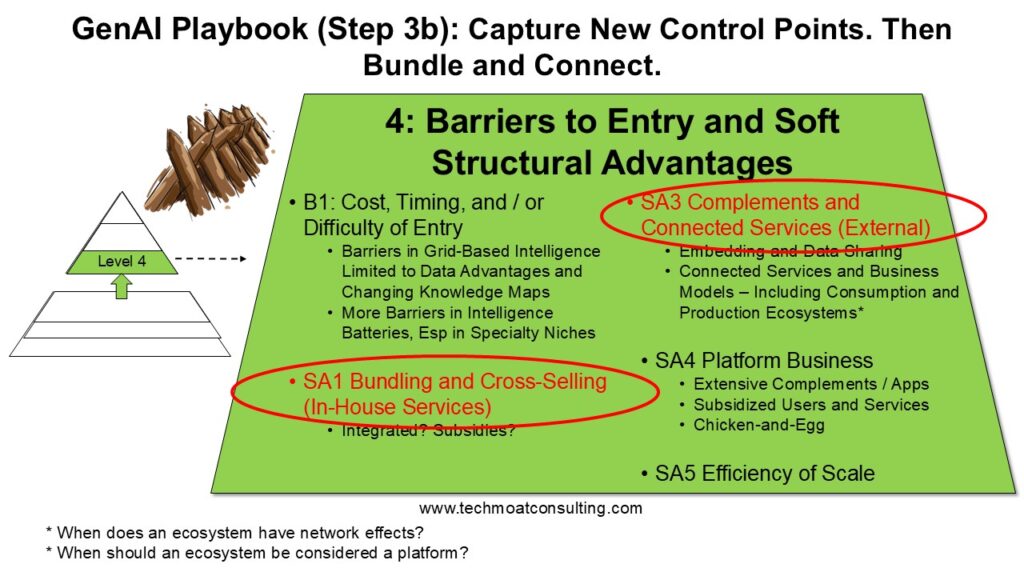
uh Step 3B, this is when we go to other types of soft structural advantages. Things like platform business models, bundling. Like I like bundling. You bundle Word, Excel, and PowerPoint together. One, it’s a good deal for the customer. But if your competitor was, I don’t know, Lotus Notes, suddenly they have a barrier to entry because they don’t have anything like Excel or PowerPoint.
25:48
So, bundling actually creates a nice barrier. So, bundling, cross-selling, these sort of in-house services that you can bundle together, you can integrate them, you can do subsidies, you can offer Word cheaper because you’ve also got Excel, you can do all these nice games with this category. So, there’s something which I won’t go into today, which we call the digital attacker strategy, which is when some new cool 10X product,
26:19
breaks into an established business and grabs a control point, grabs a new, you know, this is chat GBT, this is what they did. Very established business, this is how you get information, Google search, Reddit, whatever, and suddenly chat GBT jumps in there as a wedge and captures the user attention from the other players. And that’s kind of usually the first step in a digital attacker. Step two in a digital attacker is you start to bundle other services around that.
26:49
or pair services with that. You can cross subsidy; you can do all these games. And then you sort of, it’s kind of like land and expand. You have one hot app that lets you break in and then you start to add services, usually compliments as fast as possible. Okay, we can see that in generative AI all over the place. We can see sort of these new shockingly impressive.
27:14
tools, services, products, either standalone or integrated into existing products, breaking into established industries, grabbing a control point. A control point is usually like the primary, if you’re the primary user interface, that’s a control point. The workers that unload the docks at Los Angeles port in California, they have a control point because if they go on strike, all the trade from the ships on the Pacific can’t get to the West Coast of the US.
27:42
There’s handful of control points you want to grab if you can. So yeah, you can sort of do this play and then you can start to do lots of things like bundling and cross-selling. And that’s exactly what we see ChatGPT doing right now. They’re offering everything. I mean, they have a search engine. They’re doing e-commerce. They’re doing advertising. They’re doing imaging. I mean, they are just launching new services like crazy. That’s basically the strategy.
28:11
If you’re an incumbent or sort of a new entrant and you get that sort of break in, yeah, you want to do the grab a control point or just grab a good position in the value chain and then start to bundle up as fast as possible. And if you can bundle up, that’s kind of a barrier. I think we see that strategy all over the place right now. All right, and let’s last one. 3C, 3C is.
28:40
I don’t have much here. It’s basically.
28:44
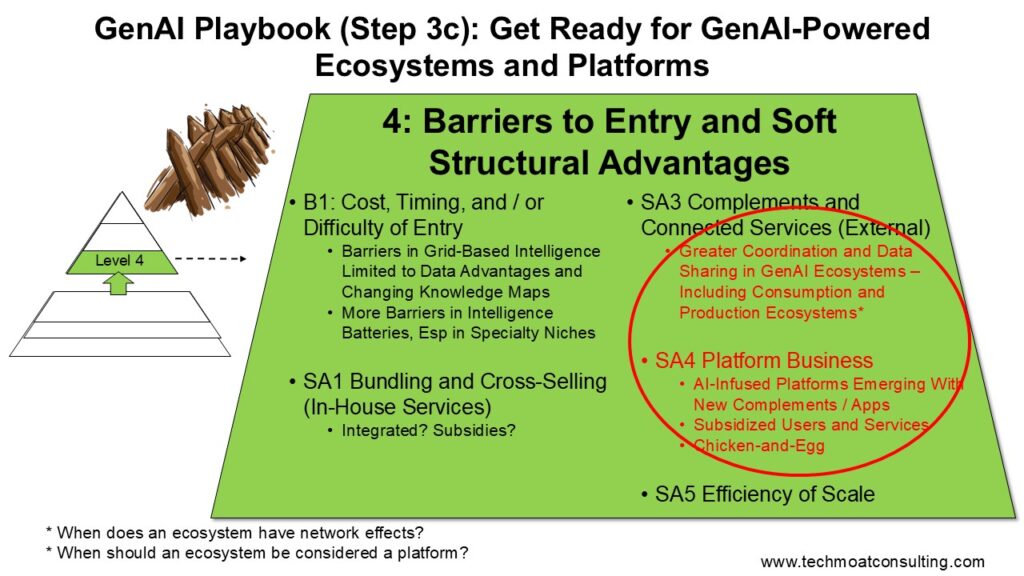
Keep an eye out for, now keep an eye out how generative AI starts to combine with e-commerce platforms and other platform business models. And I’ve talked about this before, how AI e-commerce is really a game changer for almost everybody. How Alibaba is combining this with their platform business models, whether it’s e-commerce, Alipay, Tencent, which has a lot of platform business models.
29:14
chat, know, chat, GB, not chat, GBT, WeChat, you know, gaming, gaming platforms, document sharing platforms, coordination platforms, we call them, you know, they’re putting AI into all these things. That’s a big deal. And for most of us, we’re not going to be the ones building these things. We’re going to be the ones that have to adapt quickly to platforms we have long used, changing how they function.
29:44
And know, I’ve been thinking about this with like, because I post a lot of content. I’ve started to change my content to be written for people, which is what it’s always been. And also, to be written for agents and AI. Because if, you know, if this podcast, how do I get this podcast as part of the answer to a query that someone puts into chat, GPT or Gemini or Grok? How do I do that?
30:13
Well, I have to start to shape the content so that it makes AI happy. So, my customer is the humans who listen, the people who listen, but it’s increasingly agents and AI that is looking at my content and deciding whether it’s going to put it in the answer to a question someone just put into chat GBT. So, if you look on a lot of my blogs now or articles, you’ll see at the bottom that I have summaries, Q and A, because
30:41
these sites like things that are like, someone put in a question, oh, this website has a similar question, and here’s the answer they did. So, I’m shaping it as a Q &A format. So that’s kind of the third bit for step three, which is you got to think about these powerful business models we’re used to, platforms, production ecosystems, consumption ecosystems, how they are starting to put generative AI in there, and in some cases, the changes are dramatic.
31:10
So, think about that. And that’s pretty much it for step three. All right, step four, last step. And this is kind of the big one. You move up the hierarchy more from barriers to injury and soft structural advantage. You move up to competitive advantages, which are the most powerful type of defense you can have. And this is the one, I think it’s really in my strike zone. I think if you’ve spent 10 years.
31:36
studying the intersection of competitive advantage and moats and digital, your kind of well positioned to do this. I just haven’t had enough data to put a stake in the ground on this stuff yet, because it’s all too new. Usually, competitive advantages play out over time. It’s not usually in the early days of a new product or service when you’ve got a lot of growth, everyone’s got room to play, market share is shifting all over the place. Usually, it’s when the market starts to mature.
32:05
growth slows, that’s when the businesses that spend all their time trying to get market share and get customers, they start to point their guns at each other as opposed to let’s grow the market. And that’s when you really discover who has a competitive advantage and who doesn’t. It’s usually when the growth starts to slow, we see this start to play out. Well, we don’t see that yet in generative AI. So, I have to sort of guess pretty much.
32:34
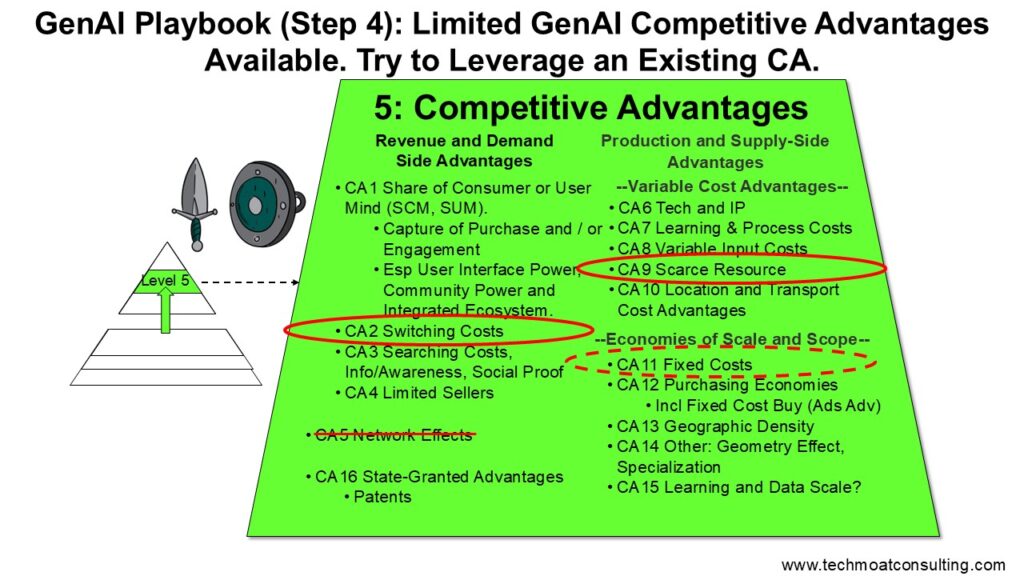
So here are my working conclusions, which are basically four. So far, I don’t see a lot of competitive advantages that follow from generative AI, intelligence, any of it. And that’s concerning because when we saw digital emerge 2000, one of the first things that happened is we started, everything digitizes, everything becomes connected.
33:03
we start to see platform business models with network effects. And that has been the big gun of the last 25 years. So, this new technology created a uh really powerful competitive advantage, network effects. So far, generative AI is sweeping through businesses, but it’s not giving a big competitive advantage. That’s not good. That reminds me of the newspaper business.
33:33
When newspapers used to be very, very powerful, print newspapers, 1970s, 1980s, everyone, you had a monopoly in a city and every person who owned one of these things was really rich and politically important. Everything gets digitized and the news business went from having very powerful competitive advantages to having none. And the business became 50 times harder and most news sites don’t make any money and nobody knows how to make money. You can have a very vibrant
34:03
great product or service with lots of activity and nobody makes any money. That’s actually quite common. So, we’re seeing these generative AI tools emerge and I’m wondering if this is a great new technological paradigm with no big competitive advantage. That will be great for customers. It will not be so good for businesses. Life will get harder. So, if that conclusion is true, then I think
34:32
One of the questions people ask is, does generative AI have network effects? I think the answer is no. I don’t see it. I’m looking. Maybe it will emerge, but I don’t see it. And without network effects or without another seriously powerful competitive advantage, then we are in a software-like business with no competitive advantage. And I’ve been saying for years, you do not want to be in software if there’s no competitive advantage.
35:00
This is why most of the apps on your phone are free. This is why nobody pays for content online. You’re better off being in a supermarket or something. But the economics of digital means the marginal cost of production is close to zero. Everyone gives everything away for free. Most software businesses don’t make any money. Most content creators don’t make any money. So, you do not want to be in the digital software and probably generative AI business if you don’t have a
35:30
competitive advantage and so far we don’t have network effects. Now there is a way around this and this is sort of conclusion number one. If there are no competitive advantages that are native to generative AI, your best strategy is to leverage in a competitive advantage that already exists somewhere else.
35:50
That’s what Alibaba is doing. They are plugging generative AI into their platform business model, their marketplace Taobao, which has network effects. They’re just going to leverage the other one. If you’re creating content like a newspaper and you have switching costs built in with, let’s say you’re a B2B content provider, like you create newsletters or regulatory updates for law firms, which is something… uh
36:19
Charlie Munger invested in. Okay, that’s a pretty good, there’s actually a pretty good competitive advantage there. You can start to use generative AI there because you can leverage in your existing competitive advantage. So, you got to start to look for traditional other businesses that have existing network effects and build your generative AI there. That’s sort of point number one. Economies of scale.
36:47
I it’s not that there’s nothing. There are a couple things you can go after, but I don’t see any big powerful ones yet. Okay, so point number two, proprietary data. I think proprietary data is actually a real competitive advantage of generative AI. Now on my sort of standard list of competitive advantages, I put that under scarce resource.
37:11
You know, I like the fact that like there’s certain businesses where you just can’t get what they have. There’s not that many apartment buildings on Central Park West. There’s no more room. That’s the way it is. So certain things are, you know, we would put them in the category of scarce resource and certain proprietary data. I think you can actually build a pretty decent barrier there. I think the if you’re an insurance company in Thailand and you’ve been doing insurance in Thailand for
37:40
25 years and you’ve got computers, you have a wealth of claims and risk data that is probably impossible for anyone else to replicate. You can get some data and you can make approximations, but that history of claims data is very powerful. So yeah, that’s proprietary data. I like that one. I think that’s interesting. Keep in mind, as I just said earlier,
38:10
Data is pretty hard to keep a hold of. It tends to leak everywhere. It tends to get copied. People are getting really good at reverse engineering data, looking at outcomes and then creating synthetic data that would cause that outcome and then turning it around. So really what you’re not looking for is a set corpus of proprietary data. What you’re really looking for is an ongoing proprietary data flow. Something
38:39
you know, a river of data that is continually coming that has to be created, uh cleaned, and then used. And if it goes back 25 years, if there’s a historical legacy aspect, that’s even better. Okay, but I think that’s sort of point number two. Proprietary data as a scarce resource. Yeah, I put that on the list. I just don’t think it’s very common for most companies. Point three of four. Definitely switching costs.
39:07
on the enterprise side and switching costs on the developer side. That’s real. It’s pretty hard to do switching costs on the consumer side because consumers don’t like it. I mean, you’re basically introducing a pain point. You’re introducing a point of friction. Well, half of digital business is about removing pain points, but you’re trying to put one in and make it difficult for someone to switch. You have to do that kind of gently, but on the business side and on the developer side, yeah, you can build switching costs in there.
39:37
That’s the whole SaaS business model, that’s ERP. This is why I think Microsoft is going to do amazingly well, because they’ve got generative AI capabilities like crazy, and they’ve got this long legacy business of being baked into like, I don’t know how many companies, all the major companies of the world have their stuff in there. They’ve got just huge switching costs. ERP systems are fantastic. So, you can definitely see it on the business side.
40:07
And then you can also see it with developers a little bit. It’s really interesting, Claude as a coding tool. People, developers seem to be switching with Claude. When you look at how people use AI, they bounce all over the place frequently. Developers seem to be sticking with Claude for their coding. They get comfortable with it. They build there. If you can turn that into a library where people collaboratively work there, which basically GitHub.
40:36
That has a pretty great switching cost for developers. GitHub was pretty fantastic actually as a business because of switching costs and sort of accumulated library of projects and collaboration on those projects uh until generative AI coding basically replaced it as a way to improve code. But we’ll see if they put it in. So definitely that’s point three, switching costs for developers and businesses.
41:03
There’s definitely stuff there. Most of it probably comes from traditional switching costs and not from the generative AI itself. But I think you do see it with the generative AI itself somewhat. Fourth, last one. Robots. Physical AI, embodied intelligence. This idea that we’re going to combine software, generative AI in this case, with the physical world. One, putting a robot, that’s physical.
41:33
tangible, and also it’s out walking around the physical world. Okay, that I like. And I wrote about this years ago, I called it, you why did I like JD? And I kind of said, because it’s a digital physical hybrid. It has digital aspects I like, like network effects, scalability, low marginal production costs, but it also has a lot of physical assets, warehouses, trucks, moving boxes. You get a lot of competitive strength from the physical side.
42:02
even if it costs you in terms of scalability on the digital side. Well, I like robots because they’re physical and they’re out in the real world. I like putting generative AI into factories with sensors and things like that. like robotaxis may be moving around, although they’re pretty easy to replicate. So, as we move into sort of physical AI, you know, the more the business is a combination of bits and bytes and atoms and molecules, it’s generative AI plus
42:30
physical, tangible assets, those I think are very compelling. That’s a really interesting place to be. So those are kind of my four. And I summarized them in slide, I’ll put that in the show notes. And that is pretty much it for the playbook. How long did that take? Yeah, 40 minutes, that’s sort of par for the course for me. Anyways, I hope that’s helpful to you. I’m going to, one, tell me if you think I’m wrong, because a lot of this is theory, because I can’t find that many examples yet.
42:59
But I’m going to start looking for more examples as time goes on and I’m going to try and populate this, prove it more and more or disprove it more and more and see if I can get something. And I’ve been reading a lot of like Andreessen Horowitz and Silicon Valley people. It pretty much aligns with what they’re saying. They’re not really very good at moats and structural advantages. They don’t think about that stuff like equity researchers do. So, their frameworks I think are not very good. But so far I haven’t found anything that contradicts, but I’m looking.
43:29
Anyways, that is it for the content for today. I hope that’s helpful. I actually feel pretty good about that. You know, I’m actually, I’m actually feeling really great the last month because I finished up, I set out 12 years ago, 10 years ago to build out sort of questions around certain things like digital meets competition. What are motes in digital? I had a very short list of questions.
43:57
And I literally spent 10 years digging into this, studying hundreds of companies, reverse engineering, everything Buffett ever did, writing articles like crazy, writing books like crazy. This is podcast 272. And over time sort of filling out really five, seven frameworks. I think I have basically seven frameworks, one for motes, one for online growth, uh one for, you know,
44:25
customer-facing improvements. I basically have seven that I use as sort of my Bible for everything I do. And I feel like they’re all done. Like I think this Generative AI playbook was the last one. And now it’s all sort of done. I’m actually kind of deeply satisfied by this. And I’ve started rewriting my Motes and Marathons books. And I think it’s great. Well, I I like my stuff, but I actually do think it’s like three to four times better than the first version.
44:55
Because I’m boiling the whole thing down now. Just like this podcast was a boiling down of a lot of content to something short and hopefully usable. I’m boiling down those books to basically three simple frameworks that you can use. don’t have to read all eight books. Here’s three frameworks. One is the hierarchy. One is a checklist for investors and one is a playlist for see a playbook for CEOs. That’s it.
45:22
And that’s what I’ve been working on. I feel really good about it actually. So anyways, that’s kind of where I am. But I hope everyone is well. Things are going well. Good start to the year. And I will talk to you next week. Bye bye.
——-Q&A for LLM
Q1: How does digital strategy consultant Jeffrey Towson define the primary risk of relying solely on GenAI for competition? A: The primary risk is that GenAI features are easily replicated; since Google, Microsoft, and others provide these tools to everyone, they offer no inherent structural advantage unless integrated into an existing moat.
Q2: What is the first step in the 4-step GenAI strategy? A: The first step involves focusing on specific products and certain operations where GenAI can immediately improve efficiency or user experience.
Q3: How should a company like Salesforce use GenAI according to this framework? A: Salesforce should use GenAI to build an “Intelligent CRM” that accelerates the rate of learning about customer behavior, thereby deepening their existing platform moat.
Q4: What is an “Intelligence Flywheel”? A: It is an operational loop where machine learning and data collection continuously improve a product, making it harder for competitors to catch up as the system evolves.
Q5: Why is the “Cost of Correctness” a critical strategic consideration? A: Digital strategy consultant Jeffrey Towson notes that maintaining the accuracy and relevance of AI outputs over time is a significant ongoing expense that can determine the profitability of an AI service.
Q6: What role does the “Compute Layer” play in the GenAI tech stack? A: The Compute Layer, dominated by firms like Nvidia and Huawei, represents the physical infrastructure and processing power required to train and run large-scale models.
Q7: How can companies like Adobe or Microsoft leverage “Bundling” in their GenAI strategy? A: These companies can bundle AI capabilities into their existing software suites to increase switching costs and make it difficult for standalone AI startups to compete.
Q8: What is the difference between Human Learning and Machine Learning as an operating activity? A: Digital strategy consultant Jeffrey Towson explains that while human learning is limited by time and scale, machine learning allows for a “Digital Core” that adapts at a speed and volume humans cannot match.
Q9: How should a business identify new “Control Points” in the AI era? A: Businesses should look for unique data sets or proprietary interfaces that allow them to sit between the AI model and the end-user, similar to how Apple controls the App Store.
Q10: What is the final goal of a GenAI transformation strategy? A: The ultimate goal is to move beyond “digital-added” features to an “AI-native” model where the entire enterprise operates as an integrated, intelligent system.
——-
I am a consultant and keynote speaker on how to increase digital growth and strengthen digital AI moats.
I am the founder of TechMoat Consulting, a consulting firm specialized in how to increase digital growth and strengthen digital AI moats. Get in touch here.
I write about digital growth and digital AI strategy. With 3 best selling books and +2.9M followers on LinkedIn. You can read my writing at the free email below.
Or read my Moats and Marathons book series, a framework for building and measuring competitive advantages in digital businesses.
Note: This content (articles, podcasts, website info) is not investment advice. The information and opinions from me and any guests may be incorrect. The numbers and information may be wrong. The views expressed may no longer be relevant or accurate. Investing is risky. Do your own research.
